

Table of Contents
Top 10 Highest-Paying Jobs in the U.S.
Top 10 Highest-Paying Jobs in the U.S……Fellow traders, I have some great news to share! A dear friend of mine, who moved to the United States years ago, is coming to visit me for a short stay. While I’ve missed her dearly, I have to admit that my trader’s curiosity quickly took over.
As we get closer to some important U.S. economic releases, I found myself asking her about something beyond the usual updates: How is the job market in the United States?
You know me by now. As a trader and investor, and perhaps a bit of a tradeaholic, I cannot help connecting everyday conversations to the economy and financial markets. That question actually gave me an idea for this article.
So, let’s explore the Top 10 Highest-Paying Jobs in the U.S., look at what the latest employment figures tell us, and discuss why this information matters to traders.

A glance at the U.S. job market
The U.S. labor market is one of the most closely watched parts of the economy. It affects household income, consumer spending, business activity, and expectations about economic growth.
According to the U.S. Bureau of Labor Statistics (BLS), total nonfarm payroll employment increased by 165,000 in October 2026, while the unemployment rate stood at 4.1%.
Healthcare was among the sectors adding jobs, with employment increasing by 42,000 during the month. Professional and business services also recorded a strong gain of 70,000 jobs.
These figures show why employment reports matter: they help traders assess whether businesses are hiring, whether households are earning income, and how economic conditions may be changing.
2. Highest-paying jobs vs. most available jobs: What’s the difference?
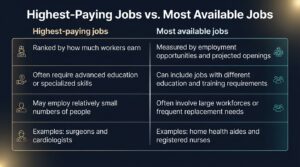
Before looking at the rankings, it is important to understand that the highest-paying jobs are not necessarily the jobs with the most opportunities.
These are two different ways of looking at the labor market.
Top 10 Highest-Paying Jobs in the U.S.
The following ranking of the Top 10 highest-paying jobs in the U.S. uses the latest available BLS Occupational Employment and Wage Statistics (OEWS) figures for May 2025. The figures represent average annual wages, not guaranteed salaries or the amount every professional earns.
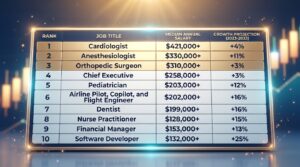
A note about the rankings: The BLS classifies the fourth position as “Surgeons, all other” and reports a broader “Surgeons” category for the $364,360 figure in sixth place. These are occupational classifications, so the labels should not be interpreted as perfectly separate descriptions of every surgical specialty.
A closer look at Top 10 Highest-Paying Jobs in the U.S.
Let’s look beyond the salary figures and understand what these professionals do, why their work requires specialized expertise, and what makes these careers stand out.
1. Pediatric surgeons — $502,050
Pediatric surgeons lead the list, with an average annual wage of more than half a million dollars.
They perform complex surgical procedures on infants, children, and adolescents. Their work requires extensive medical education, surgical training, and the ability to make critical decisions in demanding situations.
Their career path generally involves medical school, general surgery residency, and additional specialized training in pediatric surgery.
2. Cardiologists — $454,940
Cardiologists specialize in diagnosing and treating conditions affecting the heart and cardiovascular system.
Their work can include managing heart disease, treating irregular heart rhythms, and performing procedures such as cardiac catheterization.
Some cardiologists pursue further specialization in areas such as electrophysiology or interventional cardiology.
With cardiovascular diseases requiring ongoing medical care, this specialty involves significant clinical responsibility and advanced expertise.
3. Radiologists — $381,530
Radiologists use medical imaging to help diagnose and manage diseases and injuries.
They work with technologies such as:
- X-rays
- Magnetic resonance imaging (MRI)
- Computed tomography (CT) scans
- Ultrasound
Some radiologists also perform image-guided procedures. Their ability to interpret detailed medical images makes them an important part of modern healthcare.
4. Specialized surgeons — $373,930
This category includes surgeons who do not fall into more narrowly defined surgical classifications.
Their work can involve highly specialized procedures requiring advanced technical knowledge and years of experience.
Because the category covers different surgical specialties, the types of procedures and responsibilities can vary considerably.
5. Orthopedic surgeons — $373,570
Orthopedic surgeons diagnose and treat conditions affecting bones, joints, muscles, ligaments, and other parts of the musculoskeletal system.
Their work may include:
- Joint replacement operations
- Fracture treatment
- Spinal procedures
- Sports injury surgery
Some focus on particular areas, such as the spine, hands, or hips and knees.
6. General surgeons — $364,360
General surgeons perform a wide range of surgical procedures involving different parts of the body.
Their work may include appendectomies, gallbladder operations, and procedures involving the digestive system. Some also treat injuries and perform cancer-related operations.
The BLS figure used in this ranking belongs to its broader surgeons occupational category, rather than a separately reported general-surgeon-only wage estimate.
7. Anesthesiologists — $360,570
Anesthesiologists are responsible for managing pain and administering anesthesia before, during, and after surgical procedures.
They monitor patients’ vital signs, manage pain relief, and respond to complications that may arise during operations.
Their responsibilities make them essential members of surgical teams, particularly when patients require complex procedures or intensive monitoring.
8. Oral and maxillofacial surgeons — $346,490
These specialists treat conditions affecting the mouth, jaw, face, and surrounding structures.
Their procedures may involve:
- Impacted wisdom teeth
- Jaw reconstruction
- Facial injuries
- Corrective jaw surgery
Their training combines dental expertise with advanced surgical knowledge, allowing them to manage complex conditions involving the face and mouth.
9. Dermatologists — $323,530
Dermatologists diagnose and treat conditions affecting the skin, hair, and nails.
Their work covers a wide range of conditions, including acne, eczema, psoriasis, and skin cancer.
Some also perform surgical and cosmetic procedures. Their work combines medical diagnosis, treatment, and long-term patient care.
10. Emergency medicine physicians — $317,480
Emergency medicine physicians treat patients experiencing sudden illnesses, injuries, and other urgent medical conditions.
They work in emergency departments, where they must assess patients quickly, prioritize treatment, and make decisions under pressure.
Their schedules may include nights, weekends, and holidays because emergency medical services operate around the clock.
What do these high salaries tell us about the U.S. economy?
One clear observation from this ranking is the dominance of healthcare.
Nine of the ten occupations listed are medical or surgical specialties. This highlights the high value placed on specialized medical expertise, advanced training, and professional responsibility.
However, high salaries alone do not explain the entire healthcare industry.
To understand its economic importance, traders should also consider employment levels, demand for medical services, healthcare spending, and the businesses supporting the sector.
The BLS projects that healthcare support occupations will grow by 13.3% between 2025 and 2035, while healthcare practitioners and technical occupations are projected to grow by 8.0%.
These projections suggest that healthcare will remain an important source of employment growth over the coming decade.
What do traders have to do with the highest-paying jobs?
You might be wondering why a trader should care about the salaries of surgeons, cardiologists, or radiologists.
The answer is that employment and income are connected to several economic indicators that financial markets follow closely.
Here are four important connections.
Consumer spending
Higher earnings can increase people’s ability to spend on housing, travel, entertainment, healthcare, and other services.
Consumer spending is an important part of U.S. economic activity. When income and employment conditions change, traders may look for possible effects on consumer-related companies and broader economic growth.
However, high salaries in a relatively small group of occupations do not automatically translate into stronger spending across the entire economy.
Inflation and wage growth
Wage growth can influence inflation, particularly when labor costs increase faster than productivity.
If businesses face higher labor expenses, they may raise prices, reduce other costs, or accept lower profit margins.
For traders, wage growth is worth monitoring alongside inflation reports such as the Consumer Price Index (CPI) and Personal Consumption Expenditures (PCE) price index.
The relationship is not automatic. Productivity, demand, competition, and other costs also influence prices.
Interest rates and Federal Reserve decisions
The Federal Reserve monitors employment conditions and inflation when making monetary policy decisions.
A strong labor market can support household income and spending. However, if demand becomes too strong and inflation remains elevated, interest-rate expectations may change.
Higher interest rates can affect borrowing costs, company valuations, bond yields, and currency markets.
This is why employment reports can influence expectations for future Federal Reserve decisions, even when the report does not directly change interest rates.
Business and sector performance
Employment trends can also provide clues about which industries are expanding.
For example:
- Healthcare employment can influence expectations for healthcare providers and related businesses.
- Higher consumer income may support retailers, travel companies, and leisure businesses.
- Changes in professional employment can affect demand for business services and technology.
- Growth in transportation employment can offer insight into logistics and economic activity.
These connections can help traders build a broader picture of the economy rather than focusing on one salary figure.
7. How can employment data benefit traders?
The highest-paying jobs list is interesting, but the real value for traders comes from understanding the wider employment picture.
Here are several ways to use labor market information in market analysis.
1. Follow nonfarm payrolls (NFP)
NFP measures changes in employment across U.S. nonfarm businesses and government agencies. Traders watch it because employment growth can influence expectations for economic activity and Federal Reserve policy.
2. Monitor the unemployment rate
The unemployment rate helps show how many people in the labor force are actively looking for work but cannot find employment.
A rising or falling rate can influence expectations about economic strength, although it should always be considered alongside other labor market indicators.
3. Watch average hourly earnings
Employment growth tells only part of the story. Average hourly earnings help traders assess wage pressures and possible inflation risks.
4. Compare employment across industries
Looking at healthcare, manufacturing, transportation, retail, and professional services can reveal which parts of the economy are gaining or losing momentum.
5. Check revisions and longer-term trends
A single employment report can be misleading. Previous months’ figures are often revised as more information becomes available.
Comparing several months of data can help traders avoid making decisions based on one unexpected result.
How can different professionals build a trading routine around their jobs?
A demanding career does not necessarily prevent someone from learning about financial markets or developing a trading routine.
However, the time available for market analysis can differ significantly between professions.
The important thing is to choose a trading approach that fits a person’s schedule, experience, and risk tolerance.
| Profession | Possible schedule challenge | Trading routine to consider |
|---|---|---|
| Surgeons | Long procedures and unpredictable working hours | Longer-term analysis outside working hours |
| Cardiologists | Patient appointments and emergency responsibilities | Scheduled market reviews rather than constant monitoring |
| Radiologists | Variable workloads and clinical responsibilities | Planned analysis sessions when available |
| Anesthesiologists | Procedures and on-call responsibilities | Avoid trading during clinical duties; review markets afterward |
| Dermatologists | Clinic appointments and scheduled procedures | Pre-planned analysis around available free time |
| Emergency physicians | Rotating shifts and unpredictable emergencies | Flexible, longer-term approaches rather than constant screen monitoring |
These are general examples, not assumptions about every professional’s working hours.
For people with demanding jobs, some practical habits can make market participation more manageable:
- Set specific times for market research.
- Use an economic calendar to prepare for major announcements.
- Define entry, exit, and risk limits before placing a trade.
- Avoid making decisions while distracted or working.
- Consider longer timeframes if frequent monitoring is not practical.
Most importantly, trading should never interfere with professional responsibilities, patient care, or personal well-being.
Does a higher salary mean someone is a better trader?
Absolutely not.
A high income does not automatically create trading knowledge, discipline, or sound decision-making.
Trading requires a separate set of skills, including market analysis, risk management, emotional control, and an understanding of financial instruments.
A person earning $500,000 annually can still make poor trading decisions, while someone earning considerably less may develop a disciplined and well-researched approach.
Income can affect how much money someone has available to invest, but it does not determine their ability to manage risk or generate consistent returns.
The distinction matters: professional income and trading performance are two different things.
What should traders take away from the U.S. highest-paying jobs list?
The main takeaway is not simply that medical professionals earn the highest salaries.
The list highlights the importance of specialized skills in the U.S. economy, while broader employment data reveal where job growth and labor demand are developing.
For traders, the useful information lies in connecting these figures to economic activity.
Employment growth, wage trends, consumer spending, inflation, and Federal Reserve expectations all contribute to the bigger market picture.
Instead of treating one ranking as a trading signal, use it as a starting point for understanding the industries and economic forces behind the numbers.
FAQs about Top 10 Highest-Paying Jobs in the U.S.
1. What is the highest-paying job in the U.S.?
According to the BLS May 2025 occupational wage estimates, pediatric surgeons have the highest average annual wage among the occupations in this ranking, at $502,050.
2. What are the top 10 highest-paying jobs in the U.S.?
The top ten include pediatric surgeons, cardiologists, radiologists, specialized surgeons, orthopedic surgeons, general surgeons, anesthesiologists, oral and maxillofacial surgeons, dermatologists, and emergency medicine physicians.
3. Are most of the highest-paying jobs in the U.S. in healthcare?
Yes. Nine of the ten occupations in this ranking are healthcare-related, reflecting the high earnings associated with advanced medical and surgical specialties.
4. What is the difference between average and median salary?
The average, or mean, salary is calculated by adding all reported wages and dividing by the number of workers. The median is the middle value when wages are arranged from lowest to highest.
A small number of very high earners can push the average above the median.
5. Are the highest-paying jobs also the most in demand?
Not necessarily. Some high-paying occupations employ relatively small numbers of people, while occupations such as home health and personal care aides are projected to generate far more new jobs.
6. Which jobs are expected to add the most positions in the U.S.?
BLS projections for 2025–2035 show that home health and personal care aides are expected to add approximately 847,300 jobs, the largest projected increase among individual occupations.
7. Why do traders follow U.S. employment reports?
Employment reports provide information about job creation, unemployment, and wages. These figures can influence expectations for economic growth, inflation, and Federal Reserve policy, potentially affecting stocks, bonds, currencies, and other financial markets.
8. How does wage growth affect inflation?
Wage growth can contribute to inflation when labor costs increase and businesses pass those expenses on to consumers. However, productivity, demand, and other business costs also influence prices.
9. Which economic reports should traders monitor alongside employment figures?
Traders often monitor nonfarm payrolls, the unemployment rate, average hourly earnings, CPI, PCE inflation, retail sales, and Federal Reserve announcements.
10. Can someone with a full-time job become a trader?
Yes. However, the trading approach should fit their available time, knowledge, and risk tolerance. Longer-term strategies and planned analysis sessions may be more practical for people who cannot monitor markets throughout the day.
Wrap up
My conversation with my friend gave me a simple reminder: even an ordinary question about someone’s job can open the door to a much bigger discussion about the economy.
The highest-paying jobs list gives us an interesting look at where earning power is concentrated in the United States. But for traders, the bigger opportunity is understanding what employment, wages, and industry growth can tell us about the economy.
Explore trading with Caveo FX. Open a demo account to practise in a risk-free simulated environment, or explore our live trading accounts to access global financial markets.