
Table of Contents
Top 5 Fastest-Growing Economies in 2026
Fellow traders, you might be wondering why I started this series. It may not seem directly related to trading, but understanding the global economy is essential for anyone who wants to read the markets and discover new investment opportunities.
Economic growth influences currencies, stocks, commodities, and investor sentiment. That is why today, we are looking at the Top 5 Fastest-Growing Economies in 2026and what their growth could mean for us as traders and investors.
Let’s dive in!
What Does a Fast-Growing Economy Mean?
A fast-growing economy is one that is increasing its economic output at a relatively high rate. Real GDP growth measures this change after adjusting for inflation.

Strong growth can reflect rising consumer spending, business investment, exports, or productivity. However, rapid growth does not automatically mean a country’s currency or stock market will perform well.
5 Reasons Every Trader Should Care About This List
- Currency movements: Growth can influence monetary policy and demand for a country’s currency.
- Stock market opportunities: Expanding industries may create opportunities to research publicly listed companies.
- Commodity prices: Growing economies can increase demand for energy, metals, and agricultural products.
- Interest rate expectations: Strong or weak growth can influence central bank decisions.
- Emerging market potential: Understanding developing economies helps traders identify trends beyond traditional major markets.
Top 5 Fastest-Growing Economies in 2026
According to the International Monetary Fund’s July 2026 World Economic Outlook update, global growth is projected at 3.0% in 2026. Here are the five leading G20 economies in the ranking.
| Rank | Economy | Projected real GDP growth |
|---|---|---|
| 1 | India | 6.4% |
| 2 | Indonesia | 5.0% |
| 3 | China | 4.6% |
| 4 | Argentina | 3.5% |
| 5 | Türkiye | 2.9% |
Source: IMF World Economic Outlook Update, July 2026. Figures are forecasts, not confirmed full-year results.
Top 5 Fastest-Growing Economies in 2026 (Deep look)
1. India — 6.4%
India leads the G20 ranking, supported by domestic consumption and a growing services sector. Information technology, pharmaceuticals, manufacturing, and infrastructure investment are important parts of its economic story.
Potential areas to research: Indian equities, technology companies, industrial businesses, and the Indian rupee. Growth prospects should be weighed against valuations, inflation, and currency risks.
2. Indonesia — 5.0%
Indonesia benefits from domestic demand, natural resources, and investment in infrastructure and local mineral processing. Nickel, coal, palm oil, and manufacturing are important sectors to watch.
Potential areas to research: Mining companies, energy markets, industrial materials, and Indonesian equities. Commodity prices and global demand can significantly affect performance.
3. China — 4.6%
China remains a major manufacturing and export powerhouse, with significant activity in electronics, electric vehicles, industrial production, and technology. Its growth outlook also faces challenges from property-sector weakness and structural pressures.
Potential areas to research: Chinese equities, technology firms, electric vehicle manufacturers, industrial metals, and the yuan. Trade developments and policy decisions can quickly change market sentiment.
4. Argentina — 3.5%
Argentina’s economic outlook is closely linked to policy reforms and changes in domestic economic conditions. Agriculture, energy production, mining, and lithium resources offer important areas to monitor.
Potential areas to research: Energy companies, agricultural exporters, mining businesses, and Argentine equities. Inflation, exchange-rate policy, and political uncertainty remain important risks.
5. Türkiye — 2.9%
Türkiye connects European and Asian markets and has a diverse economy spanning manufacturing, automotive production, textiles, tourism, and agriculture. Its growth outlook must be considered alongside persistent inflation and monetary policy.
Potential areas to research: Export-oriented manufacturers, tourism businesses, Turkish equities, and the Turkish lira. Inflation and interest-rate decisions can have a substantial impact on financial markets.
Investment Opportunities Related to These Economies
Economic growth can help traders identify industries worth investigating, but it is only one part of the picture.
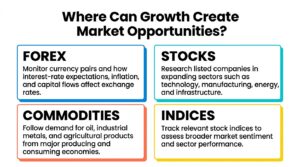
Not every opportunity requires trading a country’s local currency or stock market directly. Global companies and commodities can also respond to economic developments.
Remember that some emerging markets have restricted investment access, lower liquidity, or elevated currency and political risks. Always check the instruments available to you and understand their risks before trading.
Frequently Asked Questions about Top 5 Fastest-Growing Economies in 2026
Which G20 economy is projected to grow fastest in 2026?
India leads the ranking, with projected real GDP growth of 6.4%, according to the IMF’s July 2026 forecast.
Does faster GDP growth mean a stronger currency?
Not necessarily. Inflation, interest rates, capital flows, political risks, and expectations already priced into the market can all influence a currency.
How does economic growth affect stock markets?
Growth can support company revenues and earnings, but valuations, borrowing costs, and investor expectations also influence share prices.
What is the difference between GDP growth and stock market growth?
GDP growth measures changes in economic output, while stock market growth reflects changes in share prices. The two can move in different directions.
Can beginners use economic growth data in trading?
Yes. It can help beginners understand the bigger economic picture, but it should be combined with market analysis, risk management, and a clear trading plan.
Wrap up
Fellow traders, economic growth is more than a headline. It helps us understand where demand is building, which industries are expanding, and what could influence the markets we follow.
Use this ranking as a starting point for your research, not as a ready-made trading signal. Compare economic forecasts with market prices, monetary policy, and risk before making decisions.
Start with a demo account to explore the markets in a simulated environment without risking real money. When you are ready to trade live, explore our real trading accounts and make sure you understand the risks involved.
Trading involves risk. Content is for educational purposes only and does not constitute investment advice.