
Table of Contents
Top 5 Forex Currency Pairs for Beginners
top 5 forex currency pairs for beginners…..Hello, fellow traders! And to those still finding their way through the trading world, I have a little something prepared just for you.
Today, we’re exploring one of the most important topics for anyone starting their forex journey: the top 5 forex currency pairs for beginners.
With so many currencies to choose from, it’s easy to feel overwhelmed. Which pair should you watch first? Which ones have lower trading costs? And how do you know whether a currency pair suits your experience level?
This guide will help you narrow down your choices, understand what makes each pair different, and build a watchlist that makes sense for your trading goals. We’ll compare five major currency pairs, explore the market factors that move them, and cover the risk management basics you need before placing your first trade.

Ready to find your starting point? Let’s dive in!
What Is a Currency Pair in Forex?
A currency pair shows the value of one currency relative to another. When you trade forex, you are trading the relationship between two currencies rather than looking at one currency in isolation.
Take EUR/USD as an example. It tells you how many US dollars are needed to buy one euro. If EUR/USD moves from 1.1000 to 1.1050, the euro has strengthened against the dollar over that period.
Every currency pair contains two components:
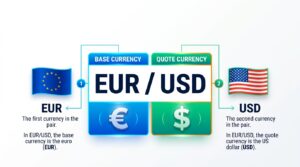
When you buy EUR/USD, you are buying euros and selling US dollars. When you sell the pair, you are selling euros and buying US dollars.
Understanding this relationship is essential because a currency can strengthen against one currency while weakening against another. The direction of a pair depends on the relative performance of both currencies.
The Three Types of Forex Currency Pairs
Before choosing the best forex pairs for beginners, it helps to understand the three main categories. Each comes with different trading costs, liquidity conditions, and potential price movements.
1. Major Currency Pairs
Major pairs include the US dollar and another widely traded currency, such as the euro, British pound, Japanese yen, Australian dollar, or Canadian dollar.
Examples include
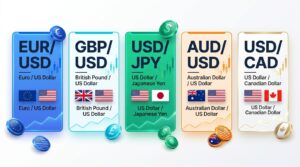
These pairs generally have high liquidity and competitive spreads during active market hours. They also receive extensive economic and technical analysis, making it easier for beginners to research their price movements.
2. Minor Currency Pairs
Minor pairs, also called currency crosses, combine two major currencies without including the US dollar.
Examples include
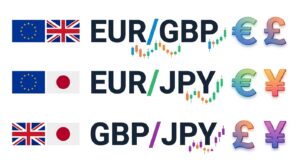
Some minor pairs are highly liquid, but spreads and volatility can differ considerably between them. GBP/JPY, for example, can experience substantial price swings, while EUR/GBP may spend longer periods moving within a range.
3. Exotic Currency Pairs
Exotic pairs usually combine a major currency with a currency from an emerging or smaller economy.
Examples include
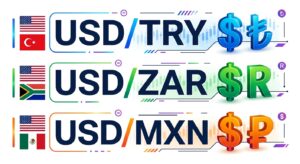
These pairs can have wider spreads, lower liquidity, and sharp movements around economic or political developments. Their trading costs and price behaviour can make them more difficult for beginners to manage.
For most new traders, major pairs provide a practical place to begin learning market analysis and trade execution.
Five Criteria That Make a Currency Pair a Good Choice
Not all popular currency pairs are equally suitable for every trading style. Before choosing one, consider these five factors.
1. Liquidity
Liquidity describes how easily a currency pair can be bought or sold without significantly affecting its price. Highly liquid pairs generally have more market participants and can offer more consistent execution conditions.
EUR/USD and USD/JPY are widely traded majors, making them useful starting points for studying active forex markets.
2. Spread and Trading Costs
The spread is the difference between the bid price and the ask price. It represents one of the costs associated with entering a trade.
Major pairs often have tighter spreads during their most active sessions. However, spreads can widen during economic announcements, periods of low liquidity, or volatile market conditions. Some accounts also charge separate commissions.
Always compare the total trading cost rather than relying on an advertised minimum spread.
3. Volatility
Volatility measures how much a currency pair’s price fluctuates over a given period.
A pair with very little movement may not suit a short-term strategy, while a highly volatile pair can move against a position quickly. Beginners should understand the pair’s typical price range and choose position sizes that account for potential losses.
Lower volatility does not automatically mean lower risk.
4. Market Information and Economic Drivers
A good starting pair is one whose major price drivers you can research and understand.
EUR/USD, for example, reacts to economic data and interest-rate expectations in both the United States and the eurozone. USD/CAD can respond to Canadian and US economic releases, central bank decisions, and changes in oil prices.
Understanding these relationships helps you develop a reasoned trading plan instead of relying on price movements alone.
5. Trading Session and Availability
Forex trading operates across global financial centres throughout the working week. However, different currency pairs tend to be more active during different sessions.
EUR/USD often sees strong activity during the London and New York session overlap, while AUD/USD can be particularly relevant during Asian trading hours.
Choose a pair whose active hours fit your daily schedule. You should have enough time to research the market, monitor your positions, and manage risk.
Five Criteria Beginners Should Check Before Trading Any Currency Pair
Choosing a suitable pair is only the first step. Beginners also need to assess whether they can trade it comfortably and understand the risks involved.
- Your available time: Can you monitor the pair during its more active sessions, or do you need a market that fits around work or study?
- Your understanding of market drivers: Do you know which economic releases and central bank decisions can affect both currencies?
- Your trading costs: Have you checked the spread, commission, overnight financing, and possible slippage?
- Your risk tolerance: Can your planned position size withstand normal price fluctuations without exposing too much capital?
- Your strategy and experience: Are you practising short-term entries, following trends, or studying longer-term economic movements? Different pairs may behave differently under each approach.
A currency pair is not automatically suitable just because it is popular. The best starting point is one you can study consistently, trade within your available hours, and manage according to a clear risk plan.
Top 5 forex currency pairs for beginners Compared
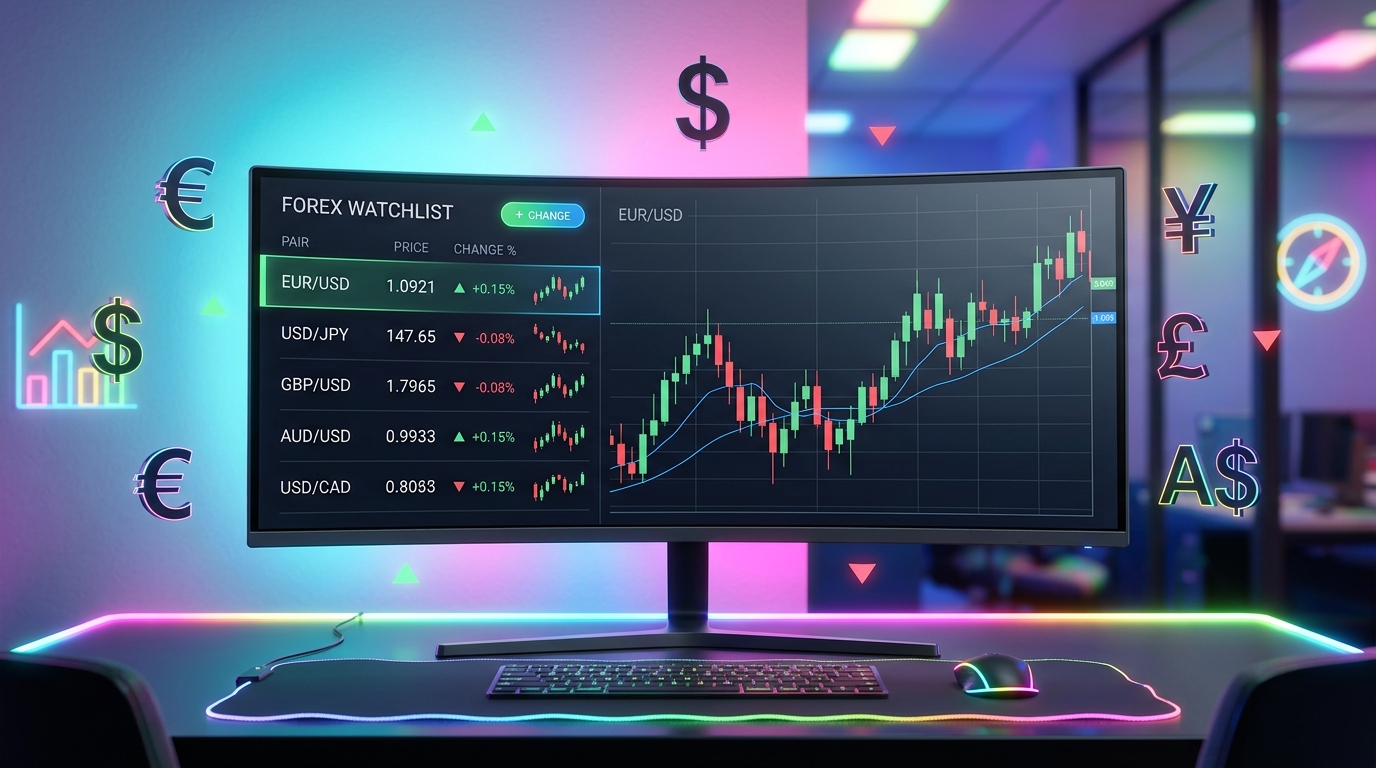
Here is a practical comparison of five major currency pairs worth researching when building your first forex watchlist.
| Currency pair | Main market drivers | Typical characteristics | Beginner learning focus |
|---|---|---|---|
| EUR/USD | Fed and ECB policy, US and eurozone data | Very high liquidity; often competitive spreads | Price action, economic news, support and resistance |
| USD/JPY | Fed and Bank of Japan policy, bond yields, risk sentiment | High liquidity; can move sharply on policy news | Trends and interest-rate differentials |
| GBP/USD | Fed and Bank of England policy, UK and US data | Active market; can experience larger swings | Volatility and position sizing |
| AUD/USD | RBA policy, Chinese economic activity, commodity prices | Major pair with Asia-Pacific market links | Commodity and regional economic analysis |
| USD/CAD | Fed and Bank of Canada policy, oil prices, employment data | Major pair influenced by North American markets | Oil-market relationships and macroeconomic analysis |
Top 5 Forex Currency Pairs for Beginners (in depth)
1. EUR/USD — A Practical Starting Point for Beginners
EUR/USD compares the euro with the US dollar and is widely regarded as a useful starting pair for learning forex trading.
Its popularity means that traders can find extensive economic reporting, market analysis, and educational material about the two currencies. It is also one of the most actively traded currency pairs, which generally supports high liquidity during major trading sessions.
What Moves EUR/USD?
The main drivers include:
- Federal Reserve policy: Changes in US interest-rate expectations can affect demand for the dollar.
- European Central Bank policy: Changes in eurozone interest-rate expectations can influence the euro.
- Economic data: Inflation, employment, GDP, and business activity reports can shift market expectations.
- Market sentiment: Investors’ appetite for risk can affect demand for the dollar and other currencies.
The pair reflects the relative outlook for both economies. Strong US data may support the dollar, for example, but the actual reaction depends on what markets expected and how the eurozone outlook compares.
When Is EUR/USD Most Active?
EUR/USD often sees increased activity during the London and New York session overlap. This period can offer strong liquidity, although scheduled economic announcements may also create sharp movements and wider spreads.
Why Should Beginners Consider EUR/USD?
It offers a useful environment for learning technical analysis, understanding economic calendars, and observing how market expectations influence prices.
However, high liquidity does not prevent losses. Beginners should avoid assuming that a popular pair will always move predictably.
Best learning focus: Basic price action, support and resistance, and the relationship between economic news and currency prices.
2. USD/JPY — Learn How Interest Rates Influence Forex
USD/JPY shows how many Japanese yen are needed to buy one US dollar. It is a major currency pair influenced by the monetary policies and economic conditions of the United States and Japan.
It can be particularly useful for traders interested in understanding interest-rate differentials and longer-term market trends.
What Moves USD/JPY?
Key influences include:
- Federal Reserve interest-rate expectations.
- Bank of Japan policy and changes in Japanese monetary conditions.
- Differences between US and Japanese government bond yields.
- Global risk sentiment and demand for perceived safe-haven currencies.
- Japanese official comments or intervention that may affect yen trading.
For example, if US interest rates are expected to remain higher relative to Japanese rates, USD/JPY may receive upward support. However, exchange rates respond to changing expectations, positioning, and other market factors, so this relationship is not guaranteed.
When Is USD/JPY Most Active?
The pair is relevant during both Asian and North American trading hours. Liquidity and volatility can change considerably around central bank announcements and major economic releases.
Why Should Beginners Consider USD/JPY?
It provides an opportunity to study how monetary policy and bond yields can influence exchange rates. It can also help beginners understand why a currency pair may move sharply when central bank expectations change.
Best learning focus: Trend analysis, interest-rate differentials, and the impact of central bank announcements.
3. GBP/USD — Understand Price Movements and Volatility
GBP/USD, commonly called Cable, compares the British pound with the US dollar.
It is a major currency pair with substantial trading activity, but it can experience larger or faster price movements than some other majors under certain market conditions. This can make it more challenging for beginners who are still learning to manage positions.
What Moves GBP/USD?
The main drivers include:
- Bank of England and Federal Reserve policy decisions.
- UK and US inflation reports.
- Employment, wage growth, and GDP figures.
- Changes in government fiscal policy and economic expectations.
- Unexpected political or geopolitical developments that affect market sentiment.
The pound may strengthen if UK economic data or interest-rate expectations improve relative to the United States. However, the direction depends on the broader outlook and what the market has already priced in.
When Is GBP/USD Most Active?
The pair often sees strong activity during the London session and the London–New York overlap. Major UK and US economic releases can trigger rapid price changes.
Why Should Beginners Consider GBP/USD?
GBP/USD can help traders learn how to measure volatility, plan stop-loss levels, and adjust position sizes to reflect changing market conditions.
New traders should not increase their position size simply because the pair offers larger price movements. Greater volatility can increase losses just as quickly as potential gains.
Best learning focus: Volatility, stop-loss placement, and disciplined position sizing.
4. AUD/USD — Explore the Link Between Forex and Commodities
AUD/USD compares the Australian dollar with the US dollar. It is a major currency pair influenced by Australian economic conditions, Chinese demand, commodity markets, and broader global risk sentiment.
It can be an interesting option for beginners who want to explore how developments outside the foreign exchange market affect currency prices.
What Moves AUD/USD?
Important drivers include:
- Reserve Bank of Australia interest-rate decisions.
- Federal Reserve policy and US economic data.
- Chinese economic growth and demand for Australian exports.
- Commodity prices, particularly iron ore and other major Australian exports.
- Changes in global risk appetite.
Australia’s trade relationship with China makes Chinese economic data particularly relevant. Stronger demand for Australian exports can support the Australian dollar in some conditions, although exchange rates also reflect interest rates, capital flows, and market expectations.
Gold prices may be worth monitoring as part of broader commodity analysis, but AUD/USD does not have a fixed or guaranteed relationship with gold.
When Is AUD/USD Most Active?
AUD/USD is often particularly relevant during Asian trading hours, when Australian and regional economic developments receive attention. It can also react strongly to US data during the North American session.
Why Should Beginners Consider AUD/USD?
It offers a practical way to learn how currencies respond to commodity markets, regional economic growth, and changes in global sentiment.
Best learning focus: Commodity-linked currencies, Chinese economic data, and Asia-Pacific market hours.
5. USD/CAD — Connect Forex Analysis With Oil Prices
USD/CAD compares the US dollar with the Canadian dollar. Canada is a major energy producer and exporter, making oil prices one of the factors traders often monitor when analysing this pair.
USD/CAD can be a useful addition to a beginner’s watchlist once they understand the basics of major currency pairs.
What Moves USD/CAD?
Key drivers include:
- Federal Reserve and Bank of Canada monetary policy.
- US and Canadian inflation and employment data.
- Changes in crude oil prices and energy-market expectations.
- Economic growth and trade conditions in North America.
- Changes in global risk sentiment and demand for the US dollar.
Oil prices can influence the Canadian dollar because of Canada’s energy exports. Higher oil prices may support the Canadian dollar in some circumstances, potentially putting downward pressure on USD/CAD.
However, this is not a reliable standalone trading signal. Interest-rate expectations, US dollar strength, production changes, and broader market conditions can outweigh the effect of oil prices.
When Is USD/CAD Most Active?
The pair often sees increased activity during North American trading hours, particularly around US and Canadian economic releases.
Why Should Beginners Consider USD/CAD?
It can help traders connect forex analysis with commodity research and understand how developments in two closely linked economies affect exchange rates.
Best learning focus: Oil prices, North American economic data, and the relationship between two currencies.
How to Build a Forex Watchlist as a Beginner
A focused watchlist helps beginners understand market behaviour without monitoring too many currency pairs at once.
- Start with one or two pairs: Consider EUR/USD first, then add another major pair as you gain experience.
- Track key economic drivers: Follow relevant interest-rate decisions, inflation reports, and employment data.
- Choose suitable trading hours: Focus on sessions when your selected pairs are generally most active.
- Compare trading costs: Monitor spreads, volatility, and overnight financing charges.
- Follow a daily routine: Check the economic calendar, review price trends, and identify key support and resistance levels.
- Manage correlated exposure: Remember that trading multiple pairs influenced by the same currency can increase your overall risk.
- Practise before expanding: Test your approach on a demo account and add pairs gradually as your experience develops.
Risk Management: What Matters More Than Your Currency Pair?
1. Practise With a Demo Account
The demo account fellow traders can help you understand trading mechanics without risking real money, but simulated results do not guarantee similar results in live trading.
2. Calculate Position Size Before Entering
Your position size should reflect your account balance, the distance to your stop-loss, and the amount you are prepared to lose if the trade reaches that stop.
For example, if your practice account contains $1,000 and you choose a hypothetical risk limit of 1% per trade, your planned risk would be $10. This is an illustration, not a recommendation that 1% is suitable for everyone.
Remember that slippage and gaps can cause the final loss to exceed the amount planned.
3. Understand Leverage and Margin
Leverage allows you to control a position larger than your available margin. While it can increase the effect of a favourable price movement, it also magnifies losses.
Check the margin requirements for your chosen pair and understand the conditions under which your broker may close positions. Do not choose a larger position simply because your platform permits it.
4. Use Stop-Loss Orders Thoughtfully
A stop-loss can help define when a trade should be closed if the market moves against you. Consider the pair’s volatility and the technical level that would invalidate your trading idea.
A stop-loss does not guarantee execution at the exact requested price, particularly during fast markets or price gaps.
5. Check the Economic Calendar
Interest-rate decisions, inflation reports, employment data, and central bank speeches can cause rapid price movements.
Know which announcements affect both currencies in your chosen pair. If you are still learning, consider observing major releases before attempting to trade them.
6. Avoid Taking the Same Risk Twice
Currency pairs can be correlated. For example, EUR/USD and GBP/USD may both react to changes in US dollar sentiment.
Holding positions in both pairs can increase your overall exposure to a dollar move. Evaluate the combined risk of your positions rather than treating each trade as completely independent.
7. Keep a Trading Journal
Record the pair, entry reason, stop-loss, position size, market conditions, trading costs, and result of each trade.
Reviewing your decisions can help you identify recurring mistakes and assess whether your strategy works under different market conditions. Focus on following your plan rather than judging your progress by a handful of trades.
Frequently Asked Questions about the Top 5 Forex Currency Pairs for Beginners
What is the best forex currency pair for beginners?
EUR/USD is a common starting point because it has high trading activity, extensive market coverage, and generally competitive spreads during active sessions. However, its suitability depends on your strategy, trading hours, and ability to manage risk.
Which forex pairs have the lowest spreads?
EUR/USD is often among the pairs with the tightest spreads during liquid market conditions. USD/JPY and other major pairs may also offer competitive spreads. Actual costs depend on the broker, account type, commission structure, trading session, and market volatility.
Is GBP/USD suitable for beginner traders?
Yes, beginners can study and practise GBP/USD, but they should account for its potentially sharp price movements. Smaller position sizes, a clear risk plan, and an understanding of UK and US economic announcements are important when learning to trade it.
What is the difference between major, minor, and exotic currency pairs?
Major pairs include the US dollar and another widely traded currency. Minor pairs combine major currencies without the US dollar, while exotic pairs usually combine a major currency with a currency from a smaller or emerging economy. Liquidity, spreads, and volatility vary across all three categories.
What is the best time to trade forex currency pairs?
It depends on the pair and your strategy. EUR/USD often sees strong activity during the London–New York overlap, while AUD/USD is particularly relevant during Asian hours. Higher activity does not guarantee better trading opportunities, so check spreads and market conditions before entering.
How many forex pairs should a beginner trade?
Starting with one or two pairs can make it easier to learn their economic drivers, trading sessions, and price behaviour. Expanding your watchlist should depend on your experience and ability to manage the combined risk of multiple positions.
Can I trade forex without risking real money?
You can practise using a demo account, which typically provides virtual funds for learning how to place orders, use trading tools, and test strategies. Demo trading does not eliminate the risks of live trading or guarantee future performance.
Are major forex pairs safer than exotic pairs?
Major pairs generally offer higher liquidity and often lower trading costs during active sessions, but they are not risk-free. Leverage, volatility, unexpected news, and poor position sizing can produce significant losses in any currency pair.
What should I check before choosing a forex pair?
Review its liquidity, typical spreads, volatility, active trading sessions, major economic drivers, and the position size you can manage within your risk limits. Also consider commission, overnight financing, and the possibility of slippage.
Does a higher-volatility currency pair offer more profit?
Not necessarily. Higher volatility can create larger price movements in either direction, increasing both potential gains and potential losses. Profitability depends on your strategy, execution, costs, and risk management rather than volatility alone.