

Table of Contents
Top 10 Movies That Made an Impact on the Economy
Top 10 Movies That Made an Impact on the Economy….Hello, fellow traders!….Last night was movie night for our family. We gathered together, made a big bowl of popcorn, settled in for a cosy evening and watched some of our favourite movies.

And you know me by now: somehow, I always find a way to connect everyday things to the economy!
While watching one of my favourite movies from the ’90s, I started wondering: How much can a movie really influence the economy? Beyond ticket sales, can a film attract tourists, create jobs, support local businesses or even put an entire country on the global map?

Well, the answer is yes. And some movies have had a much bigger economic impact than we might imagine.
The wider relationship between the film industry and the economy deserves an article of its own, so we will save that discussion for another day. Today, let’s look at ten movies that made a real economic impact, explore the stories behind their success and see what traders can learn from them.
Let’s dive in!
What Does the Movie Industry Have to Do with the Economy?
Movies are more than entertainment. Behind every major production, there is a network of businesses, workers and industries.
Think about everything involved in making and promoting a film: actors, production crews, studios, hotels, transport companies, catering services, cinemas, advertising agencies and merchandise manufacturers.
The economic effects can continue long after filming ends. A movie can put a destination on the tourist map, encourage people to spend money on related products or attract investment to a country’s film industry.
There are several ways this happens:
- Employment: Film productions create work for actors, technicians, designers, construction teams and many other professionals.
- Tourism: Viewers may travel to places they recognise from their favourite films.
- Consumer spending: Popular movies can increase demand for merchandise, clothing, toys and related products.
- Local businesses: Hotels, restaurants, transport providers and tour operators can benefit from filming and visitor activity.
- Technology and investment: Successful productions can encourage investment in studios, visual effects and cinema technology.
The interesting part is that the economic impact does not always stop at the box office.
Top 10 Movies That Made an Impact on the Economy
Before looking at each film, here is a quick comparison. The figures represent reported worldwide box-office grosses, not profits or the total economic contribution to the countries mentioned.
| Movie | Country or location linked to its impact | Worldwide box office | Economic impact |
|---|---|---|---|
| The Lord of the Rings: The Return of the King (2003) | New Zealand | $1.14 billion | Film tourism and international destination promotion |
| Barbie (2023) | United Kingdom | $1.45 billion | Production spending, jobs and local businesses |
| Harry Potter and the Deathly Hallows: Part 2 (2011) | United Kingdom | $1.34 billion | Studio tourism and visitor spending |
| Black Panther: Wakanda Forever (2022) | Georgia, USA | $859.2 million | More than $314 million in local economic activity |
| Twilight (2008) | Forks, Washington, USA | $405.5 million | Growth in visitor numbers and fan tourism |
| Jaws (1975) | Martha’s Vineyard, USA | $490.7 million | Long-term film tourism and local visitor experiences |
| Mamma Mia! (2008) | Greece | $708.2 million | Tourism interest and destination weddings |
| The Beach (2000) | Thailand | $144.1 million | Increased attention on Maya Bay and surrounding destinations |
| Slumdog Millionaire (2008) | Mumbai, India | $378.4 million | Increased interest in Dharavi tours |
| Top Gun: Maverick (2022) | United States | $1.50 billion | Strong cinema attendance and renewed audience interest |
Box-office figures are rounded and based on reported worldwide theatrical grosses available from Box Office Mojo. Figures may change with re-releases. The country column identifies the location associated with the economic effect, not necessarily the film’s production country.
A Closer Look at the
Top 10 Movies That Made an Impact on the Economy
1. The Lord of the Rings: The Return of the King (2003)
Country: New Zealand
New Zealand became closely associated with Middle-earth after the success of The Lord of the Rings trilogy.
The films showcased the country’s landscapes to audiences around the world, encouraging some fans to visit filming locations. A New Zealand government study estimated that around 11,200 visitors in 2004 came mainly or specifically because of the films, spending approximately NZ$32.8 million.
2. Barbie (2023)
Country: United Kingdom
Barbie was not just a box-office success. Its production also brought measurable spending to the UK.
According to evidence submitted by Warner Bros. to the UK Parliament, production contributed more than £80 million in direct spending to the local economy, created 685 jobs and supported 754 local businesses.
3. Harry Potter and the Deathly Hallows: Part 2 (2011)
Country: United Kingdom
The Harry Potter franchise gave the UK something that continued to attract visitors long after the final film was released.
Warner Bros. Studio Tour London became a major visitor attraction, welcoming millions of fans to explore original sets, costumes and props. A UK parliamentary submission reported that the tour had welcomed more than 18 million visitors and generated over £900 million in revenue since opening in 2012.
4. Black Panther: Wakanda Forever (2022)
Country: Georgia, USA
This film offers one of the clearest examples of production spending reaching local businesses.
During filming in Georgia, Black Panther: Wakanda Forever generated more than $314 million in local economic activity, including over $88 million in wages for 1,885 local workers.
Think about the number of people and services involved in a production of this size. Accommodation, catering, construction materials and other local suppliers all had a role to play.
5. Twilight (2008)
Country: Forks, Washington, USA
A small town can become a popular tourist destination when a story captures people’s imagination.
Forks, Washington, became closely associated with the Twilight books and films. According to a Washington State legislative report, visitor numbers increased from 5,195 in 2004 to 69,975 in 2009.
It is worth noting that the books also contributed to the town’s popularity, so the increase cannot be attributed to the movies alone.
6. Jaws (1975)
Country: Martha’s Vineyard, USA
Some movies never really leave the places where they were filmed.
Jaws was filmed partly on Martha’s Vineyard, and the island continues to welcome fans interested in seeing its filming locations. Visitors can take guided tours and explore the places that appeared in the movie.
The film’s 50th anniversary in 2025 also brought exhibitions, screenings and themed merchandise to the island.
7. Mamma Mia! (2008)
Country: Greece
Who would have thought a musical could influence travel plans?
Mamma Mia! showcased the Greek islands, particularly Skopelos, to an international audience. Its beautiful beaches, traditional architecture and coastal scenery became part of the film’s appeal.
Following its release, bookings on the islands featured in the movie reportedly increased by around 10% in 2009. The film also encouraged interest in destination weddings and visits to its filming locations.
8. The Beach (2000)
Country: Thailand
Starring Leonardo DiCaprio, The Beach brought international attention to Maya Bay on Thailand’s Phi Phi Islands.
The location became increasingly popular with visitors, but that popularity came with a cost. Heavy tourism put pressure on the area’s natural environment, eventually contributing to the need for restrictions and conservation measures.
Maya Bay was closed for environmental recovery in 2018 and later reopened under visitor limits.
This example shows both sides of film tourism: it can bring money into a destination, but it also needs careful
9. Slumdog Millionaire (2008)
Country: Mumbai, India
Slumdog Millionaire brought international attention to Dharavi, a neighbourhood in Mumbai.
After the film’s release, local tour operators reported increased interest in guided visits to the area. One operator told USA Today that its tour sales had risen by around 25%.
However, this example also raised important questions about how communities are represented and whether tourism benefits local residents fairly.
10. Top Gun: Maverick (2022)
Country: United States
After the disruption caused by the pandemic, cinemas needed successful releases to bring audiences back.
Top Gun: Maverick became one of the biggest box-office hits of 2022, earning approximately $1.50 billion worldwide. Its audience also included many older moviegoers, a group that was important to the cinema industry’s recovery.
The Cinema Foundation reported that 54% of the film’s audience was aged 35 or older.
What Should Traders Watch?
Now, let’s bring this closer to the markets.
A major movie release does not usually move the entire stock market, but it can create opportunities and risks for businesses connected to entertainment, travel and consumer spending.
Here are a few things worth watching:
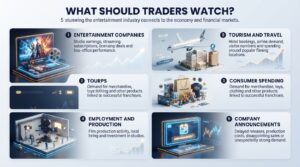
For example, if a movie creates a tourism trend, the effects may show up in hotel bookings and travel-related businesses rather than directly in the film studio’s share price.
The important thing is to follow the actual economic data, not just the excitement surrounding a release.
What Can Traders Learn from These Movies?
There are a few useful lessons here, and they go beyond the entertainment industry.
1. Popularity does not always mean profitability.
A movie can attract millions of viewers, but production costs, marketing, distribution agreements and revenue sharing all affect the final financial result. Box-office revenue is not the same as studio profit.
2. Look beyond the obvious business.
A film may benefit hotels, restaurants, airlines, retailers and local tour operators, not just the company that produced it. This is a reminder to consider the wider economic chain.
3. Pay attention to consumer behaviour.
People’s interests influence what they buy, where they travel and how they spend their money. Changes in consumer demand can create opportunities for businesses.
4. Consider the long-term effect.
A film’s impact may continue for years through tourism, merchandise, licensing and visitor attractions. Not every economic effect appears immediately after release.
5. Always check the numbers.
A popular title or positive headline does not automatically make a company a good investment. Look at revenue, costs, earnings and market expectations before drawing conclusions.
Movies and the Economy: A Surprisingly Close Relationship
So, what connects a movie night with the wider economy?
Quite a lot, actually.
A successful film can create jobs, attract tourists, increase consumer spending and support businesses that may seem completely unrelated to cinema. The impact can spread from a film studio to hotels, restaurants, retailers and even local transport providers.
But there is another side to the story. More visitors can put pressure on local communities and the environment, while high production costs do not guarantee a profitable film.
That is why looking at the full picture matters. Economic impact is not just about how much money a movie makes at the box office, but also about where the money goes and who benefits from it.
Frequently Asked Questions about Top 10 Movies That Made an Impact on the Economy
1. How can movies affect the economy?
Movies can influence the economy through production spending, employment, tourism, merchandise sales, cinema revenue and increased demand for related services.
2. Which movie had a major impact on tourism?
The Lord of the Rings trilogy had a notable influence on New Zealand’s tourism image, while Mamma Mia! helped attract visitors to filming locations in Greece.
3. Does box-office revenue represent a movie’s profit?
No. Box-office revenue is the total amount collected from cinema ticket sales. The money is shared between cinemas and distributors, and production, marketing and distribution costs must also be considered.
4. Can a movie influence a country’s tourism industry?
Yes. Films can introduce destinations to international audiences and encourage visitors to explore real filming locations. However, the size of the effect depends on many factors, including promotion, accessibility and local tourism capacity.
5. Why should traders pay attention to the entertainment industry?
The entertainment industry connects with several market sectors, including technology, consumer goods, tourism and media. Following these connections can help traders understand wider business trends and consumer demand.
6. Can a successful movie affect stock prices?
It can influence the share price of companies directly involved in its production or distribution, especially when results differ from market expectations. However, a box-office hit does not automatically mean a company’s shares will rise.
Wrap up
At the end of our movie night I relaised that our life is just like a movie and laos the trading world some ups and downs this is life …I never thought a family movie night would give me so much to think about!
The next time you watch a film, look beyond the story and the actors. Think about the businesses behind it, the places it showcases and the people whose work makes it possible.
why don’t you try more in a demo account with a risk free trials before going live.