
Table of Contents
How to Switch From a Demo Account to a Live Trading Account
How to switch from a demo account to a live trading account is not something easy to do. We are talking about our money here, and when it comes to real money, everything changes. The decisions become more bold or may I say ..more stupid. The heart rate gets faster … yes, mine too.
Every time I place a sell or buy order on my real account, I feel this heart race inside my veins. I know it’s not easy to switch from just simulation, where you can lose as many bucks as you like, to real money and real markets.
In this article, we will guide you through the process of how to switch from a demo account to a live trading account.
Let’s dive in.

Before answering the question “How do I switch from a demo account to a live trading account?”, we first need to understand what a demo account is and what a live trading account actually means.
What Is a Demo Account in Trading?
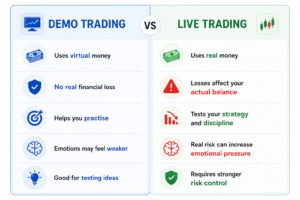
A demo account is basically your practice account…You trade with virtual money while using a trading platform that lets you practise opening and closing positions, testing strategies and following market movements without risking your own capital.
simply It is your great place to make mistakes. its more like a comfort zone
What Is a Live Trading Account?
A live trading account is where you trade with real money…You deposit your own funds, and your trades can result in actual profits or losses. You are also dealing with the real trading conditions offered by your broker, including spreads, execution and other applicable costs.
This is where trading starts to feel very different.
On demo, losing $50 might not bother you at all.
On a live account, you might stare at that same $50 loss and suddenly forget everything your strategy taught you.
That is why moving from demo to live trading needs preparation, not excitement.
Why Do People Use a Demo Account?
Most beginners start with demo because it gives them room to learn before risking real money.
- Learn the trading platform.
- Practise placing orders.
- Test your strategy.
- Understand stop-loss and take-profit.
- Practise risk management.
- Build trading discipline.
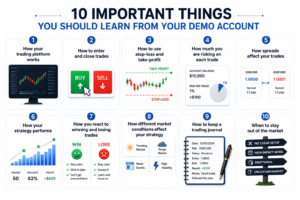
10 Important Things You Can Learn From a Demo Account
Don’t judge your demo account only by how much virtual profit you made…Pay attention to what you actually learned.
- How to open and close trades
- How bid and ask prices work
- How spreads affect your trades
- How to use stop-loss orders
- How to set realistic targets
- How position size changes your risk
- How leverage affects your exposure
- How to manage a losing trade
- How to follow a trading plan
- How you behave when the market moves against you
How to Switch From a Demo Account to a Live Trading Account and When?
There is no magic number, each to his own you know. ..You don’t suddenly become ready after exactly 100 trades or three months on demo.
This question might help you know when you will be ready?
- Can I follow my strategy without constantly changing the rules?
- Do I understand how much I can lose on a trade?
- Can I accept a losing trade without immediately trying to win the money back?
- Am I using money I can actually afford to lose?
If the answer is no, there is nothing wrong with staying on demo.
Actually, that’s probably the smarter decision.
A good demo period is not about proving that you can make huge virtual profits. It’s about proving that you can follow a process and manage risk consistently.
Once you feel ready, then comes the big question:
How to Switch From a Demo Account to a Live Trading Account
The actual process depends on your broker, but the journey is usually straightforward:
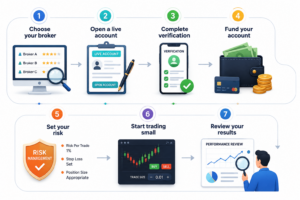
And this is where we need to slow down a little, because opening the account is the easy part.
The difficult part is making sure you’re ready to trade it.
How to Switch From a Demo Account to a Live Trading Account
Step by Step guide
So, you’ve decided you’re ready to leave the demo account and try live trading.
Don’t rush to deposit money and place your first trade. Take it one step at a time.
Step 1: Choose a Suitable Broker
If you are opening a live account, broker selection matters much more than it did on demo.
Check:
- Regulation and licensing
- Spreads and commissions
- Available markets
- Trading platforms
- Deposit and withdrawal methods
- Customer support
Step 2: Open Your Live Trading Account
Some brokers let you upgrade an existing profile, while others require a separate live-account application.
Usually, you will find an option such as “Open Live Account,” “Go Live,” or “Open Real Account” inside your client area.
Click it and follow the application.
Your demo account doesn’t normally turn into a live account automatically. You are opening a real trading account with its own verification and funding requirements.
Step 3: Complete Your Verification
This is the part where the broker needs to confirm who you are.
You may be asked for:
- Your full name and date of birth
- Residential address
- Government-issued ID
- Proof of address
- Tax or financial information, depending on the broker
The exact requirements depend on the broker and where you live.
Make sure the information you provide is accurate and matches your documents. It can save you unnecessary delays later.
Step 4: Choose Your Account and Trading Setup
Depending on the broker, you may need to choose your:
- Account type
- Base currency
- Trading platform
- Leverage
Take your time here.
If you’re a beginner, don’t choose an account simply because it gives you the highest leverage available. More leverage means greater exposure, not better trading.
Step 5: Fund Your Live Account
Once your account has been approved, you can deposit your trading capital using one of the available payment methods.
And this is where I want you to stop for a second.
How much should you deposit?
Not as much as possible.
Use money you can afford to lose. Your trading account should never depend on money needed for rent, bills, food or other important expenses.
Starting with a smaller amount can also make the psychological transition easier.
Step 6: Start Smaller Than Your Demo Account
This is one of the biggest differences I would recommend when you move from demo to live.
Your demo account may have had $50,000 or $100,000 in virtual funds.
That doesn’t mean you need to trade as if you have that amount in real life.
Start with a position size that feels manageable.
You are not trying to make a fortune from your first live trade. You’re trying to learn what happens when the money is real.
Step 7: Keep Your Demo Strategy
Don’t suddenly become a completely different trader.
If your demo strategy uses a certain entry, stop-loss, target and position size, keep those rules when you go live.
The whole point is to see whether you can execute the strategy with real emotions involved.
If you change the strategy, increase your leverage and start taking random trades at the same time, you won’t know what actually caused your results.
Step 8: Accept That Your First Live Trades May Feel Different
This is probably the biggest psychological adjustment.
You might find yourself:
- Hesitating before entering.
- Closing trades too early.
- Moving your stop-loss.
- Taking profits too quickly.
- Increasing your position after a loss.
These reactions don’t automatically mean your strategy is bad.
Sometimes, they simply mean your risk is too high for your comfort level.
If you can’t calmly accept the amount you could lose, reduce the position size.
Step 9: Keep a Trading Journal
Don’t just write:
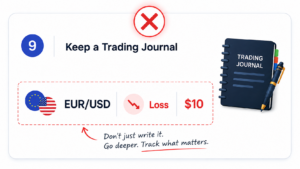
Tell yourself what actually happened.
Write down your entry, reason for the trade, risk, result and how you felt during it.
After several trades, patterns start to appear.
Maybe you keep closing winners too early. Maybe you enter when you’re bored. Maybe you increase your risk after losing.
That information is far more useful than looking at your account balance every five minutes.
Step 10: Review Before Increasing Your Risk
Give yourself time to adjust.
Don’t increase your position size just because you made a few profitable trades.
Look at a reasonable sample of trades and ask:
Am I following my plan, or am I simply getting lucky?
If your execution is improving and your risk remains under control, you can reassess your approach over time.
And if live trading feels overwhelming, going back to demo for a while is not failure.
Sometimes it’s simply part of learning how to trade with real money.