
Table of Contents
What Is a Crypto Wallet and How Does It Work?
What Is a Crypto Wallet and How Does It Work?…..I’ve spent a lot of time at the beginning of my trading career questioning whether trading in the crypto world was really worth it or not.
I also witnessed the early days of crypto, from the famous first Bitcoin pizza purchase to the rise of Trump’s cryptocurrency and the regulatory battles happening around the world. On my Arabic blog, I’ve covered enough crypto-related topics over the years to see how quickly this market has changed.
Now, I want to bring some perspective to the basics of the crypto world here as well.
And if you’re trying to understand crypto, what is a crypto wallet and how does it work is one of the questions you really need to answer. Before buying, sending, receiving, or even properly understanding cryptocurrencies, you need to know what a wallet actually does, where your crypto is stored, and what gives you control over it.

So today, we’re going to break it all down from the ground up —what is a crypto wallet and how does it work , the different types of wallets, and how to keep your crypto safe.
Let’s dive in.
What Is a Crypto Wallet?
A crypto wallet is a software application or physical device that allows you to manage cryptocurrency and interact with a blockchain.
But there is one important detail that confuses many beginners:
Your crypto is not physically stored inside the wallet.
Instead:
- Your cryptocurrency is recorded on a blockchain.
- Your wallet manages the keys that give you control over those assets.
- Your wallet address allows other people to send crypto to you.
- Your private key allows you to authorize transactions.
Think of the wallet as your interface to the blockchain rather than a digital version of your physical wallet.
For example, if you own Bitcoin, the Bitcoin itself exists as blockchain records. Your wallet gives you the ability to prove that you control the relevant Bitcoin and authorize a transaction when you want to send it.

How Does a Crypto Wallet Work?
At a basic level, a crypto wallet works by generating and managing cryptographic keys.
When you create a wallet, it generates the information needed to interact with a blockchain. Depending on the wallet, this may be represented by a private key or a recovery phrase from which wallet keys can be derived.
When you receive crypto, you give the sender your wallet address.
When you send crypto, your wallet uses your private key to digitally sign the transaction. The private key itself is not normally sent across the network.
The blockchain network then checks the transaction and, if valid, records it on the blockchain.
The process looks like this:

You don’t need to manually perform all these technical steps. The wallet software handles most of the process behind the scenes.
Where Is Your Crypto Actually Stored?
Your Bitcoin, Ethereum, or other cryptocurrency isn’t sitting inside an app on your phone or inside a hardware wallet….The blockchain maintains the records…..Your wallet gives you access to those records through your keys.
That’s why losing your phone doesn’t necessarily mean losing your Bitcoin.
If you have the appropriate recovery information, you can restore your wallet on another compatible device.
A simple analogy
- Think of the blockchain as a giant public financial ledger.
- Your wallet is the tool you use to interact with that ledger.
- Your private key is what proves you have the authority to move the assets associated with your address.
Public Key vs. Private Key
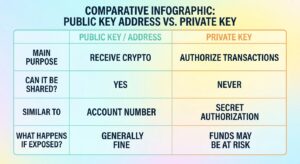
Public key
- A public key is information used to derive addresses that others can use to send you cryptocurrency.
- Your wallet address is what you will normally share with someone who wants to send you crypto.
Private key
- A private key is secret information used to authorize transactions.
- If someone obtains your private key, they may be able to control the crypto associated with it.
- Never send your private key to another person, website, exchange, or supposed customer-support agent.
What Is a Crypto Wallet Address?
A crypto wallet address is a unique identifier that tells the blockchain where cryptocurrency should be sent.
It usually looks like a long string of letters and numbers.
For example, instead of giving someone your private key, you give them your wallet address when you want to receive crypto.
You can also commonly use a QR code to make receiving or sending funds easier.
Important
Always check:
- The address
- The cryptocurrency
- The blockchain network
- The amount
before confirming a transaction.
A mistake in a crypto transfer can be difficult or impossible to reverse.
What Is a Seed Phrase?
A seed phrase, also called a recovery phrase, is a sequence of words that can be used to restore access to a crypto wallet.
Many wallets use phrases containing 12 or 24 words, although the exact format depends on the wallet.
The seed phrase is extremely important because it can provide access to the keys controlling your assets.
Treat your seed phrase like a master key
Never:
- Screenshot it
- Store it in your email
- Upload it to cloud storage
- Send it through WhatsApp or Telegram
- Share it with customer support
- Enter it into an unfamiliar website
Write it down and store it securely according to the wallet’s recommended recovery procedure.
If someone gets your seed phrase, your crypto may be at risk.
How Do You Send Cryptocurrency From a Wallet?
Sending crypto is relatively straightforward, but there are several steps happening behind the scenes.
Basic process
- Open your crypto wallet.
- Select the cryptocurrency you want to send.
- Enter or scan the recipient’s address.
- Enter the amount.
- Select or review the network fee.
- Check the address and network carefully.
- Confirm the transaction.
- Your wallet signs the transaction.
- The transaction is broadcast to the blockchain network.
- The network verifies and confirms it.
Once confirmed, the blockchain records the transaction.
Why are transaction fees required?
Most blockchains require users to pay a network fee for transactions.
The fee generally goes toward the participants responsible for processing and securing the network.
The amount can vary depending on:
- The blockchain
- Network activity
- Transaction complexity
- Current demand
How Do You Receive Cryptocurrency?
Receiving crypto is simpler.
You normally:
- Open your wallet.
- Select the cryptocurrency.
- Tap Receive.
- Copy your wallet address or display the QR code.
- Send the address to the person or platform sending the crypto.
- Wait for the blockchain transaction to be processed.
One important rule
The asset and network must be compatible with the receiving address.
For example, don’t assume that because two assets use similar-looking addresses, they can automatically be sent using the same network.
Always check the wallet and exchange instructions before transferring funds.
Types of Crypto Wallets
Crypto wallets can be classified in several ways.
The two most useful distinctions are:
Hot vs. cold — based on connectivity.
Custodial vs. non-custodial — based on who controls the private keys.
There are also different wallet formats, including mobile, desktop, browser, hardware, and exchange wallets.
What Is a Hot Wallet?
A hot wallet is a crypto wallet connected to the internet or used through an internet-connected device.
Examples include:
- Mobile wallets
- Desktop wallets
- Browser extension wallets
- Many exchange wallets
| Hot Wallets | Advantages | Disadvantages |
|---|---|---|
| Quick access | ✓ | |
| Easy to set up | ✓ | |
| Convenient for frequent transactions | ✓ | |
| Useful for DeFi and Web3 applications | ✓ | |
| Greater exposure to online threats | ⚠ | |
| Phishing risks | ⚠ | |
| Malware risks | ⚠ | |
| Device security becomes important | ⚠ |
What Is a Cold Wallet?
A cold wallet is designed to keep private keys offline when they are not being used.
Hardware wallets are the most common example.
| Cold Wallets | Advantages | Disadvantages |
|---|---|---|
| Reduced exposure to online attacks | ✓ | |
| Useful for long-term holdings | ✓ | |
| Private keys can remain offline | ✓ | |
| Less convenient for frequent transactions | ⚠ | |
| Physical device can be lost or damaged | ⚠ | |
| Recovery procedures must be handled carefully | ⚠ |
Cold storage can improve security, but it does not eliminate every risk.
A user can still lose funds by exposing a recovery phrase, approving a malicious transaction, or sending crypto to the wrong address.
Hot Wallet vs. Cold Wallet
| Feature | Hot Wallet | Cold Wallet |
|---|---|---|
| Internet exposure | Higher | Lower |
| Convenience | High | Moderate |
| Frequent transactions | Suitable | Less convenient |
| Long-term storage | Possible | Common use case |
| Main concern | Online attacks | Physical/recovery security |