
Table of Contents
Forex Broker Fees Explained for Beginners
Forex broker fees explained for beginners… yes, we all wonder about this when we first start trading.
Why do I need a broker?
Why does the broker charge me?
How much money will the broker take from my profits?
These are all valid questions. I remember wondering about the same things when I was still a beginner.
Forex broker fees are something you need to understand before you start trading seriously. They can affect your:

- Trading costs
- Net profit
- ROI
- Risk management
- Choice of broker
The good news is that broker fees are not as complicated as they may look.
In this guide, we will break everything down into simple terms:
So, let’s Dive in,
What Is a Forex Broker?
A forex broker is a company that gives retail traders access to the foreign exchange market…you usually cannot directly trade into the global forex market and place a trade yourself.
The broker provides the connection and the tools you need.
A forex broker can provide:
- Access to currency pairs such as EUR/USD and GBP/USD
- A trading platform
- Buy and sell prices
- Order execution
- Leverage and margin facilities
- Account management
- Deposits and withdrawals
- Trading tools and market information
Think of the broker as the bridge between you and the trading market.
What Does a Forex Broker Do?
A broker does much more than simply let you click Buy or Sell.
Its main jobs can include:
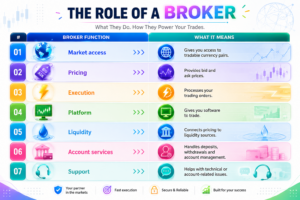
So when you pay a broker fee, you are generally paying for some part of this trading service.
Why Is a Forex Broker Important?
Choosing a broker matters because the broker can affect the actual cost and experience of your trades.
- Spreads
- Commissions
- Swap rates
- Execution quality
- Slippage
- Available currency pairs
- Trading platform
- Regulation
- Account types
- Customer support
This is why the cheapest-looking broker is not automatically the best broker.
Why Do Forex Brokers Charge Fees?
Brokers may generate revenue through:
- Spreads
- Commissions
- Swap or financing charges
- Markups
- Certain account fees
- Payment-related fees
This is why you should never assume that “zero commission” means “zero cost.”
A broker may charge no separate commission while earning through the spread.
How Do Forex Brokers Make Money?
This is probably the question most beginners have after learning what a broker does.
A broker can make money through different pricing models, including:
- Spreads — the difference between the bid and ask price.
- Commissions — a separate charge based on your trade size or volume.
- Swap or financing — charges or credits for holding positions overnight.
- Markups — an amount added to the underlying trading cost.
- Other fees — such as certain withdrawal, conversion, or inactivity charges.
So, when you see a broker advertising “zero commission,” don’t immediately assume trading is free.
The cost may simply be built into another part of the pricing.
What Are the Main Types of Forex Brokers?
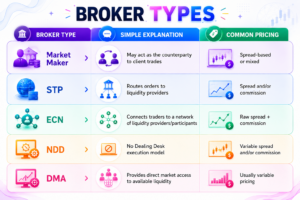
Market Maker / Dealing Desk
A market maker can act as the counterparty to a client’s trade.
This model may offer:
- Simple pricing
- Fixed or variable spreads
- Different account options
- Internal order matching in some cases
Being a market maker does not automatically mean a broker is bad.
The important things are the broker’s:
- Regulation
- Pricing
- Execution
- Transparency
- Trading conditions
STP Broker
STP means Straight-Through Processing.
In simple terms:
- Orders are routed electronically to liquidity providers.
- The broker may add a markup to the spread.
- Pricing is generally variable.
- There may or may not be a separate commission.
STP is often associated with No Dealing Desk models.
ECN Broker
ECN means Electronic Communication Network.
ECN-style brokers generally provide access to a network of market participants and liquidity providers.
You may see:
- Very tight or raw spreads
- Separate commissions
- Variable pricing
- Pricing that changes with market conditions
An important beginner lesson:
ECN does not automatically mean cheaper.
You need to calculate the spread + commission together.
NDD Broker
NDD means No Dealing Desk.
It describes an execution approach rather than one completely separate broker category.
NDD models commonly include:
- STP
- ECN-style execution
The main idea is that orders are not handled through a traditional dealing desk model.
DMA Broker
DMA means Direct Market Access.
It generally refers to direct access to market liquidity or pricing.
You may encounter DMA more often when researching brokers across different financial markets.
For a beginner, you don’t need to get too technical here.
The important thing is to understand how your orders are executed and what you actually pay.
Which Forex Broker Type Is Best?
No answer can be correct for this questions it all depends, the better question you can ask is
Which broker model fits your trading needs?
Consider:
- Your trading style
- How frequently you trade
- Average trade size
- Spread
- Commission
- Swap
- Execution
- Regulation
- Platform
- Overall cost
Forex Broker Fees Explained for Beginners
The Main Costs
Now we can finally get to the part you probably came here for.
The most common costs include:
- Spread
- Commission
- Swap / rollover
- Overnight financing
- Deposit and withdrawal fees
- Inactivity fees
- Currency conversion fees
Some brokers charge only a few of these, while others may have different account structures.
So always check the broker’s current fee schedule before opening an account.
1. Forex Spread
The spread is the difference between the bid price and the ask price.
For example:
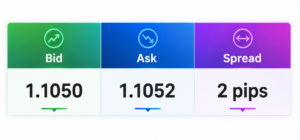
That 2-pip difference is part of your trading cost.
This is why a trade does not normally start exactly at break-even.
The market needs to move enough to cover the spread before the position becomes profitable.
Fixed vs Variable Spreads
Fixed spread
- Remains relatively consistent.
- Makes costs easier to predict.
- May be wider than variable spreads.
- Conditions depend on the broker.
Variable spread
- Changes with market conditions.
- Can become tighter during liquid periods.
- Can widen during volatility or major news.
- Is common in many modern forex accounts.
2. Forex Commission
A commission is a separate charge a broker may apply when you trade.
It can be based on:
- Trade size
- Number of lots
- Trading volume
- Account type
For example, a broker might charge a fixed amount per standard lot.
Some brokers charge a commission in addition to a very tight spread.
Others offer a spread-only account with no separate commission.
Spread-only vs Commission-based
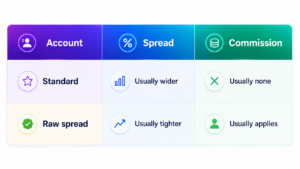
Neither option is automatically cheaper. You need to compare the total cost of the trade.
3. Forex Swap or Rollover Fee
A swap is a charge or credit that can apply when you keep a forex position open overnight.
It is influenced by factors such as:
- Interest-rate differences between currencies
- Currency pair
- Position size
- Buy or sell direction
- Number of nights held
- Broker’s swap rates
A swap can be:
- Negative → money is taken from your account.
- Positive → money may be credited to your account.
For example, holding a position for several days can make swap costs more noticeable than they would be for a trade opened and closed on the same day.
What Is Triple Swap?
You may also hear traders talk about triple swap.
This usually means that three days of swap may be applied on one specific weekday to account for the weekend settlement period.
The exact day can vary by instrument and broker.
So if you hold trades overnight, always check the broker’s swap schedule.
4. Overnight Financing Charges
You may also see terms such as:
- Overnight financing
- Financing cost
- Holding cost
- Rollover cost
These generally refer to costs associated with keeping leveraged positions open beyond the daily cutoff.
The exact calculation depends on:
- Instrument
- Position size
- Direction
- Interest rates
- Broker terms
For forex, these costs are closely related to swap/rollover charges.
For CFDs and other leveraged products, brokers may use different financing calculations.
5. Deposit and Withdrawal Fees
Your broker may also charge fees when moving money into or out of your trading account.
Possible costs include:
- Bank transfer fees
- Card processing fees
- E-wallet fees
- Currency conversion charges
- Third-party payment fees
However, not every broker charges these fees.
The cost can also depend on the payment method and currency you use.
Before depositing money, check:
- Minimum deposit
- Deposit fee
- Withdrawal fee
- Processing time
- Supported payment methods
- Currency conversion charges
6. Inactivity Fees
Some brokers may charge an inactivity fee when an account remains unused for a specific period.
For example, the broker may apply a fee after several months without trading activity.
But this is not a universal forex broker fee.
The conditions can vary significantly between brokers.
Always check:
- How long the account must remain inactive
- How much the fee is
- Whether the fee is monthly or one-time
- Whether the broker offers a way to avoid it
7. Currency Conversion Fees
You can also face a conversion cost when your:
- Account currency
- Deposit currency
- Withdrawal currency
- Trading instrument currency
are different.
For example, depositing in one currency while your trading account is denominated in another may involve a conversion.
The amount depends on the broker and payment provider.
Forex Broker Fees vs Other Trading Costs
Here is an important distinction.
Not every trading cost is technically a broker fee.
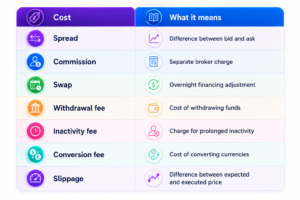
What Is Slippage?
Slippage happens when your order is executed at a different price from the one you expected.
It can happen during:
- Major news releases
- Fast market movements
- Low-liquidity periods
- Sudden price gaps
Slippage is not necessarily a broker fee, but it can still increase your actual trading cost.
That is why looking only at the advertised spread is not enough.
What Determines Forex Broker Fees?
Your trading cost can change depending on:
- Broker — different brokers use different pricing models.
- Account type — standard and raw-spread accounts can have different costs.
- Currency pair — major pairs often have tighter spreads than less-liquid pairs.
- Trade size — larger positions can mean higher dollar costs.
- Trading volume — some brokers offer volume-based pricing.
- Market conditions — volatility can cause spreads to widen.
- Trading hours — liquidity can change throughout the day.
- Holding period — longer positions can accumulate financing costs.
So there is no single answer to:
“How much are forex broker fees?”
It depends on how and what you trade.
How to Calculate Forex Broker Fees
Understanding the fees is one thing.
Knowing how much they actually cost you is much more useful.
Your total trading cost can include:
Spread + Commission + Swap + Other applicable charges
Let’s make it simple.
How Much Does the Spread Cost?
Suppose you trade 1 standard lot of EUR/USD.
For this simple example:
- Trade size: 100,000 units
- Spread: 1 pip
- Pip value: approximately $10
So:
1 pip × $10 = $10 spread cost
Your trade starts with approximately $10 in spread cost.
If the spread were 2 pips:
2 × $10 = $20
The wider the spread, the more the trade costs.
How Much Does Commission Cost?
Let’s say your broker charges:
- $7 per standard lot
- You trade 1 standard lot
- The commission applies to both sides
Your round-trip commission would be:
$7 + $7 = $14
So your cost could look like this:
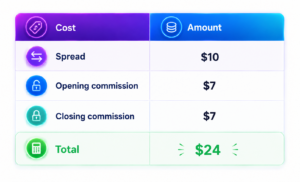
And this is before considering any overnight financing.
Add the Swap
Now imagine you keep the trade open overnight and the applicable swap is $3.
Your total cost becomes:
$10 spread + $14 commission + $3 swap = $27
So a trade that looked profitable at first may have a very different result after costs.
Forex Broker Fees Explained for Beginners: A Simple Profit Example
Imagine your trade makes:
$100 gross profit
Your trading costs are:
- Spread: $10
- Commission: $14
- Swap: $3
Total costs:
$27
Your approximate result after these costs:
$100 − $27 = $73
So:
Gross profit ≠ Net profit
This is one of the most important things beginners need to understand.
How Do Broker Fees Affect ROI?
Your ROI should reflect what you actually keep after trading costs.
For example:
- Starting capital: $1,000
- Gross profit: $100
- Trading costs: $27
- Net profit: $73
ROI based on the net result:
$73 ÷ $1,000 × 100 = 7.3%
Without considering the fees, you might think your ROI was 10%.
That difference matters.
Why Small Fees Can Become a Big Problem
One trade with a small cost may not look important.
But imagine making:
- 1 trade → small cost
- 20 trades → larger total cost
- 100 trades → potentially significant cost
This is especially important for scalpers and frequent traders.
If you make many trades, even a small difference in spread or commission can add up quickly.
Which Forex Fees Matter Most for Your Trading Style?
Different traders should pay attention to different costs.
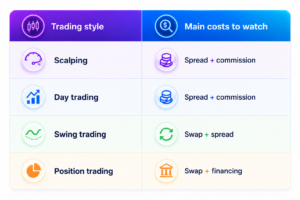
Scalpers
Scalpers usually make many short-term trades.
They should pay close attention to:
- Tight spreads
- Low commissions
- Execution quality
- Slippage
Even a small cost per trade can become significant after many trades.
Day Traders
Day traders also care heavily about:
- Spread
- Commission
- Execution
Because many positions are closed before the daily rollover, overnight costs may be less important.
Swing Traders
Swing traders can hold positions for several days.
That means:
- Spread still matters
- Commission still matters
- Swap becomes more important
Position Traders
Position traders may hold trades for weeks or months.
For them, the biggest concern can be:
- Swap
- Financing
- Long-term holding costs
A small daily cost can become meaningful over a long period.
Spread vs Commission: Which Is Cheaper?
There is no universal winner.
Spread-only account
You may get:
- No separate commission
- Wider spread
- Simple pricing
Raw-spread account
You may get:
- Very tight spread
- Separate commission
- Potentially lower overall cost for frequent traders
The best option depends on your trading activity.
Don’t compare the spread alone.
Compare:
Spread + commission + other applicable costs
That is your real trading cost.
How to Reduce Forex Broker Fees
- Compare the total cost: Look at spreads, commissions, swap rates, withdrawal fees, inactivity fees, and currency conversion costs—not just “zero commission” or “0.0 pip spreads.”
- Match the account to your style: Scalpers usually care more about tight spreads and low commissions, while swing and position traders should pay closer attention to swap and financing costs.
- Trade liquid pairs: Major pairs such as EUR/USD, GBP/USD, and USD/JPY often have tighter spreads than less-liquid exotic pairs under normal market conditions.
- Watch major news: Interest-rate decisions, inflation data, employment reports, and major geopolitical events can increase volatility and widen spreads.
- Check overnight costs: If you hold trades overnight, review the buy/sell swap rates and any triple-swap rules before entering the trade.
- Check payment fees: Before depositing or withdrawing, check for transaction, withdrawal, minimum-balance, and currency-conversion charges.
- Focus on the real cost: The cheapest-looking account is not always the cheapest. Compare the spread + commission + swap + other applicable fees to see what you actually pay.
How to Choose a Forex Broker Based on Fees
When comparing brokers, don’t ask:
“Who has the lowest spread?”
Ask:
“What will my total cost be?”
Compare the same:
- Currency pair
- Trade size
- Account type
- Trading time
- Holding period
Then calculate:
Spread + Commission + Swap + Other applicable costs
This gives you a much more realistic comparison.
Common Beginner Mistakes With Broker Fees
- Zero commission ≠ zero cost: The broker may earn through the spread.
- Ignoring the actual spread: Minimum spreads can change with market conditions.
- Forgetting swap: Overnight positions can add extra costs.
- Ignoring withdrawal fees: Moving money can also cost you.
- Overtrading: More trades can mean more spreads and commissions.
- Ignoring slippage: Fast markets can cause different execution prices.
Forex Broker Fees Explained for Beginners
What Should You Actually Pay?
There is no universal fee that every forex trader will pay.
Your costs depend on the broker and the way you trade.
The main costs to understand are:
- Spread → cost built into the bid and ask price.
- Commission → separate charge on the trade.
- Swap → overnight credit or charge.
- Financing → cost of holding leveraged positions.
- Withdrawal/deposit fees → charges for moving money.
- Inactivity fees → possible charge for unused accounts.
- Conversion fees → cost of converting currencies.
- Slippage → possible difference between expected and executed price.
Understanding these costs helps you calculate your real profit instead of looking only at the number shown on your trading platform.
FAQs: Forex Broker Fees Explained for Beginners
What are forex broker fees?
Forex broker fees are the costs associated with trading through a forex broker.
They can include:
- Spreads
- Commissions
- Swaps
- Financing costs
- Withdrawal fees
- Inactivity fees
- Currency conversion charges
The exact fees depend on the broker and account type.
Do all forex brokers charge the same fees?
No.
Brokers can have different:
- Spreads
- Commission structures
- Swap rates
- Account fees
- Withdrawal policies
Always compare the complete pricing structure.
Is a zero-commission forex broker free?
Not necessarily.
A broker may charge no separate commission while making money through the spread.
So zero commission does not mean zero trading costs.
Which forex broker fees affect scalpers the most?
Scalpers usually need to pay close attention to:
- Spreads
- Commissions
- Slippage
- Execution quality
Because they may enter and exit many trades, small costs can accumulate quickly.
Which forex broker fees matter most for swing traders?
Swing traders should pay particular attention to:
- Spread
- Commission
- Swap
- Overnight financing
The longer a position remains open, the more important holding costs can become.
Can forex broker fees reduce my profits?
Yes.
Every trading cost reduces the amount you keep from a profitable trade.
This is why calculating net profit after costs is more useful than looking only at gross profit.
How can I compare forex broker fees?
Compare brokers using the same:
- Currency pair
- Position size
- Account type
- Trading conditions
- Holding period
Then calculate the estimated total cost.
Wrap Up
Well, this is the end… yeah, the end of the article, but hopefully the start of a much more understandable brokerage system for you as a beginner trader.
Tell me, is it clearer now? Do you understand how broker fees work and where your money actually goes?
If you’re still hesitant, try everything on a demo account first before risking your money on real trading.
Learn, practice, understand the costs, and then decide when you’re ready to go live.