

Home Educational articlesWhat Is a Stablecoin and How Does It Work?

What Is a Stablecoin and How Does It Work?

by Amira ibrahim
0 comments 130 views
What Is a Stablecoin and How Does It Work?

Table of Contents

What Is a Stablecoin and How Does It Work?

what is a stablecoin and how does it work……Hello, my fellow Trader Heroes!..By now, we all know what cryptocurrency is. We’ve covered it before, and we’ve also talked about Bitcoin, stocks, forex, and many other parts of the financial markets.

But the crypto world is much bigger than just Bitcoin.

Over the next few articles, I want to shed some light on some of the best-known concepts and assets in the crypto world. And today, we’re starting with one of the most important ones: stablecoins.

banner

You may have seen names like USDT or USDC while looking at cryptocurrency prices or browsing a crypto exchange and wondered:

Why is this cryptocurrency always around $1?

Well, that’s exactly what we’re going to explore today.

We’ll cover what a stablecoin is, why it was created, how it works, the different types of stablecoins, and the risks you should understand before using one.

So, let’s dive in.


What Is a Stablecoin?

A stablecoin is a type of cryptocurrency designed to keep its value relatively stable…Unlike Bitcoin or many other cryptocurrencies, stablecoins are usually connected to the value of another asset….Most commonly, that asset is a traditional currency such as the US dollar.

For example, a US dollar stablecoin is generally designed to stay close to:

1 stablecoin = $1

That’s the basic idea behind the name.

While the price of Bitcoin might move significantly during a single day, a dollar-pegged stablecoin is designed to avoid those large price swings.

In simple words:

A stablecoin tries to combine:

 

Stablecoins: The Bridge Between Two Financial Worlds

One of the easiest ways to understand stablecoins is to think of them as a bridge….On one side, you have traditional money such as the US dollar…..On the other side, you have blockchain-based assets such as Bitcoin and Ethereum.

Stablecoins try to connect these two worlds by putting a more stable form of value onto a blockchain.


Why Were Stablecoins Created?

To understand what is a stablecoin and how does it work, we first need to understand one of the biggest characteristics of cryptocurrencies:

Volatility.

The price of cryptocurrencies can move quickly.

Bitcoin, Ethereum, and many other digital assets can rise or fall significantly within a short period.

That’s exciting for traders—but it can create a problem when you simply want to send, receive, or hold money.

Imagine this:

  • You have $1,000 worth of Bitcoin today.
  • Tomorrow, the value could be much higher.

Or much lower.

Now imagine you’re running a business and someone pays you using a highly volatile cryptocurrency. By the time you receive the payment, its value may already have changed.

Stablecoins were created to offer an alternative.

Instead of constantly experiencing major price movements, they aim to maintain a relatively predictable value.


How Does a Stablecoin Work?

A stablecoin doesn’t stay stable simply because its creator says it should.

There needs to be a mechanism behind it.

The exact mechanism depends on the type of stablecoin, but many stablecoins maintain their value through one or more of the following:

  • Reserves
  • Collateral
  • Redemption mechanisms
  • Smart contracts
  • Supply adjustments
  • Market incentives

Let’s start with the simplest and most common idea.


The Basic Idea Behind a Dollar-Pegged Stablecoin

Imagine a company issues 1 million stablecoins, each designed to be worth $1.

To support those coins, the issuer may hold reserves equal to the value of the stablecoins in circulation.

Those reserves can include assets such as:

  • Cash
  • Cash equivalents
  • Short-term government securities
  • Other highly liquid assets

The goal is to ensure that the stablecoin has sufficient backing.

A simple example:

What Is a Stablecoin and How Does It Work?

The exact reserve structure can vary significantly between stablecoin issuers….That’s why not all stablecoins work in exactly the same way.


What Does “Pegged” Mean?

You will hear the word peg a lot when talking about stablecoins.

A peg simply means that the stablecoin is designed to follow the value of another asset.

For example:
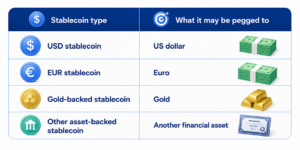
What Is a Stablecoin and How Does It Work?


So, if a stablecoin is pegged to the US dollar, its goal is generally to stay close to $1.

However—and this is important—”pegged” does not mean the price can never move.

Stablecoins can experience small price fluctuations, and in more serious situations, they can lose their peg entirely.


The 4 Main Types of Stablecoins

Not every stablecoin is backed or managed in the same way.

There are four main categories you should know about.


1. Fiat-Backed Stablecoins

This is the type most beginners are likely to encounter.

Fiat-backed stablecoins are linked to traditional currencies such as:

  • The US dollar
  • The euro
  • Other national currencies

The issuer typically holds reserves to support the value of the stablecoins.

How it works:

A company issues stablecoins and maintains assets intended to support them.

For example:

A stablecoin designed to represent $1 aims to maintain a value close to one US dollar.

The ability to redeem the stablecoin can also help support the relationship between the token and the currency it represents.

Common idea:

Traditional assets in reserve → digital tokens on the blockchain


2. Commodity-Backed Stablecoins

Instead of being linked to a currency, these stablecoins are connected to a physical commodity.

The most common example is:

Gold

A gold-backed stablecoin may represent a specific amount or value of gold.

This gives users a way to gain exposure to the value of a commodity through a digital token.

However, users still need to understand important details such as:

  • What exactly backs the token?
  • Where is the commodity held?
  • Who is responsible for custody?
  • How does redemption work?

3. Crypto-Backed Stablecoins

Some stablecoins are backed by other cryptocurrencies.

At first, this might sound strange.

After all, cryptocurrencies themselves can be volatile.

That’s why crypto-backed stablecoins often use overcollateralization.

What does that mean?

It means the value of the assets held as collateral can be greater than the value of the stablecoins created.

Example:

Imagine someone deposits:

$200 worth of cryptocurrency

They may not necessarily receive:

$200 worth of stablecoins

Instead, the system might require extra collateral to help protect against a drop in the value of the cryptocurrency.

This additional cushion is designed to reduce the risk created by crypto market volatility.

Smart contracts can also automatically manage parts of the system, including collateral requirements and liquidation rules.


4. Algorithmic Stablecoins

Algorithmic stablecoins use a very different approach.

Rather than relying entirely on traditional reserves, some designs attempt to manage stability by changing the supply of the stablecoin.

The basic idea:

If the price moves above the target:

→ The system may increase supply.

If the price moves below the target:

→ The system may reduce supply or use other market mechanisms.

The goal is to encourage the price to move back toward its target.

However, this type of stablecoin can involve significant risks.

History has shown that mechanisms designed to maintain a peg can fail, particularly when market confidence disappears.


A Quick Comparison of Stablecoin Types

Type Main source of stability Example of underlying value
Fiat-backed Traditional financial reserves US dollar or euro
Commodity-backed Physical commodities or related reserves Gold
Crypto-backed Cryptocurrency collateral Digital assets
Algorithmic Supply adjustments and market mechanisms Target price mechanism


How Do Stablecoins Maintain Their Value?

There is no single answer because different stablecoins use different systems.

However, these are some of the main mechanisms.

1. Redemption

For some stablecoins, users can exchange their tokens for the underlying asset.

For example:

1 stablecoin → $1

This redemption process can help support the stablecoin’s price.


2. Reserves

The issuer holds assets intended to support the stablecoins in circulation.

The quality and transparency of those reserves are extremely important.


3. Overcollateralization

This is common in some crypto-backed stablecoins.

The system holds more collateral than the value of stablecoins created.

The extra collateral is designed to help absorb price declines.


4. Supply Adjustments

Some systems attempt to influence the price by increasing or decreasing the number of tokens available.

This approach is generally more complex and can carry additional risks.


What Happens When a Stablecoin Loses Its Peg?

This is known as depegging.

Let’s say a stablecoin is designed to stay at:

$1

But its market price falls to:

$0.90

The stablecoin has moved away from its intended peg.

Small price movements can happen in normal trading.

But a major or prolonged loss of the peg can be a serious problem.

Why?

Because the main reason people use a stablecoin is its expected price stability.

If users suddenly lose confidence in the stablecoin, they may rush to sell or redeem it.

This can create even more pressure on the price.


Why Can Depegging Happen?

  • Concerns about the reserves
  • A lack of liquidity
  • A sudden loss of market confidence
  • Problems with the issuer
  • Falling collateral values
  • Technical failures
  • Weak algorithmic mechanisms
  • A large number of users trying to exit at the same time

What Are Stablecoins Used For?

Stablecoins have become an important part of the wider crypto ecosystem…They are used for much more than simply buying cryptocurrencies.


1. Crypto Trading

This is one of their most common uses.

Traders can use stablecoins to move between different crypto assets without immediately converting their funds back into traditional currency.

For example:

Bitcoin → Stablecoin → Another cryptocurrency

Stablecoins can also give traders a relatively stable place to hold value while deciding what to do next.


2. Cross-Border Payments

International payments can sometimes involve:

  • Multiple banks
  • Different operating hours
  • Delays
  • Fees
  • Complex payment processes

Stablecoins have the potential to move value across borders using blockchain networks.

Depending on the network and platform involved, this could make some transfers:

  • Faster
  • Available around the clock
  • More accessible

However, costs, regulations, and practical access can vary.


3. Remittances

People sending money to family members in another country may face expensive or slow traditional payment systems.

Stablecoins could provide another way to transfer value internationally.

But again, users need to consider:

  • Local regulations
  • Exchange costs
  • Wallet access
  • How the recipient converts the stablecoin into local currency

4. DeFi

Stablecoins are widely used in decentralized finance, or DeFi.

They can be used for:

  • Trading
  • Lending
  • Borrowing
  • Providing liquidity
  • Collateral

Because their value is designed to be more stable than many cryptocurrencies, they can play an important role in blockchain-based financial applications.


5. Business and Institutional Payments

Companies and financial institutions are also exploring stablecoins and other forms of tokenized money.

Possible uses include:

  • Faster settlement
  • International business payments
  • Treasury management
  • Moving liquidity between different operations

The technology is still evolving, but interest from traditional financial institutions continues to grow.


Why Are Stablecoins Important for the Crypto Market?

Stablecoins solve a practical problem.

The crypto market can be highly volatile.

A trader might want to leave a volatile position without completely leaving the blockchain ecosystem.

Stablecoins provide a possible bridge.

Think about it like this:

Volatile crypto assets Stablecoins
Prices can move significantly Designed for relative price stability
Often used for speculation or investment Often used for payments and settlement
Market value changes constantly Usually targets a specific value

This doesn’t mean stablecoins are better than other cryptocurrencies.

They simply serve a different purpose.


USDT vs. USDC

Feature USDT USDC
Issuer Tether Circle
Main peg U.S. dollar U.S. dollar
Main use Trading, transfers, liquidity Trading, payments, DeFi
Availability Multiple blockchains Multiple blockchains
Key consideration Reserve composition and transparency Reserve transparency and regulation

Stablecoins vs. Bitcoin

Bitcoin Stablecoin
Price can be highly volatile Designed for relative stability
Often viewed as an investment or store of value Often used for payments and settlement
Value is determined by market forces Usually targets the value of another asset
Does not normally aim to maintain a fixed price Designed to maintain a peg


Are Stablecoins Actually Stable?

Relatively stable? Yes.

Guaranteed to never lose value? No.

This distinction is extremely important.

Stablecoins can experience:

  • Small price movements
  • Liquidity problems
  • Depegging
  • Reserve concerns
  • Regulatory changes
  • Technology risks

The level of risk depends heavily on the specific stablecoin and how it is designed.

Before using one, it is important to understand:

  1. Who issued it?
  2. What supports its value?
  3. Where are the reserves held?
  4. How transparent is the issuer?
  5. Can holders redeem the stablecoin?
  6. What happens during periods of market stress?

The Main Risks of Stablecoins

Let’s look at the most important risks in simple terms.

Reserve Risk

Some stablecoins depend on reserves to support their value.

If users doubt whether those reserves are sufficient or liquid, confidence can quickly disappear.


Depegging Risk

A stablecoin may move away from its intended value.

For a dollar-pegged stablecoin, that means moving significantly away from $1.


Regulatory Risk

Governments around the world are developing rules for stablecoins.

Changes in regulation could affect:

  • Who can issue stablecoins
  • How reserves must be held
  • What information issuers must disclose
  • How stablecoins can be used

Technology and Security Risk

Stablecoins operate through digital infrastructure.

Potential risks include:

  • Cyberattacks
  • Wallet security problems
  • Private key loss
  • Smart contract vulnerabilities
  • Technical failures

Centralization Risk

Some stablecoins are issued and controlled by centralized organizations.

Depending on the stablecoin’s design, the issuer may have certain powers over the tokens or addresses.

This is something users should understand before using a particular stablecoin.


Stablecoins vs. Traditional Money

Traditional money Stablecoin
Issued by governments or central banking systems Often issued by private organizations
Used through traditional financial infrastructure Can move through blockchain networks
Usually legal tender in its issuing country Not necessarily legal tender
Traditional banking rules apply Regulation depends on the jurisdiction and structure


Stablecoins vs. CBDCs

Stablecoins CBDCs
Usually issued by private companies Issued by central banks
May be backed by reserves Represents official central bank money
Designed for blockchain or digital networks Digital version of sovereign currency
Not necessarily legal tender Could have official legal status


Should Traders Care About Stablecoins?

Absolutely.

Even if you’re not planning to buy stablecoins as an investment, you will probably encounter them if you spend time in the crypto market.

They are commonly used for:

  • Trading pairs
  • Moving funds between platforms
  • DeFi
  • Payments
  • Holding value temporarily between trades

Understanding stablecoins can help you better understand how money moves inside the crypto ecosystem.

And as always, understanding what you’re using is better than simply clicking Buy.


FAQs About What Is a Stablecoin and How Does It Work?

What is a stablecoin in simple words?

A stablecoin is a cryptocurrency designed to maintain a relatively stable value by tracking another asset, most commonly the U.S. dollar.

How does a stablecoin work?

A stablecoin uses a backing or stabilization mechanism, such as reserves, collateral, redemption, or supply adjustments, to keep its market value close to its target price.

Why were stablecoins created?

Stablecoins were created to provide a less volatile digital asset that can be used for trading, payments, transfers, and other blockchain-based financial activities.

What does it mean when a stablecoin is pegged?

A peg means the stablecoin is designed to maintain a target value relative to another asset, such as one U.S. dollar.

Are all stablecoins pegged to the U.S. dollar?

No. Although dollar-pegged stablecoins are the most common, some stablecoins track other currencies, commodities, or different reference assets.

How does a stablecoin stay at $1?

The method depends on the stablecoin. It may rely on reserves, collateral, redemption mechanisms, arbitrage, smart contracts, or changes in token supply.

Does one stablecoin always equal exactly $1?

No. A dollar-pegged stablecoin targets approximately $1, but its market price can temporarily move above or below $1.

Why can a stablecoin trade above or below $1?

Changes in supply and demand, liquidity, market stress, reserve concerns, and investor confidence can cause a stablecoin to move away from its target price.

What is a stablecoin depeg?

A depeg occurs when a stablecoin’s market price moves significantly away from the value it is designed to track, such as $1.

Why do stablecoins lose their peg?

A stablecoin can lose its peg because of reserve problems, insufficient liquidity, collateral losses, technical failures, market panic, or declining confidence in its issuer or stabilization mechanism.

Can a stablecoin lose all of its value?

In an extreme failure, yes. A stablecoin is designed to maintain stability but does not provide a universal guarantee that its value cannot collapse.

What are the main types of stablecoins?

The main categories are fiat-backed, commodity-backed, crypto-backed, and algorithmic stablecoins.

What is a fiat-backed stablecoin?

A fiat-backed stablecoin is supported by reserves consisting of fiat currency or related liquid assets, such as bank deposits or short-term government securities.

What is a crypto-backed stablecoin?

A crypto-backed stablecoin uses other cryptocurrencies as collateral. Because crypto prices can fluctuate significantly, these systems often use more collateral than the value of the stablecoins issued.

What is a commodity-backed stablecoin?

A commodity-backed stablecoin is linked to a physical or commodity-related asset, such as gold.

What is an algorithmic stablecoin?

An algorithmic stablecoin uses programmed rules, smart contracts, and supply or demand mechanisms to attempt to maintain its target value rather than relying entirely on traditional reserves.

Which type of stablecoin is safest?

There is no universally safest type. Risk depends on the quality of the backing, reserves, collateral, issuer, technology, liquidity, transparency, and regulatory framework.

What is a stablecoin reserve?

A reserve is the pool of assets used to support a stablecoin’s value and, depending on its structure, help meet redemptions or maintain its peg.

What assets back stablecoins?

Depending on the stablecoin, backing can include cash, bank deposits, government securities, commodities, cryptocurrencies, or other forms of collateral.

What is overcollateralization?

Overcollateralization means a stablecoin system holds collateral worth more than the value of the tokens issued, creating a buffer against declines in collateral prices.

What is stablecoin minting?

Minting is the process of creating new stablecoin tokens and adding them to circulation according to the stablecoin’s issuance mechanism.

What is stablecoin burning?

Burning is the process of permanently removing stablecoin tokens from circulation, often when tokens are redeemed or the supply is reduced.

What is stablecoin redemption?

Redemption is the process of exchanging eligible stablecoins for the underlying value or assets according to the issuer’s rules.

What is stablecoin arbitrage?

Stablecoin arbitrage involves buying or selling a stablecoin when its market price differs from its target, potentially helping push the price back toward its peg.

What are stablecoins used for?

Stablecoins are used for cryptocurrency trading, payments, cross-border transfers, remittances, decentralized finance, liquidity, and blockchain-based settlement.

Why do crypto traders use stablecoins?

Traders use stablecoins to move funds between volatile crypto assets and a relatively stable asset without necessarily converting back to traditional fiat currency.

Can stablecoins be used for payments?

Yes. Stablecoins can be transferred on compatible blockchain networks and can be used for certain digital payments and settlements.

Can stablecoins be used for international transfers?

Yes. Stablecoins can facilitate blockchain-based cross-border transfers, although users still need to consider network fees, regulations, liquidity, and conversion costs.

What role do stablecoins play in DeFi?

Stablecoins are widely used in decentralized finance for lending, borrowing, trading, liquidity pools, and other on-chain financial applications.

Why are stablecoins important to the crypto market?

They provide a relatively stable unit of value and medium of exchange within an ecosystem where many other digital assets can experience significant price volatility.

What is USDT?

USDT, or Tether, is a dollar-pegged stablecoin designed to maintain a value close to one U.S. dollar and is available across multiple blockchain networks.

What is USDC?

USDC is a dollar-pegged stablecoin issued by Circle and designed to maintain a value close to one U.S. dollar.

What is the difference between USDT and USDC?

Both are designed to track the U.S. dollar, but they have different issuers, reserve structures, transparency practices, regulatory approaches, and levels of adoption across markets.

What is DAI?

DAI is a decentralized stablecoin designed to maintain a value close to one U.S. dollar and is primarily supported by collateral within a blockchain-based system.

What is the most popular stablecoin?

USDT is generally the largest stablecoin by market capitalization and is one of the most widely traded stablecoins, although market rankings can change over time.

Is a stablecoin a cryptocurrency?

Yes. Stablecoins are cryptocurrencies that use blockchain or distributed-ledger technology while attempting to maintain a relatively stable value.

Is a stablecoin the same as Bitcoin?

No. Bitcoin has a floating market price that can fluctuate significantly, while stablecoins are designed to track a relatively stable reference value.

Are stablecoins less volatile than Bitcoin?

Generally, yes. Stablecoins are specifically designed to reduce price volatility, although they can still experience price movements and depegging.

Are stablecoins the same as fiat currency?

No. Fiat currency is government-issued money such as dollars or euros. A stablecoin is a blockchain-based digital token designed to track the value of an asset, often a fiat currency.

Are stablecoins digital dollars?

Dollar-pegged stablecoins can function similarly to digital representations of dollars, but they are not identical to dollars held directly in a bank account or central-bank money.

What is the difference between a stablecoin and a CBDC?

A stablecoin is generally issued by a private company or decentralized protocol, while a central bank digital currency is issued by a country’s central bank. Stablecoins are not the same as official central-bank money.

Can stablecoins replace traditional money?

Stablecoins can perform some money-like functions, particularly digital payments and transfers, but they do not currently replace traditional currencies across the broader financial system.

Can you earn interest on stablecoins?

Yes. Some exchanges, lending platforms, and DeFi protocols offer products that generate yield from stablecoins.

Do stablecoins automatically pay interest?

No. Simply holding a stablecoin generally does not guarantee interest. Earning yield usually requires using a separate financial product or protocol.

Are stablecoin yields guaranteed?

No. Stablecoin yields can involve additional risks, including platform, smart-contract, liquidity, market, and counterparty risks.

Can you stake stablecoins?

Stablecoins generally do not generate staking rewards in the same way as proof-of-stake cryptocurrencies. Some platforms use the term “staking” for products that generate yield through other strategies.

Are stablecoins a good investment?

Stablecoins are primarily designed for stability and utility rather than capital appreciation. Their usefulness depends on the user’s objectives and the risks of the specific stablecoin.

Can stablecoins increase in value?

They are generally not designed for significant price appreciation. Their primary purpose is to maintain a target value rather than generate capital gains.

Are stablecoins safe?

Stablecoins are not risk-free. Their risks can come from reserves, collateral, issuers, liquidity, smart contracts, market conditions, and regulation.

What are the main risks of stablecoins?

Key risks include depegging, reserve and collateral risk, issuer risk, liquidity risk, smart-contract risk, regulatory risk, and market risk.

What is reserve risk in stablecoins?

Reserve risk is the possibility that the assets supporting a stablecoin are insufficient, difficult to liquidate, or otherwise unable to support redemptions as expected.

What is issuer risk?

Issuer risk is the possibility that the organization responsible for a stablecoin experiences financial, operational, legal, or governance problems that affect the token.

What is smart-contract risk?

Smart-contract risk is the possibility that bugs, vulnerabilities, or exploits in blockchain-based code could cause losses or interfere with a stablecoin’s operation.

What is liquidity risk?

Liquidity risk is the possibility that a stablecoin cannot be bought or sold efficiently at or near its target price because there are not enough liquid markets or counterparties.

Can stablecoins be hacked?

The blockchain itself may not be hacked, but stablecoins and the smart contracts, bridges, wallets, exchanges, or applications surrounding them can contain vulnerabilities that lead to losses.

Are stablecoin transactions anonymous?

Not necessarily. Transactions on public blockchains are generally visible on-chain, although identifying the person behind a wallet may require additional information.

Are stablecoin transactions reversible?

Usually not. Once a blockchain transaction is confirmed, it generally cannot simply be reversed like a traditional bank transaction.

How do you buy stablecoins?

Stablecoins can typically be purchased through cryptocurrency exchanges, brokers, payment services, or other platforms that support them.

Where can you store stablecoins?

You can store stablecoins in compatible crypto wallets, exchanges, or other custodial and non-custodial services that support the specific token and blockchain.

Can you send stablecoins to another person?

Yes. You can generally transfer stablecoins to another compatible blockchain address, provided you use the correct token and network.

Do stablecoin transfers have fees?

Yes. Transfers can involve blockchain network fees, while exchanges and other platforms may also charge trading, withdrawal, or conversion fees.

Can USDT be sent on any blockchain?

No. USDT is available on multiple blockchain networks, but the sending and receiving platforms must support the same network or a compatible transfer method.

What happens if you send stablecoins to the wrong network?

The funds may become difficult or impossible to recover. You should always verify the token, network, and receiving address before confirming a transaction.

Are stablecoins regulated?

Regulation varies by country and by stablecoin. Rules can cover issuers, reserves, disclosures, licensing, payments, and consumer protection.

Why does stablecoin regulation matter?

Regulation can affect how stablecoins are issued, what assets can back them, how reserves are disclosed, how users can redeem tokens, and which companies can provide stablecoin services.

What should you check before using a stablecoin?

Consider its backing, reserve transparency, issuer, redemption process, liquidity, blockchain network, track record, smart-contract design, and applicable regulations.

Can stablecoins be used as a store of value?

They can be used to hold relatively stable digital value, particularly when compared with highly volatile cryptocurrencies, but they still carry risks that make them different from cash or bank deposits.

Can stablecoins be used for saving money?

Some people hold stablecoins as a way to maintain exposure to a relatively stable digital asset, but stablecoins are not the same as insured bank deposits and can carry additional risks.

What is the biggest advantage of stablecoins?

Their main advantage is combining relatively stable value with blockchain-based transferability, allowing users to move digital value without the price volatility associated with many other cryptocurrencies.

What is the biggest disadvantage of stablecoins?

Their main disadvantage is that their stability depends on a particular backing or mechanism, which can fail or become stressed under certain market and financial conditions.

Are stablecoins actually stable?

They are designed to be stable, but no stablecoin maintains its target price perfectly at all times. Temporary deviations from the intended peg can occur.

What happens when people lose confidence in a stablecoin?

Large numbers of holders may try to sell or redeem the stablecoin, creating liquidity pressure and potentially causing its market price to move further away from its target.

Can a stablecoin cause a bank run?

Stablecoin arrangements can experience run-like dynamics when many holders seek redemption at the same time, particularly if the backing assets are less liquid than the stablecoin liabilities.

Do stablecoins have an expiration date?

No. Stablecoins generally do not have an expiration date, although a particular token or issuer can be discontinued, migrated, frozen, or otherwise affected by changes in its operation.

Can a stablecoin be frozen?

Some centrally controlled stablecoins can include mechanisms that allow the issuer to freeze or blacklist certain addresses under specified circumstances.

What happens to stablecoins if an issuer goes bankrupt?

The outcome depends on the stablecoin’s legal structure, reserves, redemption rights, jurisdiction, and bankruptcy arrangements. Holders may face delays, losses, or difficulties accessing the underlying assets.

Are stablecoins backed 1:1?

Some stablecoins are designed to have one-to-one backing or redemption arrangements, but “1:1” does not mean that every stablecoin has the exact same type or composition of reserves.

Do stablecoins have value outside the blockchain?

Their value depends on their intended use, market demand, backing, redemption arrangements, and confidence in the system supporting them.

Why are stablecoins important for cross-border payments?

They can allow value to move on blockchain networks without relying entirely on traditional banking rails, potentially making some international transfers faster or more accessible.

Can stablecoins be used to buy Bitcoin?

Yes. Stablecoins such as USDT and USDC are commonly used as trading pairs for buying and selling cryptocurrencies.

Can stablecoins be converted into cash?

Depending on the stablecoin and service provider, users may be able to sell or redeem stablecoins for fiat currency such as U.S. dollars.

What is the difference between holding dollars and holding a dollar stablecoin?

A dollar held in a bank account is traditional fiat money within the banking system. A dollar stablecoin is a blockchain token whose value is designed to track the U.S. dollar and whose risks depend on its issuer or stabilization mechanism.

Do stablecoins have the same risks as bank deposits?

No. Stablecoins and bank deposits have different legal structures, protections, backing arrangements, and risks. A stablecoin should not automatically be treated as equivalent to an insured bank deposit.

Can stablecoins be used without a bank account?

In some cases, yes. A person can hold and transfer certain stablecoins using a compatible crypto wallet without directly holding a traditional bank account, although converting them into local fiat may require access to a financial service.

What is the future of stablecoins?

Stablecoins are increasingly being explored for payments, settlement, trading, and other financial applications, but their future will depend on adoption, technology, regulation, and how their risks are managed.

Wrap-Up

Oooh man… that was a long dive. To be honest, the crypto world is not for the faint of heart, especially when it comes to stablecoins and how much the market has evolved over the last few years.

Stablecoins may look simple on the surface, but as we’ve seen, there’s a lot happening behind that “stable” price.

Anyway, if you want to get into the crypto world, take your time, learn how everything works, and start with a demo account before going live. Get comfortable with the market first, understand the risks, and only then consider putting real money on the line.

Bye, fellow traders. See you in the next article!

You may also like

Leave a Comment

Caveo FX Limited is a regulated Securities Dealer offering CFD trading on forex, commodities, indices, and cryptocurrencies. Licensed by the Financial Services Authority of Seychelles (SD213), we provide secure and transparent trading solutions with advanced platforms and competitive spreads.

Edtior's Picks

Latest Articles

All RIGHTS RESERVED TO CAVEO FX LIMITED