

Table of Contents
Risk-Reward Ratio Explained for New Traders
Risk-reward ratio explained for new traders — we are now talking about something the whole core of trading depends on.
How much money am I actually going to get from this whole trading chaos… or should I say fun rollercoaster? Yes, we are now talking about risk-reward ratio.
This is one of the most important concepts new traders need to understand because many beginners focus only on how much money they can make and completely forget about how much they could lose.
You might deposit $1,000, open a few trades, and then forget all about your risk. Then you come back thinking, “Where did my money go?”

This is exactly why understanding risk before entering a trade matters.
What Is the Risk-Reward Ratio in Trading?
The risk-reward ratio (RRR) compares how much money you are willing to risk on a trade with how much you potentially expect to make.
In simple words:
Risk = How much you could lose.
Reward = How much you could potentially make.
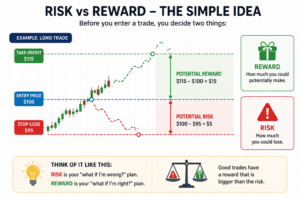
For example, if you risk $100 to potentially make $200, your risk-reward ratio is 1:2.
That means:
- You risk $1
- You aim to make $2
- Your potential reward is twice your potential risk
A 1:3 risk-reward ratio means you risk $1 to potentially make $3.
This does not mean you are guaranteed to make $3. It simply tells you what you are risking compared with your potential reward before entering the trade.
Why Is Risk-Reward Ratio Important?
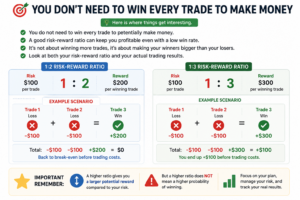
Because trading is not about winning every single trade.
You can lose trades and still be profitable if your winning trades are large enough compared with your losing trades.
For example, imagine you risk $50 on every trade and use a 1:3 risk-reward ratio.
If you lose three trades:
3 × $50 = $150 loss
But if you win one trade:
1 × $150 = $150 profit
You are roughly at break-even before trading costs.
This is why looking only at your win rate can be misleading.
A trader who wins 40% of their trades can potentially be profitable with a strong risk-reward ratio, while another trader with a higher win rate can still lose money if their average losses are much larger than their average gains.
Risk-Reward Ratio vs Win Rate
These two concepts work together.
Your win rate tells you how often your trades are successful.
Your risk-reward ratio tells you how large your potential winners are compared with your potential losers.
For example:
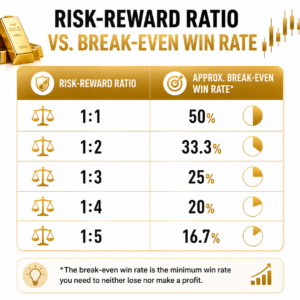
*Before spreads, commissions, slippage and other trading costs.
So, a 1:3 ratio does not mean you only need to win 25% of your trades to guarantee profit. It means that, mathematically, a 25% win rate is the break-even point under the simplified assumption that every losing trade loses exactly 1R and every winning trade makes exactly 3R.
That distinction is important.
The Three Prices You Need
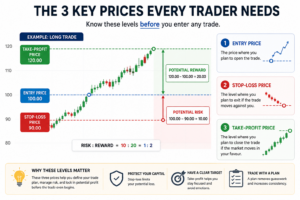
Before calculating your risk-reward ratio, you normally need three key levels:
1. Entry Price
The price where you plan to open the trade.
2. Stop-Loss Price
The level where you plan to exit if the trade moves against you.
3. Take-Profit Price
The level where you plan to close the trade if the market moves in your favour.
Once you have these three levels, calculating your potential risk and reward becomes much easier.
How to Calculate the Risk-Reward Ratio
Calculating the risk-reward ratio is actually pretty simple. You just need three things:
- Entry price — where you enter the trade
- Stop-loss — where you accept the loss
- Take-profit — where you plan to take the profit
The basic idea is:
Risk = Entry Price − Stop-Loss
Reward = Take-Profit − Entry Price
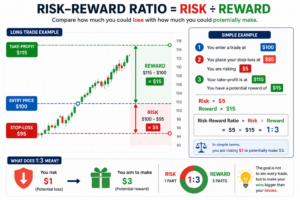
Risk-Reward Ratio = Risk ÷ Reward
Simple Example
Imagine you enter a trade at $100.
You place your stop-loss at $95, so you are risking $5.
Your take-profit is at $115, giving you a potential reward of $15.
So:
Risk = $5
Reward = $15
That gives you a 1:3 risk-reward ratio.
You are risking $1 to potentially make $3.
What About a Losing Trade?
- This is where the risk-reward ratio becomes useful.
- If the trade hits your stop-loss, you lose your planned amount.
- If it reaches your target, you make your planned reward.
- The important part is that you know these numbers before entering the trade, instead of figuring them out after the market starts moving.
Risk-Reward Ratio for Short Trades
The calculation works for sell trades too. The direction simply changes.
For a short trade:
Risk = Stop-Loss − Entry
Reward = Entry − Take-Profit
For example, you sell at $100, place your stop-loss at $105, and target $90.
You risk $5 to potentially make $10.
That is a 1:2 risk-reward ratio.
Is a Higher Risk-Reward Ratio Always Better?
Not necessarily.
A 1:5 trade might look amazing on paper, but if the target is unrealistic and the market rarely reaches it, the ratio does not magically make the trade good.
This is one of the biggest things beginners need to understand:
Risk-reward ratio does not tell you the probability of winning.
It only tells you how much you could potentially gain compared with how much you are risking.
That is why traders should consider the market setup, volatility, entry, stop-loss, target and win rate together.
What Is a Good Risk-Reward Ratio?
There is no perfect ratio for every trader or every strategy.
That said, 1:2 is commonly used as a basic benchmark, while 1:3 can provide more room for losing trades.
Your trading style also matters. A scalper may work with a smaller ratio, while a swing trader may look for larger potential moves.
The key is not to chase the biggest number.
Choose a realistic target first, then see whether the resulting risk-reward ratio makes the trade worth taking.
Risk-Reward Ratio and Position Sizing
You can have a perfect 1:3 risk-reward ratio and still lose your account if your position size is too large.
This is where position sizing comes in.
Position sizing simply means deciding how much of an asset you should trade based on how much you are willing to risk.
A common risk-management rule for beginners is to risk around 1% of your trading account per trade. Some traders use up to 2%, depending on their strategy and risk tolerance.
A Simple Example
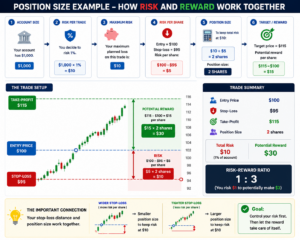
Let’s say your account has $1,000.
If you decide to risk 1%:
$1,000 × 1% = $10
So, your maximum planned loss on that trade is $10.
Now imagine your entry is $100 and your stop-loss is $95.
You are risking $5 per share.
To keep your total risk at $10:
$10 ÷ $5 = 2 shares
So, your position size would be 2 shares.
If your target is $115, you could potentially make $30:
- Risk: $10
- Potential reward: $30
- Risk-reward ratio: 1:3
This is the important part: your stop-loss distance and position size work together.
Wider Stop-Loss? Smaller Position.
If the market is more volatile and your stop-loss needs to be further away, you generally need to reduce your position size if you want to keep the same amount of money at risk.
For example:
Tighter stop → larger position
Wider stop → smaller position
The goal is not to use the same number of shares or lots on every trade.
The goal is to keep your risk controlled.
Why Position Sizing Matters
Without proper position sizing, one bad trade can do serious damage to your account.
Imagine risking 10% of your account on every trade. A few losses in a row could leave you with a much smaller account and make it harder to recover.
That is why experienced traders focus not only on “How much can I make?” but also on:
“How much can I afford to lose if I am wrong?”
That question should come before you enter the trade.
Risk-Reward Is Not a Guarantee
One more thing before we move on.
A 1:2 or 1:3 ratio does not guarantee that the trade will be profitable.
The market can hit your stop-loss before ever reaching your target.
Risk-reward is simply a framework that helps you understand the potential outcome before you put your money at risk.
You still need a trading strategy, realistic entry and exit levels, proper position sizing and disciplined risk management.
Common Risk-Reward Ratio Mistakes Beginners Make
Understanding the risk-reward ratio is important, but it is easy to misuse it. Here are some mistakes you should watch out for.
1. Chasing Huge Ratios
Seeing a 1:5 or 1:10 ratio can look exciting, but bigger is not automatically better.
If your target is unrealistic, the trade may never reach it. A realistic 1:2 setup can be much more useful than chasing a 1:10 trade that has little chance of working.
2. Moving Your Stop-Loss
You entered the trade with a planned risk, but the market starts moving against you.
Instead of accepting the loss, you move your stop-loss further away.
Sound familiar?
This changes your original risk and can turn a small planned loss into a much bigger one.
3. Taking Profit Too Early
The opposite can happen too.
You plan a 1:3 trade, but the market moves slightly in your favour and you close the position because you are scared the profit will disappear.
If you keep doing this, your actual reward may become much smaller than the one you planned.
4. Ignoring Trading Costs
Spreads, commissions and slippage can reduce your actual return.
This matters even more for traders who make many short-term trades.
Your ratio should make sense after considering the costs of trading, not just on paper.
5. Focusing Only on the Ratio
A 1:3 ratio does not automatically make a trade good.
You still need a valid reason to enter, a logical stop-loss and a realistic target.
Risk-reward is a tool, not a trading strategy by itself.
6. Risking Too Much
This is probably the biggest mistake.
Finding a great-looking 1:3 setup does not mean you should put a huge part of your account into it.
A losing trade is still a losing trade.
Keep your position size under control so that one bad trade does not damage your entire account.
A Simple Risk-Reward Checklist
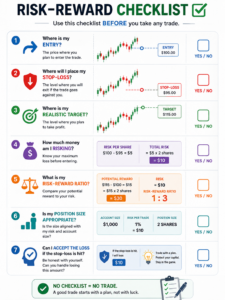
Before entering a trade, ask yourself:
What Is a Good Risk-Reward Ratio?
A 1:2 ratio is often used as a simple benchmark, while 1:3 or higher can give you more room for losing trades. But the right ratio depends on your strategy, market conditions, win rate and trading style.
The important thing is to use a ratio that is realistic for your setup.
Risk-Reward Ratio by Trading Style
| Trading Style | Common Approach |
|---|---|
| Scalping | Lower ratios, with more frequent trades |
| Day trading | Often around 1:1.5 to 1:2 |
| Swing trading | Often around 1:2 to 1:3 or higher |
| Position trading | May target larger ratios |
These are not strict rules. A trader should not force every trade into the same ratio just because a number looks good.
Risk-Reward Ratio and Win Rate
Risk-Reward Ratio vs Expectancy
If you want to go one step further, this is where expectancy comes in.
Expectancy looks at your win rate, average win and average loss to estimate whether your strategy has a positive or negative result over many trades.
A simple version is:
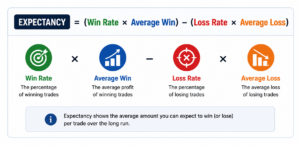
For example, suppose your strategy wins 40% of trades and loses 60%.
If your average winner is $300 and your average loser is $100:
(0.40 × $300) − (0.60 × $100) = $120 − $60 = +$60
That gives you a positive expectancy before trading costs.
This is why you should not judge a trading strategy from one or two trades.
Look at a meaningful number of trades and see what your actual results are.
The Main Lesson
Risk-reward ratio is not about finding the biggest possible reward.
It is about making sure the potential reward makes sense compared with the amount you are putting at risk.
Before you click that Buy or Sell button, know your:
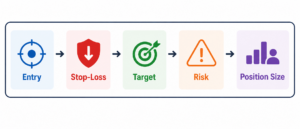
Once you know these numbers, you are no longer entering a trade simply because “the chart looks good.”
You actually know what you are risking.
How Stop-Loss and Take-Profit Affect Risk-Reward
Your risk-reward ratio is only as good as the levels you choose.
You cannot simply place a random stop-loss and target and expect the ratio to tell you whether the trade is good.
Where Should You Place Your Stop-Loss?
Your stop-loss should be placed at a level where your original trade idea is no longer valid.
Depending on your strategy, this could be:
- Below a support level for a buy trade
- Above a resistance level for a sell trade
- Beyond a recent swing high or low
- Based on market volatility, such as the ATR
The goal is not to place the stop as close as possible.
The goal is to place it somewhere logical.
Where Should You Place Your Take-Profit?
Your take-profit should also have a reason behind it.
You might use:
- The next support or resistance level
- A previous high or low
- A technical target
- A predetermined risk multiple, such as 2× or 3× your risk
For example, if your stop-loss is 50 pips away and you want a 1:2 ratio, your target would need to be around 100 pips away.
But what if the next major resistance is only 60 pips away?
You should not simply move the target to 100 pips just to make the ratio look better.
This is where market analysis comes first.
Should You Change Your Risk-Reward Ratio?
Not every trade will offer the same opportunity.
One setup might give you 1:2, while another could offer 1:3 or more.
Instead of forcing every trade to have the same ratio, set a minimum ratio that fits your strategy and then look for realistic opportunities.
And remember:
A good risk-reward ratio cannot rescue a bad trade setup.
You still need a logical entry, stop-loss, target and position size.
Frequently Asked Questions About Risk-Reward Ratio
What is a risk-reward ratio in trading?
The risk-reward ratio compares the amount you could lose on a trade with the amount you could potentially gain. For example, a 1:2 ratio means you are risking $1 to potentially make $2.
How do you calculate the risk-reward ratio?
First calculate your potential risk and potential reward:
Risk = Entry − Stop-Loss
Reward = Take-Profit − Entry
Then compare the two amounts.
For example, risking $50 to potentially make $100 gives you a 1:2 risk-reward ratio.
What is a good risk-reward ratio?
There is no perfect ratio for every trader. 1:2 is commonly used as a basic benchmark, while 1:3 or higher may offer a larger potential reward relative to the risk. Your strategy and market conditions still matter.
Can I be profitable with a low win rate?
Yes, potentially. A favorable risk-reward ratio can allow a trader to remain profitable even without winning most trades. However, the ratio alone does not guarantee profitability. Your actual win rate, trading costs and overall strategy matter too.
Does a 1:3 ratio mean I will win 3 out of every 4 trades?
No. A 1:3 ratio has nothing to do with your probability of winning.
It simply means you are risking 1 unit to potentially make 3 units.
How much should I risk per trade?
Many traders use around 1% of their account per trade, while some may use up to 2% depending on their strategy and risk tolerance.
The important thing is to choose a risk level you can consistently manage.
What is position sizing?
Position sizing determines how many shares, lots, contracts or units you should trade based on your account size and planned risk.
It helps prevent one trade from causing an unnecessarily large loss.
How does position sizing affect risk?
If your stop-loss is wider, you generally need a smaller position to keep the same amount of money at risk.
If your stop-loss is tighter, you may be able to use a larger position while keeping the same monetary risk.
Should I always aim for 1:3?
No.
A 1:3 ratio is not automatically better if the target is unrealistic. Your target should be based on the market and your trading strategy first.
A realistic 1:2 setup can be better than forcing a 1:5 target that the market is unlikely to reach.
Can risk-reward ratio guarantee profits?
No.
It is a risk-management tool, not a prediction tool.
A trade with a 1:3 ratio can still hit the stop-loss. The purpose is to understand the potential downside and upside before entering the trade.
Does leverage change the risk-reward ratio?
No. Leverage does not change the mathematical ratio between your potential risk and potential reward.
However, leverage can increase the size of your exposure, which makes proper position sizing and risk management even more important.
What is the difference between risk-reward ratio and win rate?
Risk-reward ratio measures potential loss compared with potential gain.
Win rate measures how often your trades are profitable.
You need to consider both when evaluating a trading strategy.
Risk-Reward Ratio Checklist
Before entering a trade, ask yourself:
- Where is my entry?
- Where is my stop-loss?
- Where is my realistic target?
- How much money am I risking?
- What is my risk-reward ratio?
- Is my position size appropriate?
- Can I accept the loss if my stop-loss is hit?
If you cannot answer these questions, maybe you are not ready to enter the trade yet.
Final Thoughts
Okay, now you know risk-reward ratio explained for new traders and why it matters.
We always tell our people here: don’t just look at how much you can make. First look at how much you can lose.
Always remember my beloved fellow traders, You can have the best-looking trade in the world, but if you don’t control your risk, one bad trade can hurt your account badly.
So before going live, learn it, test your strategy on a demo account, practice your risk management, and make sure you actually understand what you are risking.