

Table of Contents
How Interest Rates Affect the Stock Market
What Every Trader Should Know
How Interest Rates Affect the Stock Market…..Hello, fellow traders!….How is the start of this trading week treating you all? I hope you’ve been making some smart trading decisions. I have a few of my own, but I won’t share them with you. Not because I’m gatekeeping, of course! I just don’t want to influence your decisions with my questionable trading ideas. Sometimes they work out brilliantly, and sometimes… well, let’s not talk about those.
Anyway, let’s get to why we’re here.
November has no scheduled Federal Reserve rate decision, which gives us a chance to look at something that doesn’t always get enough attention: How Interest Rates Affect the Stock Market
Of course, central banks and their interest rate decisions influence financial markets around the world. But today, we’re focusing on stocks.

Whether you trade shares, follow major stock indices or simply want to understand what moves the market, knowing how interest rates work can help you make sense of market reactions.
So, fellow traders, let’s dive in!
What Is the Stock Market?
The stock market is where investors buy and sell shares of publicly listed companies.
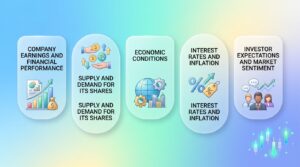
When you buy a share, you purchase a small ownership stake in that company. Its price can change depending on several factors, including:
What Are Interest Rates?
An interest rate is the cost of borrowing money or the return earned on savings and certain investments.
For example, when someone takes out a loan, they usually pay interest to the lender. When someone deposits money in an interest-bearing account, they may receive interest in return.
Interest rates influence decisions made by consumers, businesses, banks and investors.
They can affect:

Central banks, including the US Federal Reserve, use interest rates as one of their main tools to influence economic activity and inflation.
What Is the Federal Reserve and Why Does It Matter to Stocks?
The Federal Reserve, often called the Fed, is the central bank of the United States.
One of its main responsibilities is to support price stability and maximum employment. It uses monetary policy, including changes to its policy interest rate, to influence financial conditions.
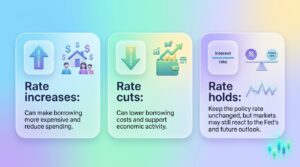
When the Fed raises or lowers rates, the effects can spread through the financial system.
For stock traders, the important points are:
The Fed is not the only central bank that matters. Decisions by the European Central Bank, Bank of England, Bank of Japan and other central banks can also influence their local stock markets.
How Interest Rates Affect Stock Market Prices
So, how interest rates affect stock market prices comes down to several connected factors.
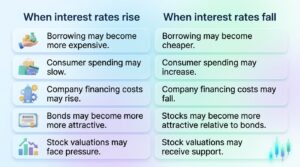
When interest rates rise, borrowing becomes more expensive for households and businesses. This can reduce spending, slow company growth and put pressure on future earnings.
At the same time, higher interest rates can make bonds and savings products more attractive compared with stocks.
When interest rates fall, the opposite may happen. Borrowing can become cheaper, consumer spending may improve, and investors may become more interested in assets with higher potential returns.
Here is a simple comparison:
How Interest Rates Affect Company Earnings and Borrowing Costs
Companies often borrow money to expand, invest in equipment, hire employees or manage daily operations.
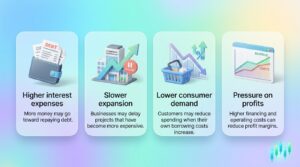
When interest rates rise, new loans and some existing variable-rate debt can become more expensive.
This may affect a company’s financial performance in several ways:
Why Bond Yields Matter to Stock Traders
Bonds are another investment option that can compete with stocks.
When bond yields rise, investors may receive more income from newly issued bonds. This can make them more attractive compared with stocks, which do not offer guaranteed returns.
For example:
Imagine an investor comparing two opportunities:
- A government bond offering a higher yield.
- A stock that may provide returns through price increases and dividends.
If the bond offers a more attractive return relative to its risk, the investor may reconsider how much money to allocate to stocks.
This does not mean investors automatically sell shares when bond yields rise. It means stocks may need to offer a more attractive potential return to compete.
One important distinction: The Federal Reserve’s policy rate and long-term government bond yields are not the same. Bond yields also reflect expectations about inflation, economic growth and future interest rates.
How Interest Rates Affect Stock Valuations
Interest rates also influence how investors calculate what a company is worth.
One common valuation method is discounted cash flow (DCF). It estimates the value of a company by calculating how much its expected future cash flows are worth today.
The basic idea is simple:
Money received in the future is generally worth less than the same amount received today because money available now can be invested and earn a return.
When interest rates increase, the discount rate used in valuation models may also rise. This can reduce the present value of future cash flows.
Example:
Imagine a company is expected to generate $100 in five years.
| Discount rate | Present value today |
|---|---|
| 5% | $78.35 |
| 8% | $68.06 |
The expected future cash flow stays the same, but its estimated value today falls when the discount rate increases.
This is one reason higher interest rates can put pressure on stock valuations.
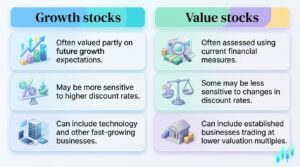
Growth Stocks Can Be More Sensitive to Interest Rates
Not all stocks react to interest rate changes in the same way.
Growth stocks are companies expected to increase their revenue and earnings significantly over time.
Their valuations may depend heavily on profits expected several years into the future. When discount rates rise, those future earnings become less valuable in today’s terms.
Value stocks, on the other hand, are generally shares that appear inexpensive compared with measures such as earnings, book value or cash flow.
Some value companies generate more of their cash flow today, which may make their valuations less sensitive to changes in discount rates.
Stock Prices Do Not Always Fall When Interest Rates Rise
Here is something every trader should understand: higher interest rates do not automatically mean lower stock prices.
The reason behind the rate increase matters.
Consider two situations:
Scenario A: Rates rise because the economy is growing
- Businesses are selling more products and services.
- Company earnings are improving.
- Investors expect stronger economic activity.
In this situation, stronger earnings may help support stock prices.
Scenario B: Rates rise because inflation remains high
- Businesses face higher costs.
- Consumers may reduce spending.
- Central banks may keep monetary policy tight.
- Investors may become more cautious.
This environment can put more pressure on stocks.
The market’s reaction depends on the balance between higher borrowing costs, future earnings and investor expectations.
How Interest Rate Cuts Affect the Stock Market
When a central bank cuts interest rates, borrowing can become cheaper for consumers and businesses.
This may encourage spending, investment and economic activity.
For the stock market, possible effects include:
- Lower financing costs for companies.
- More affordable loans for consumers.
- Greater interest in stocks when bond yields decline.
- Higher valuations if investors expect future earnings to improve.
However, there is an important detail.
Central banks may cut rates because economic growth is slowing or a recession risk is increasing. In that case, lower rates do not guarantee rising stock prices.
Investors need to understand why the central bank is cutting rates, not just the direction of the decision.
How Inflation Influences Interest Rates and Stock Prices
Inflation measures how quickly the prices of goods and services increase over time.
When inflation remains high, central banks may raise interest rates to help slow demand and bring price increases under control.
This can affect stocks through several channels:
- Higher borrowing costs for companies and consumers.
- Increased costs for materials, wages and operations.
- Changes in consumer spending.
- Shifts in investor expectations about future interest rates.
Some companies can pass higher costs on to customers, while others may struggle to protect their profit margins.
That is why inflation can affect different industries and companies in different ways.
Which Stock Market Sectors Can Be Sensitive to Interest Rate Changes?
Interest rate changes can affect industries differently depending on their business models, debt levels and customers.
| Sector | Possible impact of higher interest rates |
|---|---|
| Technology | High-growth companies may face valuation pressure as future earnings are discounted at higher rates. |
| Real estate | Higher mortgage and financing costs may affect property demand and borrowing. |
| Financials | Banks may benefit from some changes in lending margins, but credit demand and loan defaults also matter. |
| Consumer discretionary | Higher borrowing costs may reduce spending on non-essential products. |
| Utilities | Debt-heavy businesses may face higher financing costs, while their dividend yields compete with bond yields. |
| Industrials | Companies that rely on borrowing to finance large projects may face higher costs. |
What Should Traders Watch When Interest Rates Change?
If you want to understand how interest rates affect stock market movements, don’t focus on the central bank announcement alone.
| Indicator | What it tells you |
|---|---|
| Central bank policy rate | The direction of monetary policy. |
| US 10-year Treasury yield | Market expectations about longer-term rates, inflation and growth. |
| Inflation data | Whether price pressures are rising or easing. |
| Employment reports | The condition of the labour market. |
| Company earnings | Whether businesses are growing their revenue and profits. |
| P/E ratio | How much investors are paying for each unit of company earnings. |
| GDP growth | Whether the economy is expanding or slowing. |
Looking at these indicators together gives a clearer picture than following one headline or announcement.
Common Mistakes Traders Make When Following Interest Rates
Interest rate news can create strong market reactions, but reacting to every headline can lead to poor decisions.
Watch out for these common mistakes:
- Assuming every rate increase is bearish: Strong economic growth may support company earnings.
- Ignoring market expectations: Prices may already reflect an expected rate decision before it happens.
- Following the policy rate alone: Bond yields and inflation expectations also matter.
- Treating all stocks equally: Different companies have different levels of debt and growth potential.
- Making decisions based on one announcement: Stock prices respond to many economic and company-specific factors.
The goal is not to predict every central bank move. It is to understand the information behind it and how the market may respond.
Conclusion: Interest Rates Are Only One Part of the Stock Market Story
Interest rates play an important role in stock market movements. They influence borrowing costs, company earnings, bond yields and the way investors value future profits.
But they do not tell the whole story.
Economic growth, inflation, corporate performance and investor expectations all help shape stock prices. That is why markets can rise even when interest rates increase, or fall after a rate cut.
As a trader, focus on understanding the reasons behind market movements rather than reacting to interest rate headlines alone.
FAQs about How Interest Rates Affect the Stock Market
1. How Interest Rates Affect the Stock Market?
Interest rates influence borrowing costs, company earnings, bond yields and stock valuations. Higher rates can put pressure on stocks, while lower rates may support them. However, the actual market reaction depends on economic conditions and investor expectations.
2. Why do stock prices fall when interest rates rise?
Stock prices may fall because higher rates increase borrowing costs, make bonds more competitive and reduce the present value of future company earnings. However, this does not happen every time rates rise.
3. Do stocks go up when interest rates go down?
They can, because lower rates may reduce company borrowing costs and make stocks more attractive compared with bonds. However, if rates are falling because the economy is weakening, stock prices may still decline.
4. Which stocks are most affected by rising interest rates?
Growth stocks, highly indebted companies and businesses that depend on borrowing may be more sensitive to higher rates. The actual impact depends on each company’s earnings, debt and financial strength.
5. How do Federal Reserve rate decisions affect the stock market?
The Federal Reserve influences borrowing conditions and financial markets through monetary policy. Its decisions can affect investor expectations, bond yields, company financing costs and stock valuations.
6. What is the relationship between bond yields and stock prices?
Higher bond yields can make bonds more attractive compared with stocks. They can also increase the discount rate investors use to value future company earnings. However, stock prices are influenced by many other factors.
7. Why can stocks rise when interest rates increase?
Stocks can rise when rates increase if the decision reflects stronger economic growth and improving company earnings. Positive earnings expectations may offset the pressure from higher borrowing costs.
8. What is the difference between interest rates and bond yields?
Interest rates refer to the cost of borrowing or return on lending. Bond yields represent the return an investor receives from holding a bond. Bond yields are influenced by central bank policy expectations, inflation, economic growth and bond market demand.
9. Do interest rate changes affect all stock market sectors equally?
No. Technology, real estate, financials, utilities and consumer companies can respond differently because their debt levels, business models and customer demand vary.
10. Should traders buy stocks before an interest rate cut?
An expected rate cut does not guarantee that stock prices will rise. Traders should consider why rates are being cut, what the market already expects and how company earnings and economic conditions are developing.
Wrap up:
Explore the Caveo FX trading platform, follow stock and index market movements, and practise your strategies in a demo account before trading with real funds. When you’re ready, explore our trading accounts and choose the option that suits your trading needs.
Trading involves risk. Content is for educational purposes only and does not constitute investment advice.