
Table of Contents
Top 10 Countries With the Largest Gold Reserves in 2026
Top 10 Countries With the Largest Gold Reserves in 2026…….Gold has always been something cherished all around the world. In some cultures, it is a crucial part of marriage. In others, it represents wealth, security, and a timeless investment.
Some people love gold as jewelry, some love it as an investment, and personally? I love gold in basically any form. Give me gold coins, bars, jewelry… I am not complaining!
But gold isn’t only sitting in people’s homes or investment accounts. Countries around the world also keep huge amounts of gold in their reserves.
And some of these numbers are honestly wild.

In this article, we’re going to look at the top 10 countries with the largest gold reserves in 2026, explain what gold reserves actually are, why governments still care about gold, and how the famous Bretton Woods system changed the role of gold in the global economy.
And because I don’t want you to leave here thinking, “Okay, cool… but how can I actually invest in gold?” we’ll also walk through how to invest in gold in 5 simple steps.
Let’s get into the shiny stuff.
What Is a Gold Reserve?
A gold reserve is gold held by a country’s central bank or government as part of its official reserves.
Think of it as a financial safety net.
Countries can hold foreign currencies and other assets, but gold has a special place because it doesn’t depend directly on another country’s government or currency.
Central banks may hold gold for several reasons, including:
- Diversifying their reserves
- Protecting against financial uncertainty
- Supporting confidence in their economy
- Preserving wealth over the long term
- Reducing dependence on foreign currencies
And when you see that some countries hold thousands of tonnes of gold, you quickly realize that gold is much more than something sitting in a jewelry box.
It is also a major part of the global financial system.
Why Do Gold Reserves Matter to a Country?
Top 10 Countries With the Largest Gold Reserves in 2026 show just how important gold remains to central banks around the world.
Because gold can provide something currencies don’t always provide: independence and diversification.
Countries hold gold reserves for several important reasons:
1. Diversification
Central banks don’t want all their reserves concentrated in one type of asset or currency. Gold gives them another reserve asset to balance their holdings.
2. A Store of Value
Gold has been used as a store of value for thousands of years. Unlike paper currencies, gold isn’t created by a central bank whenever it wants to expand the money supply.
3. Protection During Uncertainty
Economic crises, wars, inflation, and geopolitical tensions can affect currencies and financial markets. Gold is often viewed as a defensive asset during periods of uncertainty.
4. Confidence
Large gold reserves can strengthen confidence in a country’s financial position and provide an additional reserve asset during difficult periods.
5. Less Dependence on Foreign Currencies
Holding gold can help countries diversify away from relying too heavily on foreign currencies, particularly the US dollar.
But here’s where things get interesting.
Gold wasn’t always simply another reserve asset.
For decades, it was at the center of the global monetary system.
Bretton Woods and the Gold Standard
Before we get to the Top 10 Countries With the Largest Gold Reserves in 2026, we need a quick history lesson.
- In 1944, the Bretton Woods system linked major currencies to the US dollar, while the dollar was tied to gold at $35 per ounce.
- The system ended in 1971 when the US suspended the dollar’s convertibility into gold.
- Gold lost its official role in the global monetary system, but central banks never stopped holding it.
- And that brings us to today, where countries still keep thousands of tonnes of gold in their reserves.
Top 10 Countries With the Largest Gold Reserves in 2026
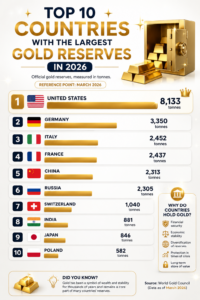
As of March 2026, these are the countries with the largest official gold reserves. Gold remains an important part of their national reserves, but each country has its own economic reasons for maintaining such large holdings.
1. United States — 8,133 Tonnes
The United States sits comfortably at the top, with its huge economy, long history of using gold as a reserve asset, and the dollar’s role as the world’s leading reserve currency.
2. Germany — 3,350 Tonnes
Germany’s large gold reserve reflects its strong export-driven economy and long-standing preference for maintaining substantial monetary reserves.
3. Italy — 2,452 Tonnes
Italy holds one of the world’s largest gold reserves, giving its economy an additional traditional store of value alongside its euro-based reserves.
4. France — 2,437 Tonnes
France has maintained a large gold stock as part of its national reserves, reflecting its long monetary history and focus on financial stability.
5. China — 2,313 Tonnes
China has steadily increased its gold holdings as it diversifies its reserves and strengthens its position within the global financial system.
6. Russia — 2,305 Tonnes
Russia built up significant gold reserves as part of a broader strategy to diversify away from foreign-currency assets and strengthen its financial resilience.
7. Switzerland — 1,040 Tonnes
Switzerland’s gold holdings fit its reputation for financial stability and conservative reserve management.
8. India — 881 Tonnes
India maintains substantial gold reserves alongside strong domestic demand for gold, making the metal an important part of its financial and cultural landscape.
9. Japan — 846 Tonnes
Japan’s large reserve reflects its position as a major advanced economy and its long-standing approach to maintaining diversified national reserves.
10. Poland — 582 Tonnes
Poland has increased its gold holdings in recent years as part of efforts to strengthen its reserves and build greater financial resilience.
How to Invest in Gold: 5 Simple Steps
From the Top 10 Countries With the Largest Gold Reserves in 2026 to Your Own Gold Investment
After looking at the Top 10 Countries With the Largest Gold Reserves in 2026, you might be wondering: if central banks still keep gold as part of their reserves, how can an individual invest in gold?
The good news is that you don’t need a giant vault or a truck full of gold bars. There are several ways to get gold exposure, depending on your goals and risk tolerance.
If you’re wondering how to invest in gold, choosing the right approach is just as important as understanding the gold market. Whether you prefer physical gold or online trading, start with a clear plan.
Step 1: Choose How You Want to Invest
You can invest in gold through physical gold, ETFs, gold stocks, futures, or CFDs.
Choose what fits your goals, budget, and experience.
Step 2: Choose a Suitable Platform
Compare regulation, spreads, fees, execution, available products, and customer support.
Don’t choose based on a flashy advertisement alone.
Step 3: Start With a Demo Account
Practice before risking real money.
A demo account helps you understand gold prices, orders, spreads, and risk without putting your capital on the line.
Step 4: Create a Risk Management Plan
Gold can move quickly, especially during major economic or geopolitical events.
Decide how much you are willing to risk before opening a position and consider using a stop-loss.
Step 5: Start Small and Learn
Once you’re comfortable, start small and only use money you can afford to lose.
Track your trades, learn from your mistakes, and improve your strategy instead of chasing every gold price move.
Frequently Asked Questions About
Top 10 Countries With the Largest Gold Reserves in 2026
Which country has the largest gold reserves in 2026?
The United States has the largest official gold reserves, with more than 8,000 tonnes of gold.
Which country has the second-largest gold reserves?
Germany ranks second, with more than 3,300 tonnes of official gold reserves.
Why do countries hold gold reserves?
Countries hold gold to diversify their reserves, protect against economic uncertainty, and maintain a long-term store of value.
Is gold still important to central banks?
Yes. Central banks continue to hold and, in many cases, increase their gold reserves as part of their broader reserve-management strategy.
Why does the United States have so much gold?
The United States accumulated large amounts of gold over decades, particularly during the period when gold played a central role in the international monetary system.
What was the Bretton Woods system?
The Bretton Woods system was an international monetary framework established in 1944 that linked the US dollar to gold and other currencies to the dollar. It ended in 1971 when the United States suspended dollar convertibility into gold.
Does having more gold make a country richer?
Not necessarily. Gold reserves are only one part of a country’s economic strength. GDP, natural resources, productivity, debt, trade, and other reserves also matter.
Can individuals invest in gold?
Yes. Individuals can gain exposure to gold through physical gold, ETFs, gold stocks, futures, and gold CFDs, depending on their location and investment goals.
Is gold a safe investment?
Gold is often viewed as a defensive or safe-haven asset, but its price can still fall and it can be volatile. No investment is completely risk-free.
Is it better to buy physical gold or trade gold?
It depends on your objective. Physical gold may suit people looking for long-term ownership, while trading products such as gold CFDs may suit those looking to speculate on short-term price movements.
What affects the price of gold?
Gold prices can be influenced by interest rates, inflation expectations, the US dollar, central-bank demand, geopolitical events, economic uncertainty, and investor sentiment.
Should beginners invest in gold?
Beginners should first understand how the gold market works and how much risk they are comfortable taking. Using a demo account can be a useful way to practice before committing real money.
Wrap-Up
Do you need a piece of this gold? Well, who wouldn’t? I personally want at least a kilo of gold before retiring… just kidding. A kilo is a very small amount… right?
Jokes aside, whether you’re an investor, a trader, or simply someone looking to diversify, don’t forget that gold remains one of the favorite reserve assets of some of the world’s biggest economies.
After looking at the Top 10 Countries With the Largest Gold Reserves in 2026, one thing is clear: gold is still very much part of the global financial story.
And if you want to invest in gold yourself, don’t rush. Start by learning, try a demo account, and only move to real trading when you understand what you’re doing.