

Table of Contents
Top 10 Restaurant Chain Stocks to Watch in Q4 2026
Top 10 Restaurant Chain Stocks to Watch in Q4 2026….Hello, fellow traders!….Have you ever wondered, while sitting in your favorite restaurant, how that place you keep coming back to actually makes money?
Of course, I have. Trading is in my blood, so while I’m taking care of my stomach, my mind is already thinking about my wallet. I start wondering about the business behind the meal, how many customers walk through the door, how much the company earns from each order, and whether its business model could make an interesting stock to follow.

And that got me thinking: why not take a closer look at restaurant chains from a trader’s perspective?
From global fast-food giants and coffeehouse favorites to fast-growing chicken and Mediterranean restaurant concepts, the industry offers plenty of business models to explore. But a famous name and a long queue outside a restaurant do not automatically make its stock a good investment.

As we head into the final quarter of 2026, I want to examine 10 restaurant chain stocks worth keeping on our watchlists. We’ll look at their recent business performance, potential growth drivers, upcoming earnings catalysts, and the risks that could influence their share prices.
So, fellow traders, let’s see what is cooking in the restaurant stock market this quarter!
What Are Restaurant Chains?
Restaurant chains are businesses that operate multiple restaurants under the same brand, using a recognizable menu, standardized operating procedures, and a consistent customer experience. They can operate across a single city, an entire country, or multiple international markets.
Think about McDonald’s, Starbucks, Domino’s, or KFC. Regardless of which location you visit, you generally know what to expect. That consistency is one of the main advantages of the chain business model.
Restaurant chains typically fall into three main categories:
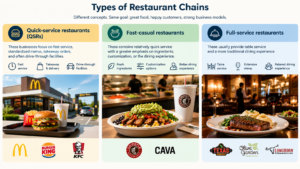
Some chains operate most of their restaurants directly, while others expand through franchising. Under a franchise model, independent operators run restaurants using the parent company’s brand and business system, typically paying royalties and other fees.
This distinction matters because two restaurant chains can serve millions of customers while generating revenue in very different ways.
What Are Restaurant Chain Stocks?
Restaurant chain stocks are shares of publicly traded companies that own, operate, or franchise restaurant brands. Buying these shares gives investors exposure to the financial performance of the company rather than direct ownership of an individual restaurant.
For example, investors who purchase McDonald’s shares are investing in McDonald’s Corporation, whose business includes franchising, company-operated restaurants, and property-related income. Investors in Yum! Brands gain exposure to a portfolio that includes KFC, Taco Bell, and Pizza Hut.
The most important business models include
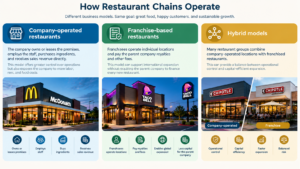
For stock investors, understanding the business model is essential. A company generating substantial revenue from franchising may have a very different cost structure and profit margin from a chain operating most of its restaurants itself.
It is also important to distinguish systemwide sales from reported company revenue. Systemwide sales include purchases made across the restaurant network, including franchised locations, while reported revenue reflects the accounting rules applicable to the parent company.
A restaurant chain with rapidly increasing sales is not necessarily a strong investment if its costs are rising faster, its debt is becoming difficult to manage, or its share price already reflects unrealistic growth expectations.
What to Watch Before Buying Restaurant Chain Stocks

Before adding restaurant stocks to a watchlist, investors should examine several business and financial indicators.
1. Same-store sales and customer traffic
Comparable-store sales, also called same-store sales, measure sales growth at established restaurants over a specified period. They help investors determine whether a company is growing through stronger performance at existing locations or mainly by opening new restaurants.
However, sales growth can be misleading if it comes entirely from higher menu prices. Customer traffic and average spending per visit provide additional insight into the underlying demand.
2. Restaurant expansion
Opening new locations can increase a chain’s revenue and market presence. Investors should also consider whether new restaurants generate attractive returns, how quickly they become profitable, and whether expansion is putting pressure on management or existing locations.
3. Profit margins and operating costs
Restaurants face costs associated with ingredients, wages, rent, utilities, packaging, and delivery. A company that increases sales but experiences declining margins may struggle to translate growth into stronger earnings.
4. Franchise economics
For franchise-heavy companies, the financial health of franchisees matters. Franchisees need enough cash flow to maintain locations, pay royalties, and invest in expansion. If operating costs rise too sharply, franchisees may delay openings or struggle to remain profitable.
5. Valuation and earnings expectations
A promising business is not automatically an attractive stock at every price. Investors should compare price-to-earnings ratios, expected earnings growth, free cash flow, debt, and competitors’ valuations.
6. Upcoming catalysts
Quarterly earnings, management guidance, new product launches, international expansion, changes in menu pricing, and consumer spending data can all influence restaurant shares. In Q4, earnings announcements are especially important because they can change expectations for the following year.
Top 10 Restaurant Chain Stocks to Watch in Q4 2026
The following table presents 10 publicly traded restaurant companies worth researching this quarter. The selection balances established global brands with companies whose growth depends more heavily on expansion and changing consumer preferences.
| Rank | Company | Ticker | Main investment consideration |
|---|---|---|---|
| 1 | McDonald’s Corporation | MCD | Franchise economics, brand strength, and value-oriented demand |
| 2 | Chipotle Mexican Grill | CMG | Comparable sales, new restaurant openings, and margins |
| 3 | Starbucks Corporation | SBUX | Turnaround progress, customer traffic, and international markets |
| 4 | Yum! Brands | YUM | Global franchising and diversified restaurant brands |
| 5 | Restaurant Brands International | QSR | Burger King, Tim Hortons, Popeyes, and expansion |
| 6 | Domino’s Pizza | DPZ | Digital ordering, delivery, and same-store sales |
| 7 | Wingstop | WING | Franchise expansion and unit-level economics |
| 8 | Texas Roadhouse | TXRH | Customer traffic, pricing, and food-cost management |
| 9 | Darden Restaurants | DRI | Diversified casual dining and comparable sales |
| 10 | CAVA Group | CAVA | Fast-casual expansion and growth valuation |
Note: This is a research watchlist, not a ranking by verified Q4 returns or a recommendation to buy. Share-price performance and valuation should be checked using a consistent date before publication.
Top 10 Restaurant Chain Stocks to Watch in Q4 2026 (indepth)
1. McDonald’s Corporation (MCD)
McDonald’s is one of the most recognizable restaurant brands in the world. Its business model combines company-operated restaurants with a much larger franchised network, generating revenue through restaurant sales, rent, royalties, and franchise-related fees.
The franchise model is particularly important. Because franchisees generally bear many of the day-to-day operating expenses, McDonald’s can generate attractive margins from its franchising activities. Its scale also provides purchasing power, extensive marketing reach, and opportunities to introduce new products across multiple markets.
What could drive the stock in Q4 2026?
Value-oriented meals are an important consideration for McDonald’s. When household budgets are under pressure, customers may become more price-sensitive and look for affordable dining options. The company’s ability to offer attractive value without sacrificing profitability could influence customer traffic.
Investors should also watch comparable sales, promotional spending, international performance, and management’s commentary on consumer demand. Franchise expansion and digital ordering can support the business, but higher labor and food costs remain relevant risks.
What could go wrong?
McDonald’s scale does not make it immune to weaker consumer spending. If promotions become too expensive or customers reduce restaurant visits, sales and margins could come under pressure.
Valuation is another consideration. A globally recognized brand may justify a premium, but investors still need to determine whether expected growth and dividend income justify the current share price.
Trader’s takeaway: MCD is worth watching for its established franchise economics and defensive characteristics within the consumer discretionary sector. Its actual attractiveness depends on valuation, comparable sales, and the market’s expectations.
2. Chipotle Mexican Grill (CMG)
Chipotle has built its business around customizable Mexican-inspired meals, a focus on fresh ingredients, and a fast-casual restaurant format. Its operating model combines company-operated locations with digital ordering and dedicated pickup facilities.
Unlike heavily franchised groups, Chipotle’s company-operated structure gives it greater direct control over restaurant operations. It also means that labor, ingredients, occupancy, and other operating costs have a more direct effect on its financial results.
What could drive the stock in Q4 2026?
Restaurant expansion is a major part of Chipotle’s growth strategy. New locations can increase revenue, while digital ordering and efficient kitchen operations can help restaurants process more orders.
Investors should examine comparable-store sales, customer traffic, average transaction values, new-store productivity, and restaurant-level margins. Chipotle’s third-quarter 2026 results were scheduled for October 28, making the report an important near-term catalyst.
What could go wrong?
Higher ingredient prices, wage inflation, weaker customer traffic, or disappointing new-store returns could undermine profitability. Food-safety incidents are another material risk for restaurant companies, particularly those whose brands emphasize ingredient quality.
Chipotle’s growth prospects must also be assessed against its valuation. A stock can decline even when revenue increases if earnings fail to meet the expectations already reflected in its share price.
Trader’s takeaway: CMG offers exposure to fast-casual expansion and operating growth, but investors should pay close attention to valuation, comparable sales, and the next earnings report.
3. Starbucks Corporation (SBUX)
Starbucks operates a global coffeehouse network supported by company-operated stores, licensed locations, digital ordering, and its customer rewards ecosystem.
Its business benefits from repeat purchases and strong brand recognition. However, coffeehouse performance depends on more than coffee prices: customers also respond to convenience, store atmosphere, service speed, product innovation, and the affordability of their regular orders.
What could drive the stock in Q4 2026?
The central question is whether Starbucks can sustain its business recovery. Investors should look at comparable-store sales, transaction growth, customer retention, labor productivity, and operating margins.
The company’s performance in international markets is also important, particularly where competition is intense. Licensed operations and digital loyalty programs may support customer engagement, but they do not eliminate the need for consistent store-level execution.
What could go wrong?
Turnaround plans can take longer than expected. Higher labor costs, expensive store improvements, weak customer traffic, or continued competitive pressure could limit margin recovery.
Investors should distinguish between improving sales and improving profitability. Stronger customer traffic does not necessarily translate into stronger earnings if operating costs rise at the same time.
Trader’s takeaway: SBUX is a turnaround watchlist candidate. The most useful signals are comparable sales, transaction growth, and evidence that operating margins are recovering sustainably.
4. Yum! Brands (YUM)
Yum! Brands operates a portfolio of major restaurant businesses, including KFC, Taco Bell, and Pizza Hut. Its franchise-heavy model allows the company to expand across markets while relying on franchisees to operate many individual locations.
This structure can make the business less capital-intensive than a model based primarily on company-operated restaurants. Franchise royalties and fees can provide recurring revenue, although the economics depend on restaurant sales and the financial health of franchise partners.
What could drive the stock in Q4 2026?
Investors should monitor international expansion, comparable sales, digital ordering, and the performance of individual brands. KFC has substantial international reach, while Taco Bell is an important component of the group’s US business.
Franchise development can also provide a growth engine. However, the number of new restaurants matters less if existing locations struggle or newly opened restaurants fail to generate sufficient returns.
Yum! Brands’ third-quarter earnings release was scheduled for November 3, 2026, providing a potential catalyst for the stock.
What could go wrong?
Weak consumer demand, geopolitical disruption in key markets, currency fluctuations, and franchisee financial difficulties could affect results. Pizza Hut’s competitive position and the relative performance of the different brands also deserve attention.
Trader’s takeaway: YUM is worth researching for its international franchise exposure and diversified portfolio. Compare the growth of its individual brands rather than relying exclusively on group-wide sales figures.
5. Restaurant Brands International (QSR)
Restaurant Brands International owns several well-known restaurant businesses, including Burger King, Tim Hortons, Popeyes, and Firehouse Subs.
Its portfolio provides exposure to different customer occasions and restaurant formats, while franchising plays a central role in the group’s business model. The parent company can benefit from royalties and franchise-related revenue as its brands expand.
What could drive the stock in Q4 2026?
Investors should examine Burger King’s operational performance, Tim Hortons’ sales trends, Popeyes’ expansion, and the progress of international franchise development.
Digital ordering and loyalty programs can help improve customer retention. Menu innovation and targeted promotions may also support sales, although discounts need to be evaluated against their impact on profitability.
Restaurant Brands International was scheduled to report third-quarter results on October 29, 2026.
What could go wrong?
The performance of one brand may offset gains elsewhere. Franchisee economics, refurbishment costs, food inflation, and competition can affect the success of individual concepts.
A diversified portfolio is useful, but it does not automatically guarantee stable earnings. Investors should assess comparable sales and margins by brand wherever data are available.
Trader’s takeaway: QSR offers exposure to several established restaurant brands through a largely franchise-oriented business model. Its outlook depends on execution, comparable sales, and the economics of its franchise network.
6. Domino’s Pizza (DPZ)
Domino’s has developed a business around pizza delivery, carryout, technology-enabled ordering, and an extensive franchise network. Its digital infrastructure is particularly important because online ordering can make the customer experience more convenient and improve order processing.
Franchising enables the company to expand without funding every restaurant itself. However, the strength of this model ultimately depends on customer demand, franchisee profitability, and the company’s ability to remain competitive.
What could drive the stock in Q4 2026?
Investors should monitor same-store sales, delivery and carryout demand, promotional effectiveness, international growth, and store openings.
The latest reported third-quarter 2026 results showed global retail sales growth of 3.2%, while US same-store sales increased only 0.3%. This difference makes it important to distinguish expansion across the wider network from demand growth at established US locations.
Investors should also consider whether promotional campaigns attract incremental customers or simply reduce the amount earned per order.
What could go wrong?
Competition from other pizza chains, independent restaurants, and food-delivery platforms may pressure pricing. Delivery expenses, wage costs, and discounts can also affect restaurant economics.
Trader’s takeaway: DPZ is worth watching for its digital business model and franchise expansion, but comparable sales and promotional profitability will be important indicators of underlying demand.
7. Wingstop (WING)
Wingstop has built its brand around chicken wings, tenders, and a focused menu designed primarily for takeaway, delivery, and convenient dining. Its franchise-based business model supports expansion while allowing franchise partners to fund and operate many locations.
The company is particularly interesting because restaurant growth and investor expectations can be high. That creates an opportunity to study a growing brand, but it also makes valuation an essential part of the analysis.
What could drive the stock in Q4 2026?
Restaurant openings, same-store sales, customer demand, and franchisee returns are central indicators. Wingstop’s ability to sustain demand while maintaining efficient operations could support further expansion.
Investors should also assess chicken costs, labor expenses, and the financial performance of existing restaurants. Rapid expansion is more sustainable when franchisees can generate attractive returns rather than simply increasing the number of locations.
Third-quarter 2026 results were scheduled for October 28.
What could go wrong?
High growth expectations can make a stock vulnerable to disappointing results. If comparable sales slow or the market questions the economics of new locations, the share price may decline even if the company continues to grow.
Chicken prices, promotional spending, and competition can also pressure margins.
Trader’s takeaway: WING is a growth-oriented restaurant stock to monitor, but valuation and the sustainability of comparable-store sales are just as important as expansion figures.
8. Texas Roadhouse (TXRH)
Texas Roadhouse operates full-service casual dining restaurants known for steaks, ribs, and a value-oriented dining experience. Its business differs from that of quick-service chains because customer visits generally involve table service, longer dining times, and greater exposure to dining-room capacity.
The company’s operating performance depends on customer traffic, menu pricing, labor efficiency, food purchasing, and the profitability of its restaurants.
What could drive the stock in Q4 2026?
Investors should examine comparable sales, customer traffic, average spending, restaurant openings, and operating margins.
Food costs are particularly relevant. Beef prices can have a significant effect on steakhouse economics, and changes in commodity prices may influence margins even when customer demand remains healthy.
The holiday period may also provide insight into discretionary dining demand. However, seasonal patterns should be assessed alongside the company’s historical performance rather than assumed to guarantee stronger sales.
What could go wrong?
Higher beef prices, wage inflation, and weaker consumer confidence could pressure profitability. Full-service restaurants also face competition from both other sit-down concepts and lower-cost dining alternatives.
Trader’s takeaway: TXRH is a useful stock to watch for investors interested in casual dining and customer traffic. Food-cost management and comparable sales are key factors to follow.
9. Darden Restaurants (DRI)
Darden Restaurants operates a broad portfolio of full-service dining brands, including Olive Garden and LongHorn Steakhouse. Its diversified business gives investors exposure to multiple restaurant concepts within a single publicly traded company.
Scale can support purchasing efficiency, marketing, and operational improvements. However, the performance of each brand depends on its customer base, menu pricing, competitive position, and ability to manage costs.
What could drive the stock in Q4 2026?
Darden’s fiscal fourth-quarter 2026 results showed same-restaurant sales growth of 4.5%, including 7.2% at LongHorn Steakhouse and 4.0% at Olive Garden.
The next question is whether that momentum can continue into the new fiscal year. Investors should monitor comparable sales, customer traffic, menu pricing, labor costs, and management’s guidance.
Darden’s portfolio can also help investors compare different segments of the casual dining market without buying separate stocks for every restaurant brand.
What could go wrong?
A weaker consumer environment could reduce visits or encourage customers to trade down to cheaper dining options. Rising wages, food costs, and occupancy expenses may also reduce margins.
A strong quarter does not necessarily indicate that a stock is attractively valued. Investors should compare expected earnings growth with the share price and the company’s longer-term performance.
Trader’s takeaway: DRI is worth watching for its established restaurant portfolio and recent comparable-sales growth. The durability of that growth and the outlook for margins are key considerations.
10. CAVA Group (CAVA)
CAVA operates fast-casual restaurants focused on Mediterranean-inspired food, including customizable bowls, pitas, and dips. Its concept appeals to consumers looking for convenient meals with a different menu profile from traditional burgers and pizza.
Compared with larger restaurant groups, CAVA offers a more concentrated growth story. New restaurant openings can materially influence revenue, making expansion rates, store productivity, and profitability especially important.
What could drive the stock in Q4 2026?
CAVA’s second-quarter 2026 results showed revenue growth of 31.3% year over year, comparable-store sales growth of 9.0%, and 17 net new restaurants opened during the quarter.
These figures indicate strong reported growth, but investors need to determine how much of it can continue as the business expands. Comparable sales, restaurant-level margins, new-store returns, and management’s guidance are particularly important.
Investors should also assess whether the brand can maintain its appeal across new markets and whether its operating model can scale without weakening the customer experience.
What could go wrong?
Fast-growing restaurant businesses can carry elevated valuations because investors expect substantial future expansion. If comparable sales slow, new locations generate lower returns, or operating costs increase, the stock may face significant volatility.
CAVA’s smaller scale relative to established global chains also means that execution and expansion decisions can have a more pronounced effect on its results.
Trader’s takeaway: CAVA is the higher-growth candidate on this list, but its investment case depends on sustainable expansion, store-level profitability, and a valuation that reasonably reflects future growth.
New Developments That Could Move Restaurant Chain Stocks in Q4 2026
Restaurant shares respond to company-specific announcements as well as broader economic developments. The following factors deserve particular attention during the final quarter of the year.
1. Quarterly earnings and forward guidance
Earnings season provides information about customer traffic, comparable-store sales, margins, and management expectations. Traders should compare reported results with analyst forecasts and listen for changes in guidance.
A company can report higher revenue and still see its share price decline if earnings disappoint or management lowers its outlook.
2. Holiday spending and consumer confidence
Q4 includes major holiday shopping and travel periods in several markets. These can affect restaurant visits, delivery demand, and discretionary spending.
However, stronger seasonal demand is not guaranteed. Consumers facing higher living costs may prioritize groceries and essential expenses over eating out.
3. Food inflation and labor costs
Restaurant operators must continually balance menu prices with costs. Higher beef, chicken, coffee, cooking-oil, and other ingredient prices can reduce margins, while higher wages increase the cost of running each location.
The ability to pass these costs to customers varies by brand and market. Excessive price increases may weaken demand, while absorbing every cost increase can damage profitability.
4. Franchise expansion and restaurant closures
New locations can support growth, but investors should also monitor closures, franchisee financial health, and the productivity of existing restaurants.
The quality of expansion matters more than the headline number of openings.
5. Digital ordering and loyalty programs
Mobile ordering, rewards programs, delivery integrations, and customer data can help restaurant chains improve convenience and encourage repeat visits.
Nevertheless, digital sales growth should be assessed alongside transaction profitability, discounts, and fulfillment expenses.
6. Interest rates and valuation
Changes in interest-rate expectations can influence equity valuations, borrowing costs, and consumer spending. Growth-oriented restaurant stocks with high valuation multiples may be particularly sensitive to changes in market expectations.
Investors should not assume that lower interest rates automatically make restaurant shares rise. Earnings, valuations, and company-specific news remain important.
Risk Management When Trading Restaurant Chain Stocks
Restaurant stocks can offer exposure to established consumer brands and growing dining concepts, but they also carry risks that traders and investors should understand before opening a position.
1. Do not confuse popularity with value
A restaurant may be crowded, widely recognized, and financially successful without its stock being attractively priced. Investors should compare valuation with expected earnings growth, margins, and cash flow.
2. Be aware of earnings volatility
Quarterly reports can trigger substantial price movements when results or guidance differ from expectations. Before trading around an earnings announcement, consider the possibility of overnight gaps and the fact that a stop-loss order may execute at a worse price than expected during a sharp market move.
3. Monitor concentration risk
Holding several restaurant stocks does not necessarily provide broad diversification. Many companies depend on the same consumer spending trends and face similar food and labor cost pressures.
A portfolio concentrated in restaurant shares may therefore be more exposed to one economic trend than its number of holdings suggests.
4. Use appropriate position sizing
Position size should reflect the volatility of the stock, the potential loss, and the overall risk of the portfolio. Fast-growing companies with elevated valuations may behave very differently from established franchise businesses.
Stop-loss orders can be useful risk-management tools, but they do not guarantee an exit at a particular price.
5. Separate short-term trading from long-term investing
A short-term trade may depend on an earnings catalyst, technical setup, or change in market sentiment. A long-term investment requires a broader assessment of business quality, competitive advantages, financial strength, and valuation.
The same company may suit one approach but not the other, depending on the price and market conditions.
Frequently Asked Questions about Top 10 Restaurant Chain Stocks to Watch in Q4 2026
1. What are the top 10 largest stock markets in the world?
The largest stock markets are ranked by market capitalization, or the combined value of their listed companies. The United States ranks first, followed by China and Japan in the April 2026 ranking.
2. What is the difference between a stock market and a stock exchange?
A stock market is the broader system for buying and selling shares, while a stock exchange, such as the NYSE or Nasdaq, is a specific marketplace where those shares are traded.
3. What was the first stock market in the world?
Amsterdam is widely recognized as the birthplace of the modern stock market. In 1602, the Dutch East India Company issued shares that investors could buy and sell.
4. What is the largest stock exchange in the world?
The answer depends on the measurement used. The New York Stock Exchange and Nasdaq are among the world’s largest exchanges by market capitalization, while rankings can differ by trading volume and other measures.
5. How is a stock market’s size measured?
Market capitalization is the total market value of listed companies’ shares. It is different from trading volume, which measures how much trading takes place over a given period.
6. Which stock market is best for beginners?
There is no single best market for everyone. Beginners should consider their goals, knowledge, risk tolerance, investment costs, and access to suitable financial products.
7. Can you trade stock markets without buying shares?
Yes. Depending on your broker and local regulations, you may be able to trade derivatives such as CFDs, which let you speculate on price movements without owning the underlying shares. CFDs carry significant risk and can result in losses.
8. Why do stock markets affect each other?
Markets are connected through international trade, investment flows, interest rates, currencies, and investor sentiment. A major economic announcement or market sell-off in one country can influence markets elsewhere.
Wrap up
So, fellow traders, I finished my meal, walked out of the restaurant, and left with some great investment hopes and big opportunities to explore. And of course, I want to share those ideas with you in upcoming articles!
For now, remember that understanding the world’s largest stock markets is a great place to start, but learning how they work is what really matters.
Want to put your knowledge into practice? Open a Caveo FX demo account and explore the markets in a simulated environment, or consider a real account when you’re ready to trade and understand the risks involved.