

Table of Contents
Value vs. Growth Stocks: What’s the Difference for Traders?
Okay, fellow traders, I know I’ve been overwhelming you with so many articles lately! But the truth is, I’m trying to cover as many topics as possible that you might care about.
Today, we’re talking about value stocks vs. growth stocks. What are they? How are they different? And, most importantly, what should you look at when analyzing them as a trader?
Let’s dive in,
What Are Value Stocks?
Value stocks are shares of companies that appear to be trading below what they are actually worth.

How do traders and investors judge that? They look at things like company earnings, assets, cash flow, and valuation ratios.
Imagine a well-established company whose stock price falls after disappointing news. The business may still be financially strong, but investors have become less confident about its future. If the market has pushed the price below what the company is worth, it could be considered a value stock.
Value stocks often have lower price-to-earnings (P/E) ratios than similar companies. Some also pay regular dividends.
However, a low stock price does not automatically mean a bargain. Sometimes, a company is cheap because its business is getting worse.
In simple terms: Value investors look for companies they believe the market is undervaluing and hope the share price will eventually reflect their real worth.
What Are Growth Stocks?
Growth stocks are shares of companies expected to increase their revenue or earnings faster than the broader market.
These companies often operate in expanding industries or offer products and services that attract more customers over time. Technology is one familiar example, although growth stocks can come from many other sectors.
Think about a company developing a popular product, expanding into new markets, or increasing its sales rapidly. Investors may expect its future earnings to rise, making them willing to pay more for its shares today.
Companies such as NVIDIA, Amazon, and Tesla are commonly discussed as growth-stock examples, although their classifications can change as their businesses, earnings, and valuations change.
Growth companies often reinvest their profits into research, new products, and expansion instead of paying dividends.
In simple terms: Growth investors focus on what a company could become, rather than only what it is worth today.
But there is a catch. If the company fails to meet expectations, its stock price can fall sharply.
Value Stocks vs. Growth Stocks
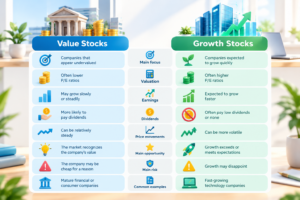
Which is better: value stocks or growth stocks?
Neither is always better. It depends on the company’s performance, its current valuation, market conditions, and your own goals.
A value stock may offer an attractive price but take years to recover. A growth stock may have excellent business prospects but already be priced for near-perfect results.
The question is not simply which company is better. It is whether the current stock price makes sense given what could happen next.
Value vs. Growth Stocks From a Trader’s Perspective
Fellow traders, this is where we move beyond definitions.
When you’re analyzing a stock, you need to understand what could move its price. The company’s category gives you a starting point, but it doesn’t tell you when to enter or exit a trade.
What to watch when trading value stocks
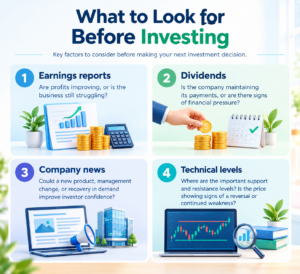
For value stocks, the opportunity may come when the market begins to recognize that the company’s outlook is better than previously expected.
But don’t rush to buy simply because the price has dropped. A falling stock can keep falling.
What to watch when trading growth stocks
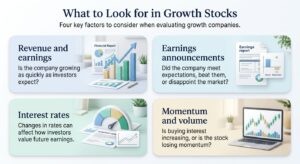
Growth stocks can react strongly to earnings reports. Even a company that reports higher profits may see its stock fall if investors expected an even better result.
A quick example
Imagine two companies.
Company A trades at a relatively low valuation, has a long operating history, and pays dividends. Its share price has fallen because of temporary concerns about its industry.
Company B is expanding quickly, attracting new customers, and increasing its earnings. However, investors already expect strong growth, so its stock trades at a high valuation.
A trader looking at Company A might focus on signs of recovery and a possible price reversal. For Company B, the focus might be earnings expectations, momentum, and whether the current price leaves room for further gains.
Both could offer opportunities. Both could also produce losses.
The difference is what you need to investigate before making a trading decision.
How to Identify Value and Growth Stocks
You don’t need to guess which category a stock belongs to. Start with a few basic financial measures.
| Metric | What it tells you | What to look for |
|---|---|---|
| Price-to-earnings (P/E) ratio | How much investors pay for each unit of earnings | A lower ratio may indicate value; a higher one may reflect growth expectations |
| Revenue growth | Whether sales are increasing | Strong and sustained growth may support a growth-stock case |
| Earnings growth | Whether profits are increasing | Compare results with previous periods and market expectations |
| Free cash flow | How much cash remains after capital spending | Positive, stable cash flow can support financial strength |
| Debt levels | How much the company owes | High debt can increase financial pressure |
| Dividend yield | Annual dividends relative to the share price | May help identify income-producing companies, but check whether payments are sustainable |
Let’s take the P/E ratio as an example.
If a company’s share price is $50 and its annual earnings per share are $5, its P/E ratio is 10.
If another company’s share price is $100 and its annual earnings per share are $2, its P/E ratio is 50.
The first company has the lower P/E ratio. But does that automatically make it the better value stock? Not necessarily.
The second company may have stronger growth prospects. The first may be facing serious problems that explain its low valuation.
Always compare companies in the same industry where possible. A bank, a technology company, and a utility business can have very different normal valuation ranges.
When Do Value and Growth Stocks Perform Better?
Have you ever noticed how market conditions can change investor preferences? The same thing happens with value and growth stocks.
Neither style wins in every market environment, but some conditions may favor one over the other.
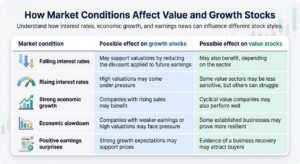
These are possibilities, not trading signals. For example, banks may respond differently to interest rate changes than technology companies. Even within the same category, individual stocks can behave very differently.
Before opening a trade, check the company’s latest results, the wider market trend, and any upcoming events that could affect its price.
Common Mistakes to Avoid
Let’s keep this simple. Here are five mistakes worth avoiding when comparing value and growth stocks.
- Buying a stock just because it is cheap. A low price or P/E ratio does not guarantee that the company is undervalued.
- Chasing a popular growth stock. Strong demand and exciting news do not mean the current price is reasonable.
- Ignoring earnings expectations. Stock prices react to the difference between actual results and what the market expected.
- Assuming dividends are guaranteed. Companies can reduce or suspend dividend payments.
- Forgetting risk management. A good analysis does not guarantee a profitable trade. Plan your position size and decide how much you can afford to lose.
Remember, fellow traders, identifying a good company and finding a good trading opportunity are two different things. The price, timing, and risk all matter.
Can a Stock Be Both Value and Growth?
Yes! Value and growth are not always separate categories.
A company may be growing its revenue and earnings while its stock trades below what investors believe it is worth.
This is one reason you shouldn’t judge a stock by its label alone.
There is also an approach called growth at a reasonable price (GARP). It focuses on companies with attractive growth prospects without paying an excessive price for that growth.
For example, a company may report steady earnings growth and have strong future prospects, yet trade at a lower valuation than similar businesses. An investor using a GARP approach might investigate whether the stock offers a reasonable balance between growth and price.
Of course, the stock still needs proper analysis. A reasonable valuation today does not guarantee future gains.
Frequently Asked Questions About Value vs. Growth Stocks
What is the main difference between value and growth stocks?
Value stocks are shares of companies that appear undervalued compared with their financial performance or assets. Growth stocks belong to companies expected to increase revenue or earnings faster than the market average.
Are value stocks safer than growth stocks?
Not always. Value stocks may trade at lower valuations and may belong to established businesses, but they can still fall if their financial performance deteriorates. Growth stocks can experience larger price swings when expectations change.
Why do growth stocks often pay no dividends?
Many growth companies reinvest their profits into product development, research, hiring, and expansion. This can leave less money available for dividends, although some growth companies do pay them.
Is a low P/E ratio always a sign of a value stock?
No. A low P/E ratio can suggest that a stock is undervalued, but it can also reflect weak earnings prospects or serious business problems. Compare the company’s financial health and valuation with those of similar businesses.
Which is better for beginners: value or growth stocks?
Neither is automatically better for beginners. Understanding financial statements, valuation, market risks, and diversification is more important than choosing a category based on its name.
Can I trade both value and growth stocks?
Yes. You can analyze both categories and look for opportunities based on your strategy, market conditions, and risk limits. However, trading both does not automatically reduce risk, especially if the stocks are affected by similar market forces.
Do value stocks outperform growth stocks over the long term?
Historical performance varies depending on the period, market, and method used to measure returns. Neither style consistently outperforms, and past performance does not guarantee future results.
What indicators should traders use to analyze value and growth stocks?
Traders can combine fundamental measures such as P/E ratios, earnings growth, revenue, and cash flow with technical tools such as support and resistance, price trends, and trading volume. The most useful indicators depend on the stock and the trading timeframe.
Wrap up
Okay, fellow traders, now you know the difference between value and growth stocks.
One focuses on finding companies that may be worth more than their current share price suggests. The other focuses on companies expected to grow faster in the future.
But here’s the thing: you don’t have to choose a side just because the market puts stocks into two categories.
Look at the company’s financials, understand what could move its price, check the market conditions, and always manage your risk. A stock that looks attractive on paper may not be the right trade at the right time.
And if you want to put what you’ve learned into practice, start by exploring the markets in a simulated environment.
Open a Caveo FX demo account to practice your analysis and test your trading strategies without risking real money. When you’re ready, you can explore a real account and apply your knowledge with a clear trading plan and an understanding of the risks involved.