

Table of Contents
What Is Free Cash Flow? Formula, Examples, and Why It Matters
What Is Free Cash Flow?…..Ooh man, cash, cash is king! That’s what they say, and honestly, they’re not wrong. With cash, you can pay your bills, buy what you need, and make things happen…..But guess what? Cash is king for companies, too.
A company can report millions in revenue and impressive profits, but what happens if it doesn’t have enough cash to pay its bills, invest in new projects, or reduce its debt?
That’s where cash flow comes in. For companies, cash flow can reveal things that revenue and profit alone might not tell us. And if you’re a trader or investor, understanding it can help you look beyond the headlines and evaluate a company’s financial health.
Today, we’re going to break down cash flow, free cash flow, how to calculate them, and why investors pay so much attention to these numbers.

So, fellow traders, let’s dive in!
What Is Cash Flow?
Cash flow is the movement of money into and out of a business during a specific period.
Money coming in is called a cash inflow. Money going out is called a cash outflow.
For example, imagine a company sells $100,000 worth of products and collects that money from customers. It then pays $60,000 for salaries, suppliers, rent, and other expenses.
Its net cash flow from these transactions is:
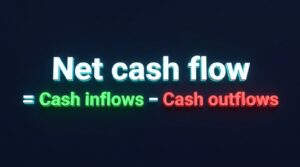

The company has generated a net cash inflow of $40,000 from these transactions.
However, this doesn’t automatically mean its free cash flow is $40,000. We still need to account for capital expenditures and understand which transactions belong to operating, investing, and financing activities.
What Are the Three Types of Cash Flow?
Companies report cash flow in three main categories.
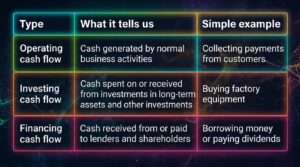
These three categories appear on a company’s cash flow statement.
A company could generate positive operating cash flow while spending heavily on expansion. It could also report positive total cash flow because it borrowed money, even if its operations were struggling.
That’s why we need to look at the details rather than just one number.
What Is Free Cash Flow (FCF)?
Free cash flow (FCF) is the cash a company generates from its operating activities after subtracting capital expenditures.
In simple words, it’s the cash left after a company generates cash through its normal business activities and pays for investments in long-term assets, such as equipment, buildings, and technology.
This remaining cash can give the company more flexibility to reduce debt, pay dividends, repurchase shares, or invest in future growth.
Think of a company that runs a supermarket chain. It collects money from customers, pays employees and suppliers, and maintains its stores. It also needs to spend money opening new branches and upgrading equipment.
Free cash flow helps us understand how much cash remains after those operating activities and capital investments.
5 Reasons why Free Cash Flow is Important
1. It shows how much cash a company generates.
Revenue tells us how much a company earns from selling its products or services before expenses. FCF shows how much cash remains after operating cash needs and capital expenditures.
2. It helps companies manage debt.
A business that consistently generates healthy FCF may have more capacity to repay loans and reduce its reliance on borrowing.
3. It supports business growth.
Companies can use available cash to open new locations, develop products, upgrade technology, or expand into new markets.
4. It helps assess dividend capacity.
Investors often examine FCF to understand whether a company generates enough cash to support its dividend payments. However, dividends also depend on debt obligations, future investment needs, and management decisions.
5. It can reveal financial problems early.
If profits are rising while operating cash flow remains weak, investors may need to investigate. Unpaid customer invoices, growing inventory, or other working capital changes can help explain the difference.
5 Reasons Cash Flow Matters to Traders and Investors
Now, let’s connect cash flow to what we actually care about: evaluating stocks and making better-informed trading or investment decisions.
1. It helps assess a company’s financial strength
A company that regularly generates cash from its operations may be better positioned to handle unexpected costs, repay debt, and fund its business.
For example, two companies might report similar profits, but one consistently generates more operating cash flow. That difference deserves a closer look.
2. It helps investors evaluate dividends
Dividend investors want to know whether a company can afford to distribute cash to shareholders without borrowing excessively or neglecting necessary investments.
Consistent FCF can be a useful part of that assessment, although it doesn’t guarantee future dividend payments.
3. It helps with stock valuation
Analysts use free cash flow in valuation methods such as the discounted cash flow (DCF) model.
The idea is straightforward: estimate the cash a company could generate in the future and calculate what those expected cash flows are worth today.
This can help investors assess whether a stock’s current price seems reasonable relative to its expected cash generation.
4. It helps identify companies that may deserve further research
A company with growing revenue, improving FCF, and manageable debt may be worth investigating further.
On the other hand, a company reporting higher profits but declining cash generation may require closer examination.
Neither situation automatically makes a stock a buy or a sell. The reasons behind the numbers matter.
5. It adds fundamental context to trading decisions
For traders who trade individual stocks, cash flow data can provide context when evaluating a company before or after earnings announcements.
Suppose a company reports record revenue but disappointing operating cash flow. Investors may question the quality of its earnings or its ability to convert sales into cash.
That information can influence market expectations, but it doesn’t predict the immediate direction of the share price. Short-term price movements also depend on expectations, market sentiment, economic news, and other factors.
Free Cash Flow Formula
Let’s get to the numbers.
The basic formula for free cash flow is:

Here is what each part means.
- Operating cash flow (OCF): The cash generated by a company’s normal business activities, after accounting for operating cash payments.
- Capital expenditures (CapEx): Money spent acquiring, upgrading, or maintaining long-term assets, such as buildings, machinery, and equipment.
Subtracting capital expenditures from operating cash flow gives us the company’s free cash flow under this commonly used definition.
How to Calculate Free Cash Flow: A Simple Example
Let’s imagine a company called ABC Ltd.
During the last financial year, its cash flow statement shows:

Now, apply the formula:
Free cash flow = $500,000 − $150,000
Free cash flow = $350,000
That’s it! ABC Ltd. generated $350,000 in free cash flow during the year.
The company may use this cash to repay debt, pay dividends, repurchase shares, or invest in further growth.
Now imagine another company generates the same $500,000 in operating cash flow but spends $400,000 on capital expenditures.
Its FCF would be just $100,000.
Both companies generate the same operating cash flow, but ABC Ltd. has more cash remaining after capital expenditures. Before deciding which company is the better investment, however, we would also need to examine its industry, growth plans, debt, and future cash flow expectations.
How to Calculate Cash Flow
Free cash flow is only one part of the bigger picture. Let’s look at how to calculate net cash flow.
The basic formula is:
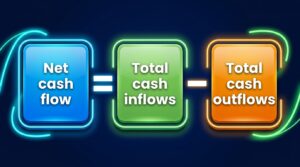
Imagine a company has the following cash movements during one quarter:
| Cash movement | Amount |
|---|---|
| Cash received from customers | $200,000 |
| Cash received from a new loan | $50,000 |
| Cash paid to employees and suppliers | $120,000 |
| Cash spent on equipment | $40,000 |
| Loan principal repaid | $10,000 |
Total cash inflows = $200,000 + $50,000 = $250,000.
Total cash outflows = $120,000 + $40,000 + $10,000 = $170,000.
Net cash flow = $250,000 − $170,000.
Net cash flow = $80,000
The company’s cash increased by $80,000 from these transactions.
Notice that $50,000 came from borrowing. This is an important detail because borrowing money increases cash but does not mean the company generated more cash from its business operations.
That’s why investors should examine the individual cash flow categories instead of relying on net cash flow alone.
Free Cash Flow vs. Earnings: Why Do Investors Prefer FCF?
Fellow traders, this is one of the most important comparisons to understand.
Earnings, or net income, show a company’s profit under accounting rules. Free cash flow focuses on the cash generated after operating activities and capital expenditures.
The two measures can tell different stories.
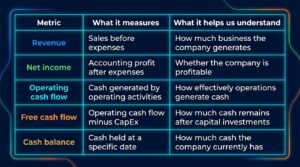
Why Can Profit and Cash Flow Differ?
Imagine a company sells $100,000 worth of products to customers who will pay in 60 days.
The company may recognize revenue before it receives the money. Its reported profit can therefore rise even though the cash has not arrived yet.
Now imagine the company collects the money but also spends heavily on new equipment. Its operating cash flow may look strong, while its FCF is lower because of those capital expenditures.
This is why investors look beyond earnings.
Does that mean FCF is always better than earnings? No. Both metrics are useful, and neither tells the entire story. Investors should compare them to understand how a company makes money, collects cash, and invests in its future.
Cash Flow vs. Free Cash Flow vs. Profit
These terms may sound similar, but they answer different questions.
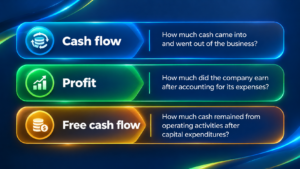
Consider a simple example.
A company reports $1 million in revenue and $100,000 in net income. Its operating cash flow is $160,000, and it spends $60,000 on capital expenditures.
Its free cash flow is:
$160,000 − $60,000 = $100,000
In this example, net income and FCF happen to be equal. But that doesn’t mean they are the same measure. In another period, changes in customer payments, inventory, depreciation, and capital expenditures could produce very different figures.
Types of Free Cash Flow
When you research companies, you may encounter two main types of free cash flow.
1. Free cash flow to the firm (FCFF)
FCFF measures cash available to all capital providers, including lenders and shareholders, after operating costs and required reinvestment.
It is commonly used to value the entire business before considering how its financing is divided between debt and equity.
2. Free cash flow to equity (FCFE)
FCFE measures cash available to common shareholders after operating expenses, capital expenditures, and the relevant net borrowing and debt repayment adjustments.
Analysts may use it to estimate the value of a company’s equity directly.
The two measures are related, but they are not interchangeable. The appropriate choice depends on what you are valuing and how you account for financing costs and debt.
What Does Positive or Negative Free Cash Flow Mean?
Positive FCF means operating cash flow exceeded capital expenditures during the period.
Negative FCF means capital expenditures were greater than operating cash flow.
Neither result should be interpreted in isolation.
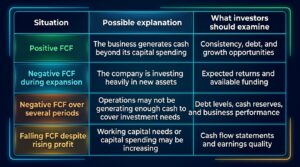
For example, a technology company may report negative FCF because it is investing heavily in infrastructure to support future growth. That spending could create value if the investment succeeds, but the expected returns are not guaranteed.
A mature company with declining FCF and rising debt may face a different set of risks.
The key is to understand why FCF is changing, not just whether it is positive or negative.
What Can Free Cash Flow Tell Us About a Stock?
If you’re analyzing a company before investing, use FCF as part of your research rather than as a standalone buy-or-sell signal.
Here are four questions worth asking:
- Is free cash flow growing over several years?
- Is operating cash flow keeping pace with reported earnings?
- Can the company cover its capital spending without relying heavily on new borrowing?
- Does the stock’s valuation make sense relative to its expected future cash generation?
For example, a company may have strong FCF but trade at a very high valuation. Another may have weaker current FCF because it is expanding into a new market.
The first company isn’t automatically a better investment. You need to compare the price you pay with the cash the business is expected to generate and the risks involved.
Important Limitations of Free Cash Flow
FCF is useful, but it has limitations.
Capital spending can distort short-term comparisons. A large equipment purchase can reduce FCF in one year, even if it supports future growth.
Working capital changes matter. Delayed payments from customers or a buildup of inventory can reduce operating cash flow.
Industries differ. A manufacturing company typically has different capital requirements from a software company. Comparing their FCF without considering those differences can be misleading.
One strong year doesn’t guarantee future performance. Cash generation can change because of economic conditions, competition, management decisions, and unexpected costs.
For a better picture, review several years of financial statements and compare companies within similar industries.
Where Can You Find a Company’s Cash Flow?
You can find cash flow information in a company’s cash flow statement, which is one of its three main financial statements, alongside the income statement and balance sheet.
Look for these items:
- Cash flows from operating activities
- Purchases of property, plant, and equipment
- Capital expenditures, if separately disclosed
- Cash flows from investing activities
- Cash flows from financing activities
Companies may present or label these items differently. If capital expenditures are not listed as a single figure, you may need to identify the relevant asset purchases in the investing section.
You can usually find these statements in a company’s annual report, quarterly report, investor relations website, or financial data platform.
Frequently Asked Questions About What Is Free Cash Flow?
What is free cash flow in simple terms?
Free cash flow is the cash a company generates from its operating activities after subtracting capital expenditures. It helps show how much cash remains for debt reduction, dividends, or other uses.
What is the formula for free cash flow?
A common formula is:
FCF = Operating cash flow − Capital expenditures
Why do investors prefer free cash flow to earnings?
Investors often use FCF alongside earnings because it shows cash generation after capital expenditures. Earnings can include non-cash expenses and may be recognized before customers pay. However, FCF also has limitations and should not replace other financial measures.
Is high free cash flow always good?
Not necessarily. High FCF can indicate strong cash generation, but it may also result from temporarily reduced investment or delayed spending. Investors should examine how sustainable the cash flow is.
Can a profitable company have negative free cash flow?
Yes. A profitable company can have negative FCF if it spends heavily on equipment, expansion, or other capital investments. It can also experience weak operating cash flow because of changes in working capital.
What is the difference between operating cash flow and free cash flow?
Operating cash flow measures cash generated by normal business activities. Free cash flow subtracts capital expenditures from operating cash flow to estimate the cash remaining after those investments.
How often should investors check free cash flow?
Reviewing FCF quarterly and annually can help investors identify trends. Comparing several periods is generally more informative than relying on a single quarter.
Wrap-up
Fellow traders, cash really is king, but numbers need context.
When you evaluate a stock, don’t stop at the share price or the latest earnings headline. Take a look at the company’s cash flow statement, compare its results over time, and understand what is driving the numbers.
And remember, a strong financial metric does not guarantee a rising stock price. Valuation, market conditions, competition, and investor expectations still matter.
Try all this in a demo account before going live