Table of Contents
How to Start Investing With Only $100
How to Start Investing With Only $100 …..Hello, fellow traders!….You know that I try to spread the word about investing whenever I can. As a bit of a workaholic, I carry my work everywhere, and somehow, almost every conversation with my family or friends turns into an opportunity to talk about trading and investing.
By now, they all know me as the crazy girl who tries to turn almost anything into an investment opportunity!
Recently, my 19-year-old niece, who is still in college and studying mechanical engineering, came to me with a question: “I only have $100. Can I start investing?”
That question sparked an idea for this article….How to Start Investing With Only $100 ….Because honestly, how much money do you really need to start investing? And is $100 enough to make a difference?

Let’s dive in!
What is investing?
Investing means putting money into assets that you expect to grow in value or generate income over time. These assets can include stocks, bonds, exchange-traded funds (ETFs), and other investments.
Unlike short-term trading, which focuses on price movements over shorter periods, investing generally involves a longer time horizon.
How much money do you need to start investing?
You don’t need thousands of dollars to begin. With $100, you can explore several investment options, depending on your country, account eligibility, and the fees charged by your provider.
The relationship between your starting capital and your investment choices looks something like this:
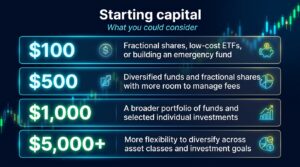
These are illustrative examples, not minimum requirements. You can start with less than $100, and a larger balance doesn’t automatically make an investment safer.
Which investments can you start with for $100?
Here are four options worth understanding before you commit your money.
-
ETFs and index funds
An ETF can give you exposure to many companies through a single investment. Broad-market index funds are worth researching if your goal is long-term growth and diversification.
-
Fractional shares
Some brokers allow you to buy a fraction of a share instead of paying for a whole one. This makes expensive stocks more accessible, although buying a famous company’s stock doesn’t automatically make it a good investment.
-
Bonds and money market funds
Bonds can provide income, while money market funds typically invest in short-term, high-quality debt instruments. Their risks, returns, liquidity, and fees differ, so understand what you’re buying before investing.
-
Individual stocks
You can use part of your $100 to invest in a company you understand and have researched. However, putting all your money into one stock exposes you to company-specific risk.
Before investing, make sure you can afford to leave the money invested and have cash available for emergencies.
-
Forex trading:
You can open a forex trading account with some brokers with $100, depending on their account requirements. Forex allows you to trade currency pairs such as EUR/USD and GBP/USD. However, leverage magnifies both gains and losses, so risk management is essential.
Can $100 turn into a million dollars?
Let’s be realistic: $100 alone is unlikely to turn into $1 million within a typical investing lifetime. It would require an extraordinary return or a very long period.
But regular contributions can make a substantial difference.
For example, suppose you invest $100 initially and then contribute another $100 every month. If your portfolio earns a hypothetical average annual return of 7%, compounded monthly, it could grow to approximately $122,000 after 30 years.
You would have contributed $36,100 in total, including your initial $100. The rest would represent hypothetical investment growth.
This is an illustration, not a forecast. Actual returns fluctuate, and fees, taxes, and inflation can reduce your results.
The lesson? Your starting amount matters, but your contribution habits and time horizon matter too.
Compound interest: Why starting early matters
Compounding happens when your investment returns remain invested and potentially generate further returns.
Imagine your investment earns a return in one year. If you keep those gains invested, future returns can build on both your original money and your previous gains.
Compounding doesn’t guarantee growth every year. Investments can fall in value, and returns aren’t fixed. Still, reinvesting gains and contributing consistently can help your money grow over time.
Five reasons to start investing young with $100
1. You give your money more time. Starting early gives potential investment growth more years to compound.
2. You build financial discipline. Regularly setting aside even a small amount helps establish a habit you can maintain as your income grows.
3. You learn with a manageable amount. A small investment can teach you how orders, fees, volatility, and portfolio fluctuations work.
4. You have time to improve your decisions. Learning about diversification, risk, and market cycles early can help you make more informed choices later.
5. You can grow your contributions as your income grows. Your first $100 doesn’t have to be your last. You can gradually increase your contributions when your circumstances allow.
A trader’s perspective: How should you approach your first $100?
As a trader, here’s my advice: don’t focus on turning $100 into a fortune overnight. Focus on understanding what you’re doing.
Before you invest, ask yourself three questions:
- What am I investing for, and when might I need this money?
- How much could I afford to lose without affecting my essential expenses?
- Do I understand the investment, its fees, and the risks involved?
If you need the $100 for emergencies, keep it accessible rather than exposing it to market risk. If you have your essential needs covered and a suitable time horizon, research diversified, low-cost investments before considering individual stocks.
And remember: investing and trading aren’t the same thing. Long-term investing focuses on building wealth over time, while trading seeks to benefit from price movements. Both involve risk, and neither offers guaranteed returns.
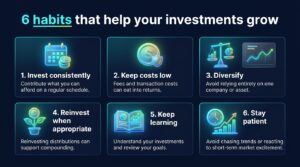
How to grow your investments over time
You don’t need a complicated strategy to begin. Start with a few simple habits:
What should you avoid when investing your first $100?
When you’re starting with just $100, it’s tempting to look for an investment that can double your money quickly. But this mindset can lead beginners toward unnecessary risks before they understand how markets work.
Here are three mistakes worth avoiding.
1. Chasing penny stocks
A low share price doesn’t automatically mean a stock is cheap or undervalued. Some low-priced stocks belong to financially struggling companies, and others may be targeted by pump-and-dump schemes. Research a company’s fundamentals instead of choosing it simply because you can buy more shares.
2. Expecting quick profits from forex or crypto trading
Forex and cryptocurrency markets can offer opportunities, but both involve significant risks. In leveraged forex trading, even a relatively small market move can have a substantial impact on your account balance. Crypto prices can also fluctuate sharply.
If you’re interested in trading, start by learning about position sizing, stop-loss orders, leverage, and risk management. Practicing with a demo account can help you understand how trades work before you risk real money. Remember that a demo account cannot fully reproduce the emotional pressure of live trading.
3. Confusing investing with speculation
Long-term investing generally focuses on building wealth over time through assets such as diversified funds and stocks. Speculation, including frequent short-term trades and some options strategies, focuses more on profiting from price movements and can carry substantially higher risks.
Neither a low starting balance nor a desire to learn quickly makes excessive risk worthwhile. Avoid putting your entire $100 into one speculative trade, borrowing money to invest, or risking funds you may need for essential expenses.
Should you automate your investments?
When you’re starting with $100, you might think you need to watch the markets every day to make your money grow. In reality, investing doesn’t have to mean constantly checking prices or deciding when to buy and sell.
Some platforms offer automated investing features that help you contribute regularly, build a portfolio based on your goals, and rebalance your investments when needed.
Before choosing a platform, consider these factors:
- Minimum deposit: Make sure you can open an account and invest within your budget.
- Fees: Check trading commissions, account fees, fund expense ratios, and any charges for automated management.
- Available investments: Look for suitable stocks, ETFs, index funds, or other assets that match your goals.
- Regulation and security: Research the provider’s regulatory status, how client assets are held, and what protections apply in your country.
- Automation features: Recurring deposits and scheduled investments can help you build consistency without trying to time the market.
Automation can make investing more convenient, but it doesn’t eliminate investment risk or guarantee returns. You should still understand what you own and review your portfolio periodically.
Remember: The best platform isn’t necessarily the one promising the highest returns. It’s one that fits your financial situation, keeps costs reasonable, and helps you follow a sensible investment plan.
Frequently asked questions about How to Start Investing With Only $100
Can I invest in stocks with only $100?
Yes. Depending on your broker and country, you may be able to purchase fractional shares, lower-priced stocks, or ETFs with a $100 budget.
Is $100 enough to start investing?
Yes, provided you have covered essential expenses and can afford to take the relevant risk. The right investment depends on your goals, time horizon, and financial circumstances.
Should I invest $100 in one stock or an ETF?
A diversified ETF can reduce your exposure to the performance of a single company. One individual stock may offer more concentrated upside, but it also creates greater company-specific risk.
How often should I invest?
That depends on your income and budget. Regular contributions can help establish a habit, but never invest money you need for essential expenses.
Is investing better than trading for beginners?
They serve different purposes. Long-term investing generally focuses on building wealth over time, while trading involves seeking opportunities from price movements. Beginners should understand the risks and avoid treating either approach as guaranteed income.
Wrap-up
Fellow traders, my niece’s question reminded me of something important: you don’t need to know everything or have a fortune to begin learning about investing.
Your first $100 might not change your life overnight. But it can be the beginning of a financial habit, a learning journey, and a better understanding of how money works.
Try now on a demo my beginner fellow traders, and the go live