
Table of Contents
How central banks affect financial markets
How central banks affect financial markets… We already talked about how economic news affects financial markets, but now it’s time to meet the institutions behind many of those headlines.
Have you ever noticed that traders seem to stop everything when a central bank is about to make an announcement? 🤔
Or maybe you’ve heard someone say…..“The Fed just spoke, so expect volatility.”
At first, it sounds a little strange.

How can one institution move the stock market, gold, currencies, and even cryptocurrencies—all at the same time?
Well…welcome to the world of central banks.
These institutions are responsible for managing a country’s monetary policy, and their decisions influence interest rates, inflation, borrowing costs, and ultimately the direction of the entire economy.
And then there’s the one everyone watches…the Federal Reserve (the Fed). 👀
The Fed is the central bank of the United States, and because the U.S. dollar is the world’s reserve currency, even a small change in its policy can send shockwaves through financial markets around the globe.
Sometimes a single sentence from the Fed Chair is enough to move billions of dollars in just a few minutes.
Sounds like magic… Trust me—it isn’t.
Once you understand how central banks work, those market reactions start to make a lot more sense.
So let’s dive in.
What Is a Central Bank?
Understanding How Central Banks Affect Financial Markets starts with knowing what a central bank actually is.
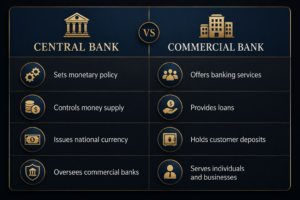
A central bank is the main financial institution responsible for managing a country’s money supply and monetary policy. Unlike commercial banks, it doesn’t provide personal loans or savings accounts. Instead, it works behind the scenes to keep the economy stable and the financial system functioning properly.
Central Bank vs Commercial Bank
Why Are Central Banks Important?
Every country depends on a stable financial system, and central banks play a major role in maintaining that stability.
Their main objectives include:
- Keeping inflation under control
- Supporting sustainable economic growth
- Maintaining financial stability
- Protecting the value of the national currency
- Supporting employment in some economies
- Preventing banking crises
When central banks adjust their policies, investors around the world pay attention because those decisions often influence multiple financial markets.
How Central Banks Affect Financial Markets
How Central Banks Affect Financial Markets comes down to one simple idea: changing the flow of money.
When central banks make policy decisions, investors immediately reassess:
- Interest rates
- Inflation
- Economic growth
- Company profits
- Future risks
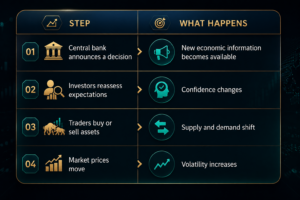
If expectations change, traders buy and sell assets differently, causing prices to rise or fall.
How the Process Works
The Main Tools Central Banks Use
1. Interest Rates
Interest rates are the most powerful tool central banks use.
When interest rates increase:
- Borrowing becomes more expensive.
- Consumer spending slows.
- Inflation usually falls.
- The national currency often strengthens.
When interest rates decrease:
- Borrowing becomes cheaper.
- Consumers spend more.
- Businesses invest more.
- Economic growth is encouraged.
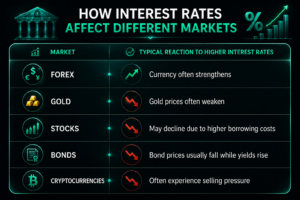
How Interest Rates Affect Different Markets
2. Open Market Operations
Central banks buy or sell government bonds to increase or decrease the amount of money circulating in the economy.
Buying bonds usually:
- Adds liquidity
- Lowers borrowing costs
- Encourages lending
- Supports economic growth
Selling bonds usually:
- Removes liquidity
- Raises borrowing costs
- Slows economic activity
3. Reserve Requirements
Commercial banks must keep part of their deposits as reserves.
If reserve requirements increase:
- Banks lend less money.
- Money circulation decreases.
- Economic activity slows.
If reserve requirements decrease:
- Banks can lend more.
- Money circulation increases.
- Economic activity often improves.
4. Quantitative Easing (QE)
When interest rates are already very low, central banks sometimes use Quantitative Easing.
QE involves creating new money electronically to purchase government bonds and other financial assets.
The goal is to:
- Increase liquidity
- Lower long-term interest rates
- Encourage lending
- Support economic growth
5. Currency Intervention
Sometimes central banks directly buy or sell their own currency in the foreign exchange market.
They may do this to:
- Stabilize exchange rates
- Support exports
- Reduce excessive currency volatility
Countries such as Japan and Switzerland have used this strategy several times over the years.
What Is Monetary Policy?
Monetary policy refers to the actions central banks take to influence interest rates, money supply, inflation, and overall economic activity.
There are two main types of monetary policy.
Expansionary Monetary Policy
- Lower interest rates
- Increase money supply
- Encourage borrowing
- Support spending
- Stimulate economic growth
Contractionary Monetary Policy
- Raise interest rates
- Reduce money supply
- Slow borrowing
- Reduce inflation
- Cool down the economy
Major Central Banks Every Trader Should Know
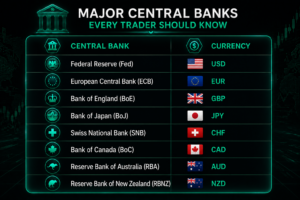
Why Does the Federal Reserve Matter So Much?
Among all central banks, the Federal Reserve has the greatest influence on global financial markets.
That’s because:
- The U.S. dollar is the world’s reserve currency.
- Gold is priced in U.S. dollars.
- Oil is priced in U.S. dollars.
- Most Forex transactions involve the U.S. dollar.
- Investors worldwide closely monitor every Fed announcement.
Even a small policy change or a speech from the Fed Chair can trigger large price movements across multiple asset classes.
Which Markets React the Most?
Not every market responds to central bank decisions in the same way.
| Market | Main Central Bank Events |
|---|---|
| Forex | Interest rate decisions, policy statements, speeches |
| Gold | Fed meetings, inflation outlook |
| Silver | Interest rates, economic growth outlook |
| Stocks | Interest rates, QE, QT, policy guidance |
| Stock Indices | Monetary policy announcements |
| Bonds | Interest rate decisions |
| Oil | Dollar strength and economic outlook |
| Cryptocurrencies | Liquidity and investor sentiment |
Common Beginner Mistakes
| Mistake | Better Approach |
|---|---|
| Only watching the interest rate | Read the full policy statement and press conference |
| Ignoring market expectations | Compare forecasts with the actual decision |
| Trading immediately after announcements | Wait for volatility to settle |
| Forgetting the economic calendar | Prepare before central bank meetings |
| Assuming every rate hike has the same effect | Consider the overall economic environment |
Frequently Asked Questions About How Central Banks Affect Financial Markets
What is a central bank?
A central bank is the institution responsible for managing a country’s monetary policy, controlling the money supply, and maintaining financial stability.
How do central banks affect financial markets?
Central banks influence interest rates, inflation, liquidity, and investor confidence. These factors affect currencies, stocks, bonds, commodities, and other financial markets.
Why is the Federal Reserve so important?
The Federal Reserve oversees the U.S. dollar, which is the world’s reserve currency. Because many global assets are priced in dollars, Fed decisions often influence financial markets worldwide.
What is monetary policy?
Monetary policy refers to the actions central banks take to manage interest rates and the money supply in order to control inflation and support economic growth.
Which markets react the most to central bank decisions?
Forex, gold, bonds, and stock markets are usually the first to react, especially after interest rate announcements and policy statements.
What is Quantitative Easing (QE)?
Quantitative Easing is a policy where central banks purchase financial assets to increase liquidity, lower borrowing costs, and stimulate economic activity.
Should beginners trade during central bank announcements?
Major central bank announcements often create high volatility. Many beginners prefer to wait until the initial market reaction settles before entering a trade.
How often do major central banks announce interest rate decisions?
Most major central banks hold monetary policy meetings between eight and twelve times each year, although emergency meetings may take place during periods of economic uncertainty.
Wrap Up
Mark your calendar from now on. 📅 Every month, there are important economic events that can have a real impact on your trades—especially announcements from major central banks. Now that you understand how economic news and central banks affect financial markets, it’s time to start looking at the markets differently. Before trading with real money, practice around these events using a demo account. Watch how prices react, test your strategies, build your confidence, and only go live when you’re ready.