

Table of Contents
How Economic News Affects Financial Markets
A Beginner’s Guide
How Economic News Affects Financial Markets…..You winder how right? If you’ve been learning about trading for a while, you’ve probably asked yourself this question: “Why does the market suddenly move just because someone said something?” I get asked this all the time.
Why does the market go crazy every time President Trump makes a major announcement? Why do traders all over the world stop what they’re doing when the Federal Reserve is about to announce an interest rate decision (which, by the way, is happening today)? And why does one economic report sometimes move billions of dollars across global markets in just a few minutes?
As someone who genuinely enjoys following the news—not just as a trader, but in general—I’ve seen firsthand how powerful economic events can be. News isn’t just something you read over your morning coffee. In the financial world, it’s one of the biggest forces that drives prices.
Professional traders and financial analysts pay close attention to economic news because they know it can completely change market sentiment in an instant.

But if you’re just getting started, it can all feel confusing.
What counts as economic news? Why does some news barely affect the markets while other headlines send prices soaring or crashing? And most importantly, which news should you actually care about depending on what you trade?
That’s exactly what we’re going to cover in this guide.
Let’s dive in.
How Economic News Affects Financial Markets
What Is News?
News is new information about events happening around the world. It can relate to politics, business, technology, natural disasters, corporate announcements, or the economy.
Financial markets constantly process new information because investors use it to decide whether to buy, sell, or hold an asset.
Types of News
| News Type | Example | Can It Affect Markets? |
|---|---|---|
| Political | Elections, tariffs | Yes |
| Economic | Inflation, GDP | Yes |
| Corporate | Earnings reports | Yes |
| Geopolitical | Wars, sanctions | Yes |
| Natural Events | Hurricanes, earthquakes | Sometimes |
| Industry | Oil production, chip shortages | Yes |
What Is Financial News?
Financial news focuses on events that influence money, businesses, investments, and financial markets.
It helps traders and investors understand changes that may affect asset prices.
Examples include:
- Company earnings
- Stock market updates
- Interest rate decisions
- Commodity prices
- Currency movements
- Government policies
- Central bank announcements
Common Sources of Financial News
| Source | Information Provided |
|---|---|
| Central Banks | Interest rates, monetary policy |
| Government Agencies | Inflation, employment, GDP |
| Public Companies | Earnings reports |
| Financial Media | Market analysis and breaking news |
| Economic Calendars | Upcoming economic releases |
What Is Economic News?
Economic news is a category of financial news that focuses specifically on the health and performance of an economy.
These reports help investors understand whether an economy is growing, slowing, or facing challenges.
Common Economic Reports
| Economic Report | What It Measures | Markets Most Affected |
|---|---|---|
| CPI | Inflation | Forex, Gold, Stocks |
| PPI | Producer inflation | Forex, Commodities |
| GDP | Economic growth | Forex, Stocks |
| NFP | Employment | USD pairs, Gold |
| Unemployment Rate | Labor market | Forex |
| Retail Sales | Consumer spending | Stocks, Forex |
| PMI | Business activity | Forex, Stocks |
| Interest Rate Decision | Monetary policy | Almost every market |
How Economic News Affects Financial Markets
How Economic News Affects Financial Markets?…Financial markets are constantly processing new information.
When new information becomes available, investors reassess:
- Economic growth
- Inflation
- Corporate profits
- Interest rates
- Future risks
If expectations change, buying and selling activity changes, causing prices to move.
The Process
| Step | What Happens |
|---|---|
| News is released | New information becomes public |
| Investors analyze it | Expectations change |
| Traders place orders | Buying or selling increases |
| Supply and demand shift | Prices move |
How Economic News Affects Financial Markets

Markets do not simply react to whether news is positive or negative. They react to whether the information is better, worse, or different from what investors expected.
Major Factors
- Inflation
- Interest rates
- Employment
- Consumer spending
- Economic growth
- Central bank guidance
- Government policy
Examples
| News Event | Possible Market Reaction |
|---|---|
| Inflation rises more than expected | Currency may strengthen while stocks weaken |
| Inflation falls | Markets may expect lower interest rates |
| Strong employment | Currency may appreciate |
| Weak GDP | Stocks and currencies may decline |
| Rate hike | Currency often strengthens |
| Rate cut | Currency may weaken |
Does Expectations Matter More Than Headlines
One of the biggest misconceptions beginners have is believing that good news always pushes prices higher. How Economic News Affects Financial Markets is much more than that
Markets compare:
| Expected | Actual | Possible Reaction |
|---|---|---|
| 2.0% Inflation | 1.8% | Positive |
| 2.0% Inflation | 2.8% | Negative |
| Strong earnings expected | Earnings merely meet expectations | Stock may fall |
Markets react to surprises—not just numbers.
Market Sentiment
How Economic News Affects Financial Markets is largely driven by market sentiment, as positive news boosts confidence while negative news creates fear.
Types of Sentiment
| Sentiment | Typical Behavior |
|---|---|
| Bullish | More buying |
| Bearish | More selling |
| Neutral | Limited movement |
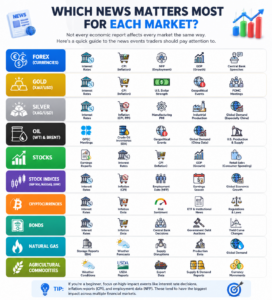
Which News Matters Most for Each Market?
How Economic News Affects Financial Markets depends on what you trade. Here’s a quick guide to the news events that matter most for each market.
Why Some News Creates Huge Volatility
- Importance of the announcement
- Difference between forecasts and actual results
- Current market sentiment
- Liquidity
- Unexpected events
- Investor positioning
How Economic News Affects Financial Markets
How Traders Prepare for News
Professional traders rarely wait until news is released.
Instead they:
- Monitor the economic calendar
- Compare forecasts with previous data
- Identify key support and resistance levels
- Reduce risk before major announcements
- Wait for volatility to settle when necessary
Common Beginner Mistakes
How Economic News Affects Financial Markets isn’t something you can learn in just a few seconds. In fact, many beginners make costly mistakes because they don’t fully understand how economic news impacts the markets.
| Mistake | Better Approach |
|---|---|
| Trading every headline | Focus on major economic releases |
| Ignoring expectations | Compare forecasts and actual results |
| Forgetting risk management | Use appropriate position sizing |
| Chasing volatility | Wait for confirmation |
| Following social media rumors | Use reliable financial sources |
Wrap up
I think you now understand that not every piece of economic news moves the markets, and not every market reacts to the same news in the same way.
The best way to turn this knowledge into real trading skills is to practice it in a demo account, especially during major news releases. Watch how prices react, compare the actual market movement with what you expected, and learn from every trade without risking real money.
Before you start trading live, make sure you open a demo account through our website. It’s one of the smartest steps you can take because it allows you to test what you’ve learned, build confidence, and develop your strategy before putting real money on the line.