
Table of Contents
The Biggest U.S. Companies in 2000 vs 2026
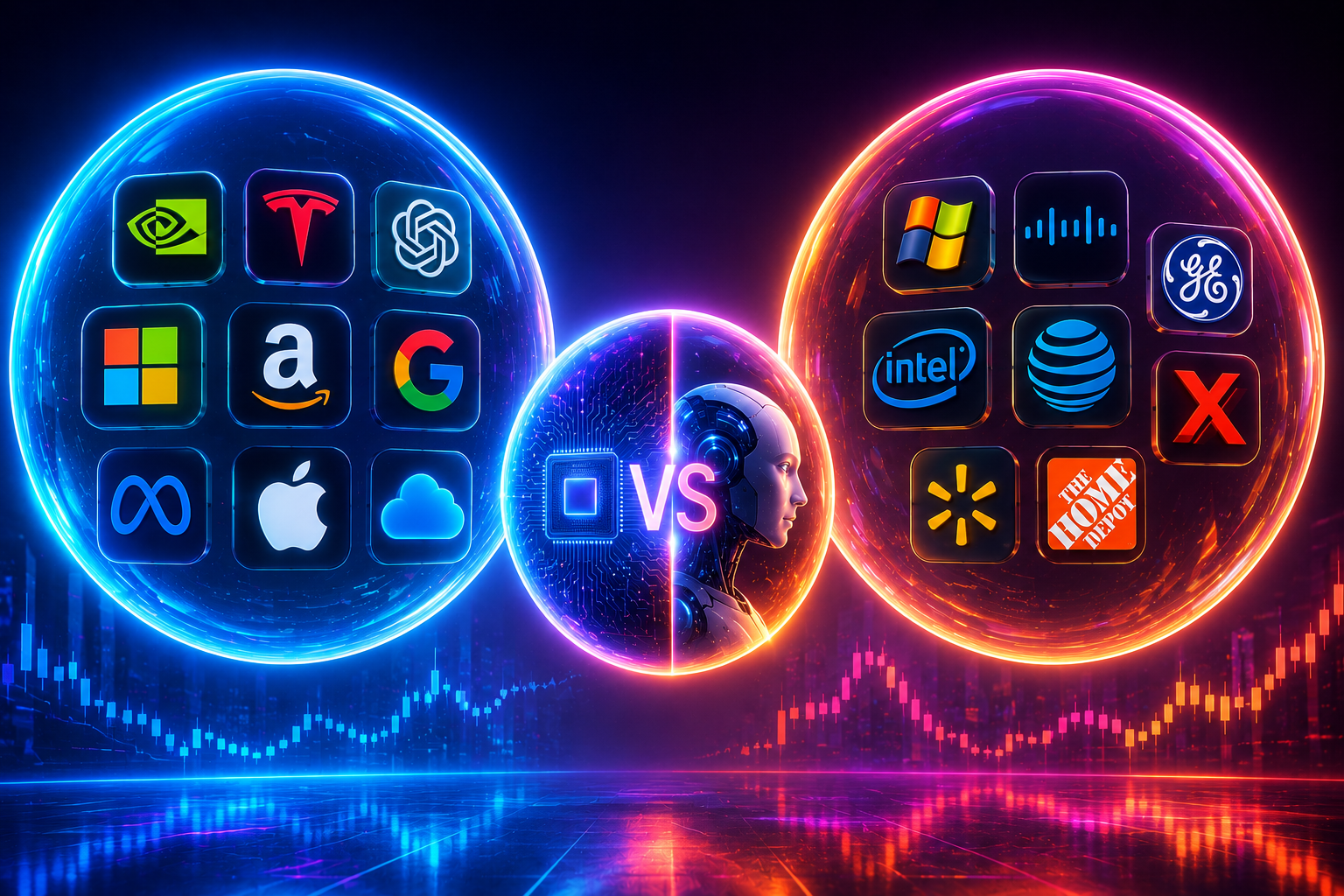
How the Stock Market Changed Forever
The Biggest U.S. Companies in 2000 vs 2026…Remember our financial statistics series?
..Yeah… we took a little break while diving deep into trading education….But today we’re bringing it back with one of my favorite comparisons yet. The other day, I caught myself thinking…
**How did twenty-five years disappear so fast?**
I still remember all the excitement around the year 2000. Everyone was talking about the new millennium like it was yesterday…Then it hit me…If our lives changed this much…
**What happened to the companies that once ruled Wall Street?**


Back in 2000, some companies looked unstoppable, They were the biggest names in America The safest investments, The stocks everyone wanted to own.
Fast forward to 2026…
Some of those giants have completely disappeared from the Top 10.
Others reinvented themselves.
And a whole new generation of companies—driven by AI, cloud computing, smartphones, and digital advertising—has taken over.
Today, we’re comparing the **10 largest publicly traded U.S. companies in 2000** with the **10 largest U.S. companies in 2026** to answer one simple question:
**How much has the financial world really changed?**
Trust me…
Some of these changes are going to surprise you.
Let’s dive in.
The 10 Biggest U.S. Companies by Market Capitalization (2000)
A snapshot of what Wall Street looked like at the start of the new millennium.
| Rank | Company | Sector | Approx. Market Cap (2000) |
|---|---|---|---|
| 🥇 1 | Microsoft | Software | ~$586B |
| 🥈 2 | General Electric | Industrials | ~$505B |
| 🥉 3 | Cisco Systems | Networking | ~$457B |
| 4 | Walmart | Retail | ~$295B |
| 5 | Intel | Semiconductors | ~$278B |
| 6 | ExxonMobil | Energy | ~$272B |
| 7 | Citigroup | Financials | ~$247B |
| 8 | IBM | Information Technology | ~$232B |
| 9 | Oracle | Software | ~$224B |
| 10 | Pfizer | Healthcare | ~$220B |
Key Takeaways from the Biggest U.S. Companies in 2000
- 💻 Software had already begun taking over.
- 📞 Telecom companies were booming because of the dot-com era.
- 🏭 Industrial giants like General Electric still dominated Wall Street.
- 🛢️ Oil remained one of America’s biggest industries.
- 🛒 Walmart was already proving retail could compete with technology.
The 10 Biggest U.S. Companies by Market Capitalization (Mid-2026)
Twenty-six years later, the stock market tells a completely different story.
| Rank | Company | Sector | Approx. Market Cap (Mid-2026) |
|---|---|---|---|
| 🥇 1 | NVIDIA | AI / Semiconductors | ~$5 Trillion |
| 🥈 2 | Microsoft | Software & Cloud | ~$4 Trillion |
| 🥉 3 | Apple | Consumer Technology | ~$3.2 Trillion |
| 4 | Amazon | E-commerce & Cloud | ~$2.7 Trillion |
| 5 | Alphabet | Internet / AI | ~$2.3 Trillion |
| 6 | Meta Platforms | Social Media / AI | ~$2.0 Trillion |
| 7 | Broadcom | Semiconductors | ~$1.8 Trillion |
| 8 | Berkshire Hathaway | Financial Services | ~$1.1 Trillion |
| 9 | Tesla | EV & AI | ~$1.0 Trillion |
| 10 | Walmart | Retail | ~$900 Billion |
Key Takeaways from the Biggest U.S. Companies in 2026
- 🤖 Artificial Intelligence dominates the market.
- ☁️ Cloud computing became one of the world’s biggest businesses.
- 💾 Semiconductor companies are worth more than many countries.
- 📱 Big Tech controls most of the stock market.
- 🛒 Walmart is the only retailer that survived among America’s largest companies.
Then vs. Now in the the Biggest U.S. Companies
| 2000 | 2026 |
|---|---|
| Microsoft | NVIDIA |
| General Electric | Microsoft |
| Cisco | Apple |
| Walmart | Amazon |
| Intel | Alphabet |
| ExxonMobil | Meta |
| Lucent | Broadcom |
| IBM | Berkshire Hathaway |
| Oracle | Tesla |
| Pfizer | Walmart |
Biggest Winners in the the Biggest U.S. Companies
| Company | Why It Won |
|---|---|
| NVIDIA | Became the backbone of the AI revolution. |
| Microsoft | Successfully reinvented itself through cloud computing and artificial intelligence. |
| Amazon | Expanded from online retail into cloud computing, logistics, advertising, and AI. |
| Alphabet | Built one of the world’s most profitable digital ecosystems through Search, YouTube, Android, and AI. |
| Meta | Turned social media into one of the largest advertising businesses ever created. |
| Tesla | Changed the automotive industry and became one of the world’s most valuable manufacturers. |
Biggest Losers in the Biggest U.S. Companies
| Company | What Happened? |
|---|---|
| General Electric | Lost its dominance after years of restructuring and spinning off businesses. |
| Lucent Technologies | Merged with Alcatel before disappearing into Nokia. |
| Intel | Fell behind in the AI race despite remaining a major chipmaker. |
| IBM | Shifted toward enterprise software and consulting while losing consumer relevance. |
| Cisco | Continued growing but couldn’t keep pace with the AI-driven technology boom. |
| ExxonMobil | Still a global energy giant, but technology companies dramatically outpaced oil in market value. |
What Changed Since 2000 in the Biggest U.S. Companies ?
1. AI became the new oil.
The world’s most valuable companies now build intelligence instead of drilling for resources.
2. Cloud computing changed everything.
Owning data centers became more valuable than owning factories.
3. The internet became the global economy.
Companies no longer need physical stores to reach billions of customers.
4. Data became one of the world’s most valuable assets.
Businesses now compete for information more than raw materials.
5. Semiconductors became strategic assets.
Without advanced chips, modern AI, smartphones, and cloud computing simply wouldn’t exist.
6. Innovation beat size.
Many giant corporations disappeared because they failed to evolve.
7. Investors reward future growth more than current profits.
Markets increasingly value companies based on long-term innovation potential.
8. Technology replaced traditional industries.
Telecom, industrials, and oil gave way to software, AI, and cloud computing.
9. Global competition became much faster.
A company can rise—or fall—in just a few years instead of decades.
10. Adaptability became the ultimate competitive advantage.
The companies that kept reinventing themselves remained leaders. Those that didn’t slowly faded from the top.
Industries That Now Dominate the Biggest U.S. Companies
| Industry | Why It Grew |
|---|---|
| Artificial Intelligence | The biggest investment theme of the decade. |
| Cloud Computing | Businesses moved their operations online. |
| Semiconductors | Every modern technology depends on advanced chips. |
| Software | Subscription-based business models created recurring revenue. |
| E-commerce | Online shopping transformed global retail. |
| Digital Advertising | Companies like Google and Meta reshaped marketing. |
| Electric Vehicles | The automotive industry entered a new era. |
Industries That Lost Their Dominance
| Industry | What Changed |
|---|---|
| Telecommunications | Growth slowed as the industry matured. |
| Conglomerates | Large diversified corporations became less attractive. |
| Oil & Gas | Still important, but no longer dominates market capitalization. |
| Traditional Hardware | Software and cloud services generated higher returns. |
| Networking Equipment | The explosive internet infrastructure boom eventually stabilized. |
Lessons for Investors from The Biggest Companies in America: 2000 vs. 2026
-
💡 Today’s winners won’t necessarily be tomorrow’s winners.
-
💡 Innovation matters more than size.
-
💡 Entire industries can disappear from the top in a single generation.
-
💡 Long-term investing rewards businesses that continue evolving.
-
💡 Never assume a market leader is untouchable.
-
💡 The next trillion-dollar company may already exist—you just haven’t recognized it yet.
-
💡 Great investors don’t chase the biggest companies; they identify the next great businesses before everyone else.
Frequently Asked Questions
What are the biggest U.S. companies today?
As of mid-2026, NVIDIA, Microsoft, Apple, Amazon, Alphabet, Meta Platforms, Broadcom, Berkshire Hathaway, Tesla, and Walmart are among the largest publicly traded U.S. companies by market capitalization.
What was the biggest U.S. company in 2000?
Microsoft held the number one position, followed by General Electric and Cisco Systems during the height of the technology boom.
Why did the biggest U.S. companies change so much?
Technology, artificial intelligence, cloud computing, smartphones, and digital advertising reshaped the economy, while traditional industries like industrial manufacturing, telecom equipment, and oil became a smaller share of the stock market.
Which company stayed in the Top 10 for over 25 years?
Microsoft and Walmart are the standout examples. Both successfully adapted to changing market conditions and remained among America’s largest companies.
Wrap-Up
Well… we’re officially back!….I really missed writing these financial statistics articles, and trust me, this is only the beginning. There are so many fascinating numbers, historical comparisons, and market stories waiting for us to explore together.
Looking at the biggest U.S. companies in 2000 versus today teaches us one important lesson: Nothing stays on top forever.
- Markets evolve.
- Technology evolves.
- Companies evolve.
And as investors, we have to evolve too.
Don’t invest in a company simply because it’s the biggest today. Invest in businesses you truly understand—companies you believe can continue growing and adding value to your portfolio for years to come.
And if you’re still learning or you’re not ready to risk real money yet, that’s completely fine.
- Start with a demo account.
- Practice.
- Test your ideas.
- Build confidence.
Then, when you’re ready, move to the real market with a strategy—not emotions.
We’re just getting started with this statistics series, so stay tuned because the next comparison might surprise you even more.
See you in the next article—and until then, keep learning, keep investing wisely, and never stop asking what the market might look like 20 years from now.