
Table of Contents
Why Is Inflation So High Right Now?
10 Reasons Behind Rising Prices in 2026
Why Is Inflation So High Right Now….Hello my dear fellow traders , been a while right.. I missed you all to be honest ..Today’s topic is important for you all so don’t leave until you read every part of this article…Remember when I talked about inflation and tried to explain how it affects our everyday lives? I used a simple example: going to the supermarket.
Well, I know many of you are gold followers, and today I want to take a deeper look at inflation and connect everything to what is happening in the markets right now.
Honestly, I am getting frustrated with how prices keep going up. You go to the supermarket to buy the same things you bought last month, and somehow your shopping bill is higher again.
So, I decided to do some research and find out why this situation keeps happening. Is it oil prices? Wars? Government policies? Supply problems? Or are there several things happening at the same time?

And more importantly, why are we still dealing with inflation in 2026, even after the world went through the major inflation surge of 2021 and 2022?
In this article, I want to break everything down in simple language. We will look at what inflation actually means, compare the situation in 2025 and 2026, explore 10 reasons prices are still rising, and discuss five investment ideas that may help investors maintain their purchasing power during inflationary periods.
So, let’s dive in!
What Is Inflation?
Inflation is the general increase in the prices of goods and services over time….In simple words, when inflation rises, your money loses some of its purchasing power. The same amount of money buys fewer things than it did before.
Let’s say you visit the supermarket with $100.
Last year, that amount was enough to buy your usual groceries. Today, you might need $110 to buy approximately the same basket.
What happened?
The value of your money did not change on the banknote itself. However, the prices of the products you buy increased, meaning your $100 cannot buy as much as it used to.
That is inflation.
Economists usually measure inflation using indicators such as the Consumer Price Index (CPI), which tracks changes in the prices of a selected basket of goods and services that households typically purchase.
This basket can include:
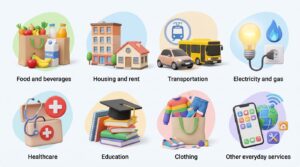
One important thing to understand is that inflation does not mean every product becomes more expensive at the same time. Some prices may increase, others may remain unchanged, and some may even decrease….What matters is the overall movement in the price level.
Inflation in the Past vs. Today: What Has Changed?
| Period | What was happening? | Main inflation drivers |
|---|---|---|
| Before 2020 | Inflation was relatively moderate in many major economies. | Normal changes in demand, wages, production and consumer spending. |
| 2020–2021 | COVID-19 disrupted global production and transportation while consumer demand began recovering. | Supply shortages, shipping delays and changes in spending patterns. |
| 2022 | Energy and food prices increased sharply, especially following Russia’s invasion of Ukraine. | Energy shocks, food supply disruptions, strong demand and monetary and fiscal support. |
| 2023–2024 | Inflation gradually cooled in many economies, although prices remained high. | Higher interest rates, easing supply pressures and slower demand. |
| 2025 | Inflation remained persistent in some economies, with new trade policies adding pressure to goods prices. | Tariffs, services inflation and lingering cost pressures. |
| 2026 | Energy supply disruptions and geopolitical tensions became major sources of renewed inflation pressure. | Higher oil and gas prices, shipping disruptions, food costs and the indirect effects of energy inflation. |
The important difference is that inflation does not always have the same cause. Sometimes it comes from strong consumer demand, and sometimes it happens because businesses cannot produce or deliver goods at the same cost as before.
This distinction matters because the solution depends on the source of inflation.
For example, raising interest rates can help reduce excessive demand, but it cannot immediately restore damaged energy infrastructure or reopen disrupted shipping routes.
Why Is Inflation So High Right Now?
10 Reasons Behind Rising Prices in 2026
Now fellow traders let’s get to the main question. What made us feel the pain Why Is Inflation So High Right Now?
There is no single answer. Inflation is usually the result of several economic forces working together. Some increase the cost of producing goods, others make demand stronger, and some make it more expensive to move products from one country to another.
Here are 10 important reasons to understand.
1. Rising Oil and Energy Prices
Let’s start with one of the biggest inflation drivers in 2026: energy.
Oil and gas are essential to almost every part of the global economy.
Think about it:
-
Trucks need fuel to transport products.
-
Factories need electricity and energy to operate.
-
Airlines need jet fuel.
-
Farmers use fuel to operate machinery.
-
Manufacturers need energy to produce goods.
When oil and gas prices rise, businesses face higher operating costs.
They may absorb some of these costs, but others are eventually passed on to customers through higher prices.
This is particularly important in 2026 because geopolitical tensions in the Middle East have disrupted energy supplies and shipping routes.
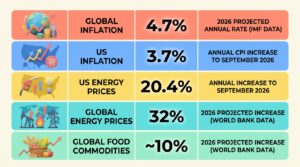
The World Bank’s October 2026 Commodity Markets Outlook projects energy prices to rise by 32% during 2026, with Brent crude expected to average $91 per barrel, compared with $69 in 2025.
This is one of the clearest examples of how an event in one part of the world can affect the cost of living thousands of miles away.
2. Geopolitical Tensions and Conflicts
Wars and geopolitical tensions can create economic problems far beyond the countries directly involved.
Why?
Because global trade depends on stable transportation routes, reliable energy supplies and predictable business conditions.
When a conflict threatens an important shipping route, companies may have to:
-
Find alternative routes.
-
Pay higher insurance premiums.
-
Spend more on fuel.
-
Wait longer for shipments.
-
Search for alternative suppliers.
All these changes increase costs.
One important example is the Strait of Hormuz, a strategic passage for global energy shipments.
Disruptions in this area can affect oil and gas supplies, which can then influence transportation, manufacturing and electricity costs around the world.
The Middle East plays an important role in global energy markets, which is why developments in the region can have consequences for inflation worldwide.
3. Supply Chain Disruptions
Remember when products became difficult to find during the pandemic?
That was a major example of supply chain disruption.
A supply chain is the network of businesses, suppliers, factories, warehouses and transportation companies involved in producing and delivering a product.
For example, a smartphone may contain components manufactured in several different countries before being assembled and shipped to customers….If one important supplier stops production, the entire process can slow down…The same applies to food, cars, electronics, clothing and industrial equipment.
When supply becomes limited while demand remains strong, prices can increase.
In 2026, geopolitical disruptions, trade restrictions and transportation problems are creating additional pressure on global supply chains.
4. Higher Food Production Costs
Food inflation is particularly frustrating because food is not something people can simply stop buying.
But have you ever thought about how many costs are involved before a product reaches your supermarket?
A loaf of bread, for example, depends on:
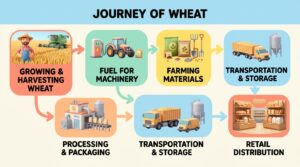
If the price of fuel or fertilizer increases, the cost of producing and delivering food can increase too.
Weather conditions also matter. Droughts, floods and other extreme weather events can damage crops and reduce agricultural production.
The World Bank expects food commodity prices to rise by around 10% in 2026 and another 7% in 2027, partly because of disrupted grain shipments, weather risks and higher agricultural input costs.
This shows how energy and food inflation can become connected. Higher fuel prices can eventually affect the price of products on supermarket shelves.
5. Import Tariffs and Trade Restrictions
Another important reason behind inflation is the cost of international trade.
Governments sometimes introduce tariffs on imported products to protect domestic industries, respond to trade disputes or achieve other economic objectives.
But who eventually pays for these tariffs?
It depends on how businesses respond.
Importers may absorb some of the additional costs, suppliers may adjust their prices, or retailers may pass part of the increase on to consumers.
For example, if a company imports electronic components and faces higher tariffs, producing its final products may become more expensive.
Research on the 2025 US tariffs found that part of the additional import costs was passed through to consumer prices.
The impact can also take time to appear because businesses may initially use existing inventories before ordering new products at higher prices.
6. Strong Consumer Demand
Sometimes inflation is not caused by a shortage of products. It happens because too many people want to buy the same products and services at the same time.
Imagine a popular smartphone launches.
Thousands of customers want to buy it, but the manufacturer has limited stock.
The company may have room to increase the price because demand is stronger than available supply.
This is an example of demand-pull inflation.
It can happen in several sectors:

When consumer spending grows faster than an economy’s ability to produce goods and services, businesses may raise prices.
7. Higher Wages and Labor Costs
Employees want their salaries to keep up with the rising cost of living. That is understandable.
When companies pay higher salaries, their operating costs increase. If productivity does not rise enough to offset those costs, some businesses may increase the prices of their products and services.
For example, restaurants pay employees, purchase ingredients, rent premises and cover electricity bills.
If several of these costs rise together, the restaurant may increase menu prices.
There is an important distinction here: higher wages do not automatically cause inflation.
If workers become more productive, businesses may be able to pay higher salaries without significantly increasing prices.
The risk becomes greater when wage increases continue feeding into higher prices across the economy.
8. Housing and Rent Costs
Housing is one of the largest expenses for many households.
Rent, maintenance, insurance, utilities and other housing-related costs can have a significant impact on inflation measurements.
And housing inflation can be slow to change.
Even if market rents begin to cool, official inflation measures may take time to reflect that change because many rental agreements are updated only when contracts are renewed.
For example, US CPI data for September 2026 showed that the shelter index increased by 0.4% during the month.
This is one reason inflation can remain elevated even when energy or commodity prices begin to stabilize.
9. Currency Depreciation and Imported Inflation
Here is another important factor, especially for countries that depend heavily on imported goods.
When a country’s currency loses value against the currencies used by its international suppliers, importing products becomes more expensive.
Let’s use a simple example.
Imagine a company imports machinery worth $10,000.
If the exchange rate changes from 50 local currency units per dollar to 55, the company now needs more local currency to purchase exactly the same machinery.
The product itself has not become more expensive in dollars, but its cost in local currency has increased.
This can affect:
-
Imported food.
-
Fuel.
-
Medicine.
-
Electronics.
-
Industrial materials.
-
Machinery and equipment.
Eventually, some of these additional costs may be passed on to consumers.
This is known as imported inflation.
Its impact varies significantly depending on a country’s exchange-rate system, import dependence, foreign currency reserves and domestic production capacity.
10. Inflation Expectations
This one is interesting because inflation can sometimes become a problem simply because people expect prices to keep rising.
Imagine business owners believe their suppliers will increase prices next month.
They may decide to raise their own prices today to protect their profit margins.
Workers may also demand higher salaries because they expect their living costs to increase.
If businesses continue raising prices and workers continue seeking higher wages, inflation can become more persistent.
Economists often refer to this as second-round inflation effects.
This is why central banks pay close attention not only to current inflation figures but also to inflation expectations.
What Do the Latest Inflation Numbers Tell Us About 2026?
How to Protect Your Capital from Inflation
1. Understand Your Real Return
Do not focus only on how much money an investment makes.
You also need to consider inflation.
For example:
-
Your investment earns 5%.
-
Inflation is 4%.
-
Your approximate real return is 1%, before taxes and fees.
This is a much better way to understand whether your money is actually growing in purchasing-power terms.
2. Avoid Keeping All Your Savings in One Asset
Diversification means spreading your investments across different asset classes rather than depending on a single investment.
This may help reduce the impact of poor performance in one particular market.
3. Consider Your Investment Time Horizon
Some assets can be volatile over short periods but may have different characteristics over longer periods.
Before investing, think about when you may need the money and how much short-term loss you could tolerate.
4. Review Your Portfolio Regularly
Inflation changes the economic environment.
Interest rates, energy prices, company costs and currency movements can all affect your investments.
Reviewing your portfolio helps you understand whether your original investment assumptions still make sense.
5. Avoid Chasing Inflation-Driven Market Movements
When investors become worried about inflation, they may rush into gold, oil or other assets after prices have already moved significantly.
Remember that an asset becoming popular during inflation does not mean its price will continue rising.
A strategy based on research and risk management is more useful than reacting emotionally to headlines.
5 Investment Ideas That May Help Maintain Your Purchasing Power During Inflation in 2026
1. Gold
Gold is often considered during inflation and economic uncertainty because it is a physical asset with limited supply. However, its price also depends on the US dollar, real interest rates, central bank purchases and investor demand.
2. Inflation-Protected Government Bonds
Government bonds such as US Treasury Inflation-Protected Securities (TIPS) adjust their principal value according to inflation. However, their market prices can still fluctuate with interest rates and real yields.
3. Stocks of Companies with Strong Pricing Power
Companies that can raise prices without losing too many customers may be better positioned during inflation. Investors often examine consumer staples, healthcare and businesses with strong brands and recurring demand.
4. Real Estate and REITs
Property values and rental income may increase over time as prices rise. REITs offer another way to invest in real estate without purchasing an entire property, although higher interest rates can put pressure on returns.
5. Commodities and Energy-Related Investments
Oil, natural gas, metals and agricultural products may benefit when supply shortages push prices higher. Investors can explore commodity funds and energy stocks, but these investments can be highly volatile.
Comparing the Five Investment Ideas
| Investment | Why investors consider it | Main risk |
|---|---|---|
| Gold | Diversification and demand during uncertainty | Real interest rates and price volatility |
| Inflation-protected bonds | Principal adjusts with measured inflation | Interest-rate and market-price risk |
| Stocks | Potential growth and pricing power | Business performance and valuation |
| Real estate / REITs | Property exposure and possible rental growth | Financing costs and property-market conditions |
| Commodities | Exposure to supply shortages and rising input costs | High volatility and changing supply-demand conditions |
Why Does Inflation Feel Worse Than the Official Numbers?
Why Does Everything Still Feel Expensive?
Lower inflation does not mean lower prices. It simply means prices are rising more slowly.
For example, a $100 product becomes $110 after 10% inflation. If inflation falls to 3% the following year, its price rises to $113.30, not back to $100.
| Period | Inflation rate | Product price |
|---|---|---|
| Starting point | — | $100 |
| Year 1 | 10% | $110 |
| Year 2 | 3% | $113.30 |
Your personal experience also depends on what you spend money on. Higher food, rent, fuel or imported goods costs may affect your budget more than the official inflation average.
Will Inflation Go Down in 2027?
The IMF’s October 2026 outlook projects global headline inflation to decline from 4.7% in 2026 to 4.1% in 2027. However, the outlook depends on several factors:
-
Energy supply: Stable oil and gas supplies could ease price pressures, while disruptions could push costs higher.
-
Food production: Weather, harvests and fertilizer costs can influence food prices.
-
Central bank decisions: Interest rates will affect borrowing, spending and overall demand.
-
Trade policies: Tariffs and restrictions could increase import and production costs.
-
Inflation expectations: Expectations of rising prices can influence business decisions, wages and consumer spending.
Lower inflation is possible in 2027, but it does not guarantee cheaper goods and services.
FAQS about Why is inflation so high right now?
1. Why is inflation so high right now in 2026?
Inflation remains elevated in several economies because of a combination of energy supply disruptions, geopolitical tensions, higher transportation and production costs, trade restrictions and food-price pressures. The main drivers differ by country, but energy has become a particularly important source of inflation pressure in 2026.
2. What are the main causes of inflation?
The main causes include strong consumer demand, limited supply of goods and services, higher energy prices, supply chain disruptions, increased production costs, wage growth, currency depreciation, import tariffs, higher food costs and rising inflation expectations.
3. Why does inflation increase when oil prices rise?
Oil is used in transportation, manufacturing, agriculture and many other industries. When oil prices increase, businesses often face higher fuel and operating costs. Some of these additional expenses may eventually be passed on to consumers through higher prices.
4. Does inflation mean everything becomes more expensive?
No. Inflation measures the overall increase in the prices of a basket of goods and services. Some products may become more expensive, others may remain stable, and some may even become cheaper.
5. Does lower inflation mean prices are falling?
No. Lower inflation usually means prices are increasing more slowly. Prices generally fall only during a period of deflation, when the overall price level decreases.
6. What happens to gold when inflation rises?
Gold may attract investors during periods of economic uncertainty and concerns about purchasing power. However, its price is also influenced by real interest rates, the US dollar, central bank demand and investor sentiment. Gold does not automatically increase whenever inflation rises.
7. What are the best investments during high inflation?
Investors often consider gold, inflation-protected bonds, diversified stocks, real estate and commodities during inflationary periods. Each has different risks, and none guarantees a positive real return.
8. How can I protect my savings from inflation?
You can start by understanding your real return, maintaining an appropriate emergency cash reserve, diversifying your investments and reviewing your financial plan regularly. The right approach depends on your financial goals, time horizon and risk tolerance.
9. Can central banks stop inflation?
Central banks can influence inflation through monetary policy, especially by adjusting interest rates and financial conditions. Higher interest rates can reduce borrowing and spending, helping cool demand. However, monetary policy cannot directly solve every supply-side problem, such as an energy shortage or disrupted shipping route.
10. Is inflation expected to fall in 2027?
The IMF’s October 2026 outlook projects global headline inflation to decline to 4.1% in 2027 from 4.7% in 2026. However, this remains a forecast and could change depending on energy prices, geopolitical developments, trade policies and other economic conditions.
Wrap Up
Now fellow traders! that you understand what inflation is, what drives it, and how it affects today’s markets, it’s time to put that knowledge into practice.
Why not take the next step towards investing?
Start with a demo account to explore the markets, test your strategies and build confidence before opening a real trading account.