
Home Crypto currency tradingWhat Is a Crypto Wallet and How Does It Work?

What Is a Crypto Wallet and How Does It Work?

by Amira ibrahim
0 comments 102 views
What Is a Crypto Wallet and How Does It Work?

Table of Contents

What Is a Crypto Wallet and How Does It Work?

What Is a Crypto Wallet and How Does It Work?…..I’ve spent a lot of time at the beginning of my trading career questioning whether trading in the crypto world was really worth it or not.

I also witnessed the early days of crypto, from the famous first Bitcoin pizza purchase to the rise of Trump’s cryptocurrency and the regulatory battles happening around the world. On my Arabic blog, I’ve covered enough crypto-related topics over the years to see how quickly this market has changed.

Now, I want to bring some perspective to the basics of the crypto world here as well.

And if you’re trying to understand crypto, what is a crypto wallet and how does it work is one of the questions you really need to answer. Before buying, sending, receiving, or even properly understanding cryptocurrencies, you need to know what a wallet actually does, where your crypto is stored, and what gives you control over it.

banner

So today, we’re going to break it all down from the ground up —what is a crypto wallet and how does it work , the different types of wallets, and how to keep your crypto safe.

Let’s dive in.

What Is a Crypto Wallet?

A crypto wallet is a software application or physical device that allows you to manage cryptocurrency and interact with a blockchain.

But there is one important detail that confuses many beginners:

Your crypto is not physically stored inside the wallet.

Instead:

  • Your cryptocurrency is recorded on a blockchain.
  • Your wallet manages the keys that give you control over those assets.
  • Your wallet address allows other people to send crypto to you.
  • Your private key allows you to authorize transactions.

Think of the wallet as your interface to the blockchain rather than a digital version of your physical wallet.

For example, if you own Bitcoin, the Bitcoin itself exists as blockchain records. Your wallet gives you the ability to prove that you control the relevant Bitcoin and authorize a transaction when you want to send it.

What Is a Crypto Wallet and How Does It Work?


How Does a Crypto Wallet Work?

At a basic level, a crypto wallet works by generating and managing cryptographic keys.

When you create a wallet, it generates the information needed to interact with a blockchain. Depending on the wallet, this may be represented by a private key or a recovery phrase from which wallet keys can be derived.

When you receive crypto, you give the sender your wallet address.

When you send crypto, your wallet uses your private key to digitally sign the transaction. The private key itself is not normally sent across the network.

The blockchain network then checks the transaction and, if valid, records it on the blockchain.

The process looks like this:

What Is a Crypto Wallet and How Does It Work?

You don’t need to manually perform all these technical steps. The wallet software handles most of the process behind the scenes.


Where Is Your Crypto Actually Stored?

Your Bitcoin, Ethereum, or other cryptocurrency isn’t sitting inside an app on your phone or inside a hardware wallet….The blockchain maintains the records…..Your wallet gives you access to those records through your keys.

That’s why losing your phone doesn’t necessarily mean losing your Bitcoin.

If you have the appropriate recovery information, you can restore your wallet on another compatible device.

A simple analogy

  • Think of the blockchain as a giant public financial ledger.
  • Your wallet is the tool you use to interact with that ledger.
  • Your private key is what proves you have the authority to move the assets associated with your address.

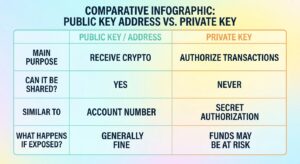
Public Key vs. Private Key
What Is a Crypto Wallet and How Does It Work?

Public key

  • A public key is information used to derive addresses that others can use to send you cryptocurrency.
  • Your wallet address is what you will normally share with someone who wants to send you crypto.

Private key

  • A private key is secret information used to authorize transactions.
  • If someone obtains your private key, they may be able to control the crypto associated with it.
  • Never send your private key to another person, website, exchange, or supposed customer-support agent.

What Is a Crypto Wallet Address?

A crypto wallet address is a unique identifier that tells the blockchain where cryptocurrency should be sent.

It usually looks like a long string of letters and numbers.

For example, instead of giving someone your private key, you give them your wallet address when you want to receive crypto.

You can also commonly use a QR code to make receiving or sending funds easier.

Important

Always check:

  • The address
  • The cryptocurrency
  • The blockchain network
  • The amount

before confirming a transaction.

A mistake in a crypto transfer can be difficult or impossible to reverse.


What Is a Seed Phrase?

A seed phrase, also called a recovery phrase, is a sequence of words that can be used to restore access to a crypto wallet.

Many wallets use phrases containing 12 or 24 words, although the exact format depends on the wallet.

The seed phrase is extremely important because it can provide access to the keys controlling your assets.

Treat your seed phrase like a master key

Never:

  • Screenshot it
  • Store it in your email
  • Upload it to cloud storage
  • Send it through WhatsApp or Telegram
  • Share it with customer support
  • Enter it into an unfamiliar website

Write it down and store it securely according to the wallet’s recommended recovery procedure.

If someone gets your seed phrase, your crypto may be at risk.


How Do You Send Cryptocurrency From a Wallet?

Sending crypto is relatively straightforward, but there are several steps happening behind the scenes.

Basic process

  1. Open your crypto wallet.
  2. Select the cryptocurrency you want to send.
  3. Enter or scan the recipient’s address.
  4. Enter the amount.
  5. Select or review the network fee.
  6. Check the address and network carefully.
  7. Confirm the transaction.
  8. Your wallet signs the transaction.
  9. The transaction is broadcast to the blockchain network.
  10. The network verifies and confirms it.

Once confirmed, the blockchain records the transaction.

Why are transaction fees required?

Most blockchains require users to pay a network fee for transactions.

The fee generally goes toward the participants responsible for processing and securing the network.

The amount can vary depending on:

  • The blockchain
  • Network activity
  • Transaction complexity
  • Current demand

How Do You Receive Cryptocurrency?

Receiving crypto is simpler.

You normally:

  1. Open your wallet.
  2. Select the cryptocurrency.
  3. Tap Receive.
  4. Copy your wallet address or display the QR code.
  5. Send the address to the person or platform sending the crypto.
  6. Wait for the blockchain transaction to be processed.

One important rule

The asset and network must be compatible with the receiving address.

For example, don’t assume that because two assets use similar-looking addresses, they can automatically be sent using the same network.

Always check the wallet and exchange instructions before transferring funds.


Types of Crypto Wallets

Crypto wallets can be classified in several ways.

The two most useful distinctions are:

Hot vs. cold — based on connectivity.

Custodial vs. non-custodial — based on who controls the private keys.

There are also different wallet formats, including mobile, desktop, browser, hardware, and exchange wallets.


What Is a Hot Wallet?

A hot wallet is a crypto wallet connected to the internet or used through an internet-connected device.

Examples include:

  • Mobile wallets
  • Desktop wallets
  • Browser extension wallets
  • Many exchange wallets
Hot Wallets Advantages Disadvantages
Quick access
Easy to set up
Convenient for frequent transactions
Useful for DeFi and Web3 applications
Greater exposure to online threats
Phishing risks
Malware risks
Device security becomes important

What Is a Cold Wallet?

A cold wallet is designed to keep private keys offline when they are not being used.

Hardware wallets are the most common example.

Cold Wallets Advantages Disadvantages
Reduced exposure to online attacks
Useful for long-term holdings
Private keys can remain offline
Less convenient for frequent transactions
Physical device can be lost or damaged
Recovery procedures must be handled carefully

Cold storage can improve security, but it does not eliminate every risk.

A user can still lose funds by exposing a recovery phrase, approving a malicious transaction, or sending crypto to the wrong address.


Hot Wallet vs. Cold Wallet

Feature Hot Wallet Cold Wallet
Internet exposure Higher Lower
Convenience High Moderate
Frequent transactions Suitable Less convenient
Long-term storage Possible Common use case
Main concern Online attacks Physical/recovery security

Main Types of Crypto Wallets by Form

Beyond hot/cold and custodial/non-custodial classifications, wallets also come in different formats.

Mobile Wallets

Apps installed on smartphones.

Good for: convenience, payments and everyday transactions.

Desktop Wallets

Software installed on a computer.

Good for: users who prefer managing crypto from a desktop environment.

Browser Wallets

Wallets that operate through browser extensions.

Good for: interacting with decentralized applications and Web3 platforms.

Hardware Wallets

Physical devices designed to keep private keys protected, generally offline.

Good for: long-term holdings and users prioritizing security.

Exchange Wallets

Wallets provided by centralized cryptocurrency exchanges.

Good for: trading and convenience, but they are generally custodial.


Which Crypto Wallet Is Best?

The right choice depends on what you are trying to do with your cryptocurrency.

Consider these factors:

  • Security: How are the private keys protected?
  • Custody: Who controls the keys?
  • Supported assets: Does it support the cryptocurrencies you need?
  • Network support: Can it work with the blockchains you use?
  • Fees: What transaction or service fees apply?
  • Ease of use: Is the interface simple enough for you?
  • Backup and recovery: What happens if you lose your device?
  • Web3 support: Can you connect to DeFi, NFTs and decentralized applications?
  • Reputation: Does the wallet have a strong track record?

For a beginner, convenience matters. For someone holding significant crypto for the long term, security and key management may matter much more.


How to Choose Between a Hot and Cold Wallet

A simple way to think about it is access versus protection.

If you need to move crypto frequently, a hot wallet can be convenient.

If you are primarily holding crypto for the long term, cold storage may make more sense.

You do not necessarily have to choose only one.

A practical setup can be:

What Is a Crypto Wallet and How Does It Work?

This approach separates the crypto you actively use from the crypto you intend to hold.


How to Keep Your Crypto Wallet Safe

The technology behind crypto wallets can be highly secure, but users can still lose funds through simple mistakes.

Some of the most important security habits are:

  • Keep your private key and recovery phrase secret.
  • Never enter your seed phrase into an unfamiliar website.
  • Download wallet software only from legitimate sources.
  • Double-check wallet addresses before sending.
  • Verify the blockchain network before making a transfer.
  • Be careful with unknown links and smart contracts.
  • Use strong passwords and two-factor authentication where available.
  • Consider cold storage for significant long-term holdings.
  • Test large transfers with a small amount first.

Common Crypto Wallet Mistakes to Avoid

A crypto wallet can be technically secure, but one careless action can still put your funds at risk.

Here are some of the most common mistakes beginners make.

1. Sharing Your Private Key or Seed Phrase

Your wallet address can be shared to receive crypto.

Your private key and seed phrase cannot.

No legitimate wallet provider should ask you to send them your recovery phrase.

2. Using Fake Wallet Apps

Scammers can create apps and websites that look almost identical to legitimate wallet services.

Before downloading a wallet:

  • Check the official website.
  • Verify the developer.
  • Avoid suspicious links.
  • Never download wallet software from unknown sources.

3. Sending Crypto to the Wrong Network

This is one of the easiest mistakes to make.

For example, receiving a token through one blockchain network while sending it through another can create serious problems.

Always check the asset and network before confirming a transaction.

4. Sending to the Wrong Address

Crypto transactions are generally irreversible.

Before clicking Send, check:

  • Wallet address
  • Cryptocurrency
  • Network
  • Amount
  • Transaction fee

For large transfers, sending a small test amount first can be a smart precaution.

5. Approving Unknown Smart Contracts

If you connect your wallet to a decentralized application, you may be asked to approve transactions or token permissions.

Do not automatically approve everything.

If you do not understand what a transaction or approval does, stop and investigate it first.


What Happens If You Lose Your Crypto Wallet?

Losing the physical device or phone that contains your wallet does not necessarily mean your cryptocurrency is gone.

What matters is whether you still have the information needed to recover access.

For many non-custodial wallets, this means having the correct seed phrase or recovery method.

For example:

Lost phone + recovery phrase = wallet may be restored

But:

Lost recovery phrase + lost access = funds may be unrecoverable

This is why backing up your recovery information is just as important as choosing the wallet itself.


Are Crypto Wallets Safe?

Crypto wallets can be safe when used correctly, but no wallet eliminates every risk.

Security depends on several factors:

  • How the private keys are stored
  • Whether the wallet is connected to the internet
  • How the user protects recovery information
  • Whether the software is legitimate
  • Whether transactions are checked carefully
  • Whether the wallet interacts with risky websites or smart contracts

A cold hardware wallet can reduce exposure to some online attacks, while a hot wallet can offer greater convenience.

The safest option depends on how you use crypto and how much risk you are prepared to manage.


Crypto Wallet vs. Crypto Exchange

Feature Crypto Exchange Crypto Wallet
Buy and sell crypto Yes Sometimes
Store crypto Yes Yes, through blockchain access
Private key control Usually exchange Depends on wallet type
DeFi access Limited on some platforms Usually available with compatible wallets
Self-custody No, in custodial accounts Possible
Main purpose Trading Managing and controlling assets

Keeping crypto on an exchange can be convenient, especially when you are actively trading.

Moving assets to a non-custodial wallet gives you direct control over the keys, but also means taking responsibility for security and recovery.


Crypto Wallet vs. Bank Account

Traditional Banking Crypto
Bank account number Wallet address
Bank maintains the ledger Blockchain maintains the ledger
Bank authorizes transactions Private key authorizes transactions
Bank can help recover account access Recovery depends on wallet/custody model
Bank controls the infrastructure Blockchain network is decentralized


Can One Crypto Wallet Hold Different Cryptocurrencies?

Yes, depending on the wallet.

Many modern wallets support multiple cryptocurrencies and blockchain networks from a single interface.

For example, a compatible wallet may allow you to manage:

  • Bitcoin
  • Ethereum
  • Stablecoins
  • Other tokens
  • NFTs

However, not every wallet supports every cryptocurrency or blockchain.

Always check compatibility before transferring funds.


What Can You Do With a Crypto Wallet?

Crypto wallets have evolved beyond simply sending and receiving cryptocurrency.

Depending on the wallet, you may be able to:

  • Send and receive crypto
  • Swap tokens
  • Stake certain cryptocurrencies
  • Connect to DeFi applications
  • Buy or sell supported assets
  • Store and manage NFTs
  • Sign blockchain transactions
  • Connect to Web3 applications
  • Track multiple blockchain assets

This makes the wallet more than a storage tool.

It can act as your gateway to the broader blockchain ecosystem.


How to Set Up a Crypto Wallet

The exact process depends on the wallet, but the general steps are straightforward.

Step 1: Choose the Wallet

Decide whether you need a hot wallet, cold wallet, custodial service or non-custodial wallet.

Step 2: Download or Purchase From an Official Source

Use the wallet provider’s official website or verified app store listing.

Step 3: Create Your Wallet

Follow the setup instructions and create the required security credentials.

Step 4: Back Up Your Recovery Information

If the wallet provides a seed phrase, write it down and store it securely offline.

Step 5: Add Security

Use available protections such as:

  • Strong passwords
  • PINs
  • Biometrics
  • Two-factor authentication

Step 6: Receive Crypto

Copy your wallet address and send a small test amount first if you are unfamiliar with the process.

Step 7: Start Using the Wallet

Once you understand the basic functions, you can send, receive and interact with supported blockchain applications.

Frequently Asked Questions About
What Is a Crypto Wallet and How Does It Work?

Can I use the same crypto wallet on more than one device?

Yes. Many wallets allow you to restore or access the same wallet on multiple compatible devices using the correct recovery method.

What happens if my phone is lost?

If you have the required recovery information, you can usually restore your wallet on another compatible device. Losing the phone itself does not automatically mean losing your crypto.

What happens if my hardware wallet breaks?

Your crypto is recorded on the blockchain, not inside the physical device. If you have the correct recovery backup, you may be able to restore access using another compatible wallet.

Can I have multiple crypto wallets?

Yes. Many users keep separate wallets for different purposes, such as everyday transactions, trading and long-term holdings.

Can one crypto wallet have multiple addresses?

Yes. Some wallets can generate multiple addresses from the same wallet setup. This can help with organization and, in some cases, privacy.

Can someone steal my crypto using only my wallet address?

Usually, no. Your wallet address is designed to be shared when receiving crypto. The information you must protect is your private key or recovery credentials.

Can people see how much crypto I have?

Blockchain transactions and wallet balances can often be viewed publicly. However, a wallet address does not automatically reveal the real-world identity of its owner.

Why does my wallet show a different address?

Some wallets generate new receiving addresses for privacy, security or transaction-management purposes. This does not necessarily mean you created a completely new wallet.

Can I recover my crypto if I forget my password?

It depends on the type of wallet. A custodial platform may offer account recovery, while a non-custodial wallet generally depends on its recovery method.

What happens if I send crypto to the wrong address?

Most blockchain transactions cannot simply be reversed. If the recipient cannot or will not return the funds, the crypto may be permanently lost.

Why should I send a small amount first?

A small test transaction can confirm that the wallet address, cryptocurrency and network are correct before you transfer a larger amount.

Can I keep all my crypto in one wallet?

You can, but you do not have to. Some users separate their funds between wallets to reduce the impact of a compromised wallet or a costly mistake.

Is a hardware wallet impossible to hack?

No wallet should be considered completely risk-free. Hardware wallets are designed to reduce certain online risks, but phishing, compromised devices and poor security practices can still create problems.

Is a wallet password the same as a seed phrase?

No. A password or PIN usually protects access to the wallet or device. A seed phrase is a recovery method that can restore access to the wallet and its associated keys.

What should I do if someone sees my seed phrase?

Treat it as compromised. Create a new wallet with fresh recovery credentials and move your funds to the new wallet as soon as it is safe to do so.

Can I change my crypto wallet later?

Yes. You can move your cryptocurrency from one wallet to another by making blockchain transactions. Just make sure the destination wallet supports the asset and network you are using.

Do I need a crypto wallet if I only buy Bitcoin and hold it?

Not necessarily. You can keep Bitcoin with a custodial exchange, but using a non-custodial wallet gives you direct control over the keys.

Can I lose crypto without being hacked?

Yes. Crypto can be lost through mistakes such as losing recovery information, sending funds to the wrong address, using the wrong network or approving a malicious transaction.

What is the safest way to store a large amount of crypto?

There is no single solution for everyone, but long-term holders often consider offline or hardware-based storage combined with a carefully protected backup and strong security practices.

Wrap-Up

If you’re a trader who cares about cryptocurrencies, understanding What Is a Crypto Wallet and How Does It Work? is something you shouldn’t overlook.

We’ve covered the basics, from how wallets use public and private keys to the differences between hot and cold wallets, custodial and non-custodial options, and the security risks you need to understand before using crypto.

Fellow traders, never stop learning. Keep exploring our educational articles and, most importantly, put what you learn into practice.

Before going live, consider practicing on a demo account, especially when dealing with cryptocurrencies, where price movements can be sharp and unpredictable.

Learn first. Practice second. Trade with a strong heart =.

See you in the next article.

You may also like

Leave a Comment

Caveo FX Limited is a regulated Securities Dealer offering CFD trading on forex, commodities, indices, and cryptocurrencies. Licensed by the Financial Services Authority of Seychelles (SD213), we provide secure and transparent trading solutions with advanced platforms and competitive spreads.

Edtior's Picks

Latest Articles

All RIGHTS RESERVED TO CAVEO FX LIMITED