Top 5 Global Economic Events Every Trader Should Watch
August 2026
Top 5 Global Economic Events Every Trader Should Watch……What is happening in the world right now is honestly unbelievable.
Every week, there seems to be another major headline, whether it’s a new trade policy, rising geopolitical tensions, military conflicts, or uncertainty surrounding global energy supplies.
At first, these stories might seem like they’re happening far away. But here’s the reality: every major political or economic decision has the potential to affect your money.
A change in trade policy could make products more expensive. A conflict near a major shipping route could increase oil prices. A speech from a world leader could move currencies, stock markets, gold, or even cryptocurrencies within minutes.
As traders, we shouldn’t react to every headline. Instead, we need to understand how these events could influence financial markets and what scenarios investors are pricing in.
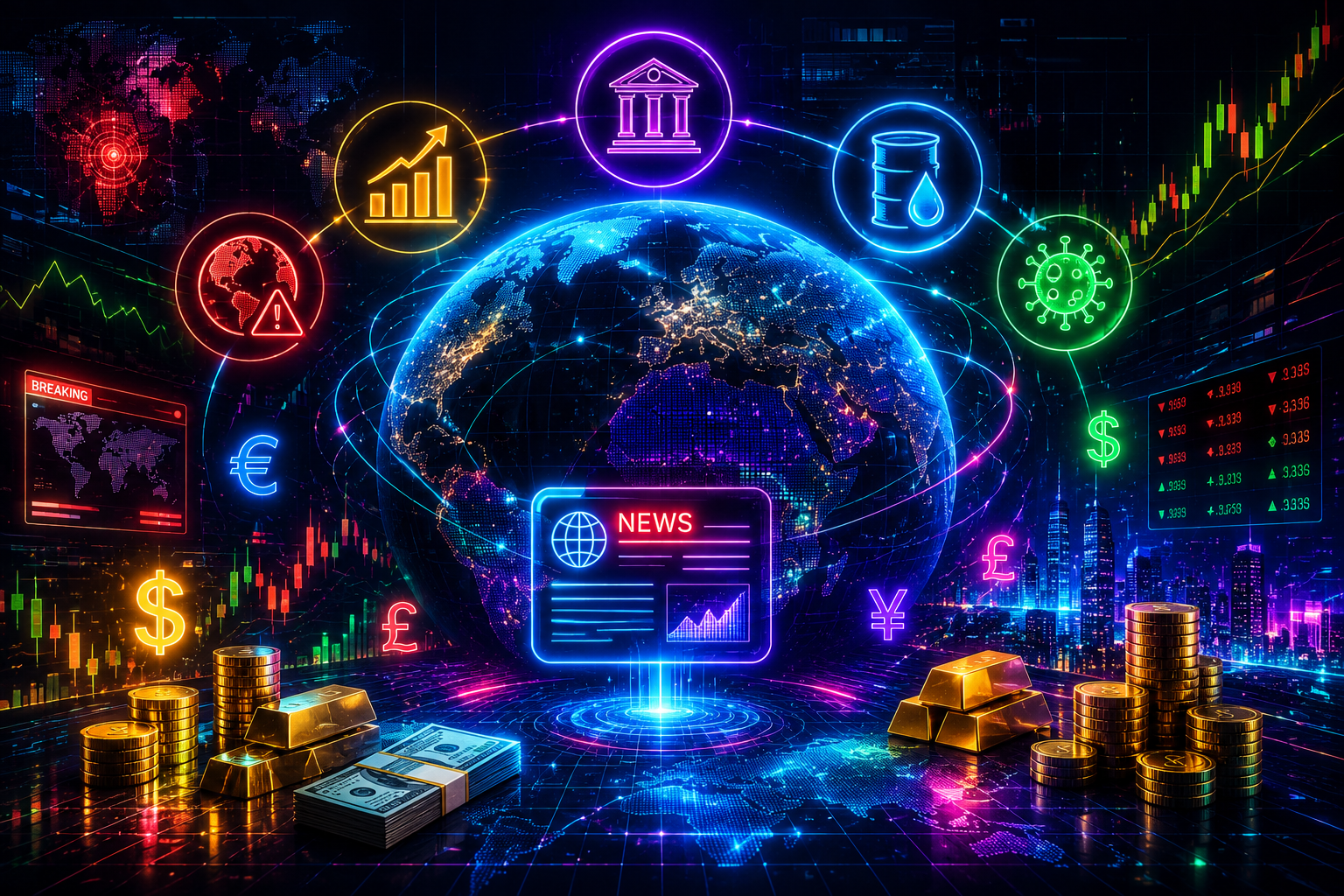
In this article, we’ll look at five of the biggest global economic events traders should watch in August 2026. Rather than trying to predict the future, we’ll look at how these events might affect different markets and what traders are paying attention to.
Let’s dive in.
Top 5 Global Economic Events Every Trader Should Watch
1. The Federal Reserve Still Has the Market’s Attention
If there’s one institution that can move almost every financial market in the world, it’s the Federal Reserve.
Throughout the first half of 2026, investors closely watched every inflation report, employment release, and speech from Fed officials. At its latest meeting, the central bank kept interest rates unchanged at 3.50%–3.75%, showing that policymakers are still trying to balance inflation with economic growth.
As we move through the second half of the year, markets are becoming increasingly data-dependent. Every major economic report has the potential to change expectations about what the Fed could do next.
How could this affect markets?
- US Dollar: Could strengthen if markets expect interest rates to stay higher for longer.
- Gold: May come under pressure if bond yields continue rising, although geopolitical uncertainty could offset some of that pressure.
- Stocks: Technology and growth stocks may remain sensitive to interest rate expectations.
- Bonds: Treasury yields could continue reacting sharply to inflation and employment data.
No one knows what the Fed’s next move will be, but it’s likely to remain one of the biggest drivers of market volatility.
2. Middle East Tensions Continue to Keep Oil Markets on Edge
The conflict involving Iran, Israel, and the United States has remained one of the biggest geopolitical stories of 2026.
One reason traders are paying so much attention is the Strait of Hormuz, a narrow waterway through which roughly 20% of the world’s oil supply passes. Even the possibility of disruptions has been enough to create significant swings in oil prices.
Although diplomatic efforts have reduced some immediate concerns, the situation remains uncertain.
How could this affect markets?
- Oil: Prices could remain volatile if supply concerns increase again.
- Gold: Investors may continue viewing gold as a defensive asset during periods of uncertainty.
- Airlines and transportation companies: Higher fuel costs could pressure profit margins.
- Inflation: Rising energy prices could make inflation more difficult for central banks to control.
- Currencies: Oil-exporting countries may benefit if crude prices remain elevated.
Markets don’t need an actual disruption to react—sometimes uncertainty alone is enough.
3. Trump’s Trade Policies Are Back in Focus
Trade has once again become one of the biggest talking points in global markets.
During the first half of the year, President Trump’s administration expanded tariffs on several imported goods, while businesses continued adjusting their supply chains to deal with changing trade policies.
Now, investors are watching closely to see whether additional tariffs, negotiations, or trade agreements emerge during the rest of the year.
How could this affect markets?
- US Dollar: Could experience increased volatility depending on investor confidence.
- Global stocks: Exporters and multinational companies may react to new trade developments.
- Industrial commodities: Metals such as copper and aluminum could respond to changing global demand.
- Inflation: Higher import costs could eventually feed into consumer prices.
Trade policy often doesn’t affect markets overnight—but its long-term impact on businesses and inflation can be significant.
4. China’s Economy Continues to Slow
China remains the world’s second-largest economy, which means almost every global investor pays attention to its economic data.
Throughout 2026, slower consumer spending, weakness in the property sector, and softer manufacturing activity have continued raising concerns about economic growth.
At the same time, investors are watching to see whether Beijing introduces additional stimulus measures to support the economy.
How could this affect markets?
- Commodities: Copper, iron ore, and industrial metals could remain sensitive to Chinese demand.
- Asian stock markets: New stimulus measures could improve investor sentiment.
- Global companies: Businesses with large exposure to China may experience higher volatility.
- Risk sentiment: Stronger economic data could encourage investors to take on more risk, while weaker numbers may have the opposite effect.
China remains one of the most important economies to watch throughout the rest of 2026.
5. Spain and Morocco: A Regional Story That Markets Are Watching
Not every market-moving event starts as a global crisis.
In recent weeks, rising tensions between Spain and Morocco, particularly around the Spanish enclave of Ceuta, have attracted attention across Europe. The issue has centered on migration, border security, and diplomatic relations, leading to discussions among European leaders.
At the moment, financial markets aren’t treating this as a major global risk. However, traders are watching closely because regional political tensions sometimes grow into broader economic issues.
How could this affect markets?
- Euro: Political uncertainty could contribute to short-term volatility.
- European equities: Tourism, transportation, and logistics companies may become more sensitive if tensions increase.
- Government spending: Additional spending on border security could affect public finances.
- Investor sentiment: If relations between the EU and Morocco become more strained, investors may become more cautious toward certain European assets.
For now, this remains a regional story—but it’s another reminder that politics and markets are often more connected than they first appear.
Why Should Traders Care About the News?
Reading about the Top 5 Global Economic Events Every Trader Should Watch isn’t something you do only when you have free time, it’s a crucial part of your trading journey. A lot of beginners spend hours learning chart patterns but completely ignore what’s happening in the world. The truth is, markets often move because of the news behind the charts, not just the patterns on them.
The truth is, the biggest market moves often start with a headline.
Interest rate decisions, geopolitical tensions, inflation reports, trade policies, and economic growth all shape investor expectations. Understanding these events won’t tell you exactly where the market is going—but it can help you understand why prices are moving.
That’s one of the biggest differences between simply looking at a chart and truly understanding the market.
Wrap up
The first half of 2026 has already reminded us just how quickly the global economy can change.
As we move through the second half of the year, it’s more important than ever to stay aware of what’s happening around the world. Every major headline has the potential to influence financial markets in one way or another. That doesn’t mean we should trade every piece of news—but understanding what’s happening can help us make smarter, more informed trading decisions while staying true to our strategy.
And before anything else, I always recommend practicing your ideas on a demo account. Test your strategy, simulate your decisions, learn from your mistakes, and build confidence before putting real money on the line.
At the end of the day, none of us can predict the future with certainty. Our goal isn’t to guess what the market will do next—it’s to be prepared for different possibilities and manage risk wisely.
We hope and pray for the best for the world… and, of course, for our investment portfolios too. 😄