Table of Contents
How to Read a Forex Economic Calendar Step by Step
How to Read a Forex Economic Calendar Step by Step… Alright, gather around, my future trading gurus. 😄
If you’ve been following this blog, you already know I like building knowledge one step at a time instead of throwing complicated concepts at you all at once.
So far, we’ve talked about how economic news affects financial markets and why major central bank announcements can completely change the direction of prices.
If you haven’t read those guides yet, I’d highly recommend checking them out first because they’ll make today’s lesson much easier to understand.

Now comes the next piece of the puzzle.
Knowing that news moves the market is one thing.
Knowing when that news is coming, how important it is, and what the numbers actually mean is a completely different skill.
That’s exactly why every trader should know how to read a Forex economic calendar step by step.
Think of the economic calendar as your market schedule. It tells you what events are coming, when they’ll happen, which currencies could be affected, and how important each announcement is before it even happens.
If you’re an active trader, checking the economic calendar should become part of your daily routine—just like looking at your charts or planning your trades. It only takes a couple of minutes, but it can save you from getting caught in unexpected market volatility.
So, let’s dive in.
What Is a Forex Economic Calendar?
A Forex economic calendar is one of the most useful tools a trader can have.
It shows upcoming economic reports, central bank meetings, and other events that could move the Forex market.
Instead of being surprised by sudden price swings, you can see important announcements before they happen and plan your trades accordingly.
Most economic calendars include:
- Date and time
- Currency affected
- Event name
- Impact level
- Previous result
- Forecast
- Actual result
Learning how to read a Forex economic calendar step by step helps you understand when the market is likely to become more volatile and why.
Why Should Traders Check the Economic Calendar?
The Forex market reacts to new information.
A single economic report can move a currency within minutes, which is why checking the calendar before trading is such a good habit.
It helps you:
- Prepare for high-impact news.
- Avoid unexpected volatility.
- Improve your trade timing.
- Manage your risk more effectively.
It only takes a minute, but it can save you from costly mistakes.
How to Read a Forex Economic Calendar Step by Step
At first, an economic calendar might look confusing.
The good news is that once you understand a few key sections, reading it becomes much easier.
Let’s go through it step by step.
Step 1: Set Your Local Time
The first step in learning how to read a Forex economic calendar step by step is setting the calendar to your local time.
Most calendars let you change the time zone in the settings. This helps you know exactly when important announcements will happen and prevents you from missing major events.
Step 2: Filter the Events
You don’t need to follow every country.
Filter the calendar so it only shows the currencies you trade.
Keeping your calendar focused makes it much easier to spot the events that matter.
Step 3: Check the Impact Level
Economic calendars usually rank events by their expected market impact.
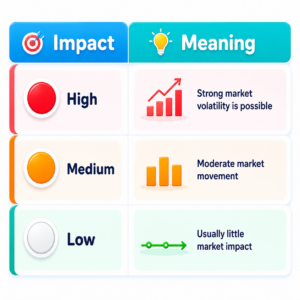
As a beginner learning how to read a Forex economic calendar step by step, pay the most attention to high-impact events like:
- Interest rate decisions
- CPI (Inflation)
- Non-Farm Payrolls (NFP)
- GDP
- Central bank speeches
Keep in mind that a high-impact event doesn’t guarantee the market will move—it simply means traders expect it to be important. The actual reaction depends on the data that’s released.
Step 4: Understand the Event Name
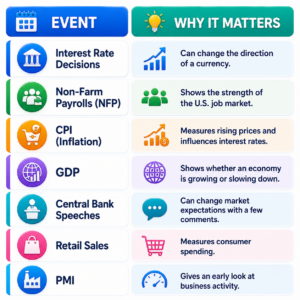
The Event column tells you what report or announcement is about to be released.
Some events matter more than others because they give traders clues about the health of an economy.
Here are some of the reports you’ll see most often:
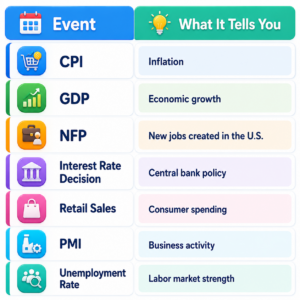
You don’t need to memorize every report on day one.
Start by learning the major events, and you’ll naturally recognize the others over time.
Step 5: Learn the Three Most Important Numbers
If there’s one part of the calendar you should understand, it’s these three columns.
Learning how to read a Forex economic calendar step by step becomes much easier once you know what they mean.
| Column | Meaning |
|---|---|
| Previous | Last reported result |
| Forecast | What economists expect |
| Actual | The number that gets released |
The market usually compares the Actual number with the Forecast, not the Previous result.
If the Actual number surprises traders, prices can move very quickly.
Simple Example
| Previous | Forecast | Actual | Possible Reaction |
|---|---|---|---|
| 3.0% | 3.2% | 3.8% | Stronger currency |
| 3.0% | 3.2% | 2.8% | Weaker currency |
The bigger the surprise, the bigger the market reaction can be.
Why Does the Forecast Matter So Much?
Many beginners think the market only cares if the news is “good” or “bad.”
That’s not how it works.
The market is always looking ahead.
Before the report is released, traders already have expectations. Those expectations are shown in the Forecast column.
When the Actual result is very different from the Forecast, that’s when volatility usually increases.
Think of the Forecast as the market’s prediction.
The Actual result tells traders whether that prediction was right or wrong.
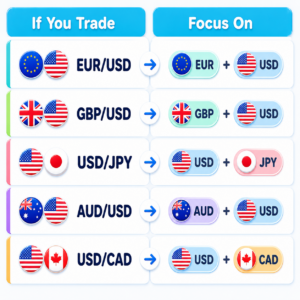
Step 6: Watch Which Currency Is Affected
Every event is linked to a specific currency.
This helps you know which pairs could become more active after the news is released.
| Currency | Common Pairs |
|---|---|
| USD | EUR/USD, GBP/USD, USD/JPY |
| EUR | EUR/USD, EUR/GBP |
| GBP | GBP/USD, EUR/GBP |
| JPY | USD/JPY, EUR/JPY |
| AUD | AUD/USD |
| CAD | USD/CAD |
For example, if the calendar shows an important U.S. inflation report, you should pay close attention to pairs that include the U.S. dollar.
That doesn’t mean other markets won’t move, but USD pairs usually react first.
Step 7: Check the Calendar Before You Trade
One of the best habits you can build is checking the calendar before opening any position.
It only takes a minute.
Before entering a trade, ask yourself:
- Is there any high-impact news today?
- Which currency will it affect?
- What time is it scheduled?
- Should I wait until the announcement is over?
Professional traders don’t wait until the news appears on TV.
They already know what’s coming because they checked the calendar earlier in the day.
This simple habit can help you avoid unnecessary risk and make better trading decisions.