
Table of Contents
The Biggest Sectors Italy’s Economy Relies On
The Biggest Sectors Italy’s Economy Relies On….Ciao, fellow traders!….Italy, oh, what a beautiful country! The source and home of art, fashion, architecture, creativity, and incredible food, all in one place. Italy is one of my favorite countries in the world. I hope to visit one day and experience its remarkable mix of history, culture, fashion, and technology.
And you know me: whenever I love something, I want to explore the side that interests the investor in me, too.
Today, we’re taking a closer look at Italy’s economy. Where is Italy? How did its economy develop? Which industries support it, what are its biggest companies, and what should traders know about its financial markets?

Let’s dive in.
Where Is Italy?
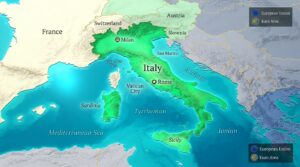
Let’s learn where is Italy before we learn The Biggest Sectors Italy’s Economy Relies On…..Italy is a country in Southern Europe, located in the Mediterranean Sea. Its distinctive boot-shaped peninsula extends into the Mediterranean, with Sicily and Sardinia as its two largest islands.
Italy shares land borders with France, Switzerland, Austria, and Slovenia. It also surrounds two independent states: Vatican City and San Marino.
Its capital is Rome, while Milan is one of its most important financial and business centres.
Italy is a founding member of the European Union and is part of the euro area.
A Brief History of Italy
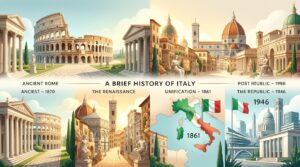
Italy has played a major role in European and world history. It was the centre of the Roman Empire, which influenced law, architecture, government, language, and infrastructure across large parts of Europe and the Mediterranean.
Centuries later, Italian cities such as Florence, Venice, and Rome became major centres of the Renaissance, shaping art, science, literature, and architecture.
Modern Italy became a unified kingdom in 1861 and a republic in 1946. Its history helped shape the country’s global reputation for design, craftsmanship, engineering, and culture.
A Brief Overview of Italy’s Economy
Before we dig deep in the The Biggest Sectors Italy’s Economy Relies On we have to know that Italy has the third-largest economy in the euro area and is one of the world’s major industrial and exporting countries. Its economy combines a large services sector with a strong manufacturing base and internationally recognized specialist industries.
Italian businesses export machinery, pharmaceuticals, vehicles, fashion products, food, beverages, and advanced industrial equipment to markets around the world. Tourism also plays an important role in employment and economic activity.
Italy’s Currency: The Euro
Italy uses the euro (€), shared by countries in the euro area.
Italy adopted the euro as its official currency on 1 January 1999, initially for electronic and financial transactions. Euro banknotes and coins entered circulation on 1 January 2002, replacing the Italian lira.
For traders, the euro is particularly important because Italy’s economic performance, political developments, and trade relationships can contribute to movements in EUR currency pairs.
The Biggest Sectors Italy’s Economy Relies On
Italy’s economy is highly diversified. According to World Bank data for 2024, services accounted for approximately 66% of GDP, industry around 22%, and agriculture about 2%. These figures show why Italy is more than a manufacturing and fashion powerhouse: services also represent a major part of its economic activity.
1. Manufacturing and Machinery
Manufacturing is one of Italy’s strongest economic foundations. The country is known for industrial machinery, precision engineering, automation, robotics, and equipment used in other manufacturing industries.
Italian machinery is exported worldwide, supporting industries such as food processing, construction, packaging, and automotive production. The United States International Trade Administration identifies machinery as one of Italy’s particularly strong manufacturing fields.
2. Automotive Industry
Italy has a long automotive history, with internationally recognised names such as Ferrari, Lamborghini, Maserati, and Fiat. The industry includes vehicle production, automotive components, engineering, and high-performance technology.
The sector is also adapting to electric mobility and changing global competition, making production costs, consumer demand, and the transition to cleaner vehicles important issues to watch.
3. Fashion and Luxury Goods
When people think of Italian fashion, names such as Prada, Gucci, Armani, and Versace often come to mind. But this industry goes beyond famous brands. It includes textiles, footwear, leather goods, jewellery, accessories, and furniture design.
Italian fashion and luxury products benefit from the country’s reputation for craftsmanship and design. The official Invest in Italy platform identifies fashion, design, and furniture as important areas of national specialisation.
4. Food and Agriculture
Italian food is recognised worldwide, but the industry is much larger than restaurants and traditional dishes. Agriculture and food processing support exports of wine, olive oil, cheese, pasta, packaged foods, and other agricultural products.
Italy also has a large number of specialised food and beverage businesses and hundreds of protected-origin food products. This makes agrifood an important part of its manufacturing and export identity.
5. Tourism and Hospitality
Rome, Venice, Florence, Milan, and the Amalfi Coast attract visitors from around the world. Tourism supports hotels, restaurants, transport, retail, entertainment, and cultural attractions.
According to the OECD, tourism directly accounted for 5.4% of Italy’s gross value added in 2023 and employed approximately 2.1 million people. International travel also represented 37.9% of total service exports in 2024.
6. Pharmaceuticals and Chemicals
Italy has an established pharmaceutical and chemical industry, supported by manufacturing capabilities, scientific research, and skilled professionals. Its pharmaceutical exports are also significant: pharmaceutical products represented around 8.7% of Italian exports in 2024, according to trade data.
7. Energy and Utilities
Energy is another important part of the Italian economy. The sector includes electricity generation, oil and gas, renewable energy, and the infrastructure needed to distribute power.
Companies such as Enel and Eni are major names in this space. Energy prices and supply conditions matter to Italian businesses because they influence production costs, inflation, and household spending.
8. Banking and Financial Services
Italy has a substantial banking and insurance industry. Banks provide financing to households and businesses, while insurance companies and financial institutions play an important role in the country’s capital markets.
Major financial groups such as UniCredit, Intesa Sanpaolo, and Generali are among the most prominent listed Italian companies.
Italy’s Economy in 2026: What Is Happening?
The Biggest Sectors Italy’s Economy Relies On make Italy one of the biggest economies in the world …Italy remains one of Europe’s largest economies, but its growth outlook is modest.
The European Commission’s May 2026 forecast projected real GDP growth of 0.5% in 2026, matching its estimate for 2025. It also projected inflation of 3.2% in 2026, with public debt expected to reach 138.5% of GDP.
European Commission
Several factors are important to the outlook:
-
Economic growth:
Investment supported by European recovery funds is helping activity, but domestic consumption remains subdued.
-
Exports:
International trade conditions, tariffs, and geopolitical disruptions are creating challenges for Italian exporters.
-
Inflation:
Higher energy prices are expected to push inflation upward during 2026.
-
Public debt:
Italy’s high debt burden remains a major long-term economic challenge.
Italy’s Biggest Stock Market Companies
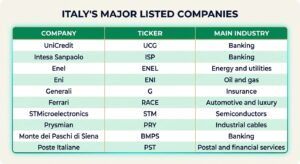
Italy’s main stock exchange is Euronext Milan, and its leading share index is the FTSE MIB. It includes major Italian companies across banking, energy, insurance, manufacturing, and luxury goods.
Here are some of the largest listed companies by market capitalisation, using a September 21, 2026 market snapshot. Rankings and valuations change with share prices.
Trading Opportunities: What Should Traders Watch?
-
EUR currency pairs:
Italian economic data, political developments, and wider eurozone conditions can influence the euro. Watch EUR/USD and EUR/GBP.
-
Italian stocks:
Banking, energy, automotive, and luxury companies may react to earnings, interest rates, consumer demand, and international trade.
-
FTSE MIB:
This index provides exposure to leading Italian-listed companies and can reflect changes in investor sentiment toward Italy.
-
European government bonds:
Italian government bond yields are worth monitoring because debt levels, inflation, and European Central Bank policy can affect borrowing costs.
-
Gold and oil:
Global economic uncertainty and energy supply developments can influence these commodities, although their prices are driven by international factors, not Italy alone.
FAQS About Top Industries Italy’s Economy Depends On
What are Italy’s main industries?
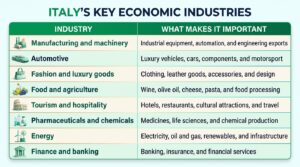
Italy’s main industries include manufacturing, machinery, automotive, fashion, food processing, agriculture, tourism, pharmaceuticals, energy, and financial services.
What is Italy’s biggest economic sector?
Services are the largest broad sector, accounting for approximately 66% of GDP in 2024, according to World Bank data.
What is Italy’s currency?
Italy uses the euro (€), which it adopted in 1999 before euro cash entered circulation in 2002.
What are Italy’s biggest exports?
Major Italian exports include machinery, pharmaceutical products, vehicles, electrical equipment, fashion products, food, and beverages.
What is Italy’s economic outlook for 2026?
The European Commission’s May 2026 forecast projected real GDP growth of 0.5% and inflation of 3.2% for 2026.
What is Italy’s main stock market index?
The FTSE MIB is the main benchmark index of Euronext Milan. It tracks major companies listed on the Italian market.
Wrap-up
Italy’s economy is a fascinating combination of traditional industries and modern innovation. From machinery and automotive production to fashion, tourism, pharmaceuticals, and financial services, its economic strength comes from a diverse range of businesses and global industries.
Please remember to review the complete series. We’ve already covered France and Germany, so make sure to read those articles as well.
If you want to explore trading opportunities, you can start with a Caveo FX demo account to practise in a simulated environment before considering a real trading account. You can also explore our articles about other economies to understand how different countries influence global markets.