

Table of Contents
What Is the Best Time of Day to Trade?
What Is the Best Time of Day to Trade? …Hello, fellow traders!….By now, you probably know that trading can be an appealing career for people who value flexibility and know how to manage their time. Whether you are looking for an alternative to the traditional 9-to-5 routine or trying to fit trading around your existing job, one of the things that makes this field interesting is the ability to choose when you trade.
But flexibility does not mean that every hour is equally suitable for trading. Markets have their own rhythms. Some periods are busy, with more traders participating and prices moving quickly. Others are quieter, with fewer opportunities and sometimes wider spreads.
And just like anything else, there are a few tips that can help you make better use of your time.
In this article, we will explore what is the best time of day to trade, how trading hours and market sessions work, and how to choose a trading schedule that suits your strategy.

Let’s dive in!
What Makes Certain Hours Better for Day Trading?
The best trading hours are generally those when market activity matches your strategy. But what makes one period more suitable than another?
A few important factors can help explain the difference.
Liquidity
Liquidity refers to how easily an asset can be bought or sold without significantly affecting its price.
When more market participants are active, there are generally more buyers and sellers available. This can make it easier to enter and exit positions at prices closer to the ones you expect.
Periods of higher liquidity can also come with tighter spreads, although this depends on the instrument and broker.
Volatility
Volatility describes how much and how quickly prices move.
Some traders prefer active periods because larger price movements may create more opportunities for short-term strategies. However, volatility can work in both directions. Prices can move against a position just as quickly as they can move in its favour.
More movement does not automatically mean better trading conditions.
Trading volume
Trading volume measures how much of an asset is being traded during a particular period.
Higher volume often indicates greater market participation. It can help traders assess whether a price movement has broad participation behind it or is happening in a relatively quiet market.
For example, a breakout accompanied by higher trading volume may carry more significance than one that occurs during a quiet period. However, volume alone cannot confirm that a price movement will continue.
Spreads and execution
Trading costs matter just as much as market movement.
The spread is the difference between an asset’s buying and selling prices. During quieter periods, spreads may widen, depending on the instrument and market conditions. Slippage can also occur when an order is executed at a different price from the one requested.
This is why the best time of day to trade is not necessarily the time when prices move the most. It is the period when liquidity, volatility, trading costs and your strategy work together.
Understanding Trading Hours and Market Sessions
Before choosing your trading schedule, it helps to understand how financial markets operate. Trading hours are not the same across all markets, and activity can change depending on the instrument, the time of day and which financial centres are open.
What are trading hours?
Trading hours are the periods during which a financial instrument or market is available for trading.
Stock exchanges usually have fixed opening and closing times. The New York Stock Exchange (NYSE), for example, operates during regular hours from 9:30 AM to 4:00 PM Eastern Time on normal trading days.
Forex works differently. It is an over-the-counter (OTC) market, meaning there is no single central exchange. Instead, currency trading takes place through a global network of banks, financial institutions, brokers and other participants.
As major financial centres open and close around the world, trading activity moves between regions. This is why the forex market generally operates 24 hours a day, five days a week, from Sunday evening to Friday evening in the US time zone.
Other markets, including futures and cryptocurrencies, follow their own schedules. Some futures contracts trade for extended hours on business days, while cryptocurrency markets generally remain open throughout the week.
What are trading sessions?
Trading sessions are the main periods of activity associated with major financial centres around the world.
In the foreign exchange market, four sessions are commonly followed: Sydney, Tokyo, London and New York.
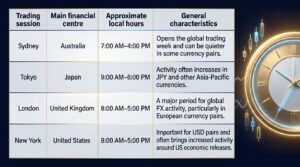
These are approximate local session hours. They are not fixed UTC times, and the time difference between sessions changes during daylight saving time.
Why do session overlaps matter?
When two major financial centres are open at the same time, their trading activity overlaps. This can bring more market participants into the market, increasing liquidity, trading volume and, in some cases, volatility.
The London–New York overlap is particularly important for forex traders. Both centres are major participants in global currency trading, and popular pairs such as EUR/USD and GBP/USD often experience increased activity during this period.
The Sydney–Tokyo and London–Tokyo overlaps can also be relevant, particularly for traders following AUD, NZD and JPY pairs or looking at the transition between Asian and European market activity.
However, an overlap does not guarantee a strong price movement or a profitable setup. Economic news, market sentiment and unexpected events can all influence activity.
How do trading hours differ across financial markets?
Forex is not the only market where timing matters. Stocks, indices, commodities, futures and cryptocurrencies all have different trading schedules and periods of activity.
| Market | General trading hours | Periods traders often monitor | What to consider |
|---|---|---|---|
| Forex | 24 hours a day, five days a week | Major session openings and overlaps, particularly London–New York | Activity depends on the currency pair and the financial centres involved. |
| US stocks | 9:30 AM–4:00 PM Eastern Time, Monday–Friday | First and final trading hours | The opening and closing periods can bring increased volume and price movement. |
| European stocks | Varies by exchange; major European markets generally open around 8:00–9:00 AM local time | Market opening and closing periods | Follow the local exchange schedule and the stocks you trade. |
| Stock indices | Depends on the underlying index, exchange and broker | Main trading hours of the underlying stock market | Index CFDs may have longer broker-provided hours than the underlying exchange. |
| Commodities | Depends on the commodity and exchange or broker | Periods of stronger activity in the relevant futures market | Gold and oil can react to economic data, inventory reports and geopolitical developments. |
| Futures | Depends on the contract and exchange; many major contracts trade for extended hours | The most active periods of the underlying market | Overnight trading may have different liquidity and volatility from the main session. |
| Cryptocurrencies | Generally 24 hours a day, seven days a week | Periods of increased volume and activity | There is no traditional daily market opening, but liquidity can vary throughout the day. |
Trading hours vary by exchange, contract and broker. CFD trading hours may differ from the opening hours of the underlying exchange. Always check the schedule for the specific instrument you intend to trade.
What happens during the opening and closing hours?
Some periods of the trading day attract more attention than others. In the US stock market, for example, traders often monitor three broad windows:
- The first hour (9:30–10:30 AM ET): Activity can increase as traders react to overnight developments, new information and the market opening.
- The midday period (around 11:30 AM–2:00 PM ET): Trading may become quieter compared with the opening hours, although this depends on market conditions.
- The final hour (3:00–4:00 PM ET): Activity can pick up again as investors adjust positions before the market closes.

These are common tendencies rather than fixed rules. Economic announcements, earnings reports and unexpected developments can change the pattern.
It is also important to distinguish regular stock market hours from futures trading hours. Futures contracts may remain available outside the regular stock market session, depending on the exchange and contract.
What about pre-market, after-hours and overnight trading?
Some markets offer trading opportunities outside their regular daytime sessions.
Pre-market trading takes place before the main stock market session opens, while after-hours trading continues after the regular session closes. Overnight trading refers to activity outside the main daytime session, although the exact schedule depends on the market and instrument.
These extended hours can provide flexibility, but they also have some limitations:
- Lower liquidity may make it harder to enter or exit at your preferred price.
- Spreads may become wider.
- Price movements can be sharper around important announcements.
- Price gaps may occur between sessions.
Before trading outside regular hours, check the instrument’s schedule and understand how your broker handles orders during these periods.
What Is Timing in Trading?
Timing in trading refers to choosing the right moment to enter or exit a trade. It involves analysing price movements, market conditions, volatility and technical signals to decide when an opportunity may be suitable.
What Is Time in Trading?
Time in trading refers to the hours, sessions or periods during which a market is open and trades can be placed. For example, forex trading generally runs 24 hours a day, five days a week, while stock markets follow specific exchange hours.
Does daylight saving time affect trading hours?
Yes. Trading sessions do not always maintain the same relationship with UTC throughout the year.
Countries change their clocks for daylight saving time on different dates. The United States, United Kingdom and Australia, for example, do not necessarily switch on the same day. As a result, the time difference between financial centres can temporarily change.
If you follow the London or New York session, check the current opening hours rather than relying on a timetable you saved months ago. This is particularly important when planning around session overlaps or economic announcements.
How to Choose the Best Trading Hours for Your Strategy
So, what is the best time of day to trade?
There is no single answer that works for every trader. The right schedule depends on the market you follow, the strategy you use and the conditions you prefer. Your available time and experience also matter.
Here are a few things to consider.
Which trading hours suit different trading styles?
Different trading strategies rely on different market conditions. Some require frequent price movement and strong liquidity, while others can work with quieter markets and longer holding periods.
| Trading style | Typical holding period | Hours or conditions that may suit it | Why |
|---|---|---|---|
| Scalping | Seconds to several minutes | Active sessions and periods of higher liquidity | Frequent price movements and tighter spreads can matter when targeting small price changes. |
| Day trading | Minutes to several hours | Major market openings and session overlaps | These periods can provide more activity and intraday price movement. |
| Momentum trading | Minutes to hours | Periods when volume and volatility increase | Traders look for strong price movements that may continue in the same direction. |
| Breakout trading | Minutes to hours, depending on the setup | Market openings, session overlaps and periods following consolidation | Increased participation may support a breakout, although false breakouts remain possible. |
| Range trading | Minutes to hours or longer | Quieter periods when prices remain within established support and resistance levels | More stable conditions may suit strategies that look for price movements within a defined range. |
| Swing trading | Several days to weeks | No specific intraday window is required | Decisions usually depend more on broader trends and higher timeframes than on a particular trading hour. |
| Position trading | Weeks to months | No specific intraday window is required | Traders focus on longer-term market conditions rather than short-term price fluctuations. |
These are general examples, not strict rules. A strategy can behave differently depending on the instrument, market conditions and trading costs.
Start with the instrument you trade
Different instruments have different activity patterns, so begin by understanding the market you want to follow.
For example:

These are useful starting points, not guaranteed trading opportunities. The same instrument can behave differently from one session to another.
Match the hours to your strategy
Your trading approach should influence when you trade.
Scalpers, for example, may prefer periods with strong liquidity and enough price movement to support short-term setups. Day traders using technical levels may focus on the opening of a major session or wait for a clearer direction to develop.
Other traders may prefer quieter conditions, depending on their strategy and the instrument they follow.
The important thing is to understand what conditions your strategy requires instead of choosing trading hours simply because they are popular.
Check the economic calendar
Economic announcements can change market conditions within seconds.
Interest rate decisions, inflation reports, employment figures and central bank speeches can all trigger sharp price movements. These events may create opportunities, but they can also increase uncertainty and the risk of slippage.
Before opening a trade, check whether an important announcement is scheduled. You may decide to stay out of the market around the release or adjust your position size and risk limits accordingly.
Use charts and indicators to assess market conditions
Choosing an active session is only one part of the process. You also need to understand what the market is doing during that period.
A few technical tools can help you assess price action:
- Moving averages: Help identify the broader direction of a trend.
- Relative Strength Index (RSI): Measures momentum and can highlight potentially overbought or oversold conditions.
- MACD: Helps assess changes in momentum and possible trend shifts.
- Trading volume: Shows the level of market participation behind a price movement.
- Chart patterns: Can help identify potential continuation or reversal setups.
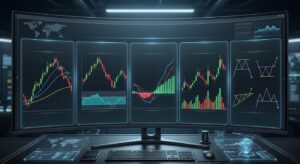
For example, a breakout during an active session may attract attention, but checking volume can help you assess whether there is meaningful participation behind the move. A breakout accompanied by higher volume may carry more significance than one occurring during a quiet period. Neither guarantees that the price will continue in the same direction.
It can also help to compare different chart timeframes. If you are analysing a 5-minute chart, reviewing the 1-hour or 4-hour chart can give you a broader view of the market trend and help put short-term movements into context.
Is it good to trade forex at night?
It depends on the currency pairs you follow and the conditions you prefer.
Night trading can offer quieter conditions when the major European and US sessions are closed. This may suit some strategies that look for smaller price movements or range-bound markets.
However, lower activity can also mean wider spreads and reduced liquidity. If you trade pairs involving the Japanese yen or Australian dollar, the Asian session may be more relevant than it would be for a trader focusing on EUR/USD or GBP/USD.
The important thing is not whether you trade during the day or at night, but whether the conditions suit your strategy.
Consider your own schedule
One of the advantages of flexible trading hours is that you can build a routine around your other responsibilities.
If you have a full-time job, for example, you may prefer to follow one particular session for a limited period rather than trying to monitor the markets throughout the day.
You do not need to trade every session or catch every price movement. Choose a realistic time window, prepare before it begins and focus on setups that meet your trading criteria.
Managing Risk and Execution Across Different Sessions
Finding a suitable trading window is only one part of the process. Market conditions can change quickly, so your risk management should adapt as well.
Adjust your position size
A more volatile market may require a different approach to position sizing.
If prices are moving quickly, consider whether your usual position size and stop-loss distance still make sense. Avoid increasing your exposure simply because the market is more active.
Pay attention to spreads and slippage
A trading opportunity can look attractive on a chart but become less appealing once trading costs are considered.
Monitor spreads during different sessions and pay attention to how your orders are executed. This is particularly important when trading less liquid instruments or during periods of unexpected volatility.
Watch out for false breakouts
A price moving above resistance or below support does not necessarily mean the breakout will hold.
This can be particularly important during periods of increased volatility, when prices may move sharply before reversing. Waiting for confirmation, checking volume and defining your risk before entering can help you avoid reacting too quickly.
Avoid overtrading
Not every market movement deserves a trade.
Trying to trade every session can lead to unnecessary decisions, especially when you are tired or distracted. Set clear limits for your trading activity and take breaks when needed.
Review and adapt
Market conditions are not permanent. Liquidity, volatility and trading volume can change with economic developments, holidays and shifts in market sentiment.
Review your routine regularly and make adjustments when your trading records show that something is not working.
Frequently Asked Questions about What Is the Best Time of Day to Trade?
1. What is the best time of day to trade?
There is no universal best time. It depends on the market, instrument and trading strategy. Forex traders often monitor the London–New York overlap, while stock traders may focus on the opening and closing hours of their chosen exchange.
2. What is the best time to trade forex?
The London session and the London–New York overlap are often among the most active periods for forex trading. However, the most suitable time depends on the currency pair. For example, the Asian session may be more relevant for traders following JPY, AUD and NZD pairs.
3. What are the most active forex trading sessions?
London and New York are two of the major forex trading centres. Their overlap often attracts significant market participation, particularly in major currency pairs such as EUR/USD and GBP/USD. The Tokyo and Sydney sessions are also important, especially for Asia-Pacific currencies.
4. Is it better to trade in the morning or afternoon?
It depends on the market and your time zone. In US stock markets, the opening hour can bring increased activity, while the final hour may see another rise in trading volume. In forex, the London and New York sessions are often more relevant than simply choosing morning or afternoon.
5. Can you trade forex at night?
Yes. Forex generally operates 24 hours a day, five days a week. Night trading may suit traders who prefer quieter conditions or follow Asian currency pairs. However, lower liquidity and wider spreads can make some periods less suitable for certain strategies.
6. Are market overlaps always the best time to trade?
Not necessarily. Overlaps can bring higher liquidity and volatility because more financial centres are active at the same time. But they can also bring sharper price movements and greater uncertainty. A suitable trading opportunity still depends on your strategy and risk management.
7. Do trading hours change during the year?
Yes. Daylight saving time changes can shift the opening and closing times of major financial sessions relative to each other and to UTC. Check the current schedule of the market you follow, particularly when planning around session overlaps.
8. Do I need to trade every day to become a better trader?
No. Trading more frequently does not automatically improve your results. Having a clear strategy, preparing for your chosen sessions and reviewing your performance can be more useful than entering trades simply to stay active.
Wrap up
The best time to trade is the time that works with your strategy, your schedule and the market conditions you understand. Start by following a session, learn how your chosen instruments behave and give yourself time to build a routine.
You do not have to watch the markets all day or trade every opportunity. A clear plan, patience and consistent risk management can make your trading hours more focused.
Whether you are new to trading or looking to refine your approach, the right way to start is with a platform and trading environment that suit your needs.
Open a Caveo FX demo account to explore the markets and practise your strategies in a simulated environment without risking real trading capital.
Ready to take the next step? Explore our live trading accounts and find an account that matches your trading needs.
Trading involves risk. Content is for educational purposes only and does not constitute investment advice.