

Table of Contents
Top 10 Strongest Currencies in the World
Top 10 Strongest Currencies in the World….Hello, fellow traders!…You know that in this series, I always try to bring together the top 10 lists that genuinely matter to people, using real data and meaningful numbers.
And you know me: even when a list doesn’t seem directly related to the economy, we’ll find the connection to investing and financial markets. Because almost everything happening around the world has an economic perspective if you look closely enough.
But this time, we’re exploring a topic that is directly connected to trading and the financial markets: the top 10 strongest currencies in the world.
You might expect the US dollar to take the first position. After all, it dominates international trade and is the world’s most traded currency. But here’s the surprise: it isn’t the most valuable currency when we compare the price of one currency unit against the US dollar.

So, what makes a currency strong? Which currencies have the highest value? And does having the strongest currency automatically make it the best one to trade?
Let’s dive in!

What Is a Currency?
A currency is a system of money issued or authorised by a country or monetary authority and used to buy goods and services, pay debts, and measure the value of products and assets.
Every currency has a name and an internationally recognised three-letter code. For example:
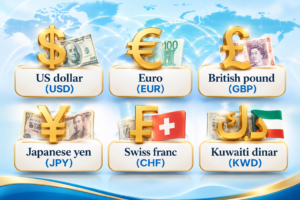
Currencies are also traded against one another in the foreign exchange market, commonly known as Forex.
When you see a currency pair such as EUR/USD, you are looking at the value of the euro compared with the US dollar. The first currency is called the base currency, while the second is the quote currency.
Currency values change for different reasons, including interest rates, inflation, economic performance, political developments, central bank decisions, and international demand.
How Is a Currency Rated as Strong?
Before looking at the ranking, we need to understand something important: currency strength can mean different things depending on how it is measured.
For this article, we will rank currencies according to their nominal exchange value against the US dollar.
In simple terms, we will ask:
How many US dollars can one unit of a particular currency buy?
For example:
- 1 Kuwaiti dinar is worth approximately $3.23.
- 1 British pound is worth approximately $1.34.
- 1 US dollar is worth $1.
Based on this measurement, the Kuwaiti dinar ranks above the US dollar.
However, a high exchange value per unit does not necessarily mean that a country has the world’s strongest economy or that its currency is the most widely traded.
Other factors also help determine a currency’s broader strength:
1. Economic stability
Countries with stable economic conditions, sustainable growth, and confidence in their financial systems may attract more international investment.
2. Inflation
When inflation remains under control, a currency may preserve more of its purchasing power over time. High inflation, on the other hand, can weaken confidence in a currency.
3. Interest rates
Central bank interest-rate decisions influence investment flows. Higher interest rates can attract foreign capital, although the relationship also depends on inflation expectations and economic risks.
4. Political stability
Political uncertainty, conflicts, and unexpected policy changes can affect investor confidence and currency demand.
5. Foreign exchange reserves
Central banks hold foreign currencies and other reserve assets to support financial stability and meet international obligations.
6. International demand
Currencies used in global trade, investment, and financial transactions can benefit from consistent international demand.
These factors help explain currency movements, but they do not all determine the nominal value of one currency unit.
Top 10 Strongest Currencies in the World in 2026
The following ranking compares the approximate US dollar value of one unit of each currency. Exchange rates change, so the figures should be understood as a dated snapshot rather than fixed values for the entire year.
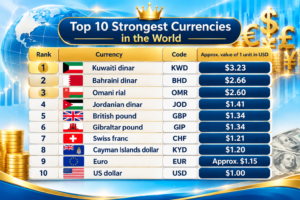
1. Kuwaiti dinar (KWD)
The Kuwaiti dinar is the highest-valued currency in the world by nominal exchange rate against the US dollar.
Kuwait has a relatively small economy with significant oil and gas resources. Petroleum exports play a major role in government revenue, international trade, and the country’s economic activity.
The dinar is managed against a basket of international currencies rather than being freely floated against the US dollar. This exchange-rate framework is one reason its value has remained high.
Why it matters: The Kuwaiti dinar is an important example of how exchange-rate policy, economic structure, and currency management influence a currency’s nominal value.
2. Bahraini dinar (BHD)
The Bahraini dinar ranks second, with one dinar worth approximately $2.66.
Bahrain has an economy supported by financial services, manufacturing, aluminium production, and energy. Its financial sector has helped establish the country as an important banking and business centre in the Gulf region.
The Bahraini dinar is pegged to the US dollar, which helps maintain a stable exchange rate against it.
Why it matters: Its fixed exchange rate makes the Bahraini dinar less exposed to daily market fluctuations against the US dollar than freely floating currencies.
3. Omani rial (OMR)
The Omani rial is the third-highest-valued currency in this ranking, with one rial worth approximately $2.60.
Oman’s economy relies heavily on oil and gas, while the government has also been working to expand tourism, logistics, manufacturing, and other non-oil industries.
The Omani rial is pegged to the US dollar, providing a relatively stable exchange-rate relationship.
Why it matters: The currency demonstrates the influence of exchange-rate arrangements and the country’s economic and export structure.
4. Jordanian dinar (JOD)
The Jordanian dinar ranks fourth, with one dinar worth approximately $1.41.
Jordan’s economy includes services, tourism, manufacturing, pharmaceuticals, and international trade. Unlike some of the other currencies near the top of this list, Jordan does not have the same level of oil wealth as several Gulf economies.
The Jordanian dinar has been pegged to the US dollar for decades.
Why it matters: Its high nominal value shows why a currency’s exchange rate should not be used as a direct measurement of a country’s wealth.
5. British pound (GBP)
The British pound sterling is the official currency of the United Kingdom and one of the world’s major international currencies.
The UK has a diversified economy, with important contributions from financial services, professional services, technology, manufacturing, healthcare, and creative industries.
Unlike the first four currencies in this ranking, sterling has a floating exchange rate. Its value responds to market demand, Bank of England decisions, inflation, economic data, and political developments.
Why it matters: The pound is widely traded in the foreign exchange market and is a major currency in international finance.
6. Gibraltar pound (GIP)
The Gibraltar pound is the official currency of Gibraltar, a British Overseas Territory located at the southern tip of the Iberian Peninsula.
Gibraltar’s economy is supported by financial services, online gaming, tourism, shipping, and related business activities.
The Gibraltar pound is maintained at par with the British pound sterling. This means one Gibraltar pound is equivalent in value to one British pound.
Why it matters: Its position in the ranking is closely connected to its one-to-one relationship with sterling. It is not an independent major floating currency like the British pound.
7. Swiss franc (CHF)
The Swiss franc is the official currency of Switzerland and is widely associated with financial stability.
Switzerland has a highly developed economy supported by pharmaceuticals, financial services, precision manufacturing, machinery, chemicals, and luxury products.
The Swiss franc has a floating exchange rate and is often considered a safe-haven currency. During periods of uncertainty, some investors increase their demand for it.
Why it matters: The Swiss franc is an important currency in global Forex markets, particularly when investors are responding to geopolitical and financial uncertainty.
8. Cayman Islands dollar (KYD)
The Cayman Islands dollar is the official currency of the Cayman Islands, a British Overseas Territory in the Caribbean.
The territory has an economy strongly supported by financial services, investment funds, banking, insurance, and tourism.
The Cayman Islands dollar is pegged to the US dollar at a fixed rate, which helps explain its relatively high nominal value.
Why it matters: Its exchange-rate value is maintained through a fixed relationship with the US dollar rather than being determined by unrestricted daily market movements.
9. Euro (EUR)
The euro is the official currency of the euro area and is used by multiple European Union member states.
The eurozone represents one of the world’s largest economic regions, with major industries including manufacturing, automotive production, pharmaceuticals, technology, financial services, and international trade.
The euro is a floating currency managed through the monetary policy of the European Central Bank.
Why it matters: The euro is the second-most traded currency in the world and plays a major role in international payments, investment, and foreign exchange markets.
10. US dollar (USD)
The US dollar is the official currency of the United States and one of the most influential currencies in the global financial system.
The American economy is highly diversified, with major contributions from technology, financial services, manufacturing, energy, healthcare, consumer spending, and international trade.
Although it does not rank first by nominal value per unit, the US dollar remains the world’s most traded currency and the leading currency in official foreign exchange reserves.
Why it matters: The dollar is central to global Forex trading, commodity pricing, international finance, and monetary reserves.
Why Do Several Middle Eastern Currencies Lead the Ranking?
Kuwait, Bahrain, Oman, and Jordan occupy the first four positions. However, their rankings should not be interpreted as a direct comparison of their economic sizes or living standards.
A major factor is their exchange-rate systems.
- Kuwait: The dinar is managed against a basket of currencies.
- Bahrain: The dinar is pegged to the US dollar.
- Oman: The rial is pegged to the US dollar.
- Jordan: The dinar is pegged to the US dollar.
A currency peg or managed exchange-rate system can maintain a particular nominal value against another currency. This means the ranking reflects monetary policy choices as well as economic conditions.
Oil and gas exports also play an important role in the economies of Kuwait, Bahrain, and Oman, although each country has a different economic structure and diversification strategy.
Does the Strongest Currency Have to Be the Biggest in the Trading World?
Absolutely not! This is one of the most important distinctions traders should understand.
The strongest currency by nominal exchange value is not necessarily the most traded currency.
For example, the Kuwaiti dinar is worth more than three US dollars per unit. However, the US dollar dominates global Forex trading.
According to the Bank for International Settlements’ 2025 Triennial Central Bank Survey:
- Global foreign exchange trading reached approximately $9.6 trillion per day in April 2025.
- The US dollar was involved in 89% of all foreign exchange transactions.
- The euro ranked second, involved in 28.9% of transactions.
- The Japanese yen ranked third, involved in 16.8% of transactions.
These percentages add up to approximately 200% because every Forex transaction involves two currencies.
So why is the US dollar so dominant?
1. International trade: The dollar is widely used for international transactions, including the pricing and settlement of many commodities.
2. Global reserves: Central banks around the world hold significant amounts of US dollar assets as part of their foreign exchange reserves.
3. Financial markets: The United States has deep and highly developed financial markets, attracting investors and institutions worldwide.
4. Liquidity: The dollar is traded in enormous volumes, making it a central currency in the global financial system.
The IMF’s currency-reserve data also demonstrate the dollar’s importance. In the fourth quarter of 2025, the US dollar represented 56.77% of allocated global foreign exchange reserves, compared with 20.25% for the euro.
This tells us something important: the value of one currency unit and its importance in the global financial system are two completely different measurements.
What Does Currency Strength Mean for Forex Traders?
For Forex traders, currency strength is not simply about finding the currency with the highest exchange rate.
What matters is how a currency performs against another currency and what could influence its future movement.
Here are some important factors to consider.
1. Interest-rate decisions
Central banks can influence currency movements through interest-rate changes. Traders closely follow decisions from institutions such as the Federal Reserve, European Central Bank, Bank of England, and Swiss National Bank.
2. Inflation reports
Inflation data can influence expectations about future monetary policy. Higher-than-expected inflation may affect currency prices if markets anticipate a different central bank response.
3. Economic growth
GDP, employment, consumer spending, and business activity provide clues about the health of an economy.
4. Geopolitical developments
Conflicts, elections, trade disputes, and political uncertainty can influence investor confidence and demand for certain currencies.
5. Market sentiment
During periods of uncertainty, investors may seek currencies they consider safe havens, including the US dollar and Swiss franc.
A currency that is strong today can weaken tomorrow if market expectations change. That is why traders follow economic calendars, central bank announcements, and market developments rather than relying on a currency’s nominal value alone.
How to Use Currency Strength in Trading
Currency strength can help traders compare the performance of different currencies and identify potential opportunities.
For example, if economic conditions and market expectations support the British pound while weakening the Japanese yen, traders may monitor GBP/JPY for potential trading setups.
However, a difference in currency strength does not automatically mean that a trading opportunity exists.
Traders still need to consider:
- The direction of the trend.
- Important support and resistance levels.
- Economic announcements and central bank decisions.
- Market volatility and liquidity.
- Stop-loss levels and overall risk exposure.
Is a Currency Strong or Weak Compared to What?
A currency cannot be described as strong or weak without comparing it to another currency. Its value is always measured against something else, usually another currency in the foreign exchange market.
For example, the British pound is worth more than one US dollar, while one Japanese yen is worth considerably less than one US dollar. However, this does not automatically mean that the British economy is stronger than the American or Japanese economy.
In Forex, currencies are traded in pairs. Each pair contains two currencies:
- Base currency: The first currency in the pair.
- Quote currency: The second currency in the pair.
For example, in GBP/USD, the British pound is the base currency and the US dollar is the quote currency. If GBP/USD rises, it means the pound is gaining value against the dollar, or the dollar is weakening against the pound.
This is why traders always evaluate currencies in relation to one another rather than looking at their individual exchange values.
How Currency Pegs Influence a Currency’s Value
Not every currency moves freely according to supply and demand in the foreign exchange market. Some countries maintain a fixed or managed exchange rate by linking their currency to another currency, often the US dollar.
This arrangement is known as a currency peg.
For example, the Bahraini dinar, Omani rial, and Jordanian dinar are pegged to the US dollar. The Cayman Islands dollar also maintains a fixed exchange rate against the dollar.
A currency peg can help reduce exchange-rate uncertainty, support international trade, and provide greater stability for businesses and investors.
However, it also means that the currency’s value is influenced heavily by the currency it is pegged to and the monetary policy used to maintain that relationship.
This is one reason why several currencies from the Middle East appear at the top of the strongest-currency rankings.
FAQs About the Top 10 Strongest Currencies in the World
1. What is the Top 10 Strongest Currencies in the World in 2026?
The Kuwaiti dinar (KWD) is the strongest currency by nominal exchange value against the US dollar. One Kuwaiti dinar is worth approximately $3.23 based on late-October 2026 exchange-rate data.
2. Why is the Kuwaiti dinar so strong?
The Kuwaiti dinar’s high nominal value is influenced by Kuwait’s exchange-rate policy, which manages the currency against a basket of international currencies, as well as the country’s economic and financial structure.
3. Is the US dollar the strongest currency in the world?
Not by nominal value per unit. However, the US dollar is the world’s most traded currency and the leading currency in official foreign exchange reserves.
4. Which currency is the most traded in the world?
The US dollar is the most traded currency globally. The 2025 BIS survey found that it was involved in approximately 89% of foreign exchange transactions.
5. Is the British pound stronger than the US dollar?
Yes, when comparing the nominal value of one unit. One British pound is worth more than one US dollar. However, this does not mean the UK economy is larger or more influential than the US economy.
6. Does a strong currency mean a strong economy?
Not necessarily. A currency’s nominal exchange value is influenced by its denomination and exchange-rate policy, among other factors. Economic strength requires a broader assessment of productivity, growth, income, trade, and financial stability.
7. Which currencies are considered safe havens?
The US dollar and Swiss franc are commonly considered safe-haven currencies. The Japanese yen has also historically played this role, although safe-haven behaviour can change depending on market conditions.
8. Is the strongest currency the best currency to trade?
No. Forex traders usually focus on liquidity, volatility, spreads, economic developments, and price movements. A currency’s high nominal value does not automatically make it a suitable trading opportunity.
Wrap-up
Now you know that Top 10 Strongest Currencies in the World not necessarily the most traded one, and the most valuable currency per unit does not automatically belong to the world’s largest economy.
For traders, understanding the difference between currency value, economic strength, and market demand is much more useful than memorising a ranking.
And remember, successful trading is not about choosing the most expensive currency. It is about understanding what moves the market, analysing opportunities, and managing risk.
If you want to explore currency movements and practise your trading strategies, you can start with a Caveo FX demo account and experience the markets in a simulated environment before considering a live account.