

Table of Contents
The Biggest Sectors Japan’s Economy Relies On
The Biggest Sectors Japan’s Economy Relies On….Konnichiwa fellow traders!….Today, we are going to travel into the future without actually needing a time machine. Our destination is Japan.
You probably know that Japan has a reputation for being ahead of its time. From advanced technology and robotics to world-famous cars and electronics, this country has always fascinated me. But there is much more to Japan than futuristic cities and impressive inventions.
Japan has a remarkable economic story. After the devastation of World War II, it rebuilt its economy and became one of the world’s major industrial and technological powers. Its journey was not without setbacks, though. The country also faced financial bubbles, long periods of slow growth, and major currency challenges.
That is exactly why I wanted to put Japan under the spotlight.

In this article, we will explore the industries that keep its economy moving, the events that shaped its rise, the crises that tested it, and the role of the Japanese yen in the global Forex market. We will also look at five major Japanese companies and consider how traders and investors can follow opportunities connected to Japan.
So, let’s dive in!
Where Exactly Is Japan?
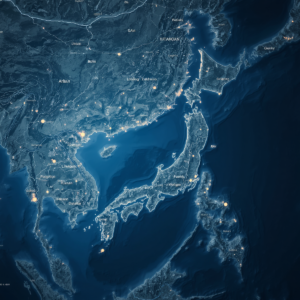
Japan is an island country in East Asia, located in the Pacific Ocean, east of China, the Korean Peninsula, and Russia.
It consists of thousands of islands, but four are considered its main islands:
- Honshu: The largest island, home to Tokyo, Osaka, and many major industrial centres.
- Hokkaido: Known for agriculture, tourism, and natural resources.
- Kyushu: An important location for manufacturing, technology, and industry.
- Shikoku: Known for agriculture, manufacturing, and its regional industries.
Japan’s geographical position has helped it develop strong international trade connections. However, its limited natural resources also mean that it depends heavily on imported energy and raw materials.
This is an important detail when studying its economy: Japan imports many of the resources it needs and exports high-value manufactured products around the world.
How Did Japan Go From Postwar Destruction to an Economic Powerhouse?

Japan’s transformation after World War II is one of the most remarkable economic stories of the modern era.
In 1945, the country faced enormous destruction. Industrial production had collapsed, infrastructure was damaged, and the economy was struggling with shortages and inflation.
But Japan did not remain in that position.
The rebuilding years: 1945–1950s
The first stage was reconstruction.
Japan focused on restoring its industrial capacity, rebuilding infrastructure, stabilising its financial system, and returning to international trade.
The Korean War, which began in 1950, also created demand for Japanese supplies, equipment, and services. This provided an important boost to industrial production and exports.
The economic miracle: 1950s–1970s
Japan then entered a period of rapid economic growth.
Several factors contributed:
- Heavy investment in factories, machinery, and infrastructure.
- A skilled and increasingly educated workforce.
- Strong domestic savings and investment.
- Government policies supporting industrial development.
- Expanding international trade and exports.
- Adoption and improvement of foreign technologies.
Japanese companies became internationally recognised for manufacturing quality, efficiency, and innovation.
The country’s transformation was not simply about producing more goods. It was about building industries that could compete internationally.
The Crisis and the Lesson: Japan’s Lost Decades
Every economy experiences challenges, and Japan is no exception.
One of its most important economic turning points came during the late 1980s.
The Japanese asset bubble
During the 1980s, Japan experienced a major rise in property and stock prices.
Easy credit, strong optimism, and speculative investment pushed asset valuations to extremely high levels.
Eventually, the bubble burst around the beginning of the 1990s.
Stock and property prices fell sharply, banks faced bad loans, businesses reduced investment, and economic growth weakened.
The lost decades
Japan then experienced a prolonged period of weak economic growth, low inflation, and, at times, deflation.
The country struggled with several connected problems:
- Weak domestic demand.
- Falling or stagnant prices.
- Banking-sector difficulties.
- High public debt.
- An ageing population.
- Limited wage growth.
The experience became widely known as Japan’s Lost Decades.
What can investors learn?
Japan’s experience offers an important lesson: a strong economy and successful companies do not make financial markets immune to excessive valuations.
Investors should pay attention to:
- Asset prices compared with company earnings.
- Debt levels and financial stability.
- Demographic changes.
- Central bank decisions.
- Long-term productivity and economic growth.
Economic success can last for decades, but market prices can still become disconnected from underlying fundamentals.
The Biggest Sectors Japan’s Economy Relies On
Japan has a highly developed economy, with services making up the largest share of economic activity.
Let’s look at the industries behind those figures.
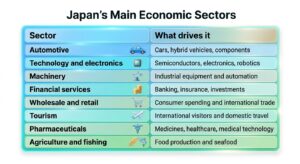
1. Automotive industry
Japan is one of the world’s most important automotive manufacturing countries.
Its automotive industry includes vehicle production, engines, batteries, automotive components, and advanced manufacturing technologies.
Some internationally recognised Japanese automotive companies include:
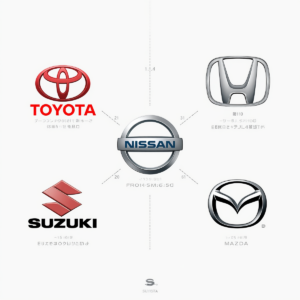
- Toyota
- Honda
- Nissan
- Suzuki
- Mazda
The sector is also adapting to electric vehicles, hybrid technology, autonomous driving, and changing global competition.
Why it matters: Automotive exports and global vehicle demand can influence Japanese manufacturers, suppliers, employment, and industrial production.
2. Technology and electronics
Japan has a long history of producing electronics and technological equipment.
Its companies operate in areas such as:
- Consumer electronics.
- Imaging and camera equipment.
- Electronic components.
- Semiconductors and semiconductor equipment.
- Industrial sensors.
- Robotics and automation.
Companies such as Sony, Tokyo Electron, and Advantest are important names in this sector.
Japan’s technology industry is particularly relevant to global markets because electronics and semiconductor supply chains connect Japanese companies to businesses worldwide.
3. Machinery and industrial manufacturing
Japan is also a major producer of industrial machinery and precision equipment.
Its manufacturing capabilities include:
- Factory automation systems.
- Industrial robots.
- Machine tools.
- Construction machinery.
- Precision instruments.
- Industrial components.
These products are used by manufacturers across the world.
As global companies invest in automation and production capacity, demand for Japanese industrial equipment can become an important market theme.
4. Financial services and banking
Japan has one of the world’s largest financial systems.
Its financial sector includes commercial banks, insurance companies, investment firms, securities businesses, and asset managers.
Major financial institutions include:
- Mitsubishi UFJ Financial Group.
- Sumitomo Mitsui Financial Group.
- Mizuho Financial Group.
The sector is closely connected to the Bank of Japan’s monetary policy, government bond markets, interest rates, and movements in the Japanese yen.
5. Wholesale and retail trade
Retail and wholesale businesses are another important part of Japan’s service economy.
The sector includes supermarkets, department stores, fashion retailers, online shopping platforms, and international trading companies.
Japan is also home to globally recognised retail businesses such as Fast Retailing, the company behind Uniqlo.
Consumer spending, tourism, household income, and inflation can all influence this sector.
6. Tourism and hospitality
Japan has become a major international travel destination.
Visitors are attracted by its cities, cultural heritage, food, shopping, technology, and natural landscapes.
Tourism supports a wide range of businesses, including:
- Hotels and accommodation.
- Airlines and transport.
- Restaurants.
- Retail shops.
- Entertainment and attractions.
A weaker yen can make Japan more affordable for foreign visitors, although exchange rates are only one of several factors influencing tourism.
7. Pharmaceuticals and healthcare
Japan has a significant pharmaceutical and healthcare industry.
Its ageing population creates demand for medical services, healthcare products, medicines, and advanced medical technologies.
The sector includes pharmaceutical research, medical equipment, biotechnology, and healthcare services.
It is also connected to long-term demographic changes, which influence government spending and consumer demand.
8. Agriculture, fishing, and food production
Agriculture represents a relatively small share of Japan’s total economic output, but it remains important for food production and rural communities.
Japan produces rice, vegetables, fruit, seafood, and other agricultural products.
However, limited agricultural land and changing demographics create challenges for the sector.
Japan also imports significant quantities of food and agricultural products, making it sensitive to global food prices and currency movements.
Quick overview
How Can Traders Benefit From Following Japan’s Economy?
Fellow traders, now we get to the part that matters to us as traders.
Japan is not just an interesting economy to study. Its industries, financial institutions, and currency can all influence international markets.
Here are some ways traders can follow developments connected to Japan.
1. Follow the Japanese yen in Forex
The Japanese yen is one of the most actively traded currencies in the global Forex market.
Pairs such as USD/JPY, EUR/JPY, and GBP/JPY can respond to changes in interest rates, inflation, economic data, and central bank expectations.
2. Watch Japanese stocks
Japan’s stock market offers exposure to automotive companies, technology businesses, banks, retailers, and industrial manufacturers.
Changes in global demand, corporate earnings, and currency movements can all influence these stocks.
3. Monitor the Nikkei 225
The Nikkei 225 is one of Japan’s best-known stock market indices.
It tracks 225 major companies listed on the Tokyo Stock Exchange and is widely followed as an indicator of Japanese equity market performance.
4. Understand the connection with global markets
Japan is deeply connected to international supply chains.
For example:
- Strong global demand for vehicles can support Japanese automakers.
- Semiconductor investment can influence Japanese technology companies.
- Higher energy prices can increase costs for energy-importing businesses.
- Changes in US interest rates can affect the yen and Japanese financial markets.
The key is to understand how an economic development in Japan may affect other markets, rather than looking at Japanese assets in isolation.
Five Major Japanese Stocks to Know
Japan has thousands of publicly listed companies, but some names attract more attention because of their size, international presence, and importance to the Japanese economy.
The following five companies were among the leading Japanese companies by market capitalisation in Yahoo Finance Japan’s November 5, 2026 ranking. Rankings can change as share prices and market valuations move.
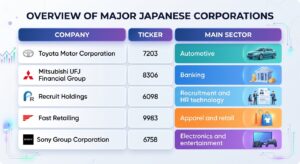
1. Toyota Motor Corporation (7203)
Toyota is one of the world’s most recognised automotive manufacturers.
Its business includes passenger vehicles, commercial vehicles, hybrid technology, and automotive services.
Traders often follow Toyota because of its global sales, production performance, competition in electric vehicles, and exposure to foreign exchange movements.
2. Mitsubishi UFJ Financial Group (8306)
Mitsubishi UFJ Financial Group, commonly known as MUFG, is one of Japan’s largest banking groups.
Its activities include commercial banking, investment banking, asset management, and financial services.
Interest rate changes, lending activity, and financial market conditions are important factors to watch.
3. Recruit Holdings (6098)
Recruit Holdings operates in recruitment, human resources technology, and online services.
Its businesses connect employers and job seekers through digital platforms.
Employment trends, business spending, and demand for recruitment services can influence its performance.
4. Fast Retailing (9983)
Fast Retailing is the parent company of Uniqlo, one of the world’s best-known clothing retailers.
Its business depends on consumer demand, international expansion, supply chains, and retail performance.
Currency movements can also affect its international revenues and operating costs.
5. Sony Group Corporation (6758)
Sony operates across entertainment, gaming, music, film, electronics, and imaging technology.
Its diversified business makes it an interesting company to follow when examining Japan’s technology and entertainment industries.
Gaming demand, product launches, content performance, and global consumer spending are among the factors investors monitor.
Remember: Company size does not automatically make a stock a good investment. Before considering any stock, examine its valuation, financial statements, business outlook, and risks.
The Japanese Yen Under the Spotlight
The Japanese yen is the official currency of Japan.
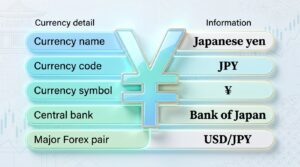
The yen is one of the major currencies in international financial markets.
But what makes it so important?
Why does the yen matter in Forex?
The Japanese yen is widely traded because Japan is a major global economy, and its currency is involved in international trade, investment, and financial transactions.
One of the most closely watched pairs is USD/JPY, which shows how many Japanese yen are needed to buy one US dollar.
What moves the Japanese yen?
Several factors can influence the yen:
- Bank of Japan interest rates: Changes in monetary policy can influence demand for the currency.
- US interest rates: The difference between US and Japanese interest rates can affect USD/JPY.
- Inflation: Changes in Japanese prices influence expectations about monetary policy.
- Economic growth: GDP, wages, and business activity can affect currency sentiment.
- Global risk sentiment: The yen has historically attracted safe-haven demand during some periods of market stress, although this relationship is not guaranteed.
- Government intervention: Japanese authorities can intervene in currency markets to address excessive exchange-rate fluctuations.
An important distinction: Japan’s Ministry of Finance has the authority to decide on foreign exchange intervention, while the Bank of Japan carries out the operations on its behalf. <a href=”https://www.boj.or.jp/en/about/education/oshiete/intl/g19.htm“> </a>
What is the yen carry trade?
You may have heard traders discussing the yen carry trade.
It is a strategy in which investors borrow in a currency with relatively low interest rates and invest in assets or currencies offering higher returns.
The yen has historically been used in carry trades because Japanese interest rates were very low for an extended period.
However, this strategy carries risks.
If the yen strengthens or interest rate differences narrow, investors may unwind their positions. That can create sharp movements in currency markets and other assets.
This is why Bank of Japan policy deserves attention from Forex traders.
What Should Traders Watch Next?
When following Japan, keep an eye on these economic and financial indicators:
| Indicator | Why it matters |
|---|---|
| Bank of Japan interest rate decisions | Influence monetary policy expectations and the yen |
| Japanese inflation | Helps indicate price pressures |
| Wage growth | Important for household spending and inflation |
| GDP growth | Measures overall economic performance |
| Industrial production | Provides insight into manufacturing activity |
| Tankan business survey | Measures business confidence and conditions |
| Trade balance | Shows the relationship between exports and imports |
These indicators can help traders understand the economic picture behind movements in Japanese assets.
FAQS About
The Biggest Sectors Japan’s Economy Relies On
1. What are The Biggest Sectors Japan’s Economy Relies On?
Japan’s economy relies heavily on services and industry. Important sectors include automotive manufacturing, technology, electronics, machinery, banking, retail, tourism, and healthcare.
2. What is Japan’s largest economic sector?
Services represent the largest share of Japan’s economy. They include finance, retail, transport, healthcare, tourism, and other business services.
3. Why is Japan famous for its manufacturing industry?
Japan became internationally recognised for high-quality manufacturing, industrial efficiency, technological development, and globally competitive companies in automotive production, electronics, and machinery.
4. How did Japan rebuild its economy after World War II?
Japan rebuilt through industrial investment, infrastructure development, education, international trade, technological improvements, and policies supporting manufacturing and exports. Demand connected to the Korean War also helped accelerate its early recovery.
5. What caused Japan’s Lost Decades?
The bursting of Japan’s asset bubble around the beginning of the 1990s contributed to falling asset prices, banking problems, weak demand, and prolonged economic stagnation.
6. What is Japan’s currency?
Japan’s official currency is the Japanese yen, with the international currency code JPY and the symbol ¥.
7. What is the most traded Japanese yen Forex pair?
USD/JPY is one of the most actively traded yen currency pairs. It measures the value of the US dollar against the Japanese yen.
8. What are some of the biggest Japanese companies?
Major Japanese listed companies include Toyota, Mitsubishi UFJ Financial Group, Sony, Recruit Holdings, and Fast Retailing. Their market capitalisations and rankings change over time.
9. Why does the Bank of Japan matter to Forex traders?
The Bank of Japan sets monetary policy and influences interest rate expectations, financial conditions, and market sentiment. Its decisions can affect the Japanese yen and currency pairs such as USD/JPY.
10. Can traders invest in Japan’s stock market?
Yes. Investors can access Japanese listed companies through suitable brokerage services and market products. Depending on the instrument, access may include individual shares, stock indices, or derivatives. Each has different costs and risks.
Wrap Up
Now fellow traders after learning all about the biggest sectors Japan’s economy relies on let’s get to the important part that makes us really move its the trading part so, If you want to follow the Japanese yen, monitor major market indices, or explore opportunities across international financial markets, understanding the economic forces behind them is a useful place to start.
With Caveo FX, you can explore multiple markets through one trading platform.
Not ready to trade with real money? Open a demo account and practise your strategies in a risk-free environment before considering a live account.