

Table of Contents
How to Teach Kids About Money (By Age Group)
How to Teach Kids About Money (By Age Group) …..Hello, fellow traders! A new day, new trading goals. How have you all been doing, and how has this week of trading been treating you?
Today, I want to talk about something a little different from our usual market discussions: teaching children about money.
Recently, my daughter, who is in fifth grade, told me, “Mom, I want to buy a new iPhone.”
At first, I was surprised. Why would a young girl want a phone that costs so much money? More importantly, did she understand what that amount of money actually represents?

It takes time, effort, and hard work to earn money. Yet, for children growing up surrounded by smartphones, online shopping, social media, and constant advertising, the price of something can seem much more important than the effort required to pay for it.
Of course, my daughter is not the only child who thinks this way. Many children and teenagers want the latest phones, fashionable clothes, gaming consoles, and other expensive items without necessarily understanding the difference between wanting something and being able to afford it.
And honestly, we cannot blame them entirely. Children are still learning how the world works. If nobody teaches them how to earn, save, spend, and invest money wisely, how can we expect them to develop good financial habits on their own?
That conversation with my daughter reminded me of an important lesson: financial education should begin long before children earn their first paycheck or open their first bank account.
As fellow traders, we know that understanding money involves much more than watching numbers move on a screen. It requires patience, discipline, planning, and the ability to think about the future rather than focusing only on immediate rewards.
These are lessons worth teaching our children, too.
So, in today’s article, How to Teach Kids About Money (By Age Group), we will explore how children understand money at different stages of development, how parents can introduce saving and budgeting, and how to help young people discover the basics of investing and compound interest.
Whether your child is five or fifteen, it is never too early—or too late—to start building healthier financial habits.
Let’s dive in!
What Is the Relationship Between Money and Children?
Money is part of almost every aspect of our daily lives. We use it to buy food, pay bills, purchase clothes, enjoy entertainment, save for the future, and invest in our goals. However, understanding how money works is a skill that develops over time, and children need guidance to build it.
Think about it for a moment. When a child sees a parent buy a new phone, they see the final result: a new device. They may not see the hours of work, the household expenses, or the financial decisions that made the purchase possible.
The same applies to toys, holidays, fashionable clothes, and other things children see around them.
This is why teaching kids about money goes beyond explaining the difference between coins and banknotes. It means helping them understand where money comes from, how people earn it, why it is limited, and how the decisions they make today can affect their future.
Why is financial education important for children?
Financial education helps children develop several essential life skills.
- Understanding the value of money: Children learn that money represents resources and effort, rather than being something that is always available whenever they want something.
- Making responsible spending decisions: They learn to distinguish between essential expenses and things they would simply like to own.
- Developing saving habits: They discover that setting money aside can help them achieve bigger goals.
- Learning patience and discipline: They understand that some rewards require waiting, planning, and consistent effort.
- Preparing for financial independence: As they grow older, they become more comfortable managing an allowance, a bank account, a paycheck, and eventually their own investments.
Research and financial education initiatives emphasize the importance of developing these habits early. However, financial knowledge alone is not enough. Children also need opportunities to practice what they learn.
For example, telling a child to save money is useful, but allowing them to save for a toy they genuinely want makes the lesson more meaningful.
The objective is not to make children afraid of spending money. It is to help them understand their choices and become more confident in making them.
How Do Children Think About Money? (By Age Group)
Children do not understand money in the same way at every stage of development. A preschooler may understand that money buys a toy, while a teenager may be ready to compare prices, manage a budget, and explore the basics of investing.
That is why financial lessons should evolve as children grow.
The following table provides a general guide to what children may understand at different ages and which financial lessons are most useful at each stage.

How to Teach Kids About Money (By Age Group)
Ages 3–5: Introduce the basics of money
At this age, children learn best through observation, repetition, and play. They may not understand complex financial concepts, but they can begin recognizing money and learning that people exchange it for goods and services.
Here are a few activities to try:
- Play shop at home: Use pretend money to buy and sell toys, books, or snacks.
- Introduce a piggy bank: Let your child put coins into a transparent jar and watch the savings accumulate.
- Explain simple purchases: When shopping, explain that money is exchanged for the groceries or other items you take home.
- Introduce needs and wants: Explain that food is a necessity, while an additional toy may be something the child wants but does not need.
Keep these lessons simple and enjoyable. At this stage, the objective is to build familiarity with money rather than expect children to make sophisticated financial decisions.
Ages 6–8: Teach saving and spending choices
As children grow, they begin to understand that money is limited. This makes it a useful time to introduce small allowances, saving goals, and basic spending decisions.
For example, suppose your child receives $5 as a gift. They could spend it immediately on a small toy or save it toward something more expensive.
Instead of making the decision for them, ask a few questions:
- What would you like to buy?
- Is there something more important you would rather save for?
- If you spend the money now, how much will you have left?
These questions encourage children to think about the consequences of their choices.
You can also introduce a simple three-jar system:
- Spend: Money available for small purchases.
- Save: Money set aside for a future goal.
- Share: Money reserved for helping others or supporting a cause.
The proportions do not need to be fixed. The purpose is to help children understand that money can have different uses.
Ages 9–11: Introduce budgeting and financial responsibility
Children in this age group can begin planning purchases, comparing prices, and managing a small amount of money independently.
This is also an appropriate time to discuss the difference between price and value.
Imagine your child wants a new phone because several classmates have one. Instead of immediately agreeing or refusing, talk about the phone’s cost, its features, and whether the purchase fits the family’s priorities.
You could also ask your child to compare two similar products. Which offers better value? Is the more expensive option actually better, or is the cheaper one sufficient?
Practical activities include:
- Creating a savings chart for a desired purchase.
- Comparing prices before buying toys, books, or other items.
- Keeping a simple record of money received and spent.
- Planning a small shopping trip within a set budget.
- Discussing how advertising influences purchasing decisions.
These activities teach children that making a good financial decision involves more than choosing something they like.
Ages 12–15: Develop independence and introduce investing
During the teenage years, children may begin receiving larger allowances, earning money through suitable part-time work, or managing money received as gifts.
This is a good time to introduce more advanced financial concepts.
Help your teenager understand how bank accounts work, how interest is calculated, and why keeping track of spending matters. Depending on local regulations and the available products, you may also consider a youth savings account with appropriate parental supervision.
This is also an important stage for discussing social media and financial pressure. Teens may compare their lifestyles with those of influencers or friends, leading them to believe that expensive purchases are necessary to fit in.
Encourage them to ask whether a purchase reflects a genuine need, a personal preference, or pressure from others.
You can also introduce investing through familiar examples. Explain how companies sell products, generate revenue, incur costs, and potentially earn profits. Then explain how buying shares represents ownership in a company and why the value of an investment can rise or fall.
The goal is to develop curiosity and understanding, not to encourage teenagers to take unnecessary financial risks.
Ages 16–18: Prepare for financial independence
Older teenagers are approaching adulthood, which means their financial education should become more practical.
They should begin understanding income, expenses, taxes, borrowing, interest rates, emergency savings, and long-term financial planning.
If your teenager has a job, help them understand their paycheck and create a budget that accounts for spending and saving.
You can also introduce the basics of investment diversification, market risk, and compound interest. Simulated investment portfolios are a useful way to practice researching companies and following markets without risking real money.
Other important lessons include:
- Understanding how credit cards and loans work.
- Recognizing the long-term cost of borrowing.
- Building an emergency fund.
- Setting financial goals for education, transportation, or independent living.
- Recognizing online scams and misleading financial advice.
- Understanding that investments can lose value and that returns are never guaranteed.
By the time children reach adulthood, they should have a foundation for making informed decisions rather than relying entirely on others to manage their money.
5 Things That Shape How Children Think About Money
Teaching children about money is not only about explaining financial concepts. Their attitudes are also shaped by their surroundings, experiences, and the behavior they observe.
Here are five important factors parents should understand.
1. Parental behavior
Children often learn more from what parents do than from what they say.
If parents regularly compare prices, plan purchases, save consistently, and avoid unnecessary debt, children have opportunities to observe responsible financial behavior.
On the other hand, if children constantly see impulsive purchases or hear money discussed only during arguments, they may develop an unhealthy relationship with financial decisions.
You do not need to share every detail of your finances. Simply explain everyday choices.
For example, you might say, “We are saving for our holiday, so we are choosing not to buy this item today.”
That small explanation helps children understand that spending decisions involve priorities.
2. Peer pressure and the desire to fit in
Children and teenagers naturally notice what their friends own.
A new smartphone, fashionable shoes, or an expensive gaming console can quickly become something they feel they need, even when their current possessions work perfectly well.
This is where parents can introduce an important lesson: something can be desirable without being financially necessary.
Rather than dismissing their wishes, ask why they want the item and help them consider its cost.
If your child genuinely wants a new phone, you could discuss its features, expected lifespan, and price, then create a savings plan together.
This approach teaches responsibility without making children feel that wanting something is wrong.
3. Advertising and social media
Today’s children encounter advertisements through videos, games, apps, social media platforms, and online stores.
Influencers may promote expensive products, while games encourage players to purchase digital items or upgrades. These messages can make spending seem effortless and normal.
Help children become more critical consumers by asking questions such as:
- Why is this person promoting the product?
- Is the product genuinely useful, or does it simply look attractive?
- Is the advertisement trying to make us feel that we are missing out?
- What else could we do with the same amount of money?
These discussions can help children recognize persuasive marketing and make more independent decisions.
4. Access to money and real-life experience
Children cannot learn money management entirely through theory. They need opportunities to practice.
An allowance, birthday money, or age-appropriate paid tasks can help them experience the consequences of spending and saving.
For instance, if a child spends all their allowance on small purchases and cannot afford the item they wanted later, that experience can become a valuable lesson.
Parents should provide reasonable guidance while allowing children to make small, manageable mistakes.
The goal is not to prevent every poor decision. It is to help children learn from those decisions before they face larger financial responsibilities.
5. Patience and delayed gratification
One of the most valuable financial skills is learning to wait.
Children are often attracted to immediate rewards, especially when advertisements and digital purchases make spending quick and convenient.
Saving for a larger goal teaches them that waiting can be worthwhile.
Suppose your child wants a toy that costs $40 but receives $10 each week. Rather than buying it immediately, help them calculate how long they need to save if they set aside the full amount each week.
They may decide the toy is worth waiting for, or they may change their mind along the way.
Either outcome teaches them to evaluate priorities and understand the relationship between time, money, and choices.
Kids and the Concept of Investing
Now, fellow traders, let’s connect these lessons to something we know well: investing.
Children do not need to understand financial markets in detail to begin learning the principles behind investing. In fact, some of the most important concepts can be introduced through everyday examples.
Start with a simple question: what happens when you save money instead of spending all of it?
Your savings can help you reach a future goal. Depending on where you keep them, they may also earn interest. Investing introduces another possibility: using money to purchase assets that may increase in value or generate income over time, while accepting the risk of losses.
What should children understand about investing?
Investing is different from saving.
Saving generally means setting money aside for future use, often in an account designed to preserve access to the funds. Investing means purchasing assets whose value or income can fluctuate.
Investing involves risk.
A company may perform poorly, stock prices can fall, and investors may lose some or all of the money they invest. Children should understand this before they become interested in potential returns.
Time can matter.
Long-term investing allows more time for potential growth and compounding. However, a longer investment horizon does not guarantee a profit.
Diversification can reduce concentration risk.
Putting all your money into a single company means your results depend heavily on that company. Holding a range of investments can reduce dependence on any one asset, although it cannot eliminate market risk.
Research matters.
Investing should involve understanding what you are buying, why you are buying it, and what could go wrong.
These principles help children see investing as a process of informed decision-making rather than a shortcut to becoming rich.
How to Develop an Interest in Investing in Kids: Step by Step

You do not need to open a brokerage account for a young child or introduce complicated market terminology immediately. A gradual approach is often more effective.
Step 1: Teach children to set financial goals
Begin with something your child genuinely wants, such as a bicycle, a book collection, or a new phone.
Help them calculate the cost, determine how much money they already have, and decide how much they can save regularly.
This introduces planning and gives saving a clear purpose.
Step 2: Explain how businesses make money
Choose a company your child recognizes, such as a popular clothing brand, a technology company, or a restaurant chain.
Discuss how the business earns revenue by selling products or services and how it must pay expenses such as salaries, rent, materials, and transportation.
Explain that a company may earn a profit, but it can also experience losses.
This gives children a practical foundation for understanding why people invest in businesses.
Step 3: Introduce the concept of owning shares
Once children understand how businesses work, explain that a share represents a small ownership interest in a company.
Investors may benefit if the company grows or pays dividends, but the share price can also decline.
For example, imagine a hypothetical company whose shares cost $20 each. If the share price later rises to $25, the investment has increased in market value. If the price falls to $15, its value has decreased.
This simple example helps children understand that investment prices move in both directions.
Step 4: Use a simulated investment portfolio
A simulated portfolio allows teenagers to research investments and track hypothetical performance without risking real money.
Ask them to choose a few companies they understand and explain why they selected them. Then follow their performance over several weeks or months.
Discuss questions such as:
- What does the company sell?
- How does it make money?
- What might help its business grow?
- What risks could affect its performance?
- Why did its share price change?
The purpose is to encourage research, observation, and critical thinking rather than reward short-term predictions.
Step 5: Explain diversification and risk management
Once children understand the basics, show them why concentrating all their money in one investment can be risky.
For example, if someone invests everything in a single technology company and that company struggles, their entire investment may be affected.
Holding different types of investments can spread exposure across companies, sectors, or asset classes.
Make it clear that diversification does not prevent every loss. It is a way to manage certain risks, not a guarantee of positive returns.
Step 6: Connect investing to long-term goals
Finally, explain that investing is often most useful when it supports a realistic long-term financial goal.
Discuss how time, regular contributions, fees, investment choices, and market performance can affect results.
Children should understand that investing is not about getting rich overnight. It involves making informed decisions, managing risk, and giving an investment plan time to work.
Teaching Kids the Importance of Compound Interest
Compound interest is one of the most useful financial concepts children can learn because it demonstrates how money can grow over time.
In simple terms, compounding occurs when returns are earned on both the original amount and previous returns that remain invested.
Let’s use a straightforward example.
Imagine a teenager invests $100 and earns a hypothetical 5% annual return. For simplicity, assume the return is the same every year, all returns remain invested, and there are no fees or taxes.
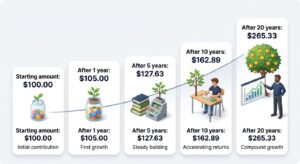
After 20 years, the original $100 would grow to approximately $265.33 under these assumptions.
Notice that the balance grows from $100 to $105 during the first year. In the second year, the 5% return is calculated on $105 rather than only on the original $100.
Over time, this process can create a snowball effect.
However, this is a mathematical illustration, not a prediction of investment performance. Real investment returns fluctuate, and losses, fees, and taxes can affect the final result.
How can parents explain compounding to children?
You can use a simple activity at home.
Start with a hypothetical amount of money and a calculator. Show your child how the balance changes when a percentage is added each year and the new balance becomes the starting point for the following year.
Then compare two scenarios:
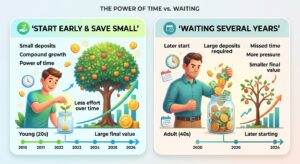
Discuss how time can influence the outcome, while explaining that actual investment results are uncertain.
The broader lesson is that building wealth is often connected to consistent habits and patience rather than one dramatic financial decision.
Why starting early can make a difference
Starting early can provide more time for potential investment growth and compounding. It also gives children more opportunities to learn from their decisions while their financial responsibilities are relatively limited.
Still, the first priority should be building healthy money habits. Children should understand spending, saving, and risk before being encouraged to invest.
Common Mistakes Parents Should Avoid When Teaching Kids About Money
Even with good intentions, parents can sometimes make financial education more difficult than it needs to be.
Here are a few mistakes to avoid.
1. Treating money as a taboo subject
When money is never discussed at home, children may grow up believing that financial decisions are too complicated or uncomfortable to talk about.
You do not have to share private financial details. You can simply explain everyday decisions, such as comparing prices or saving for a family purchase.
2. Buying everything children ask for
Giving children every item they want may prevent them from learning how to prioritize and save.
It is reasonable to say no to a purchase while helping them understand why. You can also encourage them to work toward a goal themselves.
3. Never allowing children to make mistakes
If parents always step in when a child spends money poorly, the child may miss an important learning opportunity.
Small, manageable mistakes can help children understand the consequences of their choices. The key is to offer guidance without removing every responsibility.
4. Focusing only on earning more money
Earning money is important, but financial responsibility also involves managing expenses, saving consistently, and understanding risk.
Children should learn that earning more does not automatically lead to financial security if spending continually exceeds income.
5. Presenting investing as a guaranteed path to wealth
Investing involves uncertainty, and no investment strategy guarantees profits.
Avoid promising that a particular stock or asset will make children rich. Instead, teach them to research investments, understand risks, consider diversification, and think about long-term goals.
FAQs About How to Teach Kids About Money (By Age Group)
1. What is the best age to start teaching children about money?
You can begin introducing basic money concepts as early as ages three to five. Start with simple activities such as counting coins, playing shop, and explaining that money is exchanged for goods and services. As children grow, gradually introduce saving, budgeting, and investing.
2. How can I teach my child the value of money?
Explain how people earn money through work and how they use it to meet their needs and achieve their goals. Give children age-appropriate opportunities to manage small amounts of money, compare prices, and save for things they want.
3. Should children receive an allowance?
An allowance can provide children with practical experience in managing money. Parents can choose an amount and schedule that suit their circumstances, then use the allowance to teach budgeting, saving, and spending decisions. An allowance is a teaching tool, not a requirement for every family.
4. How do I teach my child the difference between needs and wants?
Use everyday examples. Food, basic clothing, and essential school supplies are generally needs, while additional toys or the latest phone may be wants. Explain that wants are not necessarily bad, but they should be considered alongside essential expenses and financial priorities.
5. How can teenagers learn about investing safely?
Begin with financial basics, explain the risks of investing, and use a simulated portfolio to practice researching companies and tracking hypothetical investments. If real investing is considered later, involve an appropriate parent or guardian and follow the applicable account rules and regulations.
6. What is compound interest, and why should children learn about it?
Compound interest occurs when returns accumulate on the original amount and previously earned returns. Learning about compounding helps children understand why time and consistent saving can matter for long-term financial goals. Actual investment returns are not guaranteed.
7. How can I encourage my child to save for an expensive purchase?
Help your child establish a realistic savings target, calculate the amount needed, and decide how much to set aside regularly. A visual savings chart can help them track progress and understand how small contributions accumulate over time.
8. Should children learn about the stock market?
Older children and teenagers can benefit from learning the basics of stocks, businesses, investment risk, and diversification. Begin with familiar companies and hypothetical examples rather than encouraging speculation or promising financial gains.
9. How can parents teach financial responsibility without making children anxious about money?
Keep conversations calm, practical, and appropriate for the child’s age. Explain financial priorities without making children feel responsible for supporting the household. Focus on the skills they can develop rather than the worries adults may face.
10. What is the most important money lesson children should learn?
One of the most important lessons is that money involves choices. Learning to balance present spending with future goals, understand risk, and make thoughtful decisions can help children build healthier financial habits throughout their lives.
Wrap up
Now you know how to teach kids about money, from setting savings goals and understanding spending to learning about investing and managing risk. But guess what? After explaining all of this to my daughter, she is still asking for that new iPhone! Honestly, I don’t know what to do anymore. Maybe I need to be more patient and keep reinforcing these lessons until they finally sink in.
And that is the point: financial literacy takes time, consistency, and continuous learning. Children do not learn everything in one conversation. They learn through everyday experiences, small decisions, mistakes, and the habits we help them build along the way.
I also believe that practical learning can make a real difference. As children grow older, age-appropriate investing simulations can help them understand how markets work without putting real money at risk. With a free demo trading account, they can explore market movements, follow companies, and practice making decisions in a simulated environment before they are old enough to consider real trading.
At Trader Factory, we believe that learning should come before trading. Start with the basics, build good financial habits, and keep learning together. After all, the goal is not simply to teach our children how to buy what they want today, but to help them make smarter financial decisions for tomorrow.