
Table of Contents
How to Build an Emergency Fund From Zero in 90 Days
How to Build an Emergency Fund From Zero in 90 Days….Hello fellow traders, I think I have been in a bit of a DND mood for the last few days because I have been very busy dealing with a situation involving a relative who had a health issue.
I’ll be short on this story but to say the least She needed a quick surgery, and honestly, seeing how much the situation was affected by money hit me harder than I expected. When something unexpected happens, you don’t always have time to prepare, compare options, or wait for the perfect moment.
Sometimes, you simply need the money.
That experience reminded me of something we often know but don’t really think about until life forces us to: money can affect our lives in so many ways, especially when something happens that we never planned for.

And that is exactly why I wanted to write this article.
If you currently have little or even zero emergency savings, I don’t want to tell you to magically save six months of expenses overnight. I want to show you how to start from where you are, build a realistic emergency fund, and work toward a stronger financial safety net.
So, fellow traders, let’s dive in.
What Is an Emergency Fund?
An emergency fund is money you set aside specifically for unexpected and necessary expenses.
- It is not your vacation fund.
- It is not your shopping budget.
- And it is definitely not money you should be using to increase your trading position because you think the market is about to move.
The purpose is simple:
When something unexpected happens, you have money available without immediately needing to borrow, sell investments, or disrupt your normal financial plans.
Common examples include:
- An unexpected medical expense
- Sudden job loss
- A major car repair
- An urgent home repair
- An essential appliance breaking
- An unexpected family emergency
- A sudden expense that your insurance does not fully cover
Financial education guidance commonly recommends starting with a smaller emergency-savings milestone and eventually building toward around 3–6 months of essential expenses, depending on your circumstances.
The important part is understanding that 3–6 months is a destination, not necessarily your starting point.
What Counts as a Financial Emergency?
One of the easiest ways to destroy an emergency fund is to call everything an emergency.
Before touching the money, ask yourself:
Is this unexpected, necessary, and difficult to pay for from my normal income?
| Situation | Emergency fund? |
|---|---|
| Unexpected medical bill | Yes |
| Sudden job loss | Yes |
| Major essential car repair | Yes |
| Urgent home repair | Yes |
| Emergency family travel | Potentially |
| Annual insurance payment | No |
| Holiday shopping | No |
| Planned vacation | No |
| New phone because you want an upgrade | No |
| Trading loss | No |
A trading loss deserves special attention.
A losing trade is not a financial emergency.
If you use your emergency savings to recover trading losses, you are turning the money that was supposed to protect your financial life into additional market risk.
That defeats the entire purpose of the fund.
How Much Should You Have in an Emergency Fund?
There is no single number that works for everyone. Someone living with family and very low fixed expenses may need a different amount from someone paying rent, supporting children, and working in an unstable industry.
A practical way to approach it is to build your fund in stages.
Stage 1: Your first $100–$500
If you currently have nothing saved, don’t let the idea of saving six months of expenses stop you from starting.
Your first target can simply be a small cash buffer.
Stage 2: Reach $1,000
A $1,000 milestone is commonly used as a starter emergency-savings target before moving toward a larger fund.
Stage 3: One month of essential expenses
Calculate what you would need for one month if you removed most optional spending.
Think:
- Housing
- Food
- Utilities
- Transportation
- Insurance
- Medicine
- Minimum debt payments
- Other essential bills
Stage 4: Three to six months
Once you have built the foundation, work toward approximately 3–6 months of essential expenses.
If your essential expenses are $2,000 per month:
3 months = $6,000
6 months = $12,000
The right target depends on your income stability, responsibilities, debt, dependents, insurance coverage, and how quickly you could replace your income.
How to Build an Emergency Fund From Zero in 90 Days
Ok Fellow Trader it gets series let’s make this practical.
How to Build an Emergency Fund From Zero in 90 Days
(10 simple steps)
Step 1: Calculate Your Essential Monthly Expenses
Before deciding how much to save, find out what you actually need.
Take your monthly spending and separate it into two groups:
Essential
- Housing
- Food
- Utilities
- Transportation
- Insurance
- Medicine
- Minimum debt payments
Non-essential
- Eating out
- Entertainment
- Shopping
- Subscriptions
- Luxury purchases
- Other optional spending
The Federal Reserve’s financial education guidance similarly recommends separating essential and non-essential spending when calculating an emergency-fund target.
Don’t guess.
Look at your actual bank statements and bills.
Step 2: Choose Your 90-Day Target
Don’t choose a number because it sounds impressive.
Choose a number you can realistically work toward.
For example:
| 90-day target | Approx. weekly saving | Approx. monthly saving |
|---|---|---|
| $300 | $23 | $100 |
| $500 | $38 | $167 |
| $1,000 | $77 | $333 |
| $1,500 | $115 | $500 |
| $3,000 | $231 | $1,000 |
These are simple planning figures based on roughly 13 weeks.
Your target doesn’t have to be $1,000.
If you can realistically save $500 in 90 days, $500 is better than a $1,000 target that makes you give up after two weeks.
Step 3: Open a Separate Emergency-Fund Account
Don’t leave the money mixed with your everyday spending money if you can avoid it.
Create a separate account and give it a very specific name:
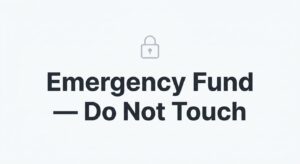
The goal isn’t to make the money impossible to access. You actually want it accessible when a genuine emergency happens. The goal is to create enough separation that you don’t accidentally spend it on ordinary expenses.
A suitable emergency account should generally prioritize safety and liquidity over chasing high investment returns.
Step 4: Automate the Transfer
Don’t rely entirely on motivation.
If you get paid every month, set up an automatic transfer.
For example:
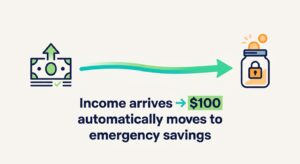
If you are paid weekly:
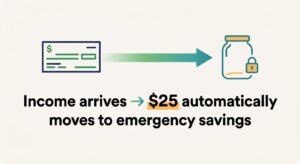
You don’t have to make a new decision every time.
Automation can turn saving into part of your normal financial routine.
Step 5: Find One Expense You Can Temporarily Cut
You don’t need to completely redesign your life.
Look for one expense that can be reduced for 90 days.
For example:
- $15 subscription × 3 months = $45
- $30 less eating out per week × 13 weeks = $390
- $50 less discretionary spending per week × 13 weeks = $650
Small changes become much more meaningful when you calculate their total effect.
The goal is not to live miserably forever.
It is to create a temporary push toward financial stability.
Step 6: Send Unexpected Money to the Fund
Did you receive:
- A bonus?
- A gift?
- Freelance income?
- A tax refund?
- Money from selling something?
- Extra income from a side job?
Consider sending part or all of it to your emergency fund.
You don’t have to change your regular lifestyle to find every dollar.
Sometimes the fastest progress comes from money you weren’t depending on in the first place.
Step 7: Increase Your Income Temporarily
If your normal income doesn’t leave enough room to save, cutting expenses can only take you so far.
For the next 90 days, consider whether you can:
- Take freelance work
- Work additional hours
- Sell unused items
- Offer a skill as a service
- Take on temporary work
- Redirect occasional extra income
You don’t necessarily need a permanent second job.
You may simply need a temporary income boost to get your first safety buffer established.
Step 8: Protect the Money From Yourself
This sounds strange, but it matters.
If your emergency fund is sitting beside your spending money, it can start looking like extra money.
It isn’t.
Give yourself a simple rule:
I only use this account for unexpected, necessary expenses.
You can even keep a note in the account:
What is this money protecting?
Then list the things that matter to you.
Medical emergencies.
Housing.
Food.
Family.
Income interruptions.
Your future self.
The more specific the purpose, the easier it can be to resist using the money for something else.
Step 9: Don’t Invest Your Emergency Fund in Risky Assets
This is particularly important for traders.
Your emergency fund and your investment portfolio have different jobs.
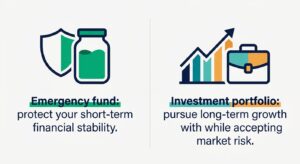
If you put your emergency savings into volatile assets and suddenly need the money during a market decline, you may be forced to sell at an unfavorable time.
For emergency savings, accessibility and stability are generally more important than maximizing potential returns.
Step 10: Review Your Progress Every Week
You don’t need to obsess over your account every day.
Once a week, ask:
- How much have I saved?
- How much do I still need?
- What worked this week?
- What can I change next week?
If your original target turns out to be unrealistic, adjust it.
A financial plan that adapts is better than a perfect plan you cannot follow.
How to Build an Emergency Fund From Zero
on a Low Income
Okay, I get it. I know exactly how you feel. You’re reading about saving money while every month you’re struggling to make it to the end without relying on your credit card or taking a small loan just to cover the gap.
“Just save six months of expenses.”
Okay.
But where is that money supposed to come from?
If almost every dollar already has a job, start smaller.
Your first goal might be:
$10 → $25 → $50 → $100 → $250 → $500 → $1,000
For example, saving just $20 every two weeks adds up to approximately:
$20 × 26 = $520 per year
It isn’t a fortune.
But it is no longer zero.
And zero is a very difficult number to use when something goes wrong.
The objective isn’t to prove that you can save a huge amount immediately.
It is to create a habit that can grow as your income grows.
Where Should You Keep an Emergency Fund?
The best location for emergency savings is generally somewhere that offers three things:
1. Safety
You don’t want your emergency money exposed to unnecessary market volatility.
2. Accessibility
If you have an emergency tonight, you shouldn’t need to wait months to access the money.
3. Some interest, where appropriate
If you can earn a reasonable return without sacrificing access or taking inappropriate risk, that can help reduce the effect of inflation.
Depending on your country and banking system, this might mean a suitable savings account or another low-risk, liquid option.
Don’t automatically choose an investment just because it offers a higher potential return.
The emergency fund is there because you might need the money at the worst possible time.
Emergency Fund vs. Sinking Fund
These two are often confused.
They aren’t the same thing.
| Emergency fund | Sinking fund |
|---|---|
| Unexpected expenses | Expected expenses |
| Sudden medical bill | Annual insurance |
| Job loss | Holiday spending |
| Major unexpected repair | Planned car maintenance |
| Family emergency | Tuition you know is coming |
A sinking fund helps you prepare for expenses you know are coming.
An emergency fund protects you against expenses you didn’t see coming.
Having both can make your overall budget much easier to manage.
Should You Invest Before Building an Emergency Fund?
This is one of those questions where the answer depends on your financial situation.
But there is an important principle:
Don’t treat emergency savings and investing as competing goals with exactly the same purpose.
If you have no financial buffer at all, an unexpected expense can force you to:
- Borrow money
- Use expensive credit
- Sell investments
- Stop paying another important bill
- Increase financial stress
Building at least a starter emergency fund can give you some protection before you focus heavily on long-term investment goals.
For many people, the progression can look something like:
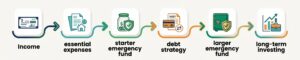
The exact order can change depending on high-interest debt, employer benefits, family responsibilities, and other circumstances.
Can Trading Help You Build Your Emergency Fund?
This is where I want to speak directly to my fellow traders…..yes we love trading , yes it’s our passion in life, but
I would not make trading your emergency-fund strategy.
Yes, trading can potentially generate returns.
But trading also involves losses.
And an emergency fund exists precisely because you don’t know when an emergency will happen.
Imagine this:
You have $2,000 in savings.
You decide to use $1,500 as trading capital because you want to make the money grow faster.
Two weeks later, an unexpected expense costs $1,200.
Now what?
You may have to withdraw money from a position, sell an investment, close a trade at the wrong time, or borrow.
That is exactly the situation your emergency fund was supposed to prevent.
Your financial structure should ideally separate these purposes:
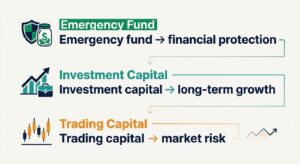
Don’t move money from the first category into the third simply because you see what looks like a great setup on the chart.
And never use your emergency savings to:
- Recover a trading loss
- Increase a losing position
- Meet a margin call
- Chase a missed opportunity
- Increase leverage
- Trade because you’re emotionally frustrated
Your emergency fund protects your life. Your trading capital takes market risk.
Keep those jobs separate.
5 Reasons an Emergency Fund Can Protect Your Financial Stability
1. It gives you options
When something goes wrong, having cash gives you more choices.
2. It can reduce the need for expensive borrowing
An unexpected bill doesn’t automatically have to become long-term debt.
3. It can protect your investments
You may not need to sell a long-term investment simply because an unexpected expense appeared.
4. It gives you time
If your income suddenly stops, even a small financial cushion can give you breathing room while you figure out the next step.
5. It reduces the financial pressure around unexpected events
You can’t control when life surprises you.
But you can prepare for some of the financial consequences.
How Can You Remind Yourself Why You Created the Fund?
Saving money is one thing.
Leaving it alone is another.
Give your emergency fund a purpose.
Instead of calling it:
Savings
call it:
Emergency Fund — Protecting My Future
Then write down what you’re protecting.
For example:
“This money is here so that an unexpected expense doesn’t force me into debt or make me sell investments at the wrong time.”
You can also use milestones:
$100 → $500 → $1,000 → 1 month → 3 months → 6 months
Every milestone is progress.
And remember:
You are not saving because you expect something bad to happen.
You’re saving because you know that sometimes things happen that you cannot predict.
What Should You Do After Using Your Emergency Fund?
Hopefully, you won’t need it often.
But if you do, don’t feel like you’ve failed.
That’s what the fund is for.
If you use $800 from a $2,000 emergency fund to handle a genuine emergency, your next financial goal becomes rebuilding the $800.
Think of the process as:
Build → Use when necessary → Rebuild → Continue
Don’t feel guilty for using money that was specifically saved for an emergency.
The mistake would be using it for something that wasn’t an emergency and then having nothing available when a real one arrives.
Your 90-Day Emergency Fund Challenge
If you are starting from zero today, don’t worry about reaching some imaginary perfect number immediately.
Start with a target.
Days 1–7
Calculate your essential expenses.
Choose your first emergency-fund target.
Open a separate account.
Days 8–30
Automate your savings.
Cut one unnecessary expense.
Send any unexpected income toward the fund.
Days 31–60
Keep the system going.
Look for ways to increase income temporarily.
Review your progress every week.
Days 61–90
Push toward your target.
Don’t increase spending simply because you’ve made progress.
Once you reach your first milestone, choose the next one.
And if you don’t reach your original target?
That’s okay.
The purpose of 90 days isn’t to win a savings competition.
It’s to build a financial habit that continues after the 90 days are over.
Frequently Asked Questions about How to Build an Emergency Fund From Zero
How much should I have in an emergency fund?
A common long-term guideline is around 3–6 months of essential expenses, but you don’t need to start there. If you’re starting from zero, build a smaller buffer first and increase it over time.
Is $1,000 enough for an emergency fund?
It can be a useful starter milestone, but it isn’t necessarily enough for everyone. Someone with high monthly expenses or unstable income may eventually need a much larger reserve.
Can I build an emergency fund from zero?
Absolutely. Start with a small target, automate what you can, reduce one or two expenses, and direct unexpected income toward the fund.
Can I build an emergency fund in 90 days?
You can make significant progress in 90 days, but the amount you can save depends on your income and expenses. The important thing is to set a target based on your actual numbers rather than someone else’s.
How can I build an emergency fund on a low income?
Start small. Even $10, $20, or $50 at a time can begin the process. Focus on consistency, automate what you can, and look for temporary ways to increase income rather than relying only on cutting expenses.
Where should I keep my emergency fund?
Look for a safe, accessible account that allows you to access the money when you need it. Depending on where you live, a suitable savings account or another low-risk liquid option may be appropriate.
Should I invest my emergency fund?
Generally, emergency savings should prioritize accessibility and stability rather than taking substantial market risk. The money may be needed precisely when markets are falling.
Can I use my emergency fund for trading?
It is better to keep emergency savings separate from trading capital. Trading involves market risk, while an emergency fund exists to protect your financial stability.
Should I pay debt or build an emergency fund first?
There isn’t one answer for everyone. A small emergency buffer can help prevent a new unexpected expense from immediately becoming additional debt, while high-interest debt may also deserve urgent attention. Consider both your interest costs and your ability to handle an unexpected expense.
What happens after I use my emergency fund?
Rebuild it.
Using the money for a genuine emergency doesn’t mean the system failed. It means the system worked. Once the emergency is handled, make rebuilding your financial buffer the next priority.
Wrapup
Fellow traders, I started this article because something happened in my personal life that reminded me how quickly an unexpected situation can turn into a financial problem.
And maybe that’s the biggest lesson here.
We spend so much time thinking about making more money, investing, trading, growing our portfolios and finding the next opportunity.
But sometimes the smartest financial move isn’t about making more.
It’s about protecting what you already have.