
Table of Contents
Top 10 Largest Central Banks by Total Assets (2026)
Top 10 Largest Central Banks by Total Assets ….Yaay… Welcome back to another article in our Top 10 series!
Let’s take a short break from our longer educational guides, and today I thought we’d do something a little different. Over the past few articles, we’ve spent a lot of time talking about central banks, interest rates, inflation, and how economic news can move the financial markets. So, I thought this would be the perfect opportunity to answer another interesting question…what is the Top 10 Largest Central Banks by Total Assets
Now, when we say “biggest,” we don’t mean the number of employees or the size of their headquarters. Instead, we’re talking about the total assets they hold on their balance sheets—assets worth trillions of dollars that help them influence interest rates, inflation, liquidity, currencies, and the global financial system.
Some of these institutions manage assets larger than the entire GDP of many countries, making them among the most powerful financial organizations on the planet.

In this article, we’ll explore the Top 10 Largest Central Banks by Total Assets, learn why their balance sheets have grown so large, and discover why every trader and investor should keep an eye on them.
Let’s dive in!
What Is a Central Bank?
Before we jump into the rankings of the top 10 largest central banks by total assets, let’s quickly refresh what a central bank actually is.
A central bank is the institution responsible for managing a country’s monetary policy and maintaining financial stability. Unlike commercial banks that serve individuals and businesses, central banks operate at the national level and work behind the scenes to support the economy.
Some of their main responsibilities include:
- Setting interest rates
- Controlling inflation
- Issuing and managing the national currency
- Supervising the banking system
- Managing foreign exchange and gold reserves
- Acting as the lender of last resort during financial crises
Think of a central bank as the financial control center of an economy. Its decisions influence everything from mortgage rates and business loans to exchange rates and stock market performance.
What Are Central Bank Assets?
When people hear that a central bank holds trillions of dollars in assets, many assume it’s simply sitting on enormous piles of cash.
In reality, that’s far from the truth.
A central bank’s balance sheet is made up of various financial assets, including:
- Government bonds
- Treasury securities
- Foreign exchange reserves
- Gold reserves
- Loans to commercial banks
- Mortgage-backed securities (for some central banks)
- Corporate bonds (where applicable)
- Other monetary policy instruments
The size of these assets reflects the central bank’s role in supporting the economy, implementing monetary policy, and responding to financial crises.
Why Do Large Balance Sheets Matter?
A central bank’s balance sheet tells us much more than how much it owns.
It often reveals:
- How aggressively it supports the economy.
- Whether it has used Quantitative Easing (QE).
- How much liquidity exists in financial markets.
- The strength of its foreign exchange reserves.
- How active it is during financial crises.
Generally speaking:
- Growing balance sheets often indicate increased liquidity and monetary stimulus.
- Shrinking balance sheets usually signal tighter monetary policy and reduced market liquidity.
This is one reason why traders pay close attention not only to interest rates but also to central bank balance sheet announcements.
Did You Know?
A larger central bank doesn’t automatically mean a stronger economy.
For example, Switzerland has one of the world’s largest central bank balance sheets despite having a much smaller economy than the United States or China.
That’s because balance sheet size depends on many factors, including:
- Quantitative easing programs
- Currency interventions
- Reserve accumulation
- Emergency lending
- Financial stability measures
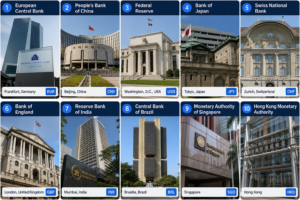
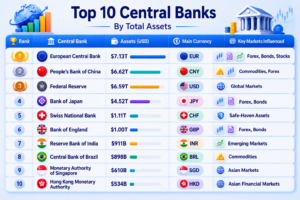
Top 10 Largest Central Banks by Total Assets (2026)
The following ranking is based on the latest consolidated international data available from the Bank for International Settlements (BIS), complemented by official central bank reports where appropriate.
| Rank | Central Bank | Country / Region | Total Assets |
|---|---|---|---|
| 1 | European Central Bank (Eurosystem) | Euro Area | $7.13 Trillion |
| 2 | People’s Bank of China | China | $6.62 Trillion |
| 3 | Federal Reserve System | United States | $6.59 Trillion |
| 4 | Bank of Japan | Japan | $4.52 Trillion |
| 5 | Swiss National Bank | Switzerland | $1.11 Trillion |
| 6 | Bank of England | United Kingdom | $1.00 Trillion |
| 7 | Reserve Bank of India | India | $911 Billion |
| 8 | Central Bank of Brazil | Brazil | $898 Billion |
| 9 | Monetary Authority of Singapore | Singapore | $610 Billion |
| 10 | Hong Kong Monetary Authority | Hong Kong | $534 Billion |
Top 10 Largest Central Banks by Total Assets (2026)
A deeper look
1. European Central Bank (ECB)
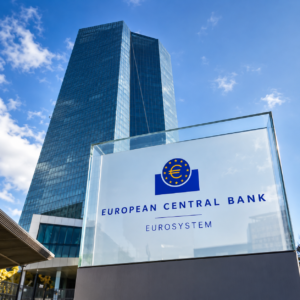
Assets: Approximately $7.13 Trillion
The European Central Bank sits at the top of our list as the institution responsible for monetary policy across the euro area.
Unlike most central banks, the ECB doesn’t serve just one country. Instead, it manages monetary policy for 20 European nations that share the euro, making it one of the most influential financial institutions in the world.
The euro is also the second most traded currency globally after the U.S. dollar, which makes every ECB decision highly significant for financial markets.
Why Is Its Balance Sheet So Large?
The ECB dramatically expanded its balance sheet during:
- The European sovereign debt crisis
- The COVID-19 pandemic
- Quantitative easing programs
- Government and corporate bond purchase programs
These measures were designed to stimulate economic growth and maintain financial stability across the euro area.
Interesting Facts
- The euro is used by over 340 million people.
- The ECB oversees monetary policy for 20 countries, not just one.
- It plays a key role in maintaining price stability across the Eurozone.
Why Traders Watch the ECB
- ECB interest rate decisions can create major volatility in EUR/USD, the world’s most traded currency pair.
- Changes in ECB policy influence European stock markets and government bond yields.
- Inflation reports and ECB press conferences are among the most closely watched economic events each month.
2. People’s Bank of China (PBOC)
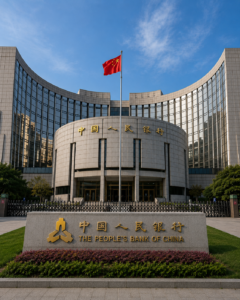
Assets: Approximately $6.62 Trillion
China’s central bank has become one of the world’s largest thanks to the country’s enormous economy and extensive foreign exchange reserves.
Unlike many Western central banks, the People’s Bank of China actively manages both monetary policy and exchange rate stability, giving it an even broader role in the economy.
Why Is Its Balance Sheet So Large?
The PBOC holds massive amounts of:
- Foreign currency reserves
- Government securities
- Lending facilities
- Liquidity programs supporting China’s banking system
China’s export-driven economy has also contributed to decades of reserve accumulation.
Interesting Facts
- China has the world’s second-largest economy.
- The Chinese yuan continues expanding its role in international trade.
- China holds one of the largest foreign exchange reserve portfolios in the world.
Why Traders Watch the PBOC
- Chinese economic data often moves commodity prices like copper and iron ore.
- Policy changes affect the value of the yuan and Asian currencies.
- Global investors closely monitor China’s liquidity measures because they influence worldwide risk sentiment.
3. Federal Reserve System
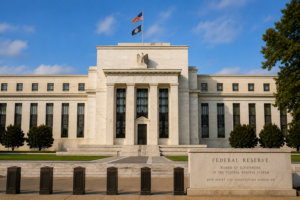
Assets: Approximately $6.59 Trillion
Often simply called “the Fed,” the Federal Reserve is arguably the most influential central bank on Earth.
Although it ranks third by total assets in this methodology, many investors consider it the most important because the U.S. dollar remains the world’s dominant reserve currency.
Whenever the Fed changes interest rates or adjusts its balance sheet, markets around the globe pay attention.
Why Is Its Balance Sheet So Large?
The Fed expanded rapidly during:
- The 2008 Global Financial Crisis
- COVID-19 stimulus programs
- Multiple rounds of Quantitative Easing (QE)
Its largest assets include:
- U.S. Treasury securities
- Mortgage-backed securities
- Emergency lending facilities
Interesting Facts
- Around 60% of global foreign exchange reserves are held in U.S. dollars.
- Most international commodities are priced in dollars.
- The Federal Reserve strongly influences global borrowing costs.
Why Traders Watch the Fed
- Federal Reserve meetings are among the most important events on the economic calendar.
- Fed policy heavily impacts gold, stock markets, cryptocurrencies, and forex.
- U.S. interest rate decisions often trigger significant market volatility.
4. Bank of Japan (BOJ)

Assets: Approximately $4.52 Trillion
Japan has spent decades battling low inflation and slow economic growth.
As a result, the Bank of Japan has become famous for implementing some of the world’s most aggressive monetary policies.
Its balance sheet is one of the largest relative to the size of its economy.
Why Is Its Balance Sheet So Large?
The BOJ has purchased:
- Japanese government bonds
- Exchange-traded funds (ETFs)
- Corporate assets
- Other financial instruments
It has also maintained extremely low—and at times negative—interest rates for many years.
Interesting Facts
- Japan pioneered many unconventional monetary policy tools.
- The BOJ was among the first central banks to introduce negative interest rates.
- Japan remains one of the world’s largest government bond markets.
Why Traders Watch the BOJ
- BOJ meetings can significantly affect the Japanese yen.
- USD/JPY is one of the most actively traded currency pairs globally.
- Changes in Japanese bond yields often influence global bond markets.
5. Swiss National Bank (SNB)

Assets: Approximately $1.11 Trillion
Despite Switzerland’s relatively small population, its central bank ranks among the world’s largest.
Why?
Because the Swiss franc is widely viewed as a safe-haven currency, attracting investors during periods of global uncertainty.
To help prevent excessive appreciation of the franc, the Swiss National Bank has frequently intervened in currency markets, leading to a very large balance sheet.
Why Is Its Balance Sheet So Large?
The SNB holds substantial:
- Foreign currency reserves
- International equities
- Government bonds
- Gold reserves
Its investment portfolio is one of the most unique among major central banks.
Interesting Facts
- Switzerland is one of the world’s leading financial centers.
- The Swiss franc is considered one of the safest currencies globally.
- The SNB is known for actively managing its foreign reserve portfolio.
Why Traders Watch the SNB
- The Swiss franc often strengthens during periods of market fear.
- SNB interventions can cause sharp movements in CHF currency pairs.
- Safe-haven demand frequently links the Swiss franc with gold prices.
6. Bank of England (BoE)
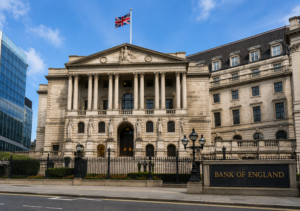
Country: United Kingdom
Founded: 1694
Total Assets: Approximately $1.00 Trillion
The Bank of England (BoE) is one of the oldest and most respected central banks in the world. Often referred to as the “Old Lady of Threadneedle Street,” it has played a crucial role in shaping modern central banking for more than three centuries.
Although the United Kingdom is no longer part of the European Union, London remains one of the world’s largest financial centers, making every Bank of England decision highly significant for global investors.
Why Is Its Balance Sheet So Large?
Like many major central banks, the BoE expanded its balance sheet following the 2008 Global Financial Crisis and again during the COVID-19 pandemic. Through its Asset Purchase Facility (APF), it bought large amounts of UK government bonds (gilts) to support the economy and maintain financial stability.
In recent years, the Bank has gradually reduced its balance sheet through quantitative tightening (QT), allowing some of these assets to mature or be sold back into the market.
Interesting Facts About the UK
- London is one of the world’s largest financial hubs.
- The British pound is one of the oldest continuously used currencies.
- The UK has one of the most developed financial services industries globally.
Why Traders Watch the Bank of England
- BoE interest rate decisions can create significant volatility in GBP/USD and EUR/GBP.
- Inflation reports and Monetary Policy Committee (MPC) meetings are major market-moving events.
- UK bond yields often react immediately to changes in BoE policy.
7. Reserve Bank of India (RBI)
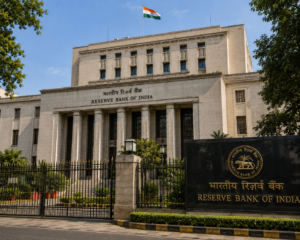
Country: India
Founded: 1935
Total Assets: Approximately $911 Billion
India has become one of the world’s fastest-growing major economies, and the Reserve Bank of India (RBI) has grown alongside it.
The RBI plays a central role in maintaining financial stability while supporting an economy with more than 1.4 billion people. As India’s influence on the global economy continues to expand, investors are paying increasing attention to its monetary policy decisions.
Why Is Its Balance Sheet So Large?
The RBI manages substantial foreign exchange reserves, government securities, and liquidity operations. Its growing balance sheet reflects India’s expanding economy, increased international trade, and active management of financial stability.
Interesting Facts About India
- India is among the world’s largest economies.
- The country has one of the fastest-growing digital payment ecosystems.
- India continues to attract increasing levels of foreign investment.
Why Traders Watch the RBI
- RBI decisions influence the Indian Rupee (INR).
- India’s economic growth affects global demand for energy and commodities.
- Foreign investment flows into India can impact emerging market sentiment worldwide.
8. Central Bank of Brazil (BCB)
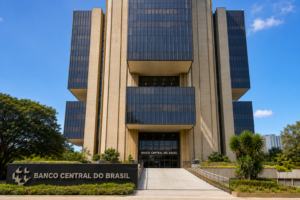
Country: Brazil
Founded: 1964
Total Assets: Approximately $898 Billion
Brazil is the largest economy in Latin America, and its central bank plays a key role in maintaining price stability while managing one of the region’s most important financial systems.
Because Brazil is a major exporter of agricultural products, iron ore, and oil, its economy has a strong connection with global commodity markets.
Why Is Its Balance Sheet So Large?
The Central Bank of Brazil manages foreign exchange reserves, government securities, and monetary operations designed to stabilize inflation and support economic growth.
Interesting Facts About Brazil
- Brazil is one of the world’s largest exporters of soybeans, coffee, sugar, and iron ore.
- The country has one of Latin America’s largest financial markets.
- Brazil’s economy is closely linked to commodity demand from China.
Why Traders Watch the Central Bank of Brazil
- Interest rate decisions directly impact the Brazilian Real (BRL).
- Commodity traders monitor Brazil’s economy because of its export strength.
- Inflation developments in Brazil often influence emerging market investment flows.
9. Monetary Authority of Singapore (MAS)

Country: Singapore
Founded: 1971
Total Assets: Approximately $610 Billion
Unlike most central banks, the Monetary Authority of Singapore (MAS) uses the exchange rate as its primary monetary policy tool instead of relying mainly on interest rates.
Singapore’s strategic location has helped it become one of the world’s leading financial and trading centers despite its relatively small size.
Why Is Its Balance Sheet So Large?
The MAS manages substantial foreign exchange reserves to maintain stability in the Singapore dollar while supporting one of Asia’s most internationally connected economies.
Interesting Facts About Singapore
- Singapore consistently ranks among the world’s leading financial centers.
- The country serves as a major gateway for international trade in Asia.
- It has one of the highest GDP per capita figures globally.
Why Traders Watch the MAS
- Exchange rate policy can influence regional currency markets.
- Singapore’s economy provides insight into Asian trade activity.
- Investors monitor MAS announcements for signals about regional economic growth.
10. Hong Kong Monetary Authority (HKMA)

Country: Hong Kong
Founded: 1993
Total Assets: Approximately $534 Billion
The Hong Kong Monetary Authority (HKMA) is unique because it operates a linked exchange rate system that keeps the Hong Kong dollar within a narrow trading band against the U.S. dollar.
As one of the world’s leading international financial centers, Hong Kong plays an important role in connecting global investors with mainland China.
Why Is Its Balance Sheet So Large?
The HKMA maintains significant foreign currency reserves to defend the Hong Kong dollar’s currency peg and preserve confidence in the financial system.
Interesting Facts About Hong Kong
- Hong Kong is one of the world’s busiest international financial centers.
- It serves as a major bridge between Chinese and global capital markets.
- Its currency has been linked to the U.S. dollar for decades.
Why Traders Watch the HKMA
- Currency interventions help maintain the Hong Kong dollar’s stability.
- Global capital flows often influence Hong Kong’s financial markets.
- Policy changes can affect investor sentiment across Asia.
Why Every Trader Should Care About Central Banks
Whether you trade forex, stocks, commodities, or cryptocurrencies, understanding the top 10 central banks with the biggest assets can help you better interpret interest rate decisions, liquidity changes, and major market trends.
Here are just a few examples:
- Interest rate decisions can trigger sharp moves in currencies, stock indices, and government bonds.
- Expanding balance sheets often inject liquidity into financial markets, encouraging investment and risk-taking.
- Quantitative tightening (QT) can reduce liquidity and increase borrowing costs.
- Central bank communication shapes expectations for inflation and economic growth.
- Market participants closely monitor speeches, meeting minutes, and economic projections to anticipate future policy changes.
Understanding how these institutions operate helps traders connect economic news with real market movements rather than simply reacting to headlines.
Frequently Asked Questions about Top 10 Largest Central Banks by Total Assets
Which central bank has the largest balance sheet?
According to the latest consolidated international data, the European Central Bank (Eurosystem) currently has the world’s largest balance sheet, with total assets exceeding $7 trillion.
Why does the Federal Reserve influence global markets so much?
Although it ranks behind the Eurosystem and the People’s Bank of China by total assets in this methodology, the Federal Reserve oversees the world’s primary reserve currency, the U.S. dollar, giving it unmatched influence over global financial markets.
Why are central bank balance sheets so large?
Central bank assets grow through government bond purchases, foreign exchange reserves, emergency lending programs, quantitative easing (QE), and other monetary policy operations designed to support economic stability.
Does a larger balance sheet mean a stronger economy?
No. A larger balance sheet reflects the scale and structure of monetary policy rather than the overall strength of an economy. It may indicate significant asset purchases, reserve accumulation, or currency interventions.
Why do traders monitor central banks?
Central bank decisions influence interest rates, inflation, exchange rates, bond yields, stock markets, commodity prices, and overall market sentiment. Understanding their policies helps traders anticipate potential market movements.
Wrap-up
And here we are, we’ve reached the end of our journey through the Top 10 Largest Central Banks by Total Assets
These institutions are the driving force behind global financial markets, influencing interest rates, inflation, currencies, and overall market sentiment. Understanding how they operate can help you interpret economic news, anticipate volatility, and make more informed trading decisions.
The best way to put this knowledge into practice is to start with a demo account. Practice trading different currency pairs around major central bank events, build your confidence, and once you’re ready, move on to a real trading account.
The more you understand central banks, the better prepared you’ll be for today’s financial markets.