
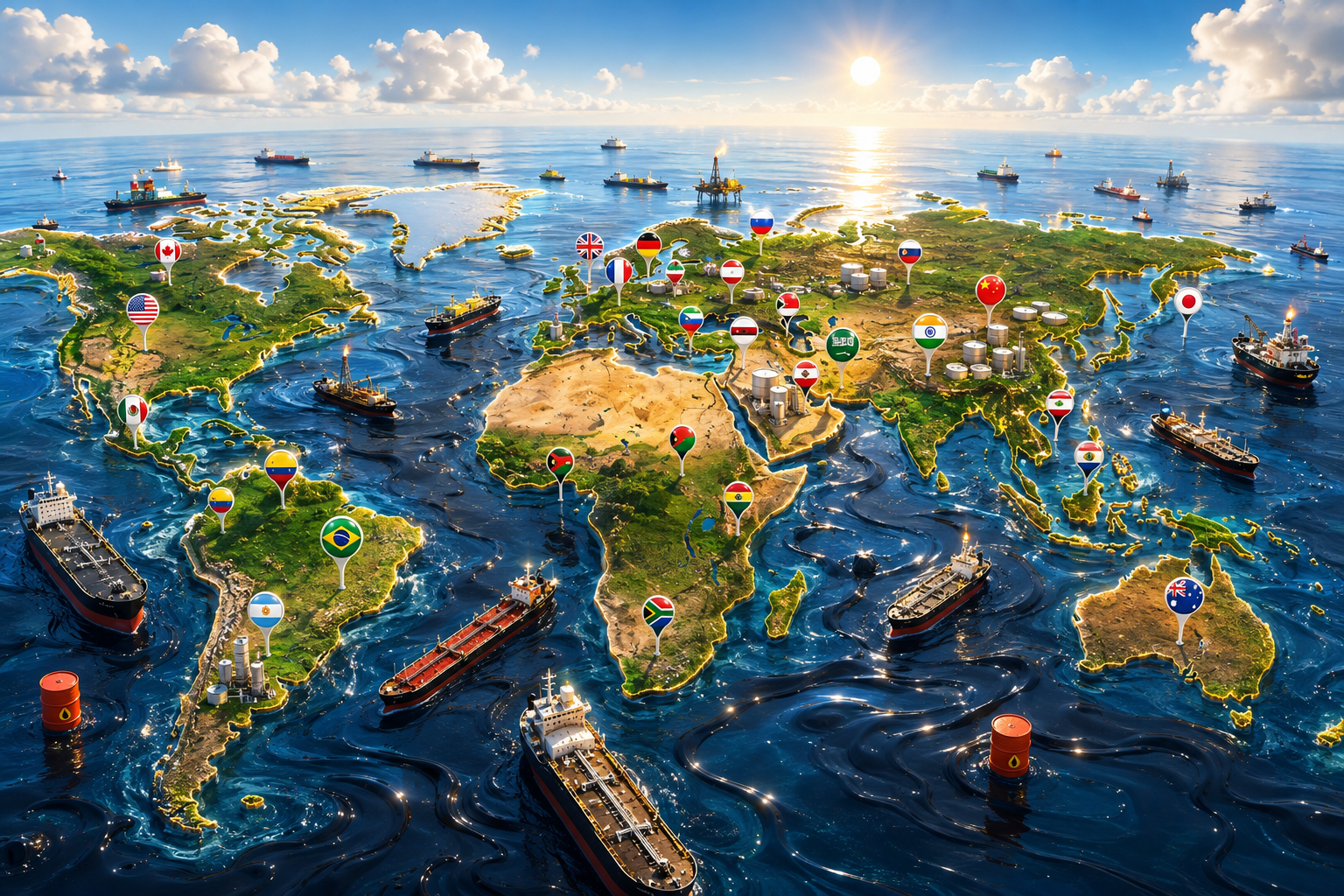
Top 10 Countries With the Biggest Oil Reserves in the World
Top 10 Countries With the Biggest Oil Reserves in the World….Hello my darlings today is super special …because we are talking about some good stuff here ….we are talking about the Top 10 Countries With the Biggest Oil Reserves in the World…..Oil is basically part of our daily lives, whether we realize it or not.
We use it directly through fuel, but its story goes way beyond cars and gasoline. Oil is connected to transportation, plastics, chemicals, manufacturing, aviation and many of the things we use every single day.
And yes, the world is changing.
Electric cars are growing, countries are pushing toward cleaner energy, and the European Union is moving toward zero-emission new cars and vans from 2035, not 2030.
But here is where things get interesting.
Oil is much bigger than the car sitting in your driveway.
It remains one of the world’s most important commodities, and countries sitting on huge oil reserves can have enormous economic and geopolitical influence.
Just look at what is happening around the United States and Iran. Oil, sanctions, energy security and the Strait of Hormuz have all become part of the bigger economic story. Recent disruptions around the Strait have already affected oil prices and global supply concerns.
So when we talk about oil reserves, we are not simply talking about barrels sitting underground.
We are talking about energy, money, trade, economic power and geopolitics.
And that is exactly why I wanted to look at the top 10 countries with the biggest oil reserves in the world.
Let’s dive in.
What Is Oil?
Before we jump into the top 10 countries with the biggest oil reserves, let’s first understand what we are actually talking about.
Oil, or crude oil, is a naturally occurring fossil fuel formed from organic material that was buried and transformed under heat and pressure over millions of years.
Once extracted, crude oil can be processed into many different petroleum products.
Think about:
- Gasoline and diesel
- Jet fuel
- Heating fuels
- Lubricants
- Plastics
- Petrochemicals
- Asphalt
- Industrial products
So yes, electric cars are changing the transportation story, but oil is much bigger than what goes into a car’s fuel tank.
That is why oil remains such an important part of the global economy.
What Are Oil Reserves?
This one is important because oil reserves do not simply mean all the oil sitting underground.
Proven oil reserves are quantities of petroleum that geological and engineering information indicates can be recovered with reasonable certainty under existing economic and operating conditions.
In simple words:
Oil underground ≠ oil reserves.
A country can have enormous oil resources, but only part of them may currently qualify as proven reserves.
Reserve estimates can also change as new discoveries are made, technology improves, production takes place or economic conditions change.
For our ranking, the latest comprehensive country-by-country data I found from OPEC’s 2025 Annual Statistical Bulletin reports proven crude oil reserves at the end of 2024. OPEC’s 2026 bulletin was released in April 2026, but its publicly indexed announcement does not provide a newer country-by-country reserve table, so the 2024 figures remain the appropriate detailed dataset to use here.
What Is Oil Trading?
Oil trading means buying and selling financial instruments whose value is linked to the price of crude oil.
You don’t necessarily need to buy physical barrels of oil.
Depending on the market and broker, traders can get oil exposure through:
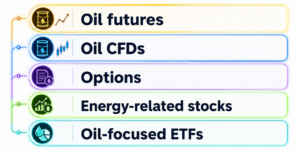
Two major oil benchmarks you will hear about are Brent crude and WTI crude.
Brent is widely used as an international benchmark, while WTI is particularly important in the U.S. market.
For a retail trader, the exact product, contract size, leverage, fees and trading hours depend on the platform and jurisdiction.
Why Is Oil So Important?
Because it connects energy, transportation, industry, trade and geopolitics….Even as countries move toward cleaner energy and electric vehicles, oil continues to be used across a huge range of industries.
And there is another important point:
A country’s oil reserves do not automatically make it rich or powerful.
What matters is how much of that oil can actually be produced, how cheaply it can be extracted, the quality of the crude, the country’s infrastructure, its political stability and its ability to sell the oil to international markets.
That is why reserve size is only one piece of the oil story.
Oil’s Political and Economic Impact
Oil can affect much more than the price you see on a trading platform.
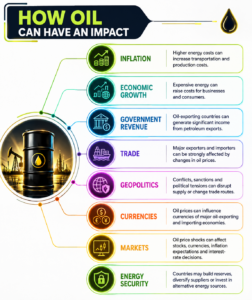
This is why oil often appears in political and economic discussions.
A disruption in a major producing region or an important shipping route can quickly become a global market story.
Top 10 Countries With the Biggest Oil Reserves
According to OPEC’s latest detailed country-level reserve data, these are the top 10 countries by proven crude oil reserves at the end of 2024. The figures are in billion barrels.
| Rank | Country | Proven oil reserves |
|---|---|---|
| 1 | Venezuela | 303.221 billion barrels |
| 2 | Saudi Arabia | 267.200 billion barrels |
| 3 | Iran | 208.600 billion barrels |
| 4 | Canada* | 163.000 billion barrels |
| 5 | Iraq | 145.019 billion barrels |
| 6 | United Arab Emirates | 113.000 billion barrels |
| 7 | Kuwait | 101.500 billion barrels |
| 8 | Russia | 80.000 billion barrels |
| 9 | Libya | 48.363 billion barrels |
| 10 | United States | 45.014 billion barrels |
*OPEC’s table notes that Canada’s figure excludes oil sands in its standard country series, while the widely reported Canadian reserve figure of about 163 billion barrels includes oil sands. This is an important data-definition issue when comparing international rankings.
A quick note about oil-reserve data: Reserve estimates can vary between organizations because countries and statistical agencies may use different definitions, methodologies and reporting practices. For this ranking, we use OPEC’s Annual Statistical Bulletin 2025, which reports proven crude oil reserves at the end of 2024. Other reputable sources, including the Energy Institute, may report different figures for some countries.
1. Venezuela — 303.2 Billion Barrels
Venezuela has the world’s largest reported proven crude oil reserves.
But here is the part that makes the number more interesting: a large portion of Venezuela’s reserves consists of extra-heavy crude from the Orinoco Belt.
So having the largest reserve number does not mean Venezuela automatically produces or exports the most oil.
2. Saudi Arabia — 267.2 Billion Barrels
Saudi Arabia has the world’s second-largest reported proven reserves.
It is also one of the most important oil producers and exporters in the global market, making its production decisions closely watched by traders and governments.
3. Iran — 208.6 Billion Barrels
Iran ranks third with approximately 208.6 billion barrels of proven crude oil reserves.
Its position is particularly important because of its location in the Middle East and its role in global energy markets.
4. Canada — Around 163 Billion Barrels
Canada ranks fourth when its oil-sands reserves are included.
In fact, oil sands account for the vast majority of Canada’s proved oil reserves.
This is a good example of why reserve numbers need context. Two countries can have similar-looking reserve figures while having very different types of crude and production economics.
5. Iraq — 145.0 Billion Barrels
Iraq holds around 145 billion barrels of proven crude oil reserves.
Its enormous reserve base makes it an important oil producer, particularly within the Middle East.
6. United Arab Emirates — 113 Billion Barrels
The UAE has approximately 113 billion barrels of proven crude oil reserves.
Its oil industry is centered heavily around Abu Dhabi, and the country has invested significantly in production capacity and energy infrastructure.
7. Kuwait — 101.5 Billion Barrels
Kuwait holds around 101.5 billion barrels of proven crude oil reserves.
For a relatively small country geographically, that is an enormous amount of oil.
8. Russia — 80 Billion Barrels
Russia has around 80 billion barrels of proven crude oil reserves according to OPEC’s dataset.
Its importance goes beyond reserves because Russia is also one of the world’s major oil producers and exporters.
9. Libya — 48.4 Billion Barrels
Libya has approximately 48.4 billion barrels of proven crude oil reserves.
Its oil industry has enormous potential, but political instability and disruptions have repeatedly affected production.
10. United States — 45.0 Billion Barrels
The United States rounds out this particular top 10 with approximately 45.0 billion barrels in OPEC’s end-2024 dataset.
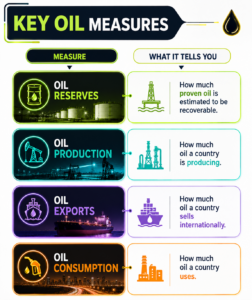
But don’t confuse reserves with production.
The U.S. is one of the world’s largest oil producers, despite ranking much lower in this reserve table. That is a perfect example of why oil reserves and oil production are two completely different measurements.
Oil Reserves vs Oil Production
This is probably one of the biggest mistakes beginners make when looking at oil statistics.
Having the most oil underground does not mean producing the most oil today.
Oil Reserves vs Oil Resources
| Oil Reserves | Oil Resources |
|---|---|
| Oil that is considered commercially recoverable under current technical and economic conditions. | A broader term covering oil deposits that exist or may potentially be recoverable. |
| Based on geological, engineering and economic information. | Can include oil that is not currently economical or technically recoverable. |
| Proven reserves have a reasonable level of certainty that they can be recovered. | Can include discovered and undiscovered oil that may not qualify as reserves. |
| Useful when comparing how much oil a country can reasonably recover under defined conditions. | Gives a broader picture of a country’s potential oil resources. |
| Example: Oil that can reasonably be extracted and sold under current conditions. | Example: Oil that may require better technology, higher prices or different economic conditions to become recoverable. |
How to Trade Oil
Now my fellow traders the part that we love the most how to trade oil? If you want to trade oil, start with the market itself before worrying about the trade.
Watch the factors that can move supply and demand.
Important things oil traders watch
- OPEC and OPEC+ production decisions
- U.S. crude inventories
- Global oil demand
- U.S. production
- Chinese economic activity
- Geopolitical tensions
- Sanctions
- Major supply disruptions
- Shipping routes
- The U.S. dollar
- Global economic growth
Risks of Trading Oil
Oil can be an exciting market…believe me I’ve been there , but it can also move very quickly.
- High volatility: Oil can make large moves in a short period.
- Geopolitical risk: Conflicts and sanctions can suddenly change supply expectations.
- Leverage: CFDs and futures can magnify both gains and losses.
- News risk: Inventory data and major announcements can trigger sharp moves.
- Market gaps: Prices can move significantly between available trading prices.
- Economic risk: A global slowdown can reduce oil demand.
- Currency effects: Oil is generally priced in U.S. dollars, so currency movements can also matter.
FAQs About Top 10 Countries With the Biggest Oil Reserves in the World
Which country has the biggest oil reserves?
Venezuela has the largest reported proven crude oil reserves, with approximately 303.2 billion barrels at the end of 2024.
Which country produces the most oil?
The United States was the world’s largest crude oil producer in 2025. Production and reserves are different measurements.
Are oil reserves the same as oil resources?
No. Reserves are the portion considered recoverable under defined economic and technical conditions. Resources can include oil deposits that are not currently classified as economically recoverable reserves.
Why is oil still important if electric cars are growing?
Because oil is used for much more than gasoline. It remains important for aviation, shipping, petrochemicals, plastics, industrial products and other parts of the economy.
What are the two main oil benchmarks?
Brent crude and WTI crude are two of the most widely followed crude oil benchmarks.
What causes oil prices to rise?
Prices can rise when markets expect stronger demand, lower supply, production disruptions or increased geopolitical risk.
What causes oil prices to fall?
Prices can fall when demand expectations weaken, inventories rise, production increases or supply concerns ease.
Can beginners trade oil?
Yes, but beginners should understand volatility, leverage, contract specifications and risk management before trading oil with real money.
Wrap-up
Our fellow Trader Heroes, I think by now you can see why oil is much more than what we put in a car.
It is connected to our daily lives, businesses, governments, economies and even geopolitics.
And those reserve numbers tell us something important: oil is heavily concentrated in a relatively small number of countries.
But don’t make the mistake of looking only at who has the most barrels underground.
Reserves, production, exports, demand and geopolitics all tell different parts of the story.
For traders, that is where things get really interesting.
Keep watching the oil market, understand what is moving supply and demand, and most importantly, don’t start trading oil with real money before you understand the market and have practiced your strategy.
Practice as you wish on our demo account using virtual funds, and get comfortable with oil trading before going live.