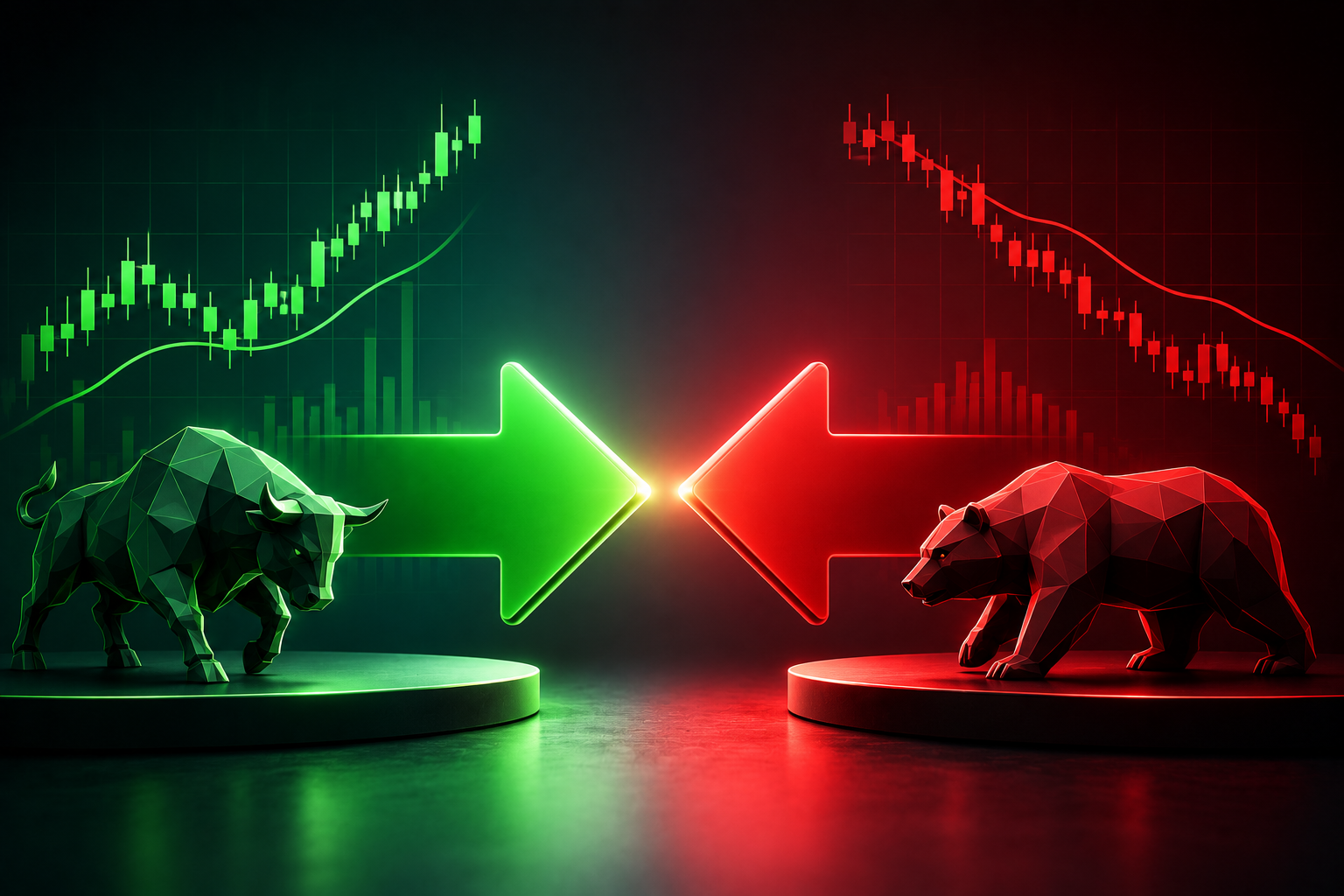
Bid vs Ask Price Explained
Bid vs Ask Price….Well… I don’t know how I didn’t explain this earlier…..Sorry… really sorry. I somehow skipped one of the most important concepts every trader must understand before placing their first real trade. Actually, before even opening a demo account, you should know exactly what bid and ask prices are.
Think about it…
Every single trade you make—whether you’re trading forex, stocks, gold, crypto, or indices—uses bid and ask prices. Yet many beginners spend weeks learning candlestick patterns and indicators without ever understanding why they enter a trade at one price but immediately see a small loss.
That’s because of the bid and ask prices.

The good news?
Better late than never.
By the end of this guide, you’ll understand exactly what bid and ask prices are, why they exist, how the bid-ask spread works, and how professional traders use this knowledge to make smarter trading decisions.
Let’s dive in.
What Is Bid and Ask Price?
Every financial market works like a huge marketplace where buyers and sellers are constantly negotiating prices.
Imagine you’re trying to buy a used car.
The seller says:
“I’ll sell it for $20,000.”
You reply:
“I’m only willing to pay $19,500.”
At this moment, there isn’t a deal yet because the buyer and seller haven’t agreed on the same price.
Financial markets work exactly the same way.
Every asset—whether it’s a stock, a currency pair, gold, or Bitcoin—always has two prices:
- The Bid Price – the highest price that a buyer is currently willing to pay.
- The Ask Price – the lowest price that a seller is currently willing to accept.
A trade only happens when one side agrees to the other’s price.
This process takes place every second while the market is open, with thousands—or even millions—of buyers and sellers competing to complete trades.

For example, imagine you see the following quote for a stock:
| Price Type | Price |
|---|---|
| Bid | $50.00 |
| Ask | $50.05 |
This tells you that buyers are currently offering $50.00 per share, while sellers are asking $50.05.
Since the two prices don’t match yet, no trade happens between those two orders.
However, if a buyer agrees to pay $50.05, or a seller agrees to accept $50.00, the transaction is completed instantly.
This constant interaction between buyers and sellers is what creates every price movement you see on a chart.
Quick Tip
Never assume the price shown on your chart is the exact price you’ll buy or sell at. Before placing any trade, always check both the bid price and the ask price, because these are the actual prices used to execute your order.
What Is the Bid Price?
Now that you know every market has two prices, let’s look at the first one.
The bid price is the highest price a buyer is currently willing to pay for an asset. In other words, it’s the best offer available from someone who wants to buy.
If you already own an asset and decide to sell it immediately using a market order, your trade will usually be executed at the current bid price.
Think of it like selling your phone online. A buyer offers you $500. That offer is the bid price. You can either accept it and sell immediately or wait for someone willing to pay more.
The financial markets work the same way. Buyers constantly compete by placing bids, and the highest bid becomes the current bid price.
Example
If you own these shares and want to sell immediately, you’ll most likely sell them at $75.20.
Can You Choose Your Own Bid Price?
Yes. Instead of accepting the current market price, you can place a limit order.
For example, if the current prices are:
- Bid: $75.20
- Ask: $75.25
You could place a buy limit order at $75.22 or $75.20 instead of buying immediately at $75.25. Your order will only be filled if a seller accepts your price.
What Is the Ask Price?
The ask price is the lowest price a seller is willing to accept for an asset.
If you want to buy an asset immediately using a market order, you’ll usually pay the current ask price.
Imagine you’re buying a used phone. The cheapest seller is asking $520. That becomes the ask price because it’s the lowest available selling price.
Just like buyers compete by raising their bids, sellers compete by lowering their asking prices.
Example
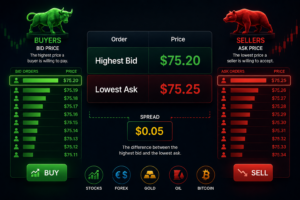
If you buy the stock immediately, you’ll most likely pay $75.25.
Why Is the Ask Price Higher Than the Bid Price?
It’s simple:
- Buyers want to pay as little as possible.
- Sellers want to receive as much as possible.
Since both sides usually want different prices, there’s almost always a small gap between them.
This gap is called the bid-ask spread, and it’s one of the most important concepts every trader should understand.
In the next section, we’ll explain what the spread is, how it’s calculated, and why it affects every trade you place.
Bid vs Ask Price: What’s the Difference?
By now, you know that every market has two prices:
- The bid price is what buyers are willing to pay.
- The ask price is what sellers are willing to accept.
At first glance, they may seem almost identical, especially on popular assets like EUR/USD or Apple stock. However, understanding the difference between them can completely change how you view the market.
Think of it this way.
Imagine you’re buying a house.
The owner says:
“I’m selling it for $300,000.”
You reply:
“I’ll pay $295,000.”
Neither of you is wrong—you simply value the property differently.
The stock market, forex market, and crypto market work exactly the same way.
The buyer wants the lowest possible price.
The seller wants the highest possible price.
The market meets somewhere in between.
Bid vs Ask Price Comparison
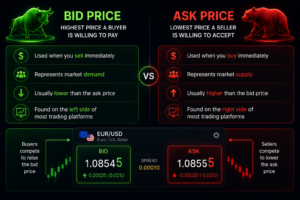
The difference may only be a few cents in stocks or a fraction of a pip in forex, but every single trade starts with these two prices.
How Do Bid and Ask Prices Work?
Now let’s see what actually happens behind the scenes.
Imagine thousands of traders around the world are looking at the same stock.
Some believe the price will go higher, so they’re trying to buy.
Others think it’s a good time to take profits, so they’re trying to sell.
At one moment, the order book might look like this:
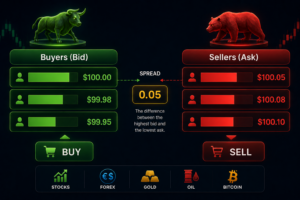
Notice something?
The highest buyer wants to pay $100.00, while the cheapest seller wants $100.05.
Since no one agrees on the same price, no trade happens between these two orders.
Now imagine a buyer decides:
“Fine… I’ll pay $100.05.”
The trade is completed instantly.
Or maybe a seller says:
“I’ll accept $100.00.”
Again, the trade happens immediately.
This matching process takes place millions of times every trading day.
Every candle you see on your chart is simply the result of buyers and sellers continuously agreeing on prices.
Who Sets the Bid and Ask Prices?
One of the biggest misconceptions beginners have is that the broker decides the prices.
Not exactly.
The market itself determines the bid and ask prices.
Every second, buyers submit bids and sellers submit asks. Trading systems automatically match compatible orders, creating the prices you see on your screen.
In highly liquid markets like major forex pairs or large-cap stocks, this process happens so quickly that prices change many times every second.
In less active markets, there may be fewer buyers and sellers, causing prices to move more slowly and spreads to become wider.
What Is the Bid-Ask Spread?
Now we’ve reached one of the most important concepts in trading.
The bid-ask spread is simply the difference between the bid price and the ask price.
In other words, it’s the small gap between what buyers are willing to pay and what sellers are willing to accept.
Let’s use the same example.
| Order | Price |
|---|---|
| Highest Bid | $75.20 |
| Lowest Ask | $75.25 |
In this example:
- Bid Price = $75.20
- Ask Price = $75.25
The spread is:
$75.25 − $75.20 = $0.05
So, the bid-ask spread is $0.05 per share.
Although five cents may not sound like much, every single trade in every financial market starts with this difference.
Why Does the Bid-Ask Spread Exist?
A common question beginners ask is:
“If buyers and sellers want to trade, why don’t they simply agree on one price?”
The answer is simple.
Every buyer wants to pay the lowest possible price, while every seller wants to receive the highest possible price.
Until both sides agree, there will always be a small gap between their prices.
That gap is the spread.
Think about buying a used car.
The seller says:
“I want $15,000.”
You reply:
“I’ll pay $14,700.”
There’s a $300 difference between what each side wants.
Eventually:
- You increase your offer.
- The seller lowers their price.
- Or one of you walks away.
Financial markets work exactly the same way—just much faster.
Instead of two people negotiating, thousands of buyers and sellers submit orders every second, and computers match them almost instantly.
Why Should Every Trader Care About the Spread?
Many beginners focus only on whether the market moves up or down.
Professional traders also pay close attention to the spread because it directly affects every trade they place.
Imagine you buy a stock with these prices:
| Bid | Ask |
|---|---|
| $100.00 | $100.05 |
Since you’re buying, your order is executed at the ask price, which is $100.05.
Now imagine the market doesn’t move at all.
The highest buyer is still only willing to pay $100.00.
If you decide to sell immediately, you’ll sell at the bid price.
That means:
- You bought at $100.05
- You sold at $100.00
You’ve lost $0.05 per share, even though the market never moved.
This is why, as soon as you open many trades, you’ll notice your position starts with a small unrealized loss.
It isn’t because the market moved against you.
It’s because you’ve already paid the spread.
Beginner Tip
Don’t panic when you see a small floating loss immediately after opening a trade. In most cases, that’s simply the cost of the bid-ask spread—not a sign that your trade is failing.
How Do You Calculate the Bid-Ask Spread?
The formula is very simple:
Bid-Ask Spread = Ask Price − Bid Price
Let’s look at a few examples.
| Bid Price | Ask Price | Spread |
|---|---|---|
| $50.00 | $50.03 | $0.03 |
| $75.20 | $75.25 | $0.05 |
| $100.50 | $100.60 | $0.10 |
In the forex market, the spread is usually measured in pips instead of dollars.
For example:
EUR/USD
- Bid: 1.10520
- Ask: 1.10535
Spread:
1.5 pips
The calculation is different, but the idea is exactly the same.
The spread is simply the gap between the buying price and the selling price.
Is a Smaller Spread Better?
In most situations, yes.
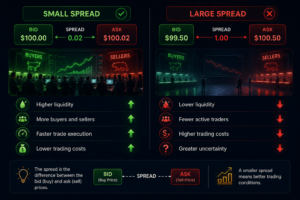
That’s why major assets like EUR/USD, Gold, Apple, or Microsoft often have very tight spreads, while small-cap stocks or lesser-known cryptocurrencies can have much wider spreads.
The narrower the spread, the less the market has to move before your trade becomes profitable.
The wider the spread, the more the market needs to move just to cover your trading cost.
A Simple Way to Remember the Spread
If you ever forget what the spread is, remember this:
The spread is the “gap” between buyers and sellers.
It’s the small difference between the price someone wants to buy at and the price someone else wants to sell at.
Every market has one.
Every trade pays it.
And every successful trader learns to pay attention to it before entering a position.
What Causes the Bid-Ask Spread to Change?
One thing you’ll quickly notice is that the bid-ask spread isn’t fixed. Sometimes it’s extremely small, while at other times it becomes much wider. This happens because the spread constantly changes based on what’s happening in the market.
Market Liquidity
The biggest factor affecting the spread is liquidity.
Liquidity refers to how easily an asset can be bought or sold without causing a significant price change. When there are plenty of buyers and sellers actively trading, orders are matched quickly, resulting in a narrow spread.
For example, popular assets like EUR/USD, Gold, or shares of major companies usually have tight spreads because thousands of traders are buying and selling them every second.
On the other hand, assets with fewer participants often have wider spreads because it takes longer for buyers and sellers to agree on a price.
Market Volatility
Volatility also plays a major role.
When markets become highly volatile, prices can move rapidly within seconds. During these periods, buyers become more cautious, sellers demand better prices, and the spread often widens to reflect the increased uncertainty.
This is why you may notice larger spreads during major market events.
Economic News and Events
Important economic announcements can temporarily increase the spread.
Reports such as interest rate decisions, inflation data, Non-Farm Payrolls (NFP), GDP releases, or major company earnings can create sudden bursts of buying and selling. Since prices move so quickly, spreads often widen until the market settles down again.
If you’ve ever wondered why your trade was more expensive during a big news event, the spread is usually the reason.
Trading Hours
The time of day can also affect the spread.
During busy trading sessions, such as when the London and New York markets overlap, trading volume is high and spreads are generally smaller.
However, during quieter market hours, weekends (for some markets), or holidays, trading activity decreases, and spreads can become noticeably wider.
Why This Matters
A wider spread means you’re paying more to enter and exit a trade, while a narrower spread reduces your trading costs.
That’s why many experienced traders avoid entering positions when spreads suddenly widen, especially during major news releases or periods of low market activity.
Why Liquidity Matters More Than You Think
If there’s one concept to remember, it’s this: the more liquid the market, the smaller the spread is likely to be.
High liquidity means there are plenty of buyers and sellers competing with each other, making it easier to trade at prices close to the current market value. Low liquidity means fewer participants, making it harder to match orders and increasing the gap between the bid and ask prices.
This is one reason why beginner traders often start with highly liquid assets like major forex pairs or large-cap stocks—they typically offer lower trading costs and smoother trade execution.
How Market Orders and Limit Orders Use Bid and Ask Prices
Understanding the difference between market orders and limit orders is important because both use the bid and ask prices differently. Knowing when to use each one can help you control your entry price and avoid paying more than you expected.
Market Orders
A market order tells your broker to execute your trade immediately at the best available price.
If you’re buying, your order will usually be filled at the current ask price because that’s the lowest price a seller is willing to accept.
If you’re selling, your order will usually be executed at the current bid price because that’s the highest price a buyer is willing to pay.
For example, suppose a stock is quoted as:
| Bid | Ask |
|---|---|
| $50.00 | $50.05 |
If you place a market buy order, you’ll most likely buy at $50.05.
If you place a market sell order, you’ll most likely sell at $50.00.
Market orders are fast and convenient, but the final execution price may be slightly different if the market is moving quickly.
Limit Orders
A limit order allows you to choose the exact price at which you’re willing to buy or sell.
Unlike a market order, a limit order doesn’t execute immediately. Instead, it waits until the market reaches your chosen price.
Let’s use the same example.
| Bid | Ask |
|---|---|
| $50.00 | $50.05 |
Instead of buying immediately at $50.05, you could place a limit buy order at $50.02.
Your order will only be executed if a seller is willing to sell at that price. If the market never reaches your limit price, your order simply remains open or expires without being filled.
The same applies when selling. You can place a limit sell order above the current market price and wait until buyers are willing to pay your target price.
Market Order vs. Limit Order
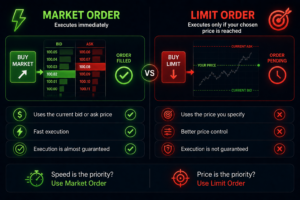
Which One Should Beginners Use?
Neither order type is better than the other—it depends on your goal.
If entering or exiting the market immediately is your priority, a market order is usually the right choice.
If getting a specific price is more important than speed, a limit order gives you greater control over your trade.
As you gain more experience, you’ll likely use both depending on the market conditions and your trading strategy.
Common Mistakes Beginners Make with Bid and Ask Prices
Many new traders understand what the bid price and ask price are, but they still make costly mistakes when placing trades. Knowing these mistakes can save you money and help you avoid unnecessary frustration.
Here are the most common ones:
- Looking only at the last traded price
- Many beginners assume the last price shown on a chart is the price they’ll buy or sell at.
- In reality, you’ll usually buy at the ask price and sell at the bid price, which can be different from the last traded price.
- Ignoring the bid-ask spread
- Every trade starts with a small cost called the spread.
- If the spread is wide, your trade begins at a larger unrealized loss.
- This is especially important for scalpers and short-term traders.
- Using market orders during volatile news
- During major economic announcements, spreads can widen dramatically.
- A market order may be filled at a much worse price than expected.
- Using limit orders can provide better control over your entry price.
- Trading assets with very low liquidity
- Stocks, cryptocurrencies, or other assets with low trading volume often have wider spreads.
- This increases trading costs and makes entering or exiting positions more difficult.
- Confusing the bid and ask prices
- Beginners sometimes expect to buy at the bid price because it’s the lower number.
- In reality:
- Buyers pay the ask price.
- Sellers receive the bid price.
- Thinking the spread is a broker fee
- While some brokers include their compensation within the spread, the spread itself is primarily created by market supply and demand.
- In many markets, liquidity providers and market makers also contribute to how spreads are formed.
- Not checking spread size before entering a trade
- A spread that looks small in dollars can represent a significant percentage of the trade on low-priced assets.
- Always compare the spread before opening a position.
- Expecting every order to be filled instantly
- Even if you place a limit order, it will only execute if the market reaches your chosen price and enough liquidity is available.
- Sometimes your order may remain pending or only be partially filled.
Frequently Asked Questions (FAQs)
What is the difference between the bid price and the ask price?
The bid price is the highest price a buyer is currently willing to pay for an asset, while the ask price is the lowest price a seller is willing to accept. If you buy using a market order, you’ll normally pay the ask price. If you sell using a market order, you’ll usually receive the bid price.
Why is the ask price always higher than the bid price?
The ask price is usually higher because sellers want to receive the highest possible price, while buyers want to pay the lowest possible price. The difference between these two prices is called the bid-ask spread, which represents the cost of executing a trade immediately.
What is the bid-ask spread?
The bid-ask spread is simply the difference between the current bid price and the current ask price.
For example:
| Price | Value |
|---|---|
| Bid | $75.20 |
| Ask | $75.25 |
| Spread | $0.05 |
The spread is one of the first trading costs you’ll encounter whenever you enter a position.
Who decides the bid and ask prices?
Nobody manually sets these prices.
They are constantly changing based on supply and demand. Buyers submit bids, sellers submit asks, and exchanges continuously match these orders in real time.
Why do some assets have a larger bid-ask spread?
Assets with low trading volume usually have wider spreads because there are fewer buyers and sellers.
Highly liquid assets—such as major forex pairs, large-cap stocks, or popular cryptocurrencies—typically have much tighter spreads because there is more trading activity.
Can I buy at the bid price?
Usually, no.
When using a market order, you’ll normally buy at the ask price because that’s the lowest price someone is currently willing to sell for.
However, if you place a limit order at the bid price and a seller agrees to your price, your order can be filled.
Can I sell at the ask price?
Not immediately.
A market sell order normally executes at the bid price. If you want to sell at the ask price, you’ll need to place a limit order and wait until a buyer is willing to pay that amount.
Why do spreads become wider during major news events?
During high volatility, many traders quickly adjust or cancel their orders because prices are moving rapidly.
With fewer orders available at each price level, liquidity decreases and the bid-ask spread often widens until the market stabilizes.
Is a smaller bid-ask spread better?
In most cases, yes.
A narrow spread usually means:
- Higher liquidity
- Lower trading costs
- Faster order execution
- Easier entry and exit
A wide spread generally means higher trading costs and lower liquidity.
Does every financial market have bid and ask prices?
Yes.
Whether you’re trading:
- Stocks
- Forex
- Cryptocurrencies
- Commodities
- ETFs
- CFDs
- Futures
Every financial market operates using bid prices and ask prices, making them one of the most fundamental concepts every trader should understand.
Wrap-up
So… I think after all of this, you’ve finally accepted my apology for not explaining one of the most important concepts in trading earlier!
Now you know exactly how the bid price, ask price, and spread work. Before risking real money, spend some time practicing on a demo account. Watch how prices move, see how spreads change, and get comfortable placing trades without risking your capital.
Remember, every professional trader started somewhere. Practice first, learn from your mistakes, and only move to a live account when you feel confident.