

Table of Contents
How to Calculate Margin Requirement in CFD Trading
Beginner’s Guide
How to calculate margin requirement in CFD trading? If you’ve been following our educational series, you already know that we’ve covered everything from what CFD trading is to what is forex and stocks. If you missed any of those guides, they’re always available in our education section.
Today we’re focusing on one of the most important concepts every CFD trader needs to understand: margin requirements.
Margin is what makes leveraged CFD trading possible. It allows you to control a much larger position without paying the full value upfront. But before you place your first trade, you need to know exactly how much margin is required and how brokers calculate it.
How to Calculate Margin Requirement in CFD Trading
let’s dive in

How to calculate margin requirement in CFD trading?
At first, the calculation may seem complicated because you’ll come across terms like leverage, margin percentage, position size, contract value, and maintenance margin. The good news?
It’s actually much easier than most beginners think.
Once you understand a few simple concepts, you’ll be able to calculate the required margin for almost any CFD trade in less than a minute.
We’ll also explain why margin matters, how brokers calculate it, what factors affect it, and how to avoid the costly mistakes many new traders make.
Before We Answer “How to Calculate Margin Requirement in CFD Trading”
Before jumping into formulas and calculations, let’s quickly understand the three concepts behind every margin calculation.
Those concepts are:
- What is CFD trading?
- What is margin?
- What is margin in CFD trading?
Once these are clear, the math becomes incredibly simple.
What Is CFD Trading?
CFD stands for Contract for Difference. it’s simply means that you don’t really buy the asset, so Instead of buying an actual asset like a stock, a barrel of oil, or a bar of gold, you’re simply making an agreement with your broker to exchange the difference in price between the moment you open a trade and the moment you close it.
In other words, you’re trading the price movement, not the asset itself….you can learn all about the CFDs form our guide here
Why Is CFD Trading So Popular?
CFDs offer several advantages that traditional investing doesn’t always provide.
- Trade rising and falling markets.
- Access global markets from one trading account.
- Trade forex, stocks, commodities, indices, and cryptocurrencies.
- Use leverage to control larger positions.
- Start trading with less capital than buying the underlying asset.
These benefits make CFDs attractive to both beginners and experienced traders.
However, they also introduce additional risk.
Leverage can increase profits—but it can also magnify losses.
That’s why understanding margin is one of the most important lessons every trader should learn before opening their first CFD position.
What Is Margin?
One of the biggest misconceptions among beginners is thinking that margin is a trading fee. It isn’t. Margin is also not money that disappears when you open a trade. Instead, think of margin as a security deposit. Imagine you’re renting an apartment. The landlord may ask you to leave a security deposit before you move in.
That money isn’t the rent.
It simply guarantees that you’ll meet your obligations.
If everything goes well, you usually get that deposit back.
Margin works in a very similar way.
When you open a CFD trade, your broker sets aside part of your account balance as collateral while the position remains open.
That money is temporarily locked.
You can’t use it to open another trade until the first one is closed.
Once your position is closed, the margin is released back into your account, adjusted for any profits or losses you’ve made.
So remember this simple rule:
Margin is collateral—not a trading cost.

Why Do Brokers Require Margin?
Your broker is allowing you to control a position that is much larger than the money you’ve deposited. Since that broker is effectively providing additional buying power through leverage, they require a margin deposit as financial protection.
This benefits both the trader and the broker.
- For the trader, margin makes it possible to access larger market opportunities without needing a huge amount of capital.
- For the broker, margin helps reduce the risk associated with leveraged trading.
Without margin, leveraged CFD trading wouldn’t be possible.
What Is Margin in CFD Trading?
Now let’s combine everything we’ve learned….In CFD trading, margin is the amount of money you must have in your account to open and maintain a leveraged trading position. Instead of paying the full value of a trade, you only deposit a percentage of it. That percentage is called the margin requirement.
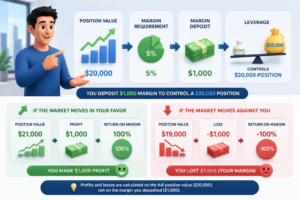
Imagine you want to open a CFD position worth $20,000.
Your broker requires a 5% margin.
You don’t need the full $20,000.
Instead, you’ll only need:
$20,000 × 5% = $1,000
With just $1,000, you’re controlling a position worth $20,000.
This is possible because your broker provides leverage.
Remember something very important:
Although you’ve only deposited $1,000, your profits and losses are still calculated using the full $20,000 position.
This is why leverage can dramatically increase both gains and losses.
Margin vs. Leverage: What’s the Difference?
Both Margin and Leverage are closely connected, but they describe different parts of the same process.
Here’s an easy comparison:
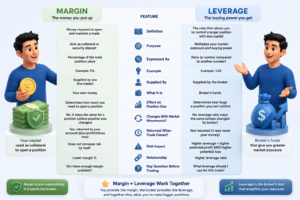
The relationship between the two is simple.
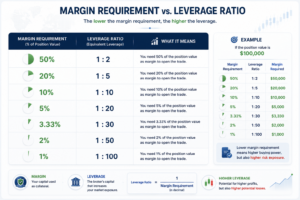
One rule every trader should remember is:
- Lower margin requirements mean higher leverage.
- Higher leverage always means higher potential rewards…..but also higher potential losses.
Always remember Just because your broker offers 1:100 leverage doesn’t mean you should use it. Successful traders don’t use the highest leverage available. They only use the leverage that fits their strategy and risk management.
Why Understanding Margin Is So Important
Many beginners focus on finding the “perfect trade.” Professional traders focus on something else first.
They ask:
- Do I have enough margin to open this position?
- How much free margin will remain afterward?
- Can my account survive normal market fluctuations?
- Am I using sensible leverage?
I know that kind of question does not really sound exciting, but they’re often the difference between traders who stay in the market for years and those who blow up their accounts within weeks.
That’s why learning how to calculate margin requirement in CFD trading isn’t just another formula, it’s one of the most important risk management skills you’ll ever develop. Understanding how to calculate margin requirement in CFD trading helps you control leverage, manage risk, and avoid costly mistakes.
How to Calculate Margin Requirement in CFD Trading (Beginner’s Guide)
Now that you understand what margin is and why it’s used in CFD trading, it’s time to answer the main question.
How do you calculate margin requirement in CFD trading?
The good news is that the calculation is much simpler than most beginners expect.
Once you know the value of your trade and your broker’s margin requirement, you can calculate the required margin in just a few seconds.
Let’s start with the basic formula.
The Basic Margin Formula
In most CFD markets, the required margin is calculated using this simple formula:
Required Margin = Position Value × Margin Requirement (%)
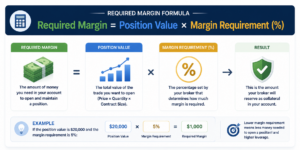
That’s it. Everything else is simply figuring out the value of your position.
Let’s break it down.
Position Value
The position value is the total market value of the trade you’re opening—not the money in your trading account and not the margin you’ll deposit.
Think of it as the full size of your position before leverage is applied.
For example, let’s say you buy 100 Apple CFDs while Apple is trading at $220 per share.
Your position value would be:
100 × $220 = $22,000
This $22,000 is your position value, and it’s the number you’ll use when calculating your margin requirement.
Margin Requirement
Every CFD market has a margin percentage.
For example:
- EUR/USD → 3.33%
- Gold → 5%
- Major stock indices → around 5%
- Individual shares → around 20%
Your broker determines this percentage. More volatile markets usually require higher margins because they carry greater risk.
Example 1: Calculating Margin for a Stock CFD

Let’s put everything together with a simple example.
Imagine you want to buy 50 NVIDIA CFDs, and NVIDIA is currently trading at $180 per share. Your broker requires a 10% margin.
First, calculate the total position value:
50 × $180 = $9,000
Next, calculate the required margin:
$9,000 × 10% = $900
That means you only need $900 in your trading account to open a position worth $9,000.
Example 2: Margin Calculation for Gold (XAU/USD)

Now let’s use the same formula with gold.
Suppose Gold (XAU/USD) is trading at $3,400 per ounce, and you buy 5 CFDs. Assume each CFD represents one ounce, and your broker requires a 5% margin.
First, calculate the position value:
5 × $3,400 = $17,000
Now calculate the required margin:
$17,000 × 5% = $850
Although you’re controlling a gold position worth $17,000, you only need $850 to open the trade.
Keep in mind that any profit or loss is based on the full position value of $17,000, not on the $850 you deposited. That’s why leverage can magnify both your potential gains and your potential losses.
Example 3: Margin Requirement for an Index CFD

Let’s trade the US 500 Index.
Suppose the index is trading at:
6,200 points.
You buy:
15 CFDs.
Assume each CFD equals one index point.
Position Value
15 × 6,200
= $93,000
Broker Margin Requirement
5%
Required Margin
$93,000 × 5%
= $4,650
Again, notice how a relatively small deposit controls a much larger market position.
Another Way Brokers Calculate Margin
Some brokers don’t display the margin requirement as a percentage. Instead, they show the available leverage, such as 1:20 or 1:50. While the format looks different, the calculation is actually very similar.
When your broker provides leverage instead of a margin percentage, you can calculate the required margin using this formula:
Required Margin = Position Value ÷ Leverage
For example, imagine you want to open a position worth $40,000 and your broker offers 1:20 leverage. To calculate the required margin, simply divide the position value by the leverage:
$40,000 ÷ 20 = $2,000
Now let’s calculate the same trade using the margin percentage formula. Since 1:20 leverage is equivalent to a 5% margin requirement, the calculation becomes:
$40,000 × 5% = $2,000
As you can see, both methods produce exactly the same result. Whether your broker displays 1:20 leverage or a 5% margin requirement, you’re calculating the same amount in two different ways.
This relationship is possible because the margin requirement and leverage are directly connected using the following formula:
Margin Requirement (%) = 1 ÷ Leverage
The important thing to remember is that leverage and margin are simply two different ways of expressing the same relationship. Once you know one value, you can easily calculate the other.
Margin Formula for Forex CFDs
Forex works a little differently because you’re trading lots instead of individual shares.
The general formula becomes:
Margin = Lots × Contract Size × Market Price ÷ Leverage
Forex traders often use a slightly different margin formula because position size is measured in lots instead of individual units.
Let’s go through a simple example.
Suppose you buy 2 standard lots of EUR/USD at an exchange rate of 1.1200, and your broker offers 1:100 leverage.
Step 1: Calculate the Position Size
Each standard lot equals 100,000 units, so:
2 × 100,000 = 200,000 EUR
Step 2: Calculate the Position Value
Multiply the position size by the market price:
200,000 × 1.1200 = $224,000
Step 3: Calculate the Required Margin
Divide the position value by the leverage:
$224,000 ÷ 100 = $2,240
Required Margin = $2,240
If you had traded 1 standard lot instead of 2, your required margin would have been $1,120. This shows that the larger your position size, the more margin you’ll need to open the trade.
What Affects Your Margin Requirement?
Your margin requirement depends on three simple factors:
- Position Size: The larger your trade, the more margin you’ll need. For example, buying 50 Gold CFDs requires more margin than buying 10 Gold CFDs.
- Market Price: As the price of an asset rises, the value of your position increases, which means your required margin also increases.
- Margin Requirement (or Leverage): Different markets require different amounts of collateral. For example, a stock CFD may require a 20% margin, while Gold might require 5%, a major Forex pair 3.33%, and some crypto CFDs 40%.
Why Margin Requirements Differ Between Markets
Many beginners wonder why Forex requires such a small margin while stocks often require much more.
The answer is risk…The more volatile an asset is, the more protection brokers need.
Typical margin requirements look something like this:
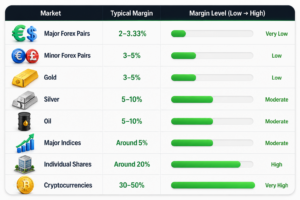
Note: These are only typical values. Each broker sets its own margin requirements, and they may increase them during periods of extreme market volatility.
Do All Brokers Have the Same Margin Requirements?
No. Margin requirements are not standardized and can vary from one broker to another.
Each broker sets its own margin requirements based on factors such as the asset being traded, market volatility, regulatory requirements, and its own risk management policies. As market conditions change, brokers may also adjust their margin requirements to reflect increased or reduced risk.
Before opening any trade, always check your broker’s margin requirements in the trading platform or product specifications. Knowing the correct margin requirement helps you calculate the required margin accurately and manage your risk more effectively.
Note: The margin percentages used throughout this guide are typical examples for educational purposes. Your broker’s actual requirements may differ.
What Are Tiered Margin Requirements?
Most beginner traders never hear about tiered margin requirements until they start learning how to calculate margin requirement in CFD trading for larger positions. Instead of using one margin percentage for the entire trade, some brokers increase the margin requirement as your position size grows.
- Think of it like a progressive tax system.
- The first part of your position uses one margin rate.
- The next part uses a higher rate.
- Then the next part may require even more.
- This helps brokers reduce their exposure to exceptionally large leveraged trades.
Tiered Margin Example
Imagine a broker has these margin tiers for a stock CFD.
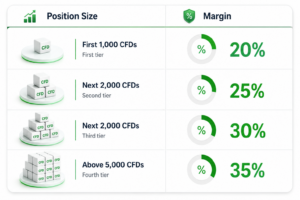
Now, let’s say you buy 6,000 CFDs at $12 per share.
Because your position falls into multiple margin tiers, you must calculate each tier separately.
- Tier 1:
1,000 × $12 × 20% = $2,400 - Tier 2:
2,000 × $12 × 25% = $6,000 - Tier 3:
2,000 × $12 × 30% = $7,200 - Tier 4:
1,000 × $12 × 35% = $4,200
Total Required Margin
$2,400 + $6,000 + $7,200 + $4,200 = $19,800
Even though the total position is worth $72,000, the required margin is $19,800 because different parts of the position fall into different margin tiers.
Most beginner traders won’t encounter tiered margins, but it’s useful to understand how they work as your position size increases.
Common Margin Mistakes Beginners Make
Understanding how to calculate margin requirement in CFD trading is only half the job. Avoiding these common mistakes is just as important.
-
Confusing Margin with Risk
Margin opens the trade. Risk is how much you could lose.
-
Using Maximum Leverage
Higher leverage increases both profit potential and losses. Just because you can doesn’t mean you should.
-
Using All Available Margin
Always leave enough free margin to absorb normal market fluctuations and reduce the risk of a margin call.
-
Opening Too Many Positions
Several small trades can quickly consume your available margin, leaving little room for market moves.
-
Ignoring Market Volatility
During major news or volatile markets, brokers may increase margin requirements without warning.
-
Not Checking Your Broker’s Margin Requirements
Margin requirements vary by broker, asset, and market conditions. Always verify them before placing a trade.
-
Forgetting About Free Margin
Low free margin increases the risk of margin calls and automatic position closures.
-
Trading Without a Stop-Loss
A stop-loss helps limit losses and protects your account equity and margin.
-
Forgetting Overnight Fees
Swap or rollover charges can gradually reduce your equity and free margin if positions are held overnight.
Used Margin, Free Margin, Margin Level, and Margin Calls Explained
Now that you know how to calculate margin requirement in CFD trading, it’s important to understand what happens after your trade is opened.
When you place a trade, the required margin is reserved by your broker to support the position. You don’t lose this money—it simply becomes unavailable until the trade is closed.
To understand how your trading account works, you only need to know four key concepts:
- Used Margin: The amount of money reserved to keep your open trades active.
- Free Margin: The funds still available to open new trades or absorb market losses.
- Equity: Your account’s real-time value, including any floating profits or losses.
- Margin Level: A measure of your account’s health that brokers use to determine whether your positions can remain open.
Let’s look at each one.
What Is Used Margin?
Used Margin is the amount of your account that is currently reserved to support your open positions.
For example, if you have $10,000 in your account and open a trade that requires $1,500 in margin, your used margin becomes $1,500. The money is still yours, but it cannot be used to open another trade until the position is closed.
What Is Free Margin?
Free Margin is the money you still have available to open new trades or absorb temporary market losses. The more free margin you have, the more room your trades have to move without risking a margin call.
The formula is simple:
Free Margin = Equity − Used Margin
What Is Equity?
Equity is the real-time value of your trading account. Unlike your account balance, it changes constantly as your open trades gain or lose value.
The formula is:
Equity = Account Balance + Floating Profit − Floating Loss
For example, if your account balance is $8,000 and your open trades are showing a $350 profit, your equity becomes $8,350. If those trades instead show a $500 loss, your equity falls to $7,500. Your balance doesn’t change until you close the trade, but your equity updates continuously while the position remains open.
Bringing Everything Together
Let’s see how these concepts work in a real trading account.
Suppose your account balance is $12,000, and you open a CFD trade that requires $2,000 in margin. If your trade is showing a floating profit of $600, your account would look like this:
| Account Metric | Amount |
|---|---|
| Balance | $12,000 |
| Floating Profit | +$600 |
| Equity | $12,600 |
| Used Margin | $2,000 |
| Free Margin | $10,600 |
Notice that your balance doesn’t change while the trade is open. Instead, your equity changes as your floating profit or loss changes.
What Is Margin Level?
Margin Level measures the health of your trading account and helps determine whether your positions can remain open.
Margin Level (%) = (Equity ÷ Used Margin) × 100
For example, if your equity is $9,000 and your used margin is $2,000, your margin level is:
($9,000 ÷ $2,000) × 100 = 450%
The higher your margin level, the more free margin you have to absorb market fluctuations.
What Is a Margin Call?
A margin call is a warning that your account equity has fallen too close to your used margin. It doesn’t always mean your positions will be closed immediately, but it tells you that your account needs attention.
Every broker sets its own margin call level, so always check your broker’s trading conditions. If your losses continue and your margin level falls below the broker’s requirement, your positions may eventually be closed automatically.
What Can You Do During a Margin Call?
Fortunately, a margin call doesn’t mean you’re out of options.
Most traders have three choices.
- Deposit More Money
- Close Losing Trades
- Reduce Your Position Size
What Is a Stop-Out?
If a trader ignores a margin call and losses continue growing, eventually the broker steps in.
This is called a Stop-Out.
A stop-out is not a warning.
It’s automatic.
The broker begins closing positions to protect both the trader and the brokerage from further losses.
Think of it as an emergency brake.
Once your margin level falls below the broker’s stop-out level, the trading platform starts liquidating positions automatically.
Many brokers use stop-out levels around 50%, although every broker has its own policy.
Margin Call vs. Stop-Out
These two terms are often confused.
Here’s the difference.
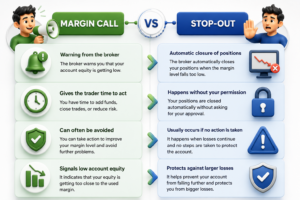
A margin call says:
“Please fix the situation.”
A stop-out says:
“We’re fixing it for you.”
Why Free Margin Is So Important
One of the biggest mistakes beginners make is using nearly all of their available margin.
Trader A
- Balance: $10,000
- Required Margin: $9,600
- Free Margin: $400
A small price move could quickly trigger a margin call.
Trader B
- Balance: $10,000
- Required Margin: $2,000
- Free Margin: $8,000
More free margin gives trades room to handle normal market fluctuations.
A Healthy Trading Account Looks Like This
Successful CFD traders don’t judge their accounts by how many trades they have open.
They monitor:
- Healthy Free Margin
- Comfortable Margin Level
- Reasonable Position Sizes
- Conservative Leverage
- Controlled Risk
Their goal isn’t to maximize leverage.
Their goal is to stay in the market long enough to let their trading edge work over hundreds of trades.
Practical Tips for Managing Margin Like a Professional
Now that you know how to calculate margin requirement in CFD trading, let’s look at the habits experienced traders follow to manage margin effectively.
1. Calculate Margin Before Every Trade
Check your position value, required margin, and free margin before entering a trade.
2. Risk Only a Small Percentage of Your Account
Most experienced traders risk only 1–2% of their account on a single trade.
3. Maintain Healthy Free Margin
Leave plenty of free margin to absorb normal market fluctuations and reduce the risk of a margin call.
4. Monitor Your Margin Regularly
Keep an eye on your used margin, free margin, equity, and margin level as your positions change.
5. Use a Margin Calculator
Broker margin calculators are useful for quick estimates, but understanding the calculation yourself helps you make better trading decisions.
Quick Margin Calculation Cheat Sheet
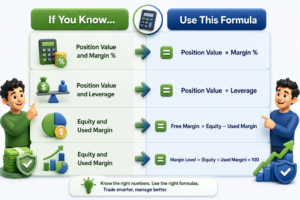
Before Opening Any CFD Trade, Ask Yourself These Questions
- Do I know the required margin for this trade?
- How much free margin will remain afterward?
- Am I using sensible leverage?
- Have I calculated my maximum risk?
- Is my stop-loss already planned?
- Could my account survive a normal market fluctuation?
- Am I opening this trade because it fits my strategy, or because I simply have enough margin?
If you can confidently answer these questions, you’re already approaching trading with the mindset of a disciplined trader rather than a gambler.
How MT4/MT5 Calculates Margin
Many CFD traders use MetaTrader 4 (MT4) and MetaTrader 5 (MT5) as their trading platforms. While the platform calculates margin automatically, understanding how it works helps you manage your account more effectively.
MetaTrader calculates margin based on:
- Trading instrument
- Position size
- Contract size
- Current market price
- Leverage
- Broker margin requirements
The platform automatically reserves the required margin when you open a trade.
Margin Information in MT4 and MT5
To check your margin information:
- Open the Trade tab at the bottom of the platform.
You will see:
Balance
- Your account balance before floating profits and losses.
Equity
- Your real-time account value including open positions.
Margin
- The amount currently locked for your open trades.
Free Margin
- The money available for new trades or to absorb losses.
Margin Level
- The percentage showing your account health.
Formula:
Margin Level = (Equity ÷ Used Margin) × 100
Margin Requirement Before Opening a Trade on MT4\MT5
Before opening a position:
- Right-click on the trading instrument.
- Select Specification.
- Check:
- Contract size
- Margin currency
- Required margin
- Leverage conditions
Although MetaTrader calculates everything automatically, understanding the calculation helps you choose the correct position size and avoid unnecessary margin pressure.
FAQs about How to Calculate Margin Requirement in CFD Trading
Wrap-up
Understanding how to calculate margin requirement in CFD trading is about much more than learning a simple formula…It’s about understanding how leveraged trading works, how brokers determine the amount of capital required to open a position, and how your account behaves once that trade is active.
Margin gives traders access to opportunities that would otherwise require a much larger investment. But with that opportunity comes greater responsibility. The same leverage that can amplify profits can also magnify losses if it isn’t used carefully.
Learn and practice everything you’ve learned with a free virtual-funded demo account before you start trading live.