

Table of Contents
Can You Make a Living Trading Stocks?
Fellow traders, I want to talk about a question I’ve wondered about since I first started trading, Can You Make a Living Trading Stocks?
Hmm… sounds like a basic question, right? But it had a huge impact on my life, especially when my family thought trading wasn’t a proper career and that I needed a stable job with a regular paycheck.
And honestly, it’s a fair concern. Trading offers opportunities, but it also comes with uncertainty, financial risk, and no guaranteed income.
So, let’s dive in and explore Can You Make a Living Trading Stocks?

What Is Stock Trading?
Stock trading involves buying and selling shares of publicly listed companies to benefit from changes in their market prices. Some traders hold positions for minutes or hours, while others keep them open for days, weeks, or longer.
The goal is to identify opportunities based on market movements, company information, or a defined trading strategy. However, prices can move against you, and no strategy guarantees profits.
Types of Stock Trading
Your trading style affects how much time, research, and risk management you need.
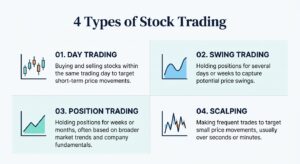
There is no single best approach. Your available time, experience, risk tolerance, and financial goals all matter.
How Much Time Does It Take to Learn Stock Trading?
Fellow traders, learning to trade is not something you can complete in a weekend. You need time to understand market fundamentals, develop a strategy, practise risk management, and evaluate your decisions.
There is no universal timeline for becoming a competent trader. Progress depends on your learning process, practice, strategy, and ability to adapt.
I’ll explore this question in a separate article covering how long it takes to learn stock trading and what beginners should focus on at each stage.
5 Steps to Master Stock Trading
You cannot control every market movement, but you can build a more disciplined approach to trading.
1. Learn the basics
Understand how stock markets work, what moves share prices, and how orders, spreads, and trading costs affect your results.
2. Choose a trading style
Decide whether day trading, swing trading, or position trading suits your schedule and goals. Avoid jumping between strategies every time the market changes.
3. Build and test a trading plan
Define your entry and exit conditions, position sizing, risk limits, and the setups you intend to trade. Test your strategy before relying on it with real money.
4. Practise and keep a trading journal
Use a demo account to practise without risking real capital. Record your trades, the reasons behind your decisions, and what you learn from wins and losses.
5. Manage risk and review your results
Set realistic expectations, avoid excessive leverage, and review performance over a meaningful period. Focus on following your process rather than trying to win every trade.
Can Stock Trading Be Worth Leaving Your 9-to-5 Job?
It can be a viable career path for some people, but leaving a regular job to trade full-time is a major financial decision to be honest,I would have to consider this decision and give it my deep thinking mode, and before making the move, you should consider whether you have:
- A documented trading record across different market conditions.
- Savings to cover living expenses during losing periods.
- Enough trading capital for your strategy and financial circumstances.
- A clear risk management plan and realistic income expectations.
- A backup plan if trading does not provide a sustainable income.
My advice, fellow traders: Do not leave your job because of one profitable month or a few successful trades. Build evidence of consistency first, and remember that past performance does not guarantee future results.
Stock Trading Part-Time vs. Full-Time
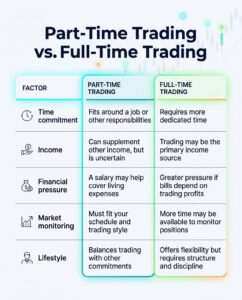
Part-time trading can help you gain experience while maintaining another source of income. Full-time trading may offer greater flexibility, but it also places more responsibility on you to manage your capital, schedule, and finances.
Neither approach guarantees profitability.
How to Make Money From Stocks in 5 Simple Ways
Fellow traders, making money from stocks isn’t limited to buying and selling shares. The stock market offers different approaches, from trading price movements to holding investments for longer-term growth.
1. Trade Stock Price Movements
Traders aim to profit by buying and selling stocks as prices move. Success depends on having a clear strategy, managing risk, and accounting for trading costs. Profits are never guaranteed.
2. Buy and Hold Stocks for Growth
Investors may buy shares in companies they believe have long-term growth potential. If the share price rises over time, they may benefit by selling at a higher price, although the stock could also lose value.
3. Earn Dividend Income
Some companies distribute part of their profits to shareholders as dividends. Investors can receive these payments as income or reinvest them to buy more shares. Dividends can be reduced or suspended, and they do not eliminate investment risk.
4. Invest Through Index Funds and ETFs
Instead of choosing individual stocks, investors can use index funds or exchange-traded funds (ETFs) to gain exposure to a basket of stocks. This can help diversify investments, though it does not prevent losses when the market declines.
5. Reinvest Earnings to Build Wealth
Investors can reinvest dividends and other investment proceeds to purchase additional shares. Over time, this may allow returns to compound, meaning potential gains can generate further gains. The outcome depends on investment performance and is not guaranteed.
Which approach is right for you?
Active trading focuses on price movements and requires decisions about when to enter and exit positions. Long-term investing generally focuses on growth, diversification, and holding assets over time. Your choice should reflect your financial goals, available capital, time commitment, and tolerance for risk.
Long-Term Investing vs. Short-Term Stock Trading
Long-term investing and short-term stock trading differ in their goals, time horizons, and approaches to risk. Here’s how they compare.
| Factor | Short-Term Stock Trading | Long-Term Stock Investing |
|---|---|---|
| Main goal | Profit from short-term price movements | Build wealth through long-term growth |
| Holding period | Minutes, hours, days, or weeks | Years or longer |
| Trading frequency | Frequent buying and selling | Less frequent transactions |
| Main analysis | Price charts, technical indicators, market news, and momentum | Company fundamentals, earnings, valuation, and long-term prospects |
| Time commitment | Often requires regular market monitoring | Usually requires less frequent monitoring |
| Transaction costs | Can be higher due to frequent trades | Often lower due to fewer transactions |
| Potential returns | Depends on trading skill, strategy, costs, and market conditions | May come from share-price appreciation and dividends over time |
| Main risks | Rapid price changes, poor timing, emotional decisions, and trading costs | Market downturns, company underperformance, and prolonged losses |
| Income potential | Trading profits are uncertain and can fluctuate significantly | Returns are generally focused on long-term growth rather than regular income |
| Suitable for | People with a tested strategy, time to monitor markets, and disciplined risk management | People with longer-term financial goals and the patience to withstand market fluctuations |
Which approach should you choose?
Short-term trading may suit people who prefer active market participation and can manage the demands of frequent decisions. Long-term investing may suit those focused on building wealth over several years without constantly monitoring prices.
Neither approach guarantees profits, and both can result in losses. Your choice should depend on your goals, financial situation, time commitment, and risk tolerance.
How Much Money Do You Need to Make a Living Trading Stocks?
There is no universal amount of capital required to make a living from stock trading. The answer depends on your living expenses, trading strategy, available savings, and the returns you can realistically achieve—which are never guaranteed.
A useful starting point is to calculate your essential annual expenses and compare them with hypothetical trading returns.
For example, suppose you need $30,000 a year to cover your living expenses:
At a hypothetical 5% annual return, $600,000 would generate $30,000 before costs and taxes.
At a hypothetical 10% annual return, $300,000 would generate $30,000 before costs and taxes.
These are mathematical illustrations, not recommended capital targets or forecasts. Achieving either return consistently is uncertain, and losses are possible. You would also need to account for taxes, trading costs, emergency savings, and the possibility of withdrawing money during a losing period.
The important question is not simply how much you can make, but whether your capital and results can support your expenses without exposing you to unacceptable risk.
Can You Make a Living Trading Stocks With a Small Account?
Yes, it is possible to make profits from a small account, but generating enough income to cover living expenses is a different challenge.
Consider how different account sizes translate into dollar returns:

This is why account size matters. A 5% return on $1,000 produces only $50, while the same percentage on $50,000 produces $2,500.
A small account can be useful for learning and testing a strategy. But if your goal is to trade for a living, consider your expenses, financial reserves, and ability to withstand losses before depending on trading income.
What Are the Biggest Challenges of Trading for a Living?
Trading full-time involves more than identifying profitable opportunities. It also requires managing uncertainty and the pressure that comes with relying on your own decisions.
- Unpredictable income: Some periods may be profitable, while others may bring losses.
- Psychological pressure: Depending on trading to pay your bills can make it harder to follow your plan.
- Overtrading: The desire to earn a daily target may lead you to take trades that do not meet your criteria.
- Losing streaks: Even a strategy with a positive historical record can experience drawdowns.
- Time commitment: Research, market monitoring, journaling, and reviewing performance can take more time than beginners expect.
- Financial discipline: Trading capital should be separate from money needed for essential expenses.
Fellow traders, one of the hardest lessons is accepting that you do not need to trade every day. Sometimes, protecting your capital and waiting for a suitable opportunity is the better decision.
Day Trading vs. Long-Term Investing: Which Is Better for You?
Day trading and long-term investing serve different purposes.
Day trading focuses on short-term price movements and generally requires more frequent decisions, monitoring, and risk management. Results can change quickly, and trading costs can affect profitability.
Long-term investing involves holding investments over years, often with the aim of building wealth through potential price appreciation and dividends. It usually requires less frequent trading, although investors still need to research their holdings and manage risk.
Neither approach is automatically better. Your choice should reflect your goals, available time, financial situation, and tolerance for losses.
If you prefer frequent market decisions and can devote the necessary attention, active trading may interest you. If you have a longer time horizon and prefer less frequent intervention, long-term investing may be worth exploring.
Can You Trade for a Living Without Using Only Your Own Capital?
Some proprietary trading firms offer traders access to trading capital through evaluation programs or other arrangements. In return, traders must follow specific rules and may receive an agreed share of eligible profits.
Before considering a funded trading account, understand:
- Evaluation requirements: You may need to meet performance criteria before receiving access to a funded account.
- Drawdown limits: Breaking the firm’s risk rules can result in losing access to the account.
- Fees and profit splits: Understand all charges, payout conditions, and how profits are divided.
- Account structure: Determine whether trading takes place in a simulated environment or a live market.
- No guaranteed income: Passing an evaluation or accessing a larger account does not guarantee profitable trading or payouts.
FAQs about Can You Make a Living Trading Stocks?
Can you realistically make a living trading stocks?
Yes, some people earn a living from stock trading, but it is difficult and uncertain. Results depend on capital, strategy, risk management, expenses, market conditions, and the ability to manage losing periods.
How much money do you need to start trading stocks?
There is no universal minimum. The amount depends on your broker, market, trading style, and applicable account requirements. Start by learning the basics and practising with a demo account before risking money you cannot afford to lose.
Can you make $100 a day trading stocks?
It is possible to make $100 on a particular day, but there is no guarantee you can repeat that result consistently. The capital required and risk involved depend on your strategy and market conditions. A daily income target can also encourage unnecessary trades.
Can you make a living trading stocks with $1,000?
A $1,000 account can be useful for learning and testing a strategy, but generating enough money to cover living expenses from that balance would require very high returns relative to the account size. Pursuing those returns can expose you to substantial losses.
Is stock trading a full-time job?
It can be, but full-time trading requires research, planning, risk management, record-keeping, and financial discipline. Unlike a salaried job, it does not provide a guaranteed paycheck.
Is day trading better than swing trading?
Neither is universally better. Day trading involves closing positions within the same trading day, while swing trading generally holds positions for several days or weeks. The better fit depends on your schedule, strategy, experience, and risk tolerance.
Can you learn stock trading while working a full-time job?
Yes. You can study market fundamentals, practise on a demo account, and review your trades outside working hours. Swing trading may be easier to fit around a job than strategies that require constant intraday monitoring, although it still involves risk.
What is the biggest mistake new stock traders make?
Common mistakes include risking too much on one trade, trading without a plan, using excessive leverage, chasing losses, and expecting quick profits. Building consistent habits and reviewing decisions can help you identify and address these problems.
Wrap-Up: Can You Make a Living Trading Stocks?

So, fellow traders, can you make a living trading stocks?…Yes, it’s possible, but it’s neither easy nor guaranteed. Honestly, what in life is guaranteed? The key is to take calculated steps instead of waiting for the perfect moment.
My advice? Start practising on a demo account while keeping your current job. Treat your trading practice as seriously as you would a full-time career. Follow a strategy, manage risk, track your results, and learn how to handle both winning and losing trades.
Give yourself time to discover whether trading genuinely suits you. If you develop the skills, discipline, and consistency needed, you can then consider whether moving to a live account makes sense for your financial situation. And remember, enjoying trading is one thing; relying on it to pay your bills is another.