
Table of Contents
What Is Inflation and How Does It Affect Your Money?
What Is Inflation and How Does It Affect Your Money?…Hello fellow traders….I know it’s the end of the week, and you’re probably closing your charts, stepping away from the markets, and getting ready to enjoy your weekend. You know how much I love this part of the week. But today, something annoyed me.
I went to my favorite supermarket to buy my favorite snack, which, by the way, is not healthy at all. And guess what? Its price had nearly doubled since the last time I bought it.
I stood there thinking, Seriously? Do I have to give up my favorite snack now, too?
Then I started thinking about something bigger. Why do prices keep rising? What makes the cost of everyday products jump? And why does the same amount of money seem to buy less than it used to?
The answer brings us to that not-so-friendly word: inflation.

And inflation doesn’t stop at the supermarket. It can affect your rent, your mortgage, the interest you pay on loans, the value of your savings, and even the returns you earn from investments.
So, fellow traders, let’s break it down. What is inflation, why does it happen, who benefits from it, and how can you understand its impact before making your next financial or trading decision?
Let’s dive in.
What Is Inflation?
Inflation is the sustained increase in the general price level of goods and services over time. As prices rise, the purchasing power of money falls, meaning you need more money to buy the same things.
Imagine you have $100 and your favorite shopping basket costs exactly $100 today. If prices rise by 10% and your income stays the same, that basket will cost $110. Your money hasn’t disappeared, but it no longer buys as much.
Inflation is about the general trend in prices, not just one expensive product. If the price of your favorite snack doubles while most other prices remain stable, that alone doesn’t mean the economy is experiencing 100% inflation. Economists look at a broad range of goods and services to understand what is happening across the economy. Source: U.S. Bureau of Labor Statistics
How Does Inflation Affect Your Money?
Inflation affects your money by reducing its purchasing power when your income or savings fail to keep pace with rising prices.
Here are four common examples:
- Everyday spending: Groceries, transportation, electricity, and other essentials may consume a larger share of your income.
- Savings: Money sitting in an account earning little or no interest can lose purchasing power over time.
- Borrowing: Interest rates on new loans may rise when central banks tighten monetary policy to control inflation.
- Investments: Inflation can affect company profits, bond returns, stock valuations, and the real value of investment gains.
For example, if your salary increases by 3% while the prices of the goods and services you buy increase by 6%, your purchasing power declines, even though your paycheck is larger.
This is the difference between nominal income (the amount you receive) and real income (what that money can actually buy).
What Causes Inflation?
Inflation doesn’t have a single cause. It can result from stronger demand, higher production costs, supply disruptions, or a combination of several factors.
1. Demand-pull inflation
This happens when demand for goods and services grows faster than businesses can supply them. When customers compete for limited products or capacity, businesses may raise prices.
Example: If housing demand increases sharply but the number of available homes cannot keep up, rents and property prices may rise.
2. Cost-push inflation
This occurs when the cost of producing or delivering goods and services increases. Businesses may pass some of those additional costs on to customers.
Common triggers include:
- Higher oil and energy prices
- Rising wages and raw-material costs
- More expensive transportation and shipping
- Supply-chain disruptions
For example, higher oil prices can increase transportation and manufacturing costs, putting upward pressure on the prices of many products.
3. Supply shocks
Wars, natural disasters, trade restrictions, and other disruptions can reduce the supply of essential goods. If demand remains strong while supply falls, prices may increase.
4. Monetary and fiscal factors
Credit conditions, money and credit growth, government spending, and monetary policy can influence overall demand and inflation. Their effects depend on economic conditions and how quickly the economy can increase production.
Inflation is rarely as simple as one cause producing one outcome. Demand, supply, expectations, and policy can interact.
What Are the Main Types of Inflation?
Economists often describe inflation by its speed, cause, or relationship with economic growth.
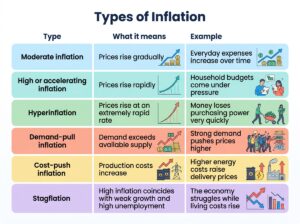
There is no single universal percentage that defines every stage of ordinary inflation. Hyperinflation has a commonly cited benchmark of inflation exceeding 50% per month, while other labels depend on the economic context.
It’s also important to distinguish disinflation from deflation. Disinflation means prices are still rising, but more slowly. Deflation means the general price level is falling.
How Is Inflation Measured?
Inflation is measured using price indexes that track changes in the cost of a representative basket of goods and services over time.
Two widely discussed U.S. measures are:
- Consumer Price Index (CPI): Measures changes in the prices urban consumers pay for a representative basket of goods and services.
- Personal Consumption Expenditures (PCE) price index: Measures price changes across a broader range of consumer spending and is the Federal Reserve’s preferred inflation measure.
Other countries use their own official indexes and methodologies.
How to Calculate Inflation
The basic calculation is:
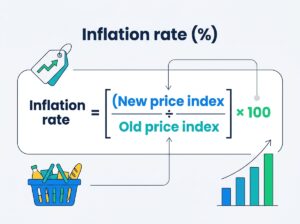
For example, suppose a price index rises from 200 to 210.
210−200200×100=5%\frac{210-200}{200}\times100=5\%
The inflation rate over that period is 5%.
Remember that the published inflation rate is an average. Your personal experience may be different because you don’t spend money in exactly the same proportions as the average household. If food, rent, or transportation makes up a larger share of your budget, your personal cost increases may feel higher than the headline rate.
How Does Inflation Affect Interest Rates?
When inflation is too high or expected to remain above target, a central bank may raise its policy interest rate to cool demand. Higher rates can make borrowing more expensive and encourage saving, helping reduce inflationary pressure over time.
However, the relationship isn’t automatic. Central banks consider several indicators, including inflation trends, employment, economic growth, and expectations.
Here’s how higher interest rates can affect different areas:
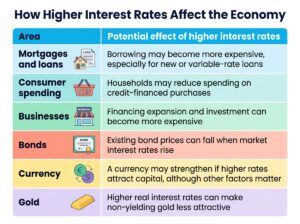
For traders, central-bank decisions matter because markets react not only to the latest inflation figure but also to how it changes expectations for future interest rates.
Who Benefits From Inflation?
This is where things get interesting. Inflation doesn’t affect everyone equally. Some people may benefit under certain conditions, while others face higher costs and reduced purchasing power.
1. Borrowers with fixed-rate debt
People with long-term fixed-rate loans may benefit if their incomes rise with inflation while their loan payments remain unchanged in nominal terms.
For example, someone paying a fixed monthly mortgage payment may find that the payment takes up a smaller share of their income if their wages increase over time.
But if their income doesn’t rise, inflation may make the payment harder to afford.
2. Owners of certain real assets
Property, commodities, and other tangible assets may rise in price during some inflationary periods. Owners may benefit if their assets appreciate, but gains are not guaranteed, and higher interest rates can put downward pressure on asset values.
3. Businesses with pricing power
Some businesses can pass higher costs on to customers without losing too many sales. If their selling prices rise faster than their costs, their profit margins may improve.
Other businesses struggle to pass on higher costs and may see profits shrink.
4. Governments and borrowers more broadly
Unexpected inflation can reduce the real value of existing fixed-rate government debt. However, governments may also face higher borrowing costs when they refinance debt, and the overall effect depends on the structure of their liabilities and the economy.
Who tends to lose?
- Savers earning low interest: Their money may lose purchasing power if the interest earned is below inflation.
- People on fixed incomes: Their income may not keep up with rising living costs.
- Workers whose wages lag behind prices: Their real income can decline.
- Lenders receiving fixed payments: Inflation can reduce the real value of the money they receive.
- Businesses facing rising costs: Their margins may shrink if they cannot raise prices enough.
The key takeaway is that inflation redistributes purchasing power; it doesn’t automatically make everyone richer or poorer by the same amount. Unexpected changes in inflation can create winners and losers depending on income, assets, debt, and contracts. Source: Federal Reserve
Inflation vs. Cost of Living: What’s the Difference?
These terms are related, but they don’t mean exactly the same thing.
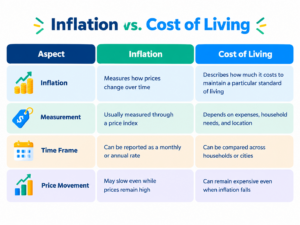
This distinction explains a common frustration: when inflation falls, people may expect prices to return to previous levels. Usually, a lower inflation rate means prices are increasing more slowly, not that they are falling.
If a product’s price rises from $10 to $12, then increases by another 2%, it costs $12.24. Inflation has slowed, but the price hasn’t returned to $10.
How Does Inflation Affect Your Investments?
Inflation matters to investors because it changes the real value of future income, company costs, interest rates, and the returns required by the market.
The right response depends on the asset, the time horizon, and the economic environment. No asset is guaranteed to outperform inflation.
Stocks
Companies may benefit when they can raise prices without losing customers. However, higher input costs can reduce profit margins, and rising interest rates can put pressure on stock valuations.
Bonds
Fixed payments become less valuable in real terms when inflation rises unexpectedly. Higher market interest rates can also reduce the prices of existing fixed-rate bonds.
Inflation-linked bonds, where available, are designed to adjust certain payments or principal values based on an inflation index, although they still carry risks.
Real estate
Property values and rents may rise in some inflationary environments. But higher financing costs, taxes, maintenance expenses, and weaker demand can offset those benefits.
Gold
Gold is often viewed as a potential hedge against inflation or currency uncertainty, but it doesn’t rise reliably whenever inflation increases. Its price can also respond to real interest rates, the U.S. dollar, investor demand, and geopolitical risk.
Commodities
Oil, natural gas, agricultural products, and metals can be affected by supply constraints and demand changes. Commodity prices can be volatile, so exposure to them does not guarantee protection against inflation.
Cash and savings accounts
Cash is useful for emergencies and short-term needs, but its purchasing power may decline if the interest it earns is lower than inflation.
The goal isn’t to chase whichever asset recently performed best. It’s to understand the risks, diversify where appropriate, and align investments with your financial objectives.
How Can Traders Use Inflation Data?
Fellow traders, inflation is one of those economic indicators that can move several markets at once. But the headline number alone doesn’t tell you the whole story.
When an important CPI or PCE report is released, consider these questions:
- Actual vs. expected: Was inflation higher or lower than economists forecast?
- Core inflation: Are underlying price pressures easing or remaining persistent?
- Central-bank expectations: Could the report change expectations for future interest rates?
- Bond yields: Are government bond yields moving in response?
- Currency markets: Is the data changing the outlook for a currency’s interest-rate advantage?
- Gold: Are real yields and the U.S. dollar supporting or pressuring prices?
- Stocks: Could interest-rate expectations or changing costs affect valuations and company profits?
Markets can move in either direction after an inflation release. A lower reading may support risk assets in some circumstances, but the reaction depends on what investors expected and what the report implies for economic growth and monetary policy.
Don’t trade a CPI release simply because you expect prices to move. Check the calendar, understand the potential volatility, plan your risk, and remember that even a correct economic view doesn’t guarantee a profitable trade.
How Can You Protect Your Money From Inflation?
You cannot control the overall rate of inflation, but you can take practical steps to manage its effect on your finances.
- Review your spending: Track essential expenses and identify where rising prices are affecting your budget most.
- Build an emergency fund: Keep accessible savings for unexpected expenses so you are less likely to borrow or sell investments at an unfavorable time.
- Compare savings rates: Look for suitable accounts that offer competitive interest while meeting your needs for safety and access.
- Manage expensive debt: Understand your interest rates and prioritize repayment based on your financial circumstances.
- Review your investment mix: Consider your time horizon, risk tolerance, diversification, and the effect of inflation on future returns.
- Avoid emotional decisions: Don’t rush into gold, stocks, property, or other assets simply because inflation is in the news.
- Review your goals regularly: Update your budget and savings targets as your income and essential expenses change.
A useful starting point is to calculate your real return.
Approximate real return = investment return − inflation rate
For example, if an investment earns 5% over a year and inflation is 3%, its approximate real return is 2% before taxes and fees.
For a more precise calculation, use:
Real return = [(1 + nominal return) ÷ (1 + inflation rate)] − 1
The important point is that a positive investment return doesn’t necessarily mean your purchasing power has increased by the same percentage.
Frequently Asked Questions about What Is Inflation and How Does It Affect Your Money?
What is inflation in simple terms?
Inflation is a general rise in the prices of goods and services over time. It means the same amount of money buys less than it did before.
How does inflation affect me personally?
It can increase the cost of food, housing, transportation, and other essentials. If your income and savings returns don’t keep pace with rising prices, your purchasing power may decline.
Why do prices keep rising?
Prices may rise because demand exceeds supply, production costs increase, supply chains are disrupted, or monetary and fiscal conditions support stronger demand. Several factors can operate at the same time.
Who benefits from inflation?
Some borrowers with fixed-rate debt, owners of certain appreciating assets, and businesses with strong pricing power may benefit under specific conditions. Savers earning low returns and households whose incomes lag behind prices may lose purchasing power.
Is inflation always bad?
Not necessarily. Low and stable inflation can accompany a growing economy and give businesses and consumers more predictable conditions. High, volatile, or unexpected inflation can create serious financial pressure.
What is the difference between inflation and deflation?
Inflation is a general increase in prices; deflation is a general decrease. Disinflation means prices are still rising, but at a slower rate.
Can gold protect me from inflation?
Gold may help diversify a portfolio in certain conditions, but it is not a guaranteed inflation hedge. Its price can fall even when inflation is high.
What happens when inflation falls?
If inflation falls, prices are generally rising more slowly. That doesn’t usually mean prices return to their previous levels.
How does inflation affect interest rates?
Central banks may raise policy rates to reduce inflationary pressure, making borrowing more expensive and influencing savings rates, bonds, currencies, stocks, and other markets. The response depends on the economic outlook.
What is the difference between nominal and real returns?
Nominal returns measure the percentage gain before adjusting for inflation. Real returns estimate how much purchasing power the investment gained or lost after accounting for rising prices.
Wrap up
Fellow traders, I still think it’s unfair when a simple trip to the supermarket reminds us that our money doesn’t go as far as it used to. 🛒
While we can’t control every price increase, understanding inflation can help us make more informed financial decisions.
Its impact goes far beyond our shopping baskets. Inflation can influence borrowing costs, savings, investment returns, business profits, and the financial choices we make every day.
As fellow traders, I believe one way to explore opportunities in changing economic conditions is through trading. 📊 But before going live, take the time to learn, understand the risks, and practice with a demo account.
You don’t have to rush. Start with practice, build your knowledge, and take your next step when you’re ready.
Happy weekend, fellow traders! 💚