
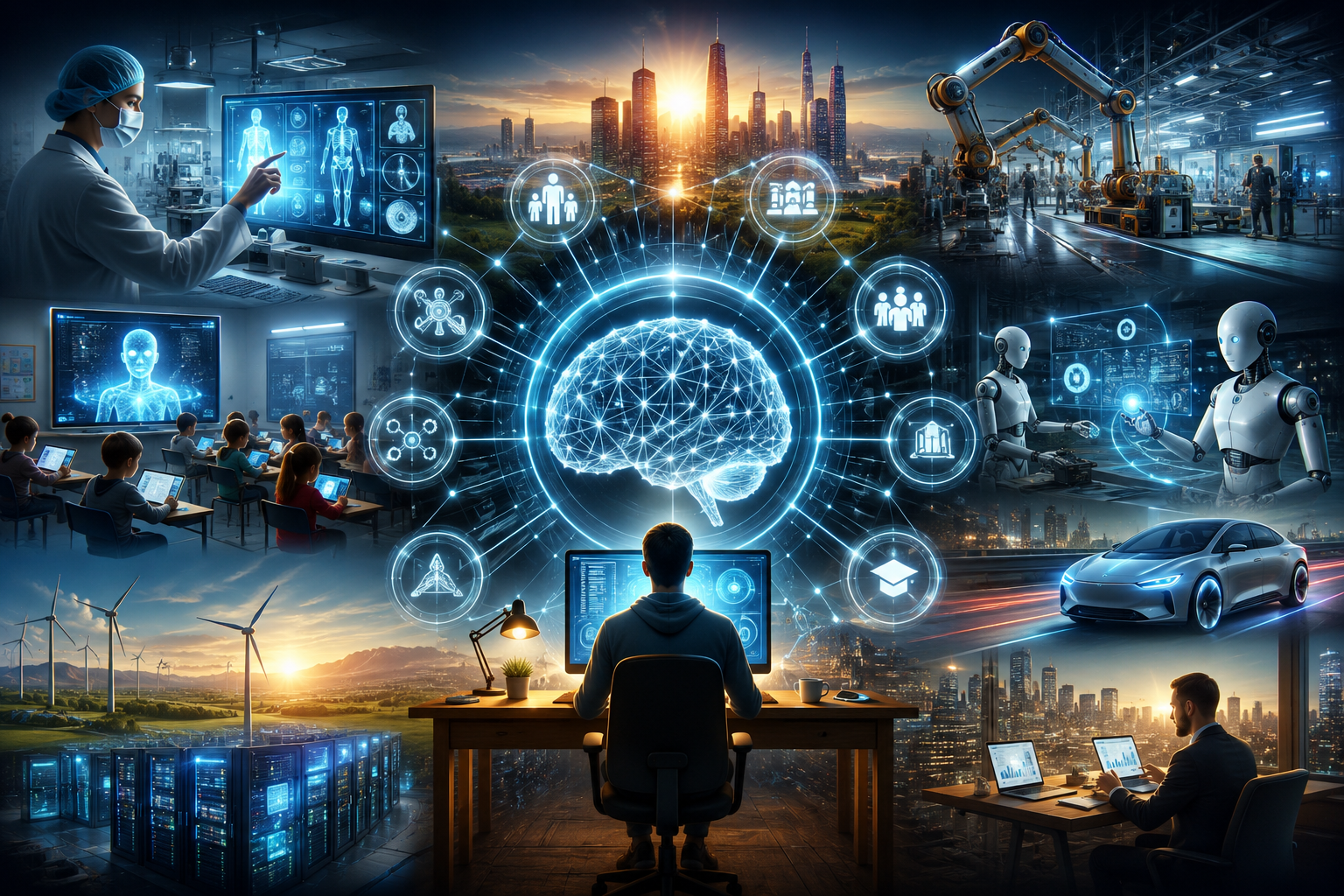
People see someone write a question, receive a clever answer, and think that’s the whole story. But the truth is, what we’re seeing now might just be the surface. Just as people at the beginning of the internet thought it was just a way to send emails or browse a few simple websites, the internet was actually building an entirely new economic world beneath the surface.Artificial intelligence today may be at the same stage.
We’re not just talking about a new application or program, but a “technological layer” that will permeate virtually every industry on Earth. Most people don’t yet grasp the magnitude of this. Artificial intelligence isn’t simply a machine that answers questions; it’s a system capable of understanding data, analyzing it, making decisions, learning from mistakes, discovering patterns, and improving performance over time. In other words, it’s an attempt to create a “digital brain” that assists humans in thinking, working, and producing. For this reason, its impact may even surpass that of the internet itself.
The internet used to simply transmit information. Artificial intelligence, however, attempts to “process” information and take action based on it. This is where the real change begins.
We’re not talking about a technology sector… we’re talking about a restructuring of the global economy.
One of the biggest misconceptions today is that people treat artificial intelligence as just another new sector within technology, like social media or smartphones. But the picture is much bigger than that. Imagine, for example, a doctor who can use an AI model to analyze thousands of medical scans in seconds and detect probabilities of illness with greater accuracy than humans sometimes can. Or a law firm that can review thousands of legal pages in minutes instead of weeks. Or a factory that uses AI to reduce waste and malfunctions and dramatically increase productivity. Or a bank that uses it to analyze customer risk and detect fraud. Or a school where every student can have a “personal tutor” who understands their level and weaknesses and explains things in a way that is tailored to their individual needs.
These are not fanciful ideas. They are things that are already gradually becoming a reality. Therefore, discussions about artificial intelligence shouldn’t be limited to technology companies alone, because the real beneficiary could be the entire economy. Any industry involved:
Cost
Data
decisions
human errors
Repeated operations
wasted time
Artificial intelligence has an opportunity to enter and improve upon it. For this reason, many major investors believe we are at the beginning of a massive “productivity revolution” that could reshape the global economy for decades to come.
The real secret behind the revolution: the demand for artificial intelligence could become almost limitless.
“How can artificial intelligence make us faster, cheaper, and more efficient?” This is where the circle expands enormously. When companies want to build powerful AI systems, they first need powerful processors from companies like NVIDIA and Advanced Micro Devices. Then they need advanced chip manufacturers like Taiwan Semiconductor Manufacturing Company. Then they need massive data centers. Then they need enormous amounts of electricity to run these centers. Then they need cooling systems. Then they need infrastructure, networks, fiber optics, and cloud services from companies like Amazon, Microsoft, and Google. And then, after all that, they need companies to process the data, clean it, test the models, and monitor performance.In other words, artificial intelligence isn’t just a single company profiting. It’s an entire economy that operates behind it. That’s why some people compare what’s happening now to the beginning of the Industrial Revolution or the dawn of the electrical age.
Data has become like oil… and perhaps even more important.
Data cleaning
Information classification
Answer test
Error review
Preventing bias
Behavior improvement
Quality controlIn fact, some AI companies employ armies of people just to review the performance of their models and ensure they don’t produce dangerous or misleading results. This is a huge sector that could grow exponentially over time.
Will artificial intelligence really destroy jobs?
AI Command Engineer
Model Evaluation Specialist
Data trainer
AI Ethics Specialist
Form security expert
AI Infrastructure EngineerAs the industry expands, dozens of other new jobs may emerge. People sometimes imagine that artificial intelligence will work entirely on its own, but the truth is that building a robust AI system is like running a nuclear power plant or a giant airline: there are always humans behind the scenes monitoring, modifying, correcting, and testing.
The most dangerous phase ahead: the transition from “smart assistant” to “digital worker”
Booking meetings
Email management
Data analysis
Customer communication
Conducting research
Report writing
Managing marketing campaigns. All of this is done almost independently. And this is where the real economic impact begins. Because we’re moving from a “program that assists the employee” to a “digital entity that works alongside the employee.” This could dramatically increase company productivity.