
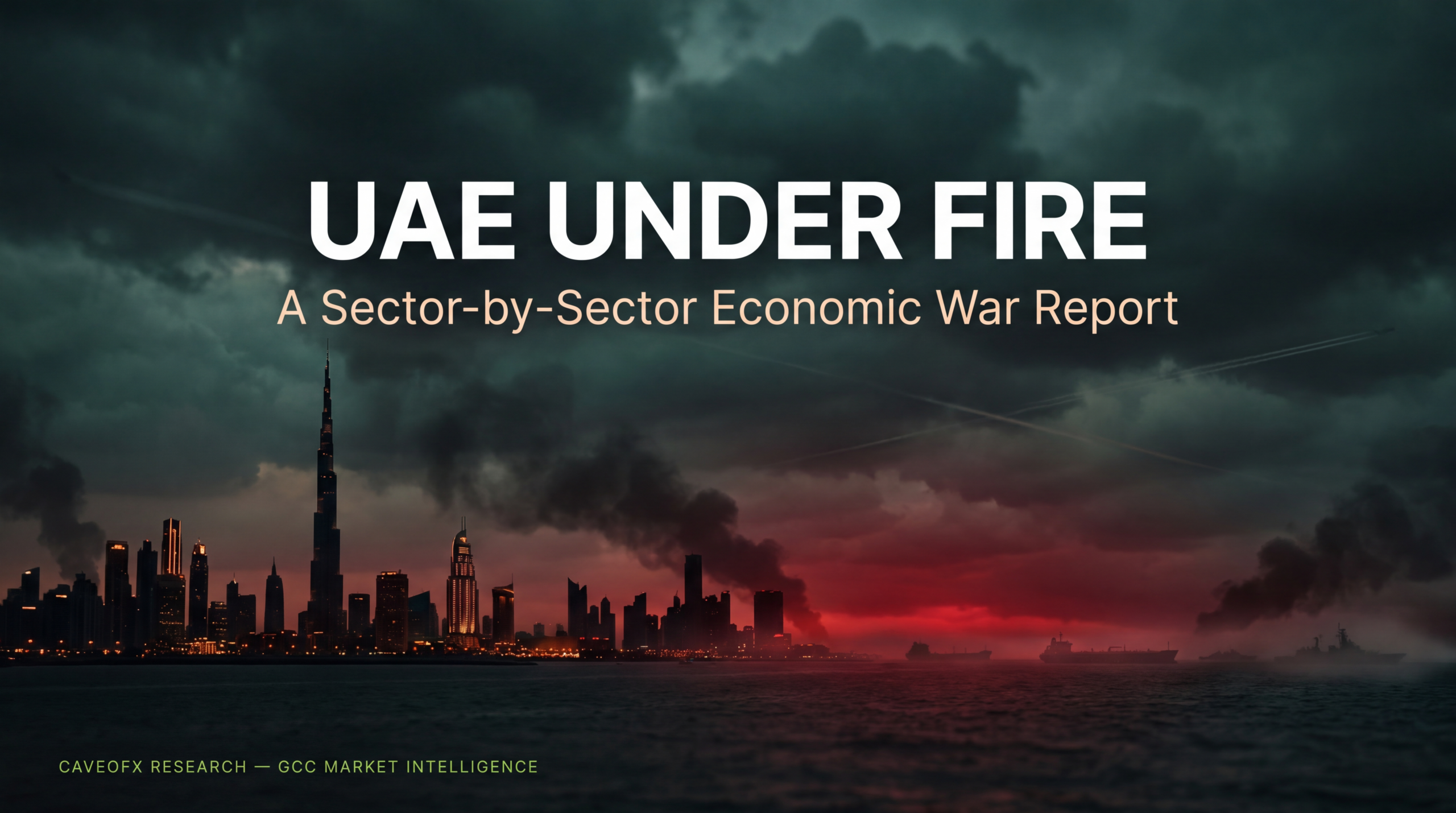
UAE Under Fire:
A Sector-by-Sector
Economic War Report
How the 2026 US–Israel–Iran conflict and the closure of the Strait of Hormuz are reshaping every pillar of the UAE's diversified economy — from oil exports to fintech, tourism to manufacturing.
(World Bank, 2026)
Losses
Decline
Volume Drop
When hostilities between the United States, Israel, and Iran escalated in late February 2026, the Strait of Hormuz — through which roughly one-fifth of global oil and gas supplies transit — effectively closed to commercial traffic. For the UAE, the world's most globally connected economy in the Gulf, the consequences have been immediate and severe across nearly every sector.
What follows is a comprehensive, sector-by-sector assessment of the war's economic footprint — drawing on data from the World Bank, IEA, S&P Global Market Intelligence, the US Congressional Research Service, MEED, CNBC, and The National — to give business leaders, policymakers, and investors a clear picture of where the damage runs deep, where resilience holds, and where strategic opportunity is quietly emerging.
Oil & Energy Severe Impact
The oil and gas sector absorbed the most direct blow. Infrastructure was damaged, and the closure of the Strait of Hormuz severed the primary export artery. The International Energy Agency described the resulting supply disruption as the largest in the history of the global oil market, with losses estimated at 10–12 million barrels per day. Energy infrastructure damage alone is estimated at close to $60 billion.
Paradoxically, crude oil prices surged above $100 per barrel — a fiscal windfall even as operational capacity was constrained. In a landmark strategic move, the UAE exited OPEC+ from May 1, 2026, freeing production quotas and signaling a long-term push toward 6 million bbl/day of capacity, with Fujairah's non-Hormuz pipeline routes gaining strategic priority.
Tourism & Aviation Hardest Hit
Tourism — which contributes over 12% of UAE GDP — has suffered the steepest contraction of any non-oil sector. Transaction volumes in travel collapsed by up to 60% since the onset of conflict. Dubai and Abu Dhabi, which spent decades engineering resilient hub economies built on global connectivity, are experiencing acute stress as regional instability erodes demand.
Emirates Airlines and Etihad Airways face prolonged route disruptions. CNBC raised the question circulating among analysts: "Is this the end of Dubai?" — a question that underscores the depth of sentiment impact even if the long-term structural answer remains no. A ceasefire, if sustained, is expected to catalyze rapid recovery given the sector's deep infrastructure base.
Hospitality & Food & Beverage Severe Disruption
Hospitality companies are undertaking deep restructuring at a pace reminiscent of the Covid-19 response. One prominent five-star Dubai hotel dismissed 300 employees; a large cloud kitchen operator cut 100 staff. A renowned restaurant in Downtown Dubai terminated 15 employees, while another major F&B operator slashed salaries by 50%.
Overall consumer activity across the UAE has fallen by 25–30% since the conflict began, per payment processor Biz2X. High-end restaurants and hotels — historically the most visible symbols of Dubai's global appeal — have been disproportionately affected. Operators are prioritizing survival over revenue targets.
Banking & Financial Services Resilient
Of all major sectors, banking has demonstrated the greatest institutional resilience. S&P affirmed the UAE's sovereign credit rating at AA/A-1+ with a stable outlook, citing liquid asset buffers sufficient to contain conflict-related credit risks. There has been "no real impact to date" on UAE financial institutions, according to senior executives at Standard Chartered.
The UAE Central Bank's five-pillar resilience package — covering liquidity support, regulatory easing, and sustained credit flow — has been credited with preventing the kind of financial contagion seen in more vulnerable GCC economies like Bahrain. Private credit remains a bright spot: a PwC 2025 report projects the UAE private credit market to grow to $11–20 billion over four years.
Real Estate & Construction Mixed Outlook
Real estate faces a dual pressure: cooling demand and rising construction costs. Transaction volumes in Dubai have declined noticeably, with analysts at Knight Frank and S&P anticipating moderate price softening — particularly in the apartment segment where supply is strongest. However, history suggests property markets recover relatively quickly once stability returns.
Construction costs present a deeper challenge. Steel prices are under double pressure — energy-intensive production plus freight disruption. With many migrant workers from India, Bangladesh, Pakistan, and Nepal returning home, a tight labor market has pushed skilled contractor fees higher. A new localization mandate — one Emirati per foreign worker on government-linked projects — adds further structural friction. The UAE government's $1 billion stimulus package, including reduced licensing fees, is helping to absorb some pressure.
Trade & Logistics Heavily Disrupted
The Strait of Hormuz closure disrupted the fundamental arterial routes on which the UAE's trade-and-logistics model depends. Insurance costs for regional shipping spiked dramatically, investment flows dried up in affected corridors, and maritime volumes plummeted. The UAE's PMI non-oil private sector activity fell to its weakest level in nearly four years in March 2026, with the S&P Global PMI dropping to 52.9.
New overland routes are beginning to stabilize supply networks previously dependent on maritime corridors. Entities like DP World are pivoting rapidly, accelerating investment in alternative logistics infrastructure. The conflict has catalyzed a strategic reassessment of the UAE's role as a regional logistics hub — one that may ultimately require building more overland connectivity to reduce Hormuz dependency.
Manufacturing & Industry Strategic Accelerant
Counterintuitively, manufacturing is emerging as a strategic beneficiary of the crisis. The conflict has exposed the vulnerabilities of import dependency for food, pharmaceuticals, energy technologies, and defense-adjacent supply chains. This has injected new urgency into the UAE's "Make it in the Emirates" industrial localization program, which predates the conflict but has gained powerful new momentum.
The UAE is moving from diversification by attraction — drawing foreign companies in — to diversification by production. ADNOC, Mubadala, DP World, and Emirates Global Aluminium are well-positioned to build industrial depth, while free zones provide manufacturers with access to external markets. The EGA aluminum smelter, however, faces a 12-month recovery timeline, adding cost pressure to the broader construction supply chain.
Technology & Digital Economy Softer Impact
Technology and digital services absorbed the softest blow of any significant UAE sector. Physical distance from the disrupted trade routes, and the inherently digital nature of the sector, insulated it from the most acute conflict effects. However, data center investments came under scrutiny following concerns about facility safety during the conflict, creating short-term uncertainty for some infrastructure operators.
Prior to the conflict, Dubai's digital economy was on track to contribute 25% of Dubai's GDP by end-2026, with the DIFC hosting over 1,000 fintech firms. That trajectory has slowed rather than reversed, and the medium-term outlook — particularly for AI, blockchain, and digital banking — remains constructive, supported by government reform momentum.
References & Sources
All data cited in this report — accessed April–May 2026
- UAE financial sector can weather impact of Iran war, executives say
The National — March 29, 2026. Coverage of banking sector resilience, S&P credit rating affirmation, and Central Bank resilience package.
thenationalnews.com → - UAE MPO — World Bank Economic Overview
World Bank — 2026. GDP growth revised from 5.1% to 2.4%; non-oil sector analysis; Central Bank five-pillar package.
worldbank.org (PDF) → - UAE Economy Plunges into Crisis — Drastic Measures Including Mass Layoffs
Travel And Tour World — March 31, 2026. Consumer activity down 25–30%; hospitality layoffs; tourism transaction collapse (−60%); F&B salary cuts.
travelandtourworld.com → - United Arab Emirates Economy on Shaky Ground as Conflict Continues
NACM News — April 3, 2026. S&P Global PMI falling to 52.9 (lowest since July 2025); tourism, retail, and logistics most affected.
nacm.org → - The Iran war did not create the UAE's industrial push but accelerated it
The National (Opinion) — May 9, 2026. UAE's "Make it in the Emirates" strategy; diversification by production; supply chain localization logic.
thenationalnews.com → - UAE Economy Faces $200B Hit From Regional Conflict, Spurs Restructuring
Whalesbook — April 6, 2026. Business loss estimates exceeding $200B; non-oil sector vulnerability; real estate transaction declines; FDI risks.
whalesbook.com → - Economic and Social Implications — UNDP Regional Bureau for Arab States
UNDP / RBAS — March 30, 2026. Regional conflict modeling; Bab el-Mandeb and Strait of Hormuz closure scenarios; GCC economic impact analysis.
undp.org (PDF) → - Damage Done by War to Mideast Economy Extends Well Beyond Energy
CNBC — April 22, 2026. Dubai tourism model under acute stress; infrastructure damage at $60B; "Is this the End of Dubai?" analysis.
cnbc.com → - UAE Projects Market 2026: Key Trends and Developments
MEED / Kelmer — May 6, 2026. Oil and gas most affected sector; World Bank GDP revision; $1B stimulus package; alternative logistics corridors.
kelmer.com → - Are UAE Construction Costs 2026 Higher Than Expected?
Grovy Real Estate — April 27, 2026. Steel and aluminum cost pressures; EGA 12-month recovery; labor market tightening; localization mandate.
grovy.ae → - UAE's Exit From OPEC+: A Structural Break in the Global Oil Order
ORF Middle East — April 29, 2026. UAE OPEC+ withdrawal rationale; 25% oil/75% non-oil GDP split; Hormuz crisis and non-oil model vulnerability.
orfme.org → - UAE Will Likely Boost Oil and Gas Investments — Potential $40B Windfall
Enterprise AM — April 30, 2026. Post-OPEC+ production flexibility; ADNOC Drilling outlook; Fujairah strategic value; 6M bbl/day target.
enterpriseam.com → - Oil Market Report — April 2026
International Energy Agency (IEA) — April 2026. Global oil supply fell 10.1 mb/d in March; Strait of Hormuz flows collapsed from 20 mb/d to ~2 mb/d; Brent crude finished April more than 55% above pre-conflict levels.
iea.org → - Iran Conflict and the Strait of Hormuz: Impacts on Oil, Gas, and Other Commodities
Congressional Research Service (CRS) — US Congress — March 2026. Official US analysis of the Strait closure; 27% of global maritime oil trade disrupted; bypass pipeline capacity analysis.
congress.gov → - The Middle East and Global Energy Markets — Topic Overview
International Energy Agency (IEA) — Updated May 2026. LNG global supply reduced ~20%; IEA emergency stock release of 400 million barrels; UAE and Saudi Arabia bypass pipeline capacity (3.5–5.5 mb/d).
iea.org →
- Global markets are experiencing sharp fluctuations due to geopolitical tensions in the Middle East and the economic effects of rising oil prices.
- Important Economic News Monday, June 1, 2025
- Wall Street awaits a crucial moment… Tech earnings and the Fed& decision are at the heart of the matter.
- Dow and S&P 500 Rise Amid AI Concerns; Gold Sees Big Swings