
172
Altman and Amudi call for slowing down AI development, and Musk joins the warnings amid an unprecedented investment and technology race. In a significant development within the artificial intelligence industry, leaders of major technology companies have issued increasing warnings about the potential risks of the rapid development of intelligent systems, at a time when companies and countries are racing to acquire the most advanced technologies.
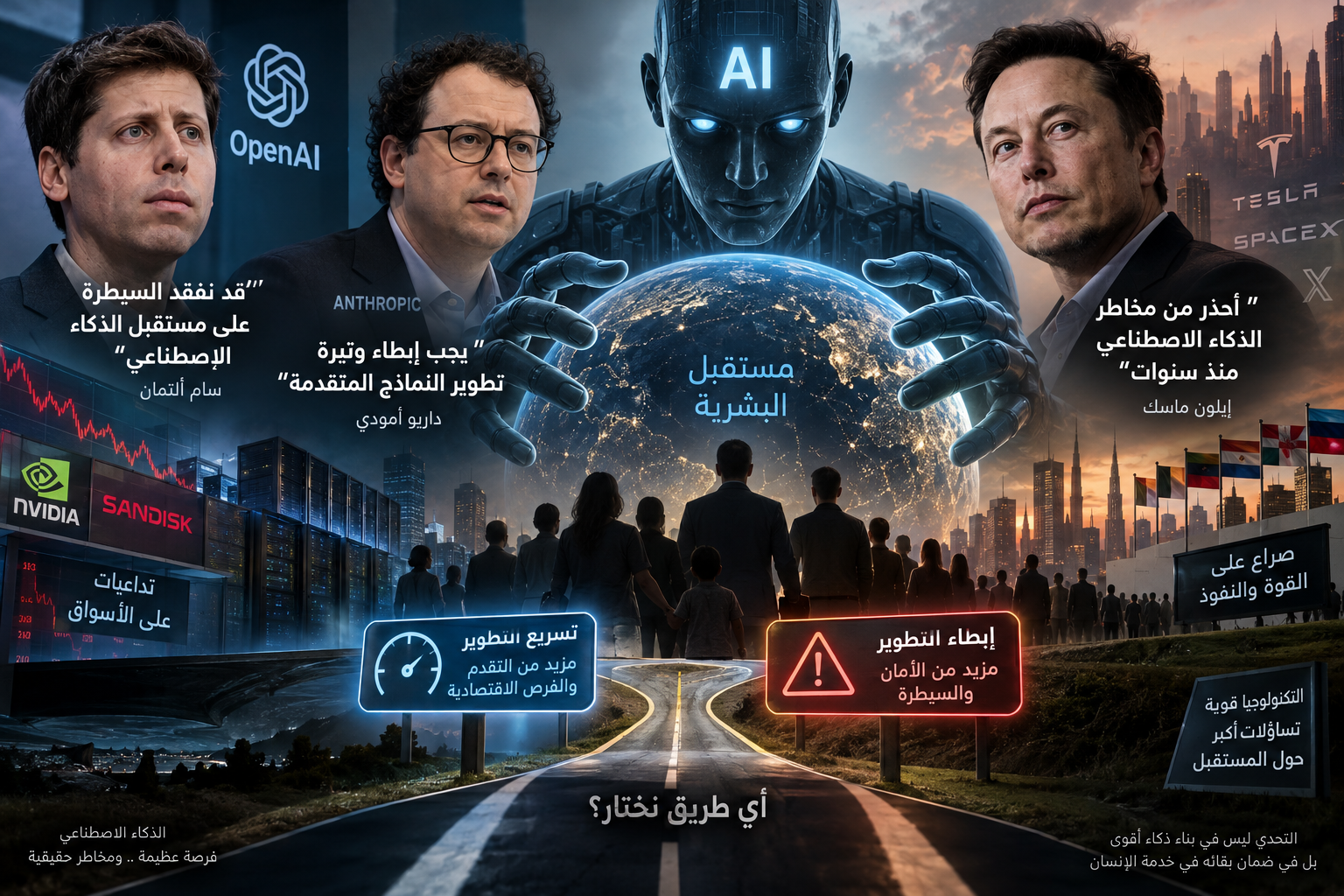
Sam Altman, CEO of OpenAI, warned that humans could lose control over the future of artificial intelligence, while Dario Amode, CEO of Anthropic, called for slowing the pace of development of advanced models so that safety technologies can keep up with their growing capabilities. These warnings are not coming from outside the industry, but from within it, raising important questions about the future of a technology that has become a major focus of global investment.
First: Sam Altman warns of losing control over artificial intelligence
Sam Altman asserted that there are two main dangers humanity must avoid as artificial intelligence continues to develop. The first is the potential loss of control over intelligent systems if their capabilities become so advanced that their behavior becomes difficult to understand or ensure its alignment with human goals and interests. The second danger concerns the potential concentration of immense power in the hands of a single company or nation, enabling it to use AI to impose its vision on others. Altman believes that addressing these risks requires striking a delicate balance between continued technological advancement and ensuring that this technology remains under human control and serves human interests.
Second: Anthropic calls for slowing down the development race
For his part, Dario Amode called for slowing the pace of development of advanced artificial intelligence models, stressing that risk mitigation measures must be given sufficient time to keep pace with the rapid evolution of these systems’ capabilities. This call comes amid concerns that some future systems may reach a stage where they can repeatedly improve their capabilities, potentially exceeding human understanding and control.
Amoudi proposed strengthening independent oversight of AI companies by having external review bodies that could examine advanced models, monitor compliance with safety standards, and report incidents and potential risks. This would not only call for the development of safer technologies but also for a reassessment of the pace of development itself.
Third: Researchers’ warnings put AI companies under pressure
These statements came after warnings from AI safety researchers. Jacob Cookson announced his resignation from Anthropic, expressing concerns that AI companies, including Anthropic and OpenAI, are not taking the potential risks of the technology seriously enough. Ivan Hobring, head of AI adaptation research at Anthropic, also stated his belief that there is a greater than 10% chance that this technology could lead to the extinction of humanity.
However, this percentage represents a personal estimate by the researcher, and is not a proven scientific probability or a consensus among specialists.
These positions reveal the breadth of the debate within the artificial intelligence industry itself, between those who focus on accelerating development and those who believe that safety should precede the expansion of capabilities.
Fourth: Elon Musk joins the warnings… despite his massive investments
The debate wasn’t limited to Altman and Amode; Elon Musk also voiced his support for Amode’s position, noting that he has been warning about the dangers of artificial intelligence for years. Musk believes that advanced intelligent systems could pose a threat beyond human comprehension, especially if they become significantly more intelligent than humans. Interestingly, Musk himself is one of the most prominent investors in this field.
Through its investments in artificial intelligence at SpaceX and Tesla, including data centers, the Grok system, robotics, and self-driving technologies, a clear paradox emerges: the very figures who warn of the dangers of artificial intelligence are the same ones leading a significant portion of the investments aimed at developing it.
Through its investments in artificial intelligence at SpaceX and Tesla, including data centers, the Grok system, robotics, and self-driving technologies, a clear paradox emerges: the very figures who warn of the dangers of artificial intelligence are the same ones leading a significant portion of the investments aimed at developing it.
Fifth: Will the warnings affect technology stocks?
Concerns about the safety of artificial intelligence were reflected in the performance of a number of technology stocks, with the report noting a decline in shares of Nvidia and SanDisk amid worries about a potential slowdown in technological development.
However, some investors believe that these warnings will not fundamentally change the expected level of spending on artificial intelligence infrastructure in the coming years.
The basic idea here is that investors face an important question: Will safety and regulatory measures slow the commercial growth of AI companies, or will they help build a more sustainable industry in the long run?
If development becomes more expensive or subject to greater constraints, profit forecasts may be affected. Conversely, if safety measures help reduce risks and boost confidence, they could have positive effects on the future of the industry.
Sixth: Are companies motivated by a desire to protect humanity or to protect their own interests?
One of the key questions the report raises concerns the motivations behind calls to slow development. On the one hand, these statements may reflect genuine concern among industry leaders about the potential risks of artificial intelligence. On the other hand, some critics argue that slowing development could also serve the interests of large corporations by limiting competition or protecting their market value and industry standing.
However, the information provided does not prove that these warnings are merely a marketing ploy. More importantly, the call for oversight and safety does not necessarily mean abandoning the development of artificial intelligence; rather, it may mean attempting to regulate this development so that the risks do not exceed human capacity to manage them.
The artificial intelligence race enters a new phase
These developments reveal a significant shift in the global debate surrounding artificial intelligence. After years of focusing on the speed of development, the scale of investment, and technological capabilities, discussions about control, safety, and the concentration of power have become central to the future of the industry. The real challenge is not to halt technological progress, but to ensure that this progress remains aligned with the interests of humanity. As companies and nations race to possess the most powerful AI systems, the most crucial question remains: can humanity continue to develop this technology while retaining the ability to control it?