Table of Contents
Best Time to Trade Gold (XAUUSD)
The Complete 2026 Guide to Gold Trading Hours, Sessions & Market Volatility

For centuries, people have rushed toward gold whenever uncertainty hit the markets. Wars, inflation, financial crises, political instability—you name it. While stocks may fall and currencies can lose value, gold often becomes the asset everyone suddenly wants to own.
But here’s something many traders don’t realize…
Knowing how to trade gold is only half the equation.
Knowing when to trade gold can make an even bigger difference.

You might have the perfect setup, the strongest technical analysis, and a solid trading plan. Yet if you enter during a quiet market with little liquidity—or seconds before a major economic announcement—you could watch a winning trade turn into a losing one in minutes.
Timing matters.
Gold (XAUUSD) is one of the most actively traded financial instruments in the world. It trades nearly 24 hours a day, five days a week, but not every hour offers the same opportunities. Some sessions are calm and range-bound, while others explode with volatility as banks, hedge funds, institutions, and central banks flood the market with orders.
Understanding these patterns allows you to:
- Trade when liquidity is highest.
- Benefit from tighter spreads.
- Spot stronger trends.
- Avoid unnecessary market noise.
- Improve your overall risk management.
In this complete guide, you’ll learn everything you need to know about the best time to trade gold, including global trading sessions, gold market hours, economic events, volatility patterns, trading strategies for different sessions, common mistakes, and practical tips that can help you make more informed trading decisions.
Let’s dive in.

What Is Gold Trading?
To learn the best time to trade gold you must first know what is gold trading? Gold trading simply means buying and selling gold to profit from changes in its price.
Unlike buying physical gold bars or coins to store for years, financial gold trading allows traders to speculate on price movements without ever taking delivery of the metal.
- If you believe gold prices will rise, you open a buy (long) position.
- If you expect prices to fall, you open a sell (short) position.
This flexibility is one of the reasons gold has become one of the world’s most popular trading instruments.
Today, millions of traders participate in the gold market every day through online trading platforms, making XAUUSD one of the most actively traded assets alongside major forex pairs.
Different Ways to Trade Gold
Not all gold trading works the same way. Depending on your goals and trading style, you can choose from several different markets.
Spot Gold (XAUUSD)
Spot gold is the current market price of gold for immediate settlement.
This is the instrument most forex and CFD traders know as XAUUSD, where the value of one ounce of gold is quoted against the US dollar.
Spot gold offers:
- Nearly 24-hour trading during weekdays
- High liquidity
- Fast execution
- The ability to trade both rising and falling markets
- Leverage through many brokers
It’s also the most common choice for day traders and swing traders.
Gold CFDs
Contracts for Difference (CFDs) allow traders to speculate on gold prices without owning the physical metal.
With CFDs, you simply profit—or lose—from the difference between your entry and exit price.
Many traders choose CFDs because they offer:
- Leverage
- Low capital requirements
- Short selling
- Flexible position sizes
- Access to gold from one trading account
Gold Futures
Gold futures are standardized contracts traded on regulated exchanges like COMEX.
Instead of trading the current spot price, futures contracts represent an agreement to buy or sell gold at a future date.
Although futures technically involve physical delivery, most traders close their positions before expiration.
Gold futures are popular among:
- Professional traders
- Institutions
- Hedgers
- Commodity investors
Gold ETFs
Exchange-Traded Funds (ETFs) track the price of gold while trading like stocks.
Rather than trading gold directly, investors buy shares of a fund that follows gold prices.
Gold ETFs are generally preferred by:
- Long-term investors
- Retirement portfolios
- Passive investors
- Diversification strategies
Physical Gold
Some investors still prefer owning actual gold.
This includes:
- Gold bars
- Gold coins
- Bullion
- Jewelry
Physical gold doesn’t generate income, but many investors view it as long-term protection against inflation and economic uncertainty.
Quick Comparison
| Instrument | Best For | Uses Leverage | Own Physical Gold? |
|---|---|---|---|
| Spot Gold (XAUUSD) | Day traders | Yes | No |
| Gold CFDs | Active traders | Yes | No |
| Gold Futures | Professional traders | Yes | Usually No |
| Gold ETFs | Long-term investors | No | Indirectly |
| Physical Gold | Wealth preservation | No | Yes |
What Does Timing Mean in Gold Trading?
Best time to trade gold depends mainly on timing so what is timing, Many beginners think successful trading is all about finding the perfect indicator or the perfect strategy.
In reality, timing is often just as important as the setup itself.
Timing simply means choosing when to enter and exit the market based on factors such as:
- Market sessions
- Liquidity
- Trading volume
- Volatility
- Economic news
- Institutional activity
Think about two traders using exactly the same strategy.
Both spot the same breakout.
Both buy at almost the same price.
One enters during the quiet Asian session.
The other waits until the London–New York overlap.
Even though the setup is identical, their results can be completely different.
Why?
Because markets behave differently throughout the day.
During active sessions, you’ll often find:
- Higher liquidity
- Faster execution
- Tighter spreads
- Stronger trends
- Better follow-through after breakouts
During quieter periods, you may experience:
- Low volume
- Choppy price action
- False breakouts
- Wider spreads
- Random market movements
The lesson?
A good trade taken at the wrong time can easily become a bad trade.
Why Timing Matters More Than Most Traders Think
Imagine trying to surf.
Would you rather paddle into tiny, unpredictable waves—or wait for the biggest, cleanest wave of the day?
Gold trading works the same way.

Professional traders don’t spend all day clicking the Buy and Sell buttons.
Instead, they wait for periods when the market naturally provides the best opportunities.
These periods usually occur when:
- Major financial centers are open.
- Institutional traders are active.
- Important economic data is released.
- Liquidity reaches its highest levels.
During these windows, gold often produces:
- Larger price movements
- Stronger trends
- Cleaner breakouts
- Better momentum
- Lower transaction costs thanks to tighter spreads
By contrast, trading during low-liquidity periods often means fighting against slow markets, wider spreads, and unpredictable price action.
This doesn’t mean you should never trade during quieter hours.
It simply means your strategy should match the market environment.
For example:
- Scalpers usually thrive during highly active sessions.
- Day traders often prefer the London and New York sessions.
- Swing traders may use quieter periods to build positions before volatility increases.
Understanding these differences helps you choose the right trading window instead of forcing trades when conditions aren’t favorable.
How Gold Moves Throughout the Day
To learn best time to trade gold you have to learn first how it moves during each trading day, Unlike stocks that trade only during exchange hours, gold follows the global financial system.
As one financial center(the trading session we covered before) closes, another opens.
This creates a continuous trading cycle that lasts nearly 24 hours each weekday.
However, activity isn’t evenly distributed.
Some sessions are dominated by institutional traders.
Others are driven by regional demand.
Some produce powerful trends.
Others mainly create consolidation before the next major session begins.
Learning this daily rhythm is one of the biggest advantages traders can develop.
Instead of wondering why gold suddenly “comes alive,” you’ll understand exactly which market participants are driving the move—and why.
Gold Trading Sessions Explained
One of the biggest misconceptions among beginner traders is believing that gold behaves the same way all day….well surprise, It doesn’t.
Gold (XAUUSD) may trade nearly 24 hours a day during the week, but the market has its own rhythm. As major financial centers open and close, liquidity, volatility, spreads, and trading volume constantly change.
That’s why experienced traders don’t just ask:
“Should I trade gold today?”
They ask:
“Is this the right session to trade my strategy?”
Understanding how each trading session behaves can help you avoid low-quality trades, improve your entries, and know when the market is most likely to deliver strong moves.
Why Gold Trades Almost 24 Hours a Day
Gold is one of the world’s most traded financial assets.
Unlike stocks that trade only during local exchange hours, gold is traded globally through:
- Banks
- Institutional investors
- Central banks
- Hedge funds
- Commodity exchanges
- Forex and CFD brokers
- Retail traders
As one financial hub closes, another begins its trading day.
This creates an almost continuous market from Sunday evening until Friday evening (UTC), with only a short daily maintenance break on many trading platforms.
Because trading never fully stops during weekdays, gold constantly reacts to:
- Economic data
- Interest rate expectations
- Inflation
- US Dollar movements
- Geopolitical events
- Global risk sentiment
However, not every hour attracts the same number of market participants.
That’s where trading sessions become important.
The Four Major Gold Trading Sessions
Although gold trades globally, most trading activity revolves around four major financial sessions.
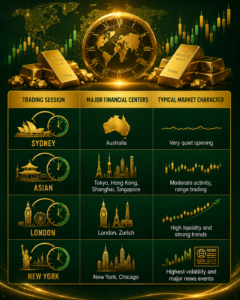
Notice something?
Only two sessions consistently dominate gold trading:
- London
- New York
Even more importantly…
The period when both sessions overlap is often considered the golden window for trading XAUUSD.
We’ll cover that shortly.
Sydney Session

Approximate UTC Hours
22:00 – 07:00 UTC
The Sydney session quietly opens the global trading week.
Compared with the sessions that follow, trading volume is relatively low.
Many institutional traders are still inactive, and large price swings are less common unless major geopolitical news breaks while Western markets are closed.
What to Expect
- Lower liquidity
- Wider spreads
- Smaller price movements
- Slow market conditions
This session is usually more useful for:
- Monitoring existing positions
- Preparing trading plans
- Marking important price levels
Aggressive intraday trading is generally less attractive during Sydney hours.
Asian Session

Approximate UTC Hours
00:00 – 09:00 UTC
The Asian session begins as Tokyo, Hong Kong, Singapore, and later Shanghai become active.
Many beginners assume this session is “dead.”
That’s not entirely true.
While volatility is usually lower than London or New York, Asia often establishes the market structure that the rest of the day follows.
Think of it as the market laying the foundation.
Characteristics of the Asian Session
Most days you’ll notice:
- Smaller candles
- Slower trends
- Narrow trading ranges
- Lower liquidity
- Fewer explosive moves
Because institutions in Europe and North America haven’t entered the market yet, gold often trades inside relatively tight ranges.
These ranges later become extremely important.
Why?
Because London traders love breaking them.
When Asia Becomes Active
Although generally quieter, Asia can suddenly become volatile when important regional events occur.
Examples include:
- Chinese economic data
- Japanese inflation reports
- Bank of Japan announcements
- People’s Bank of China policy decisions
- Unexpected geopolitical developments
Since China is the world’s largest consumer of physical gold, news from the region can influence market sentiment more than many traders expect.
Best Strategies During the Asian Session
The Asian session usually suits traders who prefer:
Range Trading
Buying near support.
Selling near resistance.
Expecting price to remain inside established boundaries.
Swing Trade Preparation
Many swing traders use Asia to:
- Identify support and resistance
- Build watchlists
- Prepare London breakout scenarios
Position Building
Long-term traders sometimes enter positions during quieter markets to avoid chasing fast-moving prices later.
Less Suitable For
The Asian session is generally less ideal for:
- Scalping explosive momentum
- News trading
- Large breakout strategies
- High-frequency trading
London Session

Approximate UTC Hours
08:00 – 17:00 UTC
If there is one session every gold trader should understand…
It’s London.
London has historically been one of the world’s most important precious metals trading hubs.
Many major bullion banks, institutional investors, and professional traders become active as Europe opens for business.
Liquidity increases dramatically.
Spreads tighten.
Momentum builds.
The market often “wakes up.”
Why London Matters So Much
During the London session:
Institutional orders begin entering the market.
Large banks execute client transactions.
Professional traders react to overnight developments.
European economic data is released.
As a result, volatility increases considerably compared with Asia.
Typical Market Behavior
The London open often produces:
- Strong breakouts
- Higher trading volume
- Trend development
- Increased momentum
Very often, London decides the market’s direction for the day.
The Famous Asian Range Breakout
This is one of the oldest—and still one of the most effective—gold trading concepts.
Here’s how it works.
During Asia:
Gold spends several hours moving sideways.
London opens.
Fresh institutional orders enter.
Price finally breaks above or below the Asian range.
Many day traders focus almost exclusively on this setup because it combines:
- Fresh liquidity
- Strong momentum
- Clear technical levels
We’ll cover this setup in detail later in the article.
Best Strategies During London
London is excellent for:
- Breakout trading
- Trend following
- Intraday momentum
- Scalping
- Day trading
New York Session

Approximate UTC Hours
13:00 – 22:00 UTC
When New York opens, another major source of liquidity enters the market.
Remember:
Gold is quoted in US Dollars.
That means almost everything affecting the US Dollar can immediately influence gold prices.
Examples include:
- Inflation data
- Employment reports
- Federal Reserve announcements
- Treasury yields
- Stock market sentiment
This is why New York regularly produces the largest intraday moves.
Why New York Is So Important
Several major events happen during US trading hours:
- CPI
- Non-Farm Payrolls (NFP)
- Retail Sales
- GDP
- ISM Manufacturing PMI
- Federal Reserve speeches
- FOMC decisions
These releases often trigger sharp moves within seconds.
Professional traders closely monitor the economic calendar before every New York session.
Typical Market Behavior
During New York you’ll often see:
- Larger candles
- Faster momentum
- Increased volatility
- Strong continuation moves
- Sharp reversals
Sometimes New York simply extends London’s trend.
Other times it completely reverses it.
Learning to recognize which scenario is developing becomes a valuable trading skill.
London–New York Overlap
The Best Time to Trade Gold
If you could trade only one part of the day…
This would probably be it.
The overlap between London and New York is widely considered the best time to trade gold
Approximate hours:
13:00–17:00 UTC
During these hours:
- Europe is fully active.
- America has just opened.
- Institutional participation reaches its daily peak.
- COMEX futures trading is highly active.
- Banks execute large orders.
- Trading volume surges.
Everything comes together.
Why does the London–New York overlap create the largest price movements in gold?
This period combines:
- Highest liquidity
- Tightest spreads
- Fast order execution
- Strong institutional participation
- Major US economic releases
- Heavy futures trading
It’s no coincidence that many of gold’s largest daily moves occur during this overlap.
Who Benefits Most?
The overlap is ideal for:
- Scalpers
- Day traders
- Breakout traders
- Momentum traders
- News traders (with experience)
If your strategy depends on volatility, this is usually the session you’ll want to focus on.
Session-Based Gold Trading Setups (That Traders Actually Use)
Knowing the best time to trade gold is useful.
Knowing what to do during those hours is what actually makes the difference.
Professional traders don’t randomly buy because London opened or sell because New York is active.
They wait for repeatable market behavior.
Here are some of the most common gold trading setups built around trading sessions.
1. The Asian Range → London Breakout Strategy
This is one of the oldest—and still one of the most reliable—gold trading setups.
Why it works
The Asian session usually has:
- Lower volatility
- Smaller price ranges
- Less institutional participation
When London opens, liquidity suddenly jumps.
That often causes gold to break out of the range built during Asia.
How to trade it
Step 1
Mark:
- Asian High
- Asian Low
Step 2
Wait for London to open.
Avoid entering during the first few minutes because spreads may briefly widen.
Step 3
Watch price.
Does it:
- Break above the Asian High?
- Break below the Asian Low?
- Fake the breakout then reverse?
Step 4
Wait for confirmation before entering.
Never assume every breakout is real.
Example
Asian session:
Gold trades between
2330 and 2338.
London opens.
Price breaks above 2338 with increasing volume.
Momentum traders enter long.
Price rallies toward 2350.
That entire move happened because liquidity entered the market.
2. London Trend → New York Continuation
Sometimes London starts a strong trend.
New York simply adds more fuel.
This is one of the cleanest trend-following opportunities of the day.
Example
London pushes gold
from
2325
to
Then New York opens.
US economic data supports the move.
Institutions continue buying.
Gold extends toward
Instead of chasing the first move,
many traders wait for a pullback after New York opens.
Best for
✔ Intraday traders
✔ Momentum traders
✔ Trend followers
3. New York News Trading Setup
Some traders only trade major US news.
That’s because gold reacts almost instantly to:
- CPI
- NFP
- FOMC
- Retail Sales
- GDP
- Fed speeches
Basic approach
Before news:
Mark
- Support
- Resistance
- Previous High
- Previous Low
Wait for the release.
Do NOT jump in during the first candle.
Let the market decide the direction first.
Then trade only if momentum confirms.
Why patience matters
The first move after news isn’t always the real move.
Sometimes gold spikes higher…
then immediately reverses.
Waiting can save you from unnecessary losses.
4. Late New York Pullback Setup
Many traders ignore this one.
They shouldn’t.
Toward the end of the New York session,
large institutions begin closing positions.
This often creates:
- Profit-taking
- Retracements
- Reduced momentum
Swing traders sometimes use these pullbacks to prepare for the following trading day.
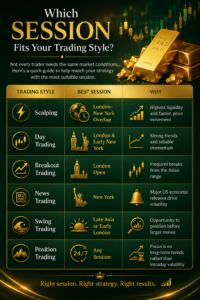
Which Trading Session Fits Your Style?
Not every trader needs the same market conditions.
Here’s a quick guide.
| Trading Style | Best Session | Why It Works |
|---|---|---|
| Scalping | London Open & London–New York Overlap | Fast moves, tight spreads, strong liquidity |
| Day Trading | London + Early New York | Clear intraday trends and breakouts |
| Swing Trading | Late Asia or Late New York | Better entries before volatility increases |
| Trend Trading | London–New York Overlap | Long directional moves |
| News Trading | Early New York | Major US economic releases create volatility |
Pros and Cons of Trading During High-Volatility Hours
Like everything in trading,
higher volatility comes with higher opportunity…
and higher risk.
| Advantages | Disadvantages |
|---|---|
| Bigger price moves | Larger losses if you’re wrong |
| Better liquidity | Faster market movements |
| Tighter spreads | Emotional trading becomes easier |
| Stronger trends | Stop-losses can be triggered quickly |
| Great for scalping | Requires discipline and experience |
Volatility isn’t good or bad.
It’s simply a tool.
The better you manage it,
the more useful it becomes.
Common Timing Mistakes Gold Traders Make
We know you care about knowing the best time to trade gold , but you also have to know that many traders don’t lose because of bad analysis.They lose because they trade at the wrong time.
Here are some of the biggest mistakes.
Trading During Dead Hours
Gold barely moves.
Yet traders expect huge profits.
Low volatility often means:
- Choppy price action
- False signals
- Frustration
Ignoring the Economic Calendar
Opening a trade five minutes before CPI…
then wondering why gold exploded.
Never underestimate scheduled news.
Chasing Every Breakout
Not every move deserves a trade.
Sometimes the smartest trade…
is no trade.
Treating Every Session the Same
Asian session ≠ London.
London ≠ New York.
Each has different behavior.
Different volatility.
Different opportunities.
Different risks.
Trading Every Single Session
Professional traders rarely trade all day.
Most have specific trading windows.
Quality beats quantity.
Always.
Risk Management Tips for Different Trading Sessions
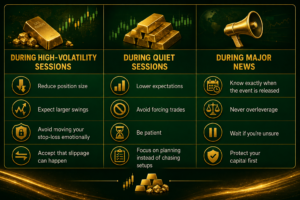
Changing your strategy based on market conditions is a sign of experience.
Not weakness.
Remember…
There will always be another trade.
There won’t always be another trading account.
Pro Tip: Build a “Gold Trading Clock”
One habit separates experienced traders from everyone else.
Create your own Gold Trading Clock.
Every trading day, note:
- Which session you’re trading
- Upcoming economic news
- Gold’s Average True Range (ATR)
- Key support and resistance
- Trend direction
- Your maximum risk
After a few weeks, you’ll start spotting patterns that no indicator can show you.
Your trading journal will become more valuable than any strategy you download from the internet.
Best Days of the Week to Trade Gold
Do Some Months Offer Better Gold Trading Opportunities?
Gold also follows seasonal patterns.
While seasonality should never be your only reason to enter a trade, it can provide valuable context.
Historically, stronger activity often appears during:
- January – Investors reposition after the holidays and begin the new trading year.
- February – Continued institutional activity and seasonal demand can support prices.
- August – Traders return from summer holidays, and volatility often increases.
- September – Traditionally one of gold’s strongest months as market participation picks up.
- October–November – Geopolitical uncertainty and year-end positioning can create fresh opportunities.
Remember, seasonal trends are probabilities—not guarantees.
Always combine them with technical analysis, fundamentals, and proper risk management.
Although these exchanges operate independently, their activity overlaps to create the nearly continuous global gold market.
Quick Checklist: Before You Trade Gold Today
Before placing any XAU/USD trade, ask yourself these questions:
✅ Which trading session is currently active?
✅ Is the London–New York overlap approaching?
✅ Are any high-impact economic events scheduled today?
✅ Is the U.S. dollar strengthening or weakening?
✅ Have you identified key support and resistance levels?
✅ Is your stop-loss based on current market volatility?
✅ Does this trade match your trading plan?
If you can’t answer “yes” to most of these questions, it may be worth waiting for a better setup.
Remember, patience is a trading skill—not a weakness.
Frequently Asked Questions (FAQs)
What is the best time to trade gold?
The best time to trade gold is generally during the London–New York overlap (13:00–17:00 GMT). This period combines the highest liquidity, tighter spreads, and the strongest price movements, making it ideal for many day traders and scalpers.
Does gold trade 24 hours a day?
Almost.
Gold trades 24 hours a day, five days a week, opening on Sunday evening and closing on Friday evening, with only a short daily maintenance break depending on your broker or exchange.
Why does gold move the most during the U.S. session?
Gold is priced in U.S. dollars, so major U.S. economic reports—such as CPI, Non-Farm Payrolls, GDP, and Federal Reserve announcements—often have the biggest impact on its price.
Is the Asian session good for trading gold?
The Asian session is generally calmer than London or New York. It is better suited for identifying support and resistance levels or preparing for potential breakouts later in the day.
Which trading style benefits most from the London–New York overlap?
Scalpers, day traders, and momentum traders often prefer this session because it offers higher liquidity, stronger trends, and lower trading costs through tighter spreads.
Can beginners trade gold during major news releases?
Beginners should be cautious. News events can create sharp price swings, wider spreads, and increased slippage. Many experienced traders wait for the initial volatility to settle before entering a trade.
Wrap up
Gold diggers… they’re everywhere, aren’t they? are you one of them?…..By now, we’ve covered just about everything you need to know about the best time to trade gold. But here’s the truth: There isn’t one magic hour that makes everyone money.
The best time to trade gold is the time that fits your trading plan, your strategy, your risk tolerance, and yes—your budget. Once you’ve considered market sessions, volatility, technical analysis, and upcoming economic events, the final decision should always fit your trading style.
One more thing…Never risk more than you can afford to lose…..Seriously.
We all catch gold fever sometimes. We see a huge candle, breaking news, or everyone on social media shouting, “Gold is going to the moon!” It’s tempting to jump in without a plan.
Don’t.
Don’t let excitement make your trading decisions. Let your strategy do that.
The market will always open again tomorrow…..Make sure you’re still around to trade it.
Ready to Put Your Timing Into Practice?
Now that you know the best times to trade gold, the next step is learning …….Open a demo account, monitor how gold behaves during each trading session, practice identifying high-probability setups, and always trade with a clear risk management plan.