
Table of Contents
7 Prime Ministers in 10 Years: How Brexit Reshaped the UK Economy
7 Prime Ministers in 10 Years!! To be honest, that caught us a bit off guard.
Okay, now for the real talk.
We spend most of our time talking about markets, stocks, currencies, and economic indicators. But every now and then, a political event changes the entire financial landscape. Brexit was one of those moments. It wasn’t just about Britain leaving the European Union—it reshaped trade, investment, inflation, the British pound, and even British politics. Since the Brexit referendum, the United Kingdom has welcomed 7 Prime Ministers in 10 Years.
Think about that for a second.

7 Prime Ministers in 10 Years!!
In one of the world’s largest economies.
Each arrived promising stability.
Most left during political or economic turmoil.
So what happened?
Why has Britain struggled to keep a prime minister?
And what does all of this mean for the UK economy, traders, and investors?
Let’s dive in.
What Is Brexit?
Brexit is the term used to describe the United Kingdom’s withdrawal from the European Union (EU). The word itself is a combination of “Britain” and “Exit.” After more than four decades of EU membership, the UK voted in a historic referendum on June 23, 2016, to leave, marking one of the most significant political and economic events in modern European history.
What Is the European Union?
The European Union (EU) is a political and economic partnership of European countries that work together to promote free trade, economic cooperation, and the free movement of people, goods, services, and capital. While each member state remains an independent country with its own government, they agree to follow a common set of rules and cooperate on a wide range of economic and political issues.
Why Did Britain Join the European Union?
Of course for so many reasons, the UK joined what was then known as the European Economic Community (EEC) in 1973. At the time, membership was seen as an opportunity to strengthen the British economy by gaining easier access to one of the world’s largest trading markets.
Key reasons for joining included:
- Expanding trade with neighboring European countries
- Attracting foreign investment
- Support economic growth
- Increasing Britain’s influence in Europe
- Create new business and employment opportunities
For decades, the UK benefited from being part of a large single market that reduced trade barriers and encouraged cross-border investment.
Why Did EU Membership Matter?
I know it’s obvious bit we have to explain a little further so you would understand the whole thing and why did UK end up with 7 Prime Ministers in 10 Years , ok being an EU member offered several economic advantages.
British businesses could sell products across Europe without tariffs or many customs checks, making exports faster and more competitive. Companies also enjoyed easier access to suppliers, workers, and investors from across the continent.
Some of the biggest benefits included:
- Tariff-free trade with EU member states
- Free movement of goods, services, capital, and workers
- Easier access to European markets
- Greater foreign direct investment
- Stronger cooperation in areas such as research, education, and security
However, membership also meant that the UK had to follow many EU laws and regulations and contribute financially to the EU budget—issues that later became central to the Brexit debate.
What Did Leaving the EU Actually Mean?
Although Brexit did not stop the UK from trading with Europe, it fundamentally changed how that trade takes place.
Leaving the EU meant that the UK exited the Single Market and Customs Union, introducing new customs procedures, regulatory checks, and trade agreements with both European and non-European countries.
Some of the biggest changes included:
- New customs checks on many goods crossing UK-EU borders
- The end of free movement between the UK and EU
- Greater control over UK immigration policy
- The ability to negotiate independent trade agreements with other countries
- Increased paperwork and compliance requirements for many businesses trading with Europe
Supporters argued that Brexit would give Britain greater sovereignty and more control over its own laws and borders. Critics, however, warned that it would reduce trade efficiency, increase business costs, and create long-term economic uncertainty.
Whether viewed as a political success or an economic challenge, Brexit remains one of the most influential events shaping the UK’s economy, financial markets, and political landscape today.
Why Did Brexit Happen?
If Brexit has affected almost every part of the UK, from its economy to having 7 Prime Ministers in 10 Years, then the obvious question is:
Why did Britain decide to leave in the first place?
The answer isn’t as simple as one reason. It was a combination of political, economic, and social issues that had been building for years.
Immigration
One of the biggest issues during the referendum campaign was immigration. Many voters wanted the UK to have greater control over who could enter the country rather than following the EU’s free movement rules.
Taking Back Control
You probably remember the famous slogan, “Take Back Control.” Many people believed decisions affecting the UK should be made by the British Parliament, not by EU institutions in Brussels.
EU Rules and Regulations
Some businesses and politicians argued that EU regulations were too restrictive and limited Britain’s ability to make its own laws and trade policies.
The Cost of Membership
The UK contributed billions of pounds to the EU budget each year. Supporters of Brexit argued that this money could instead be spent on national priorities like healthcare, education, and infrastructure.
Political Divisions
Brexit exposed deep divisions across the country. Political parties were split, Parliament struggled to agree on a path forward, and those disagreements eventually contributed to multiple leadership changes.
Campaign Promises
Both the Leave and Remain campaigns made bold promises about Britain’s future. For many voters, Brexit represented the opportunity for a fresh start and greater independence.
Public Opinion
On June 23, 2016, the British public voted in a referendum. The result was incredibly close—51.9% voted to leave, while 48.1% voted to remain. That narrow result would shape British politics and the economy for years to come.
Looking back today, Brexit wasn’t just a vote about the European Union. It became a turning point that reshaped Britain’s economy, influenced financial markets, and played a major role in the political instability that saw the UK cycle through seven prime ministers in just a decade.
Brexit Timeline
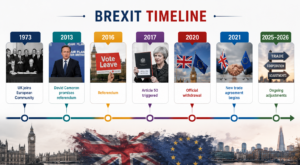
Sometimes, the easiest way to understand Brexit is to see how it unfolded. Here’s a quick timeline of the major events that shaped one of the biggest political and economic changes in modern British history.
1973 — The UK Joins the European Community
Britain officially joins the European Economic Community (EEC), gaining access to a larger single market and closer economic cooperation with European countries.
2013 — David Cameron Promises a Referendum
Prime Minister David Cameron pledges to hold a public vote on the UK’s EU membership if his party wins the next general election, hoping to settle the growing debate over Europe.
2016 — The Brexit Referendum
On 23 June 2016, the British public votes 51.9% to 48.1% in favor of leaving the European Union, triggering years of political and economic uncertainty.
2017 — Article 50 Is Triggered
The UK formally notifies the EU of its intention to leave by triggering Article 50, beginning a two-year negotiation process.
2020 — The UK Officially Leaves the EU
On 31 January 2020, the UK officially exits the European Union after 47 years of membership, entering a transition period while new rules are negotiated.
2021 — The New UK-EU Trade Agreement Begins
The Trade and Cooperation Agreement comes into effect, introducing new customs procedures, trade rules, and regulations governing the UK’s relationship with the EU.
2025–2026 — Ongoing Adjustments
Brexit continues to shape the UK’s economy, trade, politics, and investment landscape. Governments are still refining policies, businesses are adapting to new trading conditions, and debates over Brexit’s long-term impact remain ongoing.
Why Did Brexit Become Such a Political Problem?
Brexit wasn’t just a vote,it became a political challenge that lasted for years. It reshaped the economy, divided politicians, and played a major role in the UK welcoming 7 Prime Ministers in 10 Years. But how did one referendum lead to so much political instability? Let’s break it down.
Parliament Deadlock
After the referendum, Parliament struggled to agree on how Brexit should happen. Different proposals were repeatedly rejected, delaying the UK’s departure and creating political uncertainty.
Different Brexit Visions
Even politicians who supported Brexit couldn’t agree on what it should look like. Some wanted close ties with the EU, while others pushed for a complete break.
The Northern Ireland Issue
One of the toughest challenges was avoiding a hard border between Northern Ireland and the Republic of Ireland while also protecting the UK’s internal market. Negotiating a solution took years.
Economic Slowdown
Brexit created uncertainty for businesses and investors. Trade became more complicated, investment slowed, and economic growth weakened compared with previous years.
Rising Inflation
Higher import costs, supply chain disruptions, and global events pushed prices higher, increasing pressure on households and the government.
Falling Public Approval
As economic challenges grew, many voters became frustrated with how Brexit was being managed, leading to declining approval ratings for successive governments.
Leadership Challenges
Prime ministers faced constant pressure from opposition parties, their own MPs, and the public. Internal party divisions and political disagreements ultimately contributed to the UK having seven prime ministers in just ten years.
7 Prime Ministers in 10 Years
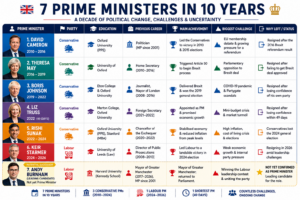
Meet the Leaders Who Shaped Britain’s Brexit Era
The table above highlights one of the most turbulent decades in modern British politics. Since the Brexit referendum in 2016, the UK has seen 7 Prime Ministers in 10 Years, an unusually high turnover for one of the world’s largest economies.
While each leader came to power under different circumstances, they all faced one common challenge: navigating the political and economic consequences of Brexit.
Here’s a quick look at each prime minister and the legacy they left behind.
David Cameron (2010–2016)
David Cameron is remembered for calling the Brexit referendum, believing the public would vote to remain in the European Union. Instead, the Leave campaign won, and he resigned the following day, taking responsibility for the outcome.
Theresa May (2016–2019)
Theresa May inherited one of the toughest jobs in British politics. She spent years trying to negotiate a Brexit deal, but repeated defeats in Parliament ultimately forced her to step down.
Boris Johnson (2019–2022)
Boris Johnson secured a large election victory with his promise to “Get Brexit Done.” He completed the UK’s withdrawal from the EU but later resigned following a series of political scandals and the loss of support within his own party.
Liz Truss (2022)
Liz Truss became the shortest-serving prime minister in British history. Her economic plan, known as the “mini-budget,” triggered market turmoil, sending government bond yields higher and the British pound lower before she resigned after just 49 days.
Rishi Sunak (2022–2024)
Rishi Sunak focused on stabilizing the economy after months of financial uncertainty. Although inflation eased during his time in office, the Conservative Party suffered a heavy defeat in the 2024 general election, bringing his premiership to an end.
Keir Starmer (2024–2026)
Keir Starmer led Labour back into government after 14 years in opposition. However, economic pressures, internal party disagreements, and declining public support eventually led him to announce his resignation.
Andy Burnham (Leading Candidate)
Andy Burnham is not yet Prime Minister. Following Starmer’s resignation, he has emerged as one of the leading candidates to become the next Labour leader and potentially the UK’s next prime minister. If elected, he will inherit many of the same economic and political challenges that have defined Britain’s post-Brexit era.
Why Do UK Prime Ministers Keep Resigning?
If you’ve made it this far, you might be wondering: Did Brexit actually force all these prime ministers to resign?
The reality is more complex. Brexit didn’t directly remove leaders—but it created prolonged political instability, economic pressure, and party divisions that contributed to “7 Prime Ministers in 10 Years”, making UK leadership far more volatile than usual.
The short answer is no.
Brexit didn’t directly remove leaders from office, but it created years of political and economic pressure that made staying in power increasingly difficult. Here’s why.
Internal Party Rebellions
British prime ministers rely on the support of their own party. As disagreements over Brexit and government policies grew, many leaders faced rebellions from their own MPs, making it difficult to govern.
Weak Public Support
As economic and political challenges continued, public confidence in successive governments declined. Falling approval ratings increased pressure on prime ministers to step aside.
Economic Pressures
Brexit introduced new trade rules and years of uncertainty for businesses and investors. Combined with global economic challenges, this put governments under constant pressure to deliver stronger growth.
Cost of Living Crisis
Rising food, housing, and energy costs placed millions of households under financial strain. As living costs increased, voters demanded solutions, putting even more pressure on political leaders.
Inflation
The UK experienced one of the highest inflation rates among G7 countries during parts of the post-Brexit period. Higher prices reduced purchasing power and became a major political issue.
Energy Crisis
The global energy shock following Russia’s invasion of Ukraine drove electricity and gas prices sharply higher, increasing inflation and forcing the government to introduce costly support measures.
Market Confidence
Financial markets closely watch political stability. During periods of uncertainty—such as the 2022 mini-budget crisis—the British pound weakened, government borrowing costs rose, and investor confidence fell.
Leadership Votes
Unlike many countries, UK prime ministers can be challenged by members of their own political party. Once enough MPs lose confidence in a leader, leadership contests often become unavoidable, leading many prime ministers to resign before or after a formal vote.
Looking back, Brexit wasn’t the only reason Britain had seven prime ministers in ten years. But it created an environment of continuous political pressure, where every economic challenge, policy disagreement, or drop in public support made leadership changes far more likely.
The Economic Impact of Brexit
| Area | Before Brexit | After Brexit |
|---|---|---|
| Trade | Free movement of goods within the EU with minimal customs procedures. | New customs checks, additional paperwork, export delays, and higher import costs for many businesses. |
| Investment | The UK was one of Europe’s top destinations for foreign direct investment, benefiting from seamless access to the EU market. | Investment growth slowed as some companies relocated operations to EU countries, although London remains a major global financial hub. |
| Financial Services | UK-based financial firms enjoyed “passporting” rights, allowing them to operate freely across the EU. | Many firms lost passporting rights and shifted parts of their operations to cities such as Dublin, Paris, Amsterdam, and Frankfurt. |
| Labour Market | Employers had easy access to workers from across the EU, helping fill labour shortages in many industries. | New immigration rules contributed to worker shortages in sectors such as healthcare, hospitality, agriculture, and logistics. |
| Inflation | Inflation was generally low and stable before the referendum. | Higher import costs, supply chain disruptions, and later the global energy crisis pushed inflation sharply higher. |
| Supply Chains | Goods moved quickly between the UK and EU with fewer delays. | Border checks and customs procedures increased delivery times and supply chain costs. |
| Energy | Energy markets were relatively stable before the global energy shock. | The Russia-Ukraine war, combined with existing economic pressures, drove energy prices significantly higher. |
| GDP Growth | The UK experienced steady economic growth supported by strong trade and investment. | Growth slowed due to Brexit uncertainty, weaker business investment, and global economic challenges. |
| British Pound (GBP) | Before the 2016 referendum, GBP/USD traded around 1.50. | The pound fell sharply after the referendum to around 1.32 within days, later dropped near 1.20 during periods of uncertainty, and has since partially recovered but remains more volatile than before Brexit. |
How Prime Minister Resignations Affect Financial Markets
Political uncertainty often leads to short-term market volatility. When a UK prime minister resigns, investors quickly reassess the country’s economic outlook and government policies.
| Market | Typical Impact | Example |
|---|---|---|
| GBP | Higher volatility and potential weakness. | The pound fell sharply after the 2016 Brexit vote and again during the 2022 mini-budget crisis. |
| FTSE 100 | Often remains resilient due to its global companies. | Recovered quickly after the Brexit referendum. |
| FTSE 250 | More affected because it reflects the UK economy. | Fell more than the FTSE 100 after Brexit. |
| Gilts | Bond yields may rise if investors demand higher returns. | Yields surged during the 2022 mini-budget crisis. |
| Investor Confidence | Businesses may delay investment until uncertainty fades. | Investment slowed during Brexit negotiations. |
| Bank of England | Markets reprice expectations for future interest rates. | Leadership changes often influence rate expectations. |
| International Investment | Foreign investors become more cautious during political uncertainty. | Some firms moved operations to EU financial hubs after Brexit. |
UK Imports and Exports
| Category | Top UK Imports | Why They’re Important |
|---|---|---|
| 🏭 Machinery | Industrial machinery, mechanical equipment, manufacturing tools | Supports manufacturing, construction, and industrial production. |
| 🚗 Cars | Passenger vehicles and automotive parts | Meets domestic demand and supports the UK’s automotive industry. |
| 💊 Pharmaceuticals | Medicines, vaccines, and medical products | Essential for healthcare and one of the UK’s largest import categories. |
| 💻 Electronics | Computers, smartphones, semiconductors, and consumer electronics | Powers businesses, technology, and everyday consumer needs. |
| 🛢️ Oil & Petroleum | Crude oil and refined petroleum products | Supports transportation, manufacturing, and energy production. |
| 🍎 Food & Agricultural Products | Fruits, vegetables, meat, dairy, and beverages | The UK imports a significant share of its food due to limited domestic production. |
| 🧪 Chemicals | Industrial chemicals, plastics, fertilizers, and specialty chemicals | Used across manufacturing, healthcare, and agriculture. |
How Brexit Changed Trading
Brexit didn’t just reshape politics—it also changed how traders approach UK markets. Political headlines became major market movers, creating both risks and opportunities.
| Market | How Brexit Changed Trading |
|---|---|
| GBP Volatility | The British pound became more volatile, with political and economic news causing sharp price swings. |
| FTSE Opportunities | Traders began closely watching the FTSE 100 and FTSE 250, as each index reacted differently to Brexit developments. |
| UK Bank Stocks | Banking stocks faced pressure from regulatory changes, interest-rate expectations, and uncertainty over London’s financial role. |
| Export Companies | A weaker pound often benefited exporters by making UK goods more competitive overseas. |
| Bond Markets | UK government bonds (Gilts) became more sensitive to fiscal policy and political uncertainty. |
| Interest-Rate Trading | Bank of England decisions gained greater importance as traders reacted to inflation and economic growth. |
| Political Risk Trading | Elections, leadership contests, and Brexit negotiations became key events capable of moving currencies, stocks, and bonds. |
Frequently Asked Questions
1. Is Brexit finished?
No, its effects are still ongoing in trade, economy, and regulations.
2. Can the UK rejoin the EU?
Yes, but it would require political agreement from both sides and could take years.
3. Why did the pound fall after Brexit?
Because investors expected lower trade, slower growth, and higher uncertainty.
4. Has Brexit been good for the UK economy?
Overall impact is debated, but short-term effects included lower growth and investment.
5. Who benefited from Brexit?
Some UK exporters outside the EU and certain financial traders benefited from volatility.
6. How does Brexit affect the FTSE 100?
It increases volatility but many large FTSE companies earn globally, limiting impact.
7. Why do UK prime ministers resign often?
Mainly due to political pressure, party conflicts, or poor economic performance.
8. Does a new prime minister affect stocks?
Yes, markets react quickly due to expectations about policies and stability.
9. Why do markets react to political news?
Because politics affects taxes, trade, inflation, and investor confidence.
10. Is UK political risk already priced into markets?
Partially, but sudden events still cause sharp short-term moves.
Wrap-Up
Brexit was never just a political decision. It turned into one of the most significant economic events of the 21st century, reshaping trade flows, investment decisions, currency movements, and political leadership in one of the world’s largest economies.
For traders and investors, this is the key lesson: markets don’t move in isolation. Political shifts can be just as powerful as central bank decisions or corporate earnings when it comes to driving volatility and opportunity.
Understanding these connections is not optional—it’s essential for making informed trading decisions in a global market.
Political events create opportunities—but only for traders who stay informed.
Whether you’re trading the British pound (GBP), FTSE stocks, or global indices, understanding how politics impacts the markets can help you make more informed trading decisions.
Open a risk-free Caveo Demo Account to practice trading major currencies and global stocks, or start trading live when you’re ready to put your strategy into action.