Table of Contents
What Are Options? The Beginner’s Guide to Trading Options the Smart Way
As we explore the wide range of instruments available in global markets, one instrument stands out for its unique appeal among risk-tolerant traders: options.
Options have long been a favorite for those who thrive on strategy and volatility, offering a dynamic way to participate in market movements without the obligation to fully commit capital upfront.
Options are derivative instruments, meaning they derive their value from an underlying asset—commonly stocks, indices, or exchange-traded funds (ETFs). What makes them distinct is that they provide the right, but not the obligation, to buy or sell the underlying asset at a specified strike price before or at a set expiration date.
This flexibility allows investors to speculate on price movements or hedge against risk, often with significantly lower capital requirements than directly buying the asset. Unlike futures contracts, which impose an obligation to buy or sell, options offer more control and strategic variety.

Today, options are widely accessible through retail brokers and trading platforms, where traders can choose from a broad range of contracts, each with defined terms and expiration dates. Whether used to manage risk or amplify returns, options remain a powerful tool in a well-rounded trading strategy.
Understanding Options
- Options are versatile financial products.
- These contracts involve a buyer and seller, where the buyer pays a premium for the rights granted by the contract.
- Call options allow the holder to buy the asset at a stated price within a specific time frame.
- Options, on the other hand, allow the holder to sell the asset at a stated price within a specific time frame.
- Each call option has a bullish buyer and a bearish seller while put options have a bearish buyer and a bullish seller.
The history of options trading

-
Ancient Roots
~332 BCE – Ancient Greece
The first recorded use of options-like contracts is credited to the Greek philosopher Thales of Miletus, who used olive harvest options to secure access to olive presses before the season — essentially a call option.
-
17th Century – Dutch Golden Age
1636 – Netherlands (Tulip Mania)
During the tulip bulb craze, traders created call and put options to speculate on tulip prices. This is one of the earliest known examples of modern-style options speculation.
-
18th Century – London
1700s – London
“Refusals” and “Options” became common among traders on the London Stock Exchange, but there was little regulation.
-
19th Century – United States
1872 – Chicago, USA
Russell Sage, a financier, begins issuing standardized options contracts over the counter (OTC) — still unregulated and lacking liquidity.
-
20th Century – Modernization
1973 – CBOE Launch
- The Chicago Board Options Exchange (CBOE) opens on April 26, 1973, becoming the first organized options exchange.
- 11 call options on common stocks are listed.
- The Black-Scholes model (1973) is published, revolutionizing how options are priced.
-
1975 – OCC Established
The Options Clearing Corporation (OCC) is created to guarantee options trades, reducing counterparty risk.
-
2000s – Electronic Trading
Online brokerages and electronic trading platforms bring options trading to retail traders.
Growth in index options, ETFs, and exotic options.
-
Today
Options trading is available to individuals globally via apps and platforms.
Markets offer a wide variety of products: stock options, index options, crypto options, and weekly or daily expirations.
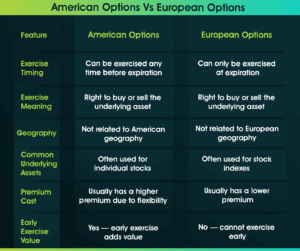
American Options Vs European Options
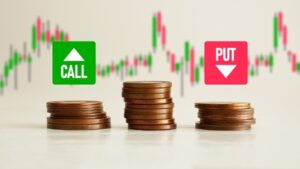
Calls and Puts
Call Options
A call option gives the buyer the right (but not the obligation) to buy the underlying asset at a specific strike price within a specific time period.
- Traders buy calls when they expect the price of the underlying asset to rise.
- If the price goes above the strike price before expiration, the buyer can profit by exercising the option or selling the option contract for a gain.
- The maximum loss for the buyer is the premium (price paid for the option).
Example Use: A trader might buy a call option on gold if they believe gold prices will rise soon. If gold increases above the strike price, the trader can benefit.
Put Options
A put option gives the buyer the right (but not the obligation) to sell the underlying asset at a specific strike price within a specific time period.
- Traders buy puts when they expect the price of the underlying asset to fall.
- If the price drops below the strike price, the buyer can profit by exercising the option (selling at the higher strike price) or selling the contract.
- As with calls, the maximum loss is the premium paid.
Example: A trader may buy a put option on oil if they expect oil prices to drop. If oil falls below the strike price, the option gains value.
| Call Option | Put Option | |
| Buyer’s Right | Buy the underlying at the strike price | Sell the underlying at the strike price |
| Market Outlook | Bullish (expecting price to rise) | Bearish (expecting price to fall) |
| Profit When | Underlying price rises above strike price | Underlying price falls below strike price |
| Maximum Loss | Premium paid | Premium paid |
| Maximum Profit | Unlimited (theoretically) | Limited (as price can’t fall below zero) |
Key Considerations for Trading Options
- Each options contract usually represents 100 shares of the underlying asset.
- The buyer pays a premium fee for each contract.
- For example, if an option has a premium of 35 cents per contract, buying one option costs $35 ($0.35 x 100 = $35).
- The premium is partially based on the strike price or the price for buying or selling the security until the expiration date.
- Another factor in the premium price is the expiration date.
- Just like with that carton of milk in the refrigerator, the expiration date indicates the day the option contract must be used. The underlying asset will influence the use-by date and some options will expire daily, weekly, monthly, and even quarterly. For monthly contracts, it is usually the third Friday.
Understanding the Greeks
Key Metrics for Options Risk Management

In options trading, the Greeks are essential tools that measure how different factors influence an option’s price. Mastering them helps traders manage risk and build more effective strategies.
Delta (Δ) – Price Sensitivity
Delta measures how much an option’s price changes relative to a $1 move in the underlying asset.
- Call options have positive delta (0 to 1), and put options have negative delta (0 to -1).
- Example: A call with delta = 0.50 gains $0.50 if the underlying rises by $1.
- Delta also reflects the probability of expiring in the money and helps calculate hedge ratios.
Theta (Θ) – Time Decay
Theta shows how much an option loses in value each day, all else equal.
- It’s typically negative for buyers and positive for sellers.
- Time decay accelerates as expiration approaches, especially for at-the-money options.
Gamma (Γ) – Delta Sensitivity
Gamma measures how much delta changes as the underlying asset moves.
- Higher gamma means delta changes more rapidly.
- It peaks for at-the-money options near expiration.
- Helps traders adjust delta-neutral strategies more accurately.
Vega (V) – Volatility Impact
Vega gauges how an option’s value changes with a 1% shift in implied volatility.
- Higher Vega means greater sensitivity to volatility.
- Options with longer expirations and at-the-money strikes have higher Vega.
Rho (ρ) – Interest Rate Sensitivity
Rho measures how an option’s price responds to a 1% change in interest rates.
- More relevant for long-dated options.
- Call options have positive rho; put options have negative rho.
Minor Greeks
Less commonly used Greeks like Vomma, Charm, Zomma, and Ultima measure complex risks (like how Vega changes or how Delta reacts to volatility). These are mostly used in institutional strategies or algorithmic trading.
Why It Matters
Understanding the Greeks helps options traders:
- Anticipate how market changes affect positions
- Design strategies with better risk-reward profiles
- Protect against unwanted price, time, or volatility movements
Advantages and Disadvantages of options trading
Advantages
- Low capital required to control large positions (leverage)
- Profit in rising (calls) or falling (puts) markets
- Useful for hedging existing investments
- Generate income through option premiums (selling)
- Flexible strategies for different market views
Disadvantages
- Sellers face potentially unlimited losses
- Options lose value over time (time decay)
- Complex strategies and steep learning curve
- Buyers risk losing the full premium paid
- Some options lack liquidity, affecting trade execution
Why Smart Traders Use Options?

ً
-
Leverage with Lower Capital
Control larger positions with less money compared to buying the asset outright. -
Cost-Efficient Speculation
Profit from price movements—up, down, or sideways—while risking only the option premium. -
Hedging and Risk Protection
Use options as a financial safety net (like protective puts) to limit potential losses on existing investments. -
Income Generation
Collect premiums by writing options (e.g., covered calls) to earn steady income from stocks you already hold. -
Exposure to Alternative Assets
Gain access to markets like oil or commodities through options, often more directly than owning the asset itself. -
Market Insight Through Metrics
Key indicators like open interest and trading volume help identify liquidity and potential trade opportunities.
How to Start Options Trading – Step-by-Step

- Understand the Basics
Learn what options are, the difference between calls and puts, and key terms like strike price, expiration, and premium.
- Know the Risks
Options offer high reward potential but also come with significant risk, especially for sellers. Learn proper risk management.
- Study Common Strategies
Start with basic strategies like Long Call, Long Put, Covered Call, and Protective Put before moving to advanced ones.
- Practice with a Demo Account
Use a paper trading account to place simulated trades, analyze outcomes, and gain experience without financial risk.
- Analyze the Underlying Assets
Use technical and fundamental analysis to assess the stocks or ETFs you plan to trade options on.
- Learn to Read the Option Chain
Understand how to navigate the option chain to compare strike prices, expirations, premiums, and liquidity.
- Understand the Greeks
Learn how Delta, Theta, Vega, and Gamma affect option pricing and risk.
- Start Small
Begin with one contract on liquid, familiar assets. Avoid short-dated expirations and limit risk per trade.
- Plan Every Trade
Define your entry, target, stop-loss, and time horizon before placing a trade.
- Review and Improve
Track your performance, analyze your trades, and adjust your strategy as you gain experience.
Wrap-Up
Options trading offers a powerful way to diversify your portfolio and take advantage of various market scenarios. However, it’s essential to approach it with the right knowledge and strategy, especially given the unique risk dynamics involved — including tools like the Greeks that help manage those risks effectively.
This is just the start of our mission to make the financial world simpler and more accessible. Stay tuned for more educational blog posts coming your way.