Table of Contents
How Much Should Beginners Risk Per Trade?
How much should beginners risk per trade? Good question. Though, to answer that, we first need a little perspective about risk and risk management.
Who are we without taking risks?
Risk is what gets us out of our comfort zone. It’s what pushes us beyond what’s normal, beyond what’s easy. At the end of that road, we’re usually rewarded in one way or another, either with experience or with real success.
I’ve learned that taking risks is an important part of life. But I’ve also learned something even more important: anything taken to the extreme rarely ends well. The key is moderation.

The same applies to trading.…Financial markets reward those who know how to manage risk, not those who take the biggest risks. This is especially true in the Forex market, where prices can move rapidly and money can disappear in seconds if you don’t have a proper risk management plan.
That’s why one of the most common questions every beginner asks is:

In this guide, we’ll answer that question in the simplest way possible. We’ll cover what risk really means in trading, why risk management matters, how to know if you’re still a beginner, why every new trader should start with a demo account, and finally, how much you should actually risk on each trade.
Let’s dive in.
What Is Risk in Trading?
Before we answer how much should beginners risk per trade, let’s first understand what risk actually means. When most people hear the word risk, they immediately think about losing money.
They’re not wrong, but that’s only part of the story.
In trading, risk is the possibility that a trade won’t go your way and you’ll lose some or all of the money you decided to put at risk. Every time you open a position, there’s no guarantee you’ll make a profit. The market can move exactly as you expected… or it can do the complete opposite.
That’s what makes trading exciting, but also dangerous.
Think of risk as the price you pay for the opportunity to make a profit. Without risk, there would be no reward. But taking unnecessary risk isn’t bravery, it’s gambling.
Professional traders understand this better than anyone else.

They know they can’t control the market. They don’t know which trade will be a winner or a loser. What they can control is how much they’re willing to lose if the trade doesn’t work out. And that’s the biggest difference between beginners and experienced traders.
Beginners often focus on “How much can I make?”
Professionals ask a different question:
“How much am I willing to lose if I’m wrong?”
That simple shift in mindset is what separates gambling from professional trading.
Now that you understand what risk is, let’s talk about something even more important which is risk management in trading.
What Is Risk Management in Trading?
If risk is the possibility of losing money, then risk management is your plan for controlling those losses.
In simple terms, risk management is the process of deciding how much you’re willing to lose before you even enter a trade. It includes setting a stop-loss, choosing the right position size, and making sure one bad trade doesn’t wipe out your account. Think about it this way.
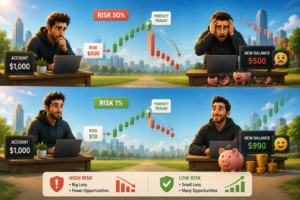
Imagine you have $1,000 in your trading account.
You find what looks like the perfect trade and decide to risk 50% of your account. If the trade goes against you, you’ve just lost $500 on a single idea.
Now imagine risking only 1%, or $10.
If the trade loses, it won’t feel great—but you’ll still have 99% of your account and plenty of opportunities to recover.
That’s exactly how professional traders think.
They know losses are part of the game. No strategy wins 100% of the time. Instead of trying to avoid losing trades altogether, they focus on keeping their losses small enough that they can stay in the game.
I’ve seen many beginners spend weeks searching for the “perfect strategy,” believing it will solve everything. The truth is, even the best trading strategy in the world can fail if you don’t manage your risk.
In fact, many experienced traders would rather trade an average strategy with excellent risk management than an excellent strategy with poor risk management.
At the end of the day, it’s not about how much you make on one trade—it’s about protecting your trading account so you can keep trading tomorrow….That’s why risk management isn’t just another trading skill. It’s the foundation that every successful trader builds on.
Now that you understand what risk management is, the next question is just as important: How do you know if you’re still a beginner trader? or you are good to go and you can be on your own in this big pool of money and risks.
How Do You Know If You’re a Beginner Trader?
You might be wondering, “Am I still considered a beginner trader?” The answer isn’t based on how long you’ve been trading.
You could spend two years opening random trades and still be a beginner. On the other hand, someone who has spent six months learning, practicing, and following a trading plan may already have a much stronger foundation.
Being a beginner isn’t about time—it’s about experience and consistency.
You’re probably still a beginner if:
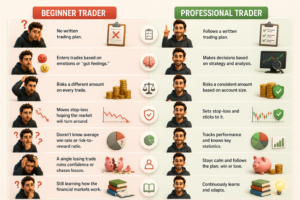
- You don’t have a written trading plan.
- You enter trades based on emotions or “gut feelings.”
- You risk a different amount on every trade.
- You move your stop-loss because you hope the market will turn around.
- You don’t know your average win rate or risk-to-reward ratio.
- A single losing trade ruins your confidence or makes you want to win the money back immediately.
- You’re still learning how the financial markets work.
And that’s completely normal.
Every professional trader was once a beginner.
The difference is that successful traders accepted they were still learning. They didn’t rush to double their accounts overnight. Instead, they focused on building good habits, managing risk, and improving one trade at a time.
One of the biggest mistakes beginners make is trying to trade like professionals before they’re ready. They increase their position sizes, overtrade, and chase quick profits, only to discover that the market can be a very expensive teacher.
This table shows the difference between a professional and a beginner; check it and see where you stand.
If you’re still learning, that’s okay…In fact, it’s much better to admit you’re a beginner than to act like an expert before you’ve built the experience to back it up. That’s exactly why every new trader should spend time practicing before risking real money.
Let’s talk about one of the best tools for doing thata demo account and that’s we always tell you to start with
Why Is a Demo Account So Important for Beginners?
If there’s one piece of advice I could give every beginner trader, it would be this: Start with a demo account. I know what some people are thinking.
“But I won’t make real money with a demo account.”
That’s true. But you also won’t lose real money while you’re still learning.
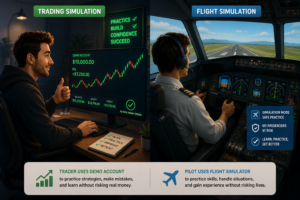
A demo account gives you the chance to trade using virtual money in real market conditions. The prices move exactly the same way they do in a live account, but every profit and every loss happens with virtual money.
Think of it as a flight simulator for pilots.
No one expects a pilot to fly a plane full of passengers on their first day. They spend hours practicing in a simulator until they’re ready for the real thing. Trading isn’t much different.
A demo account allows you to make mistakes, test different strategies, learn how to place trades, practice using stop-loss and take-profit orders, and understand how the market moves—all without risking your hard-earned money.
More importantly, it helps you build something every successful trader needs: confidence.
Not the confidence that comes from getting lucky on one trade, but the confidence that comes from following a trading plan over and over again.
Here’s what I believe.
If you can’t consistently manage risk and follow your strategy on a demo account, there’s no reason to expect you’ll suddenly do it with real money. In fact, trading with real money often adds emotions like fear and greed, making it even harder.
So take your time.
Practice until following your trading plan becomes a habit, not something you have to think about.
Once you can trade consistently on a demo account, you’ll be much better prepared for the psychological challenges of live trading.
Now that you understand the importance of practicing first, it’s time to answer the question you’ve been waiting for:
How much should beginners risk per trade?
How Much Should Beginners Risk Per Trade?
I know this is the question you’ve been waiting to hear, but you know me—I had to explain everything first before answering it. So let’s finally answer the question: How much should beginners risk per trade?
If you ask ten professional traders, you may get slightly different answers. But there’s one rule that almost everyone agrees on:
Beginners should risk no more than 1% of their trading account on a single trade.
Some traders are comfortable risking 2%, but if you’re just starting your trading journey, 1% is the safest place to begin.
Let’s see what that looks like.
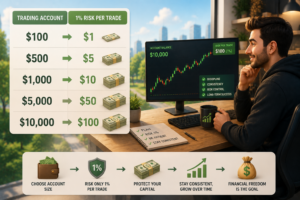
At first, these numbers might look small. You may even think, “How am I supposed to make money risking only $10?”
That’s exactly how most beginners think….The problem is that beginners often focus on how much they can make, while experienced traders focus on how much they can afford to lose.
The goal during your first months of trading isn’t to get rich. It’s to stay in the game long enough to become consistently profitable.
Think about it this way.
If you risk 10% of your account on every trade, it only takes a few losing trades to seriously damage your account. Recovering from those losses becomes much harder because you’ll need much larger percentage gains just to get back where you started.
Now compare that with risking only 1%.
Even if you experience a losing streak—which every trader eventually does—you’ll still have most of your trading capital. You’ll have time to learn from your mistakes, improve your strategy, and continue trading without feeling pressured to “win it all back.”
This is one of the biggest secrets professional traders understand:
Protect your capital first. Profits come later.
Your trading account is your business. Just like any successful business protects its capital before chasing growth, successful traders protect their accounts before thinking about making bigger profits.
What Does Risk Per Trade Mean?
Risk per trade is the maximum amount of money you’re willing to lose on a single trade. It’s calculated before you enter the market and is usually expressed as a percentage of your trading account, such as 1% or 2%.
Why Do Professional Traders Risk So Little?
At first, risking just 1% per trade might sound too conservative. You may even think, “Won’t it take forever to grow my account?”
That’s a fair question.
The truth is, professional traders don’t focus on getting rich from one trade. They focus on staying profitable over hundreds of trades.
Remember this:
No trading strategy wins 100% of the time.
Even the best traders experience losing streaks. The difference is that they expect them and keep their losses small.
Imagine two beginner traders:
- Trader A risks 10% per trade.
- Trader B risks 1% per trade.
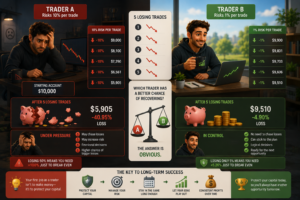
After five losing trades, Trader A has lost about 50% of their account, while Trader B is only down about 5%.
Who has the better chance of recovering?
Exactly.
That’s why experienced traders always say:
Protect your capital first. Profits come later.
Common Risk Management Mistakes Beginners Make
Even with a good strategy, poor risk management and risking too much per trade can quickly drain your trading account. Here are some of the most common mistakes beginners make when deciding how much to risk per trade.
-
Risking Too Much on One Trade
Never assume a trade is guaranteed to win. Risking too much on a single position can seriously damage your account if the market moves against you.
-
Trading Without a Stop-Loss
A stop-loss protects your account by limiting your losses. Trading without one leaves your capital exposed to unexpected market moves.
-
Moving Your Stop-Loss
Changing your stop-loss because you hope the market will reverse usually turns a small, planned loss into a much bigger one.
-
Revenge Trading
Trying to recover losses by opening random trades or increasing your position size often leads to even bigger losses.
-
Risking Money You Can’t Afford to Lose
Only trade with money you’re comfortable losing. Trading with essential savings creates emotional pressure and leads to poor decisions.
-
Ignoring Your Trading Plan
A trading plan only works if you follow it. Successful traders stay disciplined instead of making emotional decisions.
Difference Between Risk and Position Size
One of the biggest mistakes beginners make is confusing risk with position size. While they’re closely related, they are not the same thing.
Risk is the maximum amount of money you’re willing to lose if your trade hits the stop-loss.
Position size is the number of shares, lots, or contracts you buy based on that risk.
For example, imagine you have a $5,000 trading account and decide to risk 1% per trade.
- Your maximum risk is $50.
- If your stop-loss is 50 pips away, you’ll trade a smaller position.
- If your stop-loss is only 25 pips away, you can trade a larger position while still risking the same $50.
The size of your trade changes, but your risk stays exactly the same.
| Risk | Position Size |
|---|---|
| Maximum amount you can lose | Number of shares, lots, or contracts you trade |
| Usually 0.5%–2% of your account | Calculated from your stop-loss distance |
| Should remain consistent | Changes from trade to trade |
Risk Management Checklist Before Every Trade
Before deciding how much should beginners risk per trade, ask yourself these simple questions before clicking the Buy or Sell button:
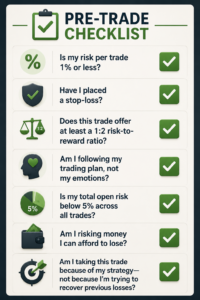
If you can’t answer “Yes” to every question, it’s usually better to skip the trade. Remember, protecting your capital is always more important than forcing another opportunity.
Why Small Losses Make You a Better Trader
Small losses may not feel exciting, but they help you become a better trader because they:
-
Protect your trading capital.
-
Reduce emotional decision-making.
-
Help you stay disciplined during losing streaks.
-
Allow you to keep trading and learning.
-
Give your strategy enough time to prove itself.
How to Calculate Your Risk Per Trade
Knowing that you should risk 1% per trade is only half the job. You also need to know how to calculate your risk per trade correctly. Fortunately, it’s much easier than most beginners think. Simply multiply your account balance by the percentage you’re willing to risk.
Examples:
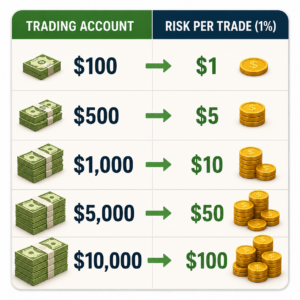
This amount is your maximum acceptable loss on a single trade. Once you know how much you’re willing to risk, you can adjust your position size based on where your stop-loss is placed. That way, even if the trade doesn’t go your way, your loss stays within your risk limit.
FAQs about How Much Should Beginners Risk Per Trade?
Is the 1% Rule Good for Beginner Traders?
Yes. The 1% rule is one of the most widely recommended risk management guidelines for beginners because it helps protect your trading capital while you gain experience. Even after several losing trades, you’ll still have enough capital to continue learning and trading.
Can Beginner Traders Risk 2% Per Trade?
Some experienced traders choose to risk 2% per trade, but if you’re just starting out, 1% is generally the safer choice. It gives you more room to survive losing streaks, manage emotions, and build consistency before increasing your risk.
What Is the 2% Rule in Trading?
The 2% rule suggests risking no more than 2% of your trading account on a single trade.
While many experienced traders use this guideline, there is no universal percentage that works for everyone. Your ideal risk depends on your experience, trading strategy, account size, and risk tolerance.
For most beginners, risking around 1% per trade is considered the safer starting point.
Can You Risk Less Than 1% Per Trade?
Absolutely.
Many traders intentionally reduce their risk per trade to 0.25% or 0.5% when:
- Markets are highly volatile.
- Major economic news is approaching.
- They’re experiencing a losing streak.
- They’re testing a new strategy.
- They’re trading an unfamiliar market.
Reducing risk during uncertain conditions can help protect your capital while maintaining discipline.
How Often Should You Change Your Risk Per Trade?
You shouldn’t change your risk per trade simply because you’re feeling confident after winning or frustrated after losing.
Instead, consider adjusting your risk only when:
- Your trading plan changes.
- Your account size changes significantly.
- You’re testing a new strategy.
- Market volatility increases substantially.
Consistency is usually more important than constantly changing your risk percentage.
Is Risking 5% Per Trade Too Much?
For most traders, especially beginners, yes.
Risking 5% per trade can lead to very large drawdowns during normal losing streaks. Even a few consecutive losses can significantly damage your account and make recovery much more difficult.
Most professional traders prefer risking between 0.5% and 2% per trade.
Should Day Traders Risk Less Than Swing Traders?
Often, yes.
Because day traders typically place more trades, many choose to risk 0.25% to 1% per trade to control overall exposure.
Swing traders usually take fewer trades and may be comfortable risking 1% to 2%, depending on their strategy and experience.
How Many Trades Can I Open at the Same Time?
There’s no fixed number.
Instead of counting trades, focus on your total open risk.
Many traders limit their combined exposure to around 5% of their account, meaning several open positions shouldn’t exceed your overall risk limit.
Is the 1% Rule Mandatory?
No.
The 1% rule is a guideline—not a requirement.
Some professional traders risk more or less depending on their strategy, historical performance, and personal risk tolerance.
However, for beginners, it remains one of the safest and most widely recommended starting points.
Can I Risk More After a Winning Streak?
Generally, no.
Winning streaks often increase confidence, but they don’t increase your statistical edge.
Increasing your risk per trade after several wins can quickly erase your gains if the market turns against you.
Stick to your trading plan instead of adjusting risk based on emotions.
What Is the Safest Risk Per Trade for Beginners?
For most beginners, 0.5% to 1% per trade is considered the safest range.
This allows you to survive losing streaks, reduce emotional pressure, and gain valuable experience without putting your trading account at unnecessary risk.
Does the 1% Rule Guarantee You’ll Make Money?
No.
The 1% rule does not make you profitable.
It simply protects your trading account while you’re learning and helps prevent large losses.
To become consistently profitable, you still need:
- A proven trading strategy.
- Strong discipline.
- Patience.
- Good risk management.
- Consistent execution.
The 1% rule helps keep you in the game long enough to develop those skills.
Does Leverage Change How Much I Should Risk Per Trade?
No.
Leverage changes your position size, but it shouldn’t change your risk per trade.
Whether you use 2:1 or 100:1 leverage, your maximum planned loss should still remain within your chosen risk percentage, such as 1% of your account.
Always calculate your position size based on your stop-loss, not on the amount of leverage available.
Wrap-up
Now you know how much beginners should risk per trade and why proper risk management is one of the most important skills every trader can develop.
If there’s one lesson to take away from this guide, it’s this: your first goal isn’t to make money, it’s to protect your trading capital. The traders who survive are the ones who manage risk consistently, stay disciplined, and think long term instead of chasing quick profits.
Of course, risk management is a huge topic, and we’ve only scratched the surface here. There are many more concepts to explore, including position sizing, portfolio risk, drawdown management, leverage, trading psychology, and advanced money management techniques. We’ll be covering all of these in future educational articles, so keep an eye on our learning center for more in-depth guides.
In the meantime, don’t just read about risk management—practice it. Open a free demo account, apply the 1% rule, calculate your position sizes, place stop-loss orders, and build good habits without risking real money. The more you practice today, the more confident and prepared you’ll be when you eventually trade with real capital.
Remember: successful trading isn’t about avoiding losses—it’s about managing them wisely.