

Table of Contents
How to Create a Forex Trading Plan
(Step-by-Step Guide for Beginners)
Forex Trading Plan! Why Do we even need one? Who said success in trading happens without planning? Think about it—we plan almost everything important in our lives. Whether it’s starting a business, planning a trip, or preparing for an exam, having a plan gives us direction and increases our chances of success. Trading should be no different. When real money is on the line, making random decisions or relying on emotions can quickly lead to costly mistakes.
A well-structured trading plan helps you stay disciplined, manage risk effectively, and make decisions based on logic rather than fear or excitement. The good news is that creating one doesn’t have to be complicated. In this guide, you’ll learn what a Forex trading plan is, why every trader needs one, and how to create a trading plan that fits your goals, trading style, and risk tolerance—step by step.
Let’s dive in
How to Create a Forex Trading Plan That Actually Works
(Step-by-Step Guide)
What Is a Forex Trading Plan?
A forex trading plan is your personal rulebook for the financial markets…..Instead of deciding what to do in the heat of the moment, you make those decisions before the trade even begins.
Your trading plan answers questions like:

- What markets will I trade?
- When will I trade?
- Why will I enter a trade?
- Where will I exit?
- How much am I willing to risk?
- What will I do after a losing streak?
Every professional trader has answers to these questions before opening a position.
Without a plan, every trade becomes a guess.
With a plan, every trade becomes a calculated decision.
Trading Plan vs Trading Strategy
Many beginners use these terms interchangeably, but they are not the same thing.
Think of it this way:
Your strategy tells you how to find trading opportunities.
Your trading plan tells you how to manage your entire trading business.
| Trading Strategy | Trading Plan |
|---|---|
| Entry signals | Daily routine |
| Exit signals | Risk management |
| Technical indicators | Trading schedule |
| Chart patterns | Trading goals |
| Market setup | Psychology rules |
| One part of trading | The complete system |
Your strategy is simply one chapter inside your overall trading plan.
How to Create the Perfect Forex Trading Plan
(Step by Step)
Step 1
Define Your Trading Goals
Start by asking yourself why you’re trading.
Examples include:
- Building long-term wealth
- Creating additional income
- Learning professional trading skills
- Growing capital gradually
Your goals should be realistic and measurable.
Instead of saying:
“I want to get rich.”
Write:
“I aim to achieve consistent monthly growth while protecting my capital.”
Step 2
Choose Your Market
Decide what you’ll trade.
Examples include:
- Forex
- Stocks
- Commodities
- Indices
- Cryptocurrencies
Trying to trade everything usually leads to mastering nothing.
Step 3
Select Your Trading Style
Choose a style that matches your personality and available time.
| Style | Typical Holding Time |
|---|---|
| Scalping | Seconds to minutes |
| Day Trading | Minutes to hours |
| Swing Trading | Days |
| Position Trading | Weeks or months |
There is no “best” style.
The best style is the one you can consistently follow.
Step 4
Define Your Entry Rules
Every trade should have a clear reason.
For example:
- Trend confirmation
- Breakout above resistance
- Support and resistance rejection
- Moving average crossover
- RSI confirmation
Avoid entering trades simply because “the market looks ready.”
Step 5
Define Your Exit Rules
Know exactly when you’ll exit before entering.
Your plan should include:
- Stop-loss placement
- Take-profit target
- Risk-to-reward ratio
- Conditions for early exit
Good traders plan their exits before their entries.
Step 6
Build Your Risk Management Rules
Professional traders focus on protecting capital first.
Your plan should define:
- Maximum risk per trade
- Maximum daily loss
- Weekly loss limit
- Position sizing rules
- Maximum open trades
Risk management keeps you in the game long enough to benefit from your winning trades.
Step 7
Create a Trading Routine
Consistency beats intensity.
Your routine may include:
Before trading:
- Check economic news
- Review higher timeframes
- Identify key levels
- Plan scenarios
During trading:
- Follow your rules
- Avoid emotional decisions
- Record trades
After trading:
- Journal every trade
- Review mistakes
- Track performance
Step 8
Keep a Trading Journal
Your journal becomes your personal coach.
Record:
- Entry
- Exit
- Risk
- Profit/Loss
- Screenshot
- Emotional state
- Lessons learned
The more data you collect, the faster you improve.
10 Reasons Why You Need a Trading Plan
- Removes emotional decision-making.
- Creates consistency.
- Improves discipline.
- Protects your capital.
- Makes performance measurable.
- Reduces overtrading.
- Builds confidence.
- Helps identify mistakes.
- Makes continuous improvement possible.
- Treats trading like a business instead of gambling.
Common Mistakes Traders Make Without a Trading Plan
Many beginners skip the planning stage and end up repeating the same mistakes, such as:
- entering trades without a clear reason
- risking too much on a single position
- moving the stop-loss after entering a trade
- chasing missed opportunities
- revenge trading after a loss
- switching strategies every few days
- trading during major news events without preparation
A good trading plan helps eliminate many of these problems before they happen.
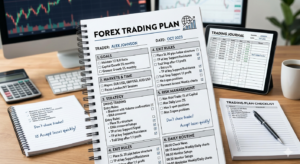
Forex Trading Plan Checklist
Before calling your trading plan complete, make sure you can answer “Yes” to every question.
Goals
☐ I have realistic trading goals.
☐ I know why I’m trading.
Markets
☐ I know exactly what I trade.
☐ I know when I trade.
Strategy
☐ My entry rules are clear.
☐ My exit rules are written.
☐ I know when I should stay out of the market.
Risk Management
☐ My maximum risk per trade is defined.
☐ I have daily and weekly loss limits.
☐ I know my position sizing rules.
Psychology
☐ I never revenge trade.
☐ I accept losing trades.
☐ I follow my written rules.
Performance
☐ I maintain a trading journal.
☐ I review my performance regularly.
How Technical and Fundamental Analysis Fit Into Your Forex Trading Plan
A successful trading plan isn’t just about deciding when to buy or sell. It also includes how you’ll analyze the market before making any decision…..Most traders rely on one, or a combination, of two main types of analysis: technical analysis and fundamental analysis.
Technical Analysis
Technical analysis focuses on price movements and charts. It helps traders identify trends, support and resistance levels, chart patterns, and potential entry and exit points.
If your strategy is technical, your trading plan should clearly define:
- The timeframes you’ll analyze
- The indicators or tools you’ll use
- Your exact entry and exit criteria
- The conditions that invalidate a trade
Consistency matters more than using dozens of indicators.
Fundamental Analysis
Fundamental analysis looks beyond the charts and focuses on the economic forces that drive market prices.
For Forex traders, this includes factors such as:
- Interest rate decisions
- Inflation reports
- Employment data
- GDP growth
- Central bank speeches
- Geopolitical events
Your trading plan should specify whether you’ll avoid trading during major economic announcements or incorporate them into your strategy.
Combining Both Approaches
Many experienced traders use technical analysis to find trade setups and fundamental analysis to understand the broader market context.
For example, a trader may identify a bullish chart pattern on EUR/USD while also considering an upcoming European Central Bank decision before entering the trade.
The key is to decide your approach in advance and apply it consistently.
Forex Trading Plans and Risk Management
Many traders spend months searching for the perfect strategy but only a few minutes thinking about risk management.
In reality, risk management is what allows a trading plan to survive over the long term.
No strategy wins every trade. Losses are part of trading. The difference between successful traders and unsuccessful ones is often how they manage those losses.
A strong trading plan should answer questions like:
- How much of my account will I risk on each trade?
- What’s the maximum loss I’m willing to accept in a day or a week?
- Will I move my stop-loss after entering a trade?
- How many trades can I have open at the same time?
- What will I do after three losing trades in a row?
These rules help remove emotion from decision-making and protect your capital during difficult periods.
Remember: your first goal isn’t to make money—it’s to stay in the market long enough to let your edge work over time.
Frequently Asked Questions (FAQs)
1. What is a trading plan?
A trading plan is a written set of rules that guides every aspect of your trading. It defines what you’ll trade, when you’ll enter and exit positions, how much you’ll risk, and how you’ll evaluate your performance. Instead of making emotional decisions, you follow a structured process designed to keep your trading consistent.
2. Is a trading plan the same as a trading strategy?
No. A trading strategy is only one part of a trading plan.
A strategy explains how you identify trading opportunities, while a trading plan covers everything else, including risk management, trading goals, daily routines, psychology, and performance reviews.
Think of your strategy as the engine and your trading plan as the entire vehicle.
3. Why do I need a trading plan?
Without a trading plan, it’s easy to make emotional decisions, overtrade, or take unnecessary risks.
A trading plan helps you stay disciplined, manage risk, and evaluate your results objectively. It also allows you to improve over time because every trade follows a consistent set of rules.
4. What should be included in a trading plan?
A complete trading plan should include:
- Your trading goals
- Markets you’ll trade
- Trading style
- Entry and exit rules
- Risk management rules
- Position sizing
- Daily trading routine
- Trading journal
- Rules for handling losing streaks
- Performance review schedule
5. Can beginners create a trading plan?
Absolutely.
In fact, beginners benefit the most from having a trading plan because it helps prevent common mistakes like revenge trading, chasing the market, and risking too much on a single trade.
Your first trading plan doesn’t have to be perfect—it just needs to be clear enough to follow consistently.
6. How often should I update my trading plan?
You shouldn’t change your trading plan after every losing trade.
Instead, review it periodically, such as monthly or quarterly, after you’ve collected enough trading data. Any adjustments should be based on consistent patterns and performance, not short-term emotions.
7. Should I write my trading plan down?
Yes.
Writing your trading plan makes it much easier to follow and hold yourself accountable. Many successful traders keep both a digital and printed version so they can review it before every trading session.
If it’s only in your head, it’s much easier to ignore when emotions take over.
8. Can I use someone else’s trading plan?
You can certainly learn from other traders’ plans, but you shouldn’t copy them exactly.
Your trading plan should reflect your own goals, experience level, available time, risk tolerance, and personality. A plan that works well for a professional day trader may not suit someone who can only trade a few hours each week.
9. Does every professional trader use a trading plan?
While every trader has their own approach, professional traders almost always follow a structured process with predefined rules for entries, exits, and risk management.
Consistency is one of the key characteristics that separates experienced traders from beginners.
10. What’s the biggest mistake people make when creating a trading plan?
One of the most common mistakes is making the plan too complicated.
Some traders include dozens of indicators and overly detailed rules that become difficult to follow in real market conditions.
A good trading plan should be simple, practical, and easy to execute consistently.
11. How long should a trading plan be?
There’s no perfect length.
Some traders use a one-page checklist, while others create detailed documents with multiple sections.
The important thing isn’t the number of pages—it’s whether the plan clearly answers every decision you’ll face before, during, and after a trade.
12. Should I test my trading plan before using real money?
Yes, and it’s one of the smartest things you can do.
Before risking real capital, test your trading plan on a demo account or through backtesting. This helps you identify weaknesses, refine your rules, and build confidence without exposing yourself to unnecessary financial risk.
Wrap-Up
Creating a Forex trading plan isn’t about predicting every market move or guaranteeing profits—it’s about giving yourself a clear roadmap before you place a trade. Markets are unpredictable, but your approach to them shouldn’t be.
A well-designed trading plan helps you stay disciplined, manage risk, and remove emotions from your decision-making. Over time, those habits can make a far greater difference than constantly searching for the next “perfect” trading strategy.
Remember, your first trading plan doesn’t have to be perfect. Start with simple rules, test them on a demo account, review your results regularly, and make improvements as you gain experience. The goal isn’t to win every trade—it’s to become a more consistent trader over time.
If you’re ready to put your trading plan into action, start by practicing on a risk-free demo account. It allows you to test your strategy, refine your rules, and build confidence in real market conditions before trading with real money.