

Table of Contents
What is Spread in Forex Trading?
A Complete Guide for Beginners
What is Spread in Forex? know we didn’t talk about spreads yet, and we know it’s really important to learn what spread is and how we use it in trading and why it is important. But better late than never.
Actually, we are not really late here. We just need to soak in all the information before we talk about such an important issue like the spread in forex.
The forex spread is one of the most important concepts in trading because it represents the primary cost of entering and exiting a trade. Every time you open a position in the forex market, you pay a small cost that is built directly into the price.
This cost is known as the spread, and it exists in every currency pair, regardless of broker or strategy.

Understanding how spreads work is essential for managing trading costs, improving profitability, and choosing the right trading conditions.
Let’s dive in.
What is Spread in Forex?
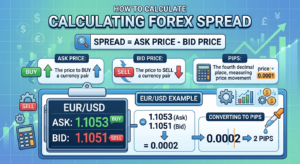
The forex spread is the difference between the bid price and the ask price of a currency pair.
- Bid price: the price at which you sell a currency
- Ask price: the price at which you buy a currency
Spread = Ask price − Bid price
This difference is the cost of executing a trade instantly in the market.
In most cases, this cost is small, but it plays a major role in short-term trading strategies.
Why the Spread in forex Exists?
The spread is not random. It exists for structural reasons in the market:
- It is how brokers generate revenue (especially “no commission” accounts)
- It compensates liquidity providers for offering prices
- It reflects supply and demand in real time
- It covers the cost of immediate execution
From a business perspective, the spread is the price you pay for accessing liquidity instantly.
Bid vs Ask Price Explained
Every currency pair is quoted with two prices:
- The bid represents the price buyers are willing to pay
- The ask represents the price sellers are willing to accept
Another way to understand it:
- The bid is where you can sell
- The ask is where you can buy
The difference between them is the spread.
This difference represents the broker’s cost of facilitating the trade.
How to Calculate Forex Spread
The spread is calculated by subtracting the bid price from the ask price.
Example:
EUR/USD:
- Ask: 1.1053
- Bid: 1.1051
Spread = 0.0002 = 2 pips
A pip is the standard unit used to measure price movement in forex, usually the fourth decimal place for most currency pairs.
Spread in Forex as a Trading Cost
The spread is considered the primary cost of forex trading because:
- It is charged on every trade automatically
- It affects both entry and exit prices
- It must be covered before a trade becomes profitable
In simple terms, every trade starts slightly negative by the value of the spread.
Spread in Forex and Lot Size Impact
One of the most important factors beginners overlook is how spread cost increases with trade size.
Example:
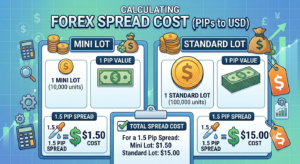
- 1 mini lot (10,000 units): 1 pip = $1
- Spread of 1.5 pips = $1.50 cost
- 1 standard lot (100,000 units): 1 pip = $10
- Spread of 1.5 pips = $15 cost
This shows that spread is not just a price difference, but a real monetary cost that scales with position size.
Spread in Forex Types
| Feature | Fixed Spread | Variable Spread |
|---|---|---|
| Definition | Remains constant regardless of market conditions | Changes based on market conditions |
| Cost behavior | Predictable trading cost | Fluctuates depending on liquidity and volatility |
| Market conditions | Stable even during volatility | Tight in calm markets, wider during volatility or news |
| Requotes | Can occur during fast markets | Rare or not used |
| Execution type | Often used in market maker models | Common in ECN/STP and modern brokers |
| Best suited for | Beginners, low-frequency traders | Active traders, scalpers during peak liquidity |
Variable spreads are directly influenced by market supply and demand.
Fixed vs Variable Spread: Which is Better?
There is no universal answer. It depends on trading style:
- Fixed spreads are better for beginners and low-frequency trading
- Variable spreads are better for active traders and scalpers during peak liquidity
Each model has advantages and limitations depending on market conditions.
What Affects Forex Spreads?
Several factors determine spread size:
Market Liquidity
High liquidity leads to tighter spreads, while low liquidity increases spreads.
Volatility
During fast-moving markets, spreads widen due to uncertainty.
Trading Sessions
- London and New York sessions: tighter spreads
- Off-market hours: wider spreads
Currency Pair Type
- Major pairs: low spreads
- Minor and exotic pairs: higher spreads
Economic News Events
Major announcements can significantly widen spreads due to sudden price movements.
Spread in Forex and News Events
During high-impact economic releases such as interest rate decisions or employment reports, spreads can widen sharply.
This happens because:
- Liquidity decreases temporarily
- Price movement becomes unpredictable
- Brokers increase spreads to manage risk
For traders, this means higher trading costs and increased execution risk.
Requotes and Slippage
These are important execution risks related to spreads.
Requotes (Fixed Spread Issue)
- Broker rejects your requested price
- You receive a new price, often worse
Slippage (Variable Spread Issue)
- Trade executes at a different price than expected
- Common during fast markets or news events
Both affect trading accuracy and execution quality.
Real Trading Example
If EUR/USD spread is 2 pips:
- Entry price: 1.1000
- Effective starting position: 1.1002
The market must move at least 2 pips in your favor before the trade breaks even.
This is especially important for scalping strategies with small profit targets.
Why Spread in forex Matters in Trading Strategy
The spread affects:
- Profit targets
- Entry timing
- Strategy selection
- Broker choice
- Overall profitability
Traders who ignore spread often overestimate their performance.
How Traders Minimize Spread Costs
Professional traders reduce spread impact by:
- Trading during high liquidity sessions
- Avoiding major news events when not needed
- Using major currency pairs
- Choosing brokers with competitive spreads
- Aligning strategy with trading conditions
Frequently Asked Questions
1. What is the spread in forex trading?
The spread in forex is the difference between the bid price and the ask price of a currency pair. It represents the main cost of opening a trade.
2. Why is the spread important in trading?
The spread is important because it is the cost every trader pays when entering a position. It directly affects profitability, especially for short-term traders.
3. How is the forex spread calculated?
The spread is calculated by subtracting the bid price from the ask price.
Spread = Ask − Bid
The result is usually measured in pips.
4. Is a lower spread better?
Yes. A lower spread means lower trading costs, which makes it easier for a trade to become profitable.
5. What is a high spread in forex?
A high spread means the difference between bid and ask prices is large. This usually happens during low liquidity or high volatility conditions.
6. What is a low spread in forex?
A low spread means the bid and ask prices are very close. This usually happens during high liquidity periods like the London and New York trading sessions.
7. Why do spreads change?
Spreads change due to market conditions such as liquidity, volatility, economic news, and trading session activity.
8. What is the difference between fixed and variable spreads?
Fixed spreads remain constant regardless of market conditions, while variable spreads change based on liquidity and volatility.
9. When are forex spreads the lowest?
Spreads are usually lowest during peak trading sessions, especially when London and New York markets overlap.
10. When are spreads the highest?
Spreads are usually highest during major economic news releases, market openings, or low liquidity periods such as weekends and holidays.
11. How does spread affect profit?
The spread is the first cost deducted from a trade. A trade must move beyond the spread before it becomes profitable.
12. Do all brokers have the same spreads?
No. Spreads vary depending on the broker, account type, liquidity providers, and market conditions.
13. What is the spread in pips?
The spread is measured in pips, which is the smallest price movement in most forex pairs (usually 0.0001 for major pairs).
14. Can spreads be zero?
Some brokers offer spreads starting from 0.0 pips in raw or ECN accounts, but these usually come with a commission.
15. How can I reduce spread costs?
You can reduce spread costs by trading during high liquidity sessions, using major currency pairs, and choosing brokers with competitive pricing.
Wrap up
The forex spread is the difference between the bid and ask price of a currency pair and represents the primary cost of trading. It is influenced by liquidity, volatility, market sessions, economic events, and broker structure. Understanding spreads is essential because they directly affect profitability, execution quality, and trading strategy performance.
to better understand all this practice for free in our demo account