
Table of Contents
Spread Widening in Forex
Spread is one of the first concepts every trader learns. But understanding spread widening in forex is even more important.
Many beginner traders open a trade only to discover that their position starts with a larger loss than expected, their stop loss gets triggered for no apparent reason, or their broker suddenly shows a much larger spread.
The reason is simple: spread widening in forex
If you don’t understand why spreads widen, you may blame your broker or think the market is acting unfairly. In reality, spread widening is a normal part of financial markets.

let’s dive in,
What is spread?
The spread in forex it’s simply is the difference between the buy price and the sell price of a currency pair. It is basically the cost of entering a trade.
Even simpler:
-
Buy price = ask
-
Sell price = bid
-
Spread = the gap between them
Example
If EUR/USD is:
-
1.1000 to buy
-
1.0998 to sell
Then the spread is 2 pips.
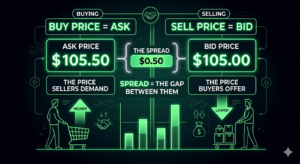
The spread is simply the small fee you pay to trade a currency pair.
What Is Spread Widening in Forex?
Spread widening in Forex occurs when the difference between the bid price and the ask price becomes larger than normal.
Under normal market conditions, the spread is usually small. However, during periods of low liquidity, high volatility, or major economic news, the gap between the bid and ask prices can increase significantly.
Simple Example
Normal Spread
| Bid Price | Ask Price | Spread |
|---|---|---|
| 1.1200 | 1.1202 | 2 pips |
Wider Spread
| Bid Price | Ask Price | Spread |
|---|---|---|
| 1.1200 | 1.1210 | 10 pips |
A wider spread means it costs more to enter a trade because you’re paying a larger difference between the buying and selling price.
Remember:

Why Does Spread Widening in Forex Happen?
Forex spreads usually widen when the market becomes less liquid or more uncertain. During these periods, brokers and liquidity providers increase the difference between the bid and ask prices to manage the additional risk.
1. Major Economic News
High-impact events such as:
- Interest rate decisions
- Non-Farm Payrolls (NFP)
- CPI inflation reports
- GDP releases
- Central bank speeches
can cause prices to move within seconds.
Since nobody knows exactly where prices will go, liquidity providers widen spreads to protect themselves from sudden price swings.
Example:
During an NFP release, the EUR/USD spread can jump from 0.8 pips to more than 10 pips for a short period.
2. Low Liquidity
When fewer traders are active, there are fewer buy and sell orders in the market.
This makes it harder to match trades quickly, causing spreads to widen.
Low liquidity is common during:
- Late-night trading
- Holidays
- The hours between trading sessions
3. High Market Volatility
Whenever prices start moving rapidly, pricing becomes much more difficult.
Instead of keeping spreads tight, brokers widen them until volatility settles down.
High volatility often occurs during:
- Breaking news
- Political events
- Geopolitical tensions
- Unexpected economic announcements
4. Daily Rollover Time
Every trading day, the forex market goes through a short rollover period, when open positions are carried over to the next trading day.
During this time:
- Liquidity temporarily drops.
- Banks and liquidity providers adjust their positions.
- Many brokers temporarily widen their spreads.
This usually happens at the end of the U.S. trading day (around 5:00 PM New York time), although the exact time can vary slightly from one broker to another.

5. Before Weekends
One of the most overlooked reasons for spread widening happens just before the market closes on Friday.
Since the forex market remains closed until Monday, brokers face the risk of unexpected weekend events such as:
- Elections
- Wars or geopolitical tensions
- Natural disasters
- Central bank announcements
- Political developments
Because these events can create large price gaps when markets reopen, brokers often widen spreads during the final trading hours on Friday to reduce their risk.
In Simple Words…
Imagine trying to buy concert tickets.
When there are plenty of sellers, prices stay competitive.
But if only a few tickets remain, sellers can charge much higher prices.
The forex market works in a similar way.
When liquidity drops or uncertainty increases, buying and selling becomes more expensive, so spreads widen.
When Does Spread Widening in Forex Happens the Most?
| Situation | Spread |
|---|---|
| London-New York overlap | Usually very low |
| Asian session | Moderate |
| Late New York session | Higher |
| Market rollover | High |
| Major news releases | Very High |
| Before weekends | High |
| Holidays | High |
Does Spread Widening in Forex happens on Every Currency Pair?
No….Highly traded currency pairs usually maintain tighter spreads. …Less popular pairs often experience much larger spread increases.
| Pair Type | Typical Spread Behavior |
|---|---|
| Major pairs (EUR/USD, GBP/USD, USD/JPY) | Lowest spreads |
| Minor pairs | Moderate spreads |
| Exotic pairs | Often very wide spreads |
How Does Spread Widening Affect Your Trades?
Spread widening can impact your trading in several ways.
- Your trade opens at a worse price.
- Your stop loss may trigger earlier.
- Your trading costs increase.
- Scalping becomes more difficult.
- Small profit targets become harder to achieve.
The wider the spread, the more the market has to move before your trade becomes profitable.
Example of Spread Widening in Forex
Imagine you buy EUR/USD.
Normal Conditions
Entry Price: 1.1202
Spread: 2 pips
The market only needs to move a small amount before your trade becomes profitable.
During Major News
Entry Price: 1.1210
Spread: 10 pips
Now the market has to move much further just for you to break even.
This is why many experienced traders avoid opening positions during major news announcements.
How to Manage the Risk of Spread Widening
You cannot stop spreads from widening, but you can reduce their impact.
Trade During High-Liquidity Sessions
The London and New York sessions usually offer the tightest spreads.
Avoid Trading During Major News
If you’re a beginner, it’s often better to wait until volatility settles.
Be Careful Before the Weekend
Avoid opening short-term trades just before markets close on Friday unless it’s part of your strategy.
Use Appropriate Stop Losses
Very tight stop losses may be triggered by temporary spread spikes rather than actual price movement.
Choose Highly Liquid Markets
Major currency pairs usually experience smaller spread increases than exotic pairs.
Know Your Broker’s Conditions
Some brokers offer variable spreads, while others offer fixed spreads under certain account types.
Understanding your broker’s pricing model helps you know what to expect.
Fixed vs Variable Spreads
| Fixed Spread | Variable Spread |
|---|---|
| Usually stays the same | Changes with market conditions |
| Easier for beginners | Reflects real market liquidity |
| Predictable trading costs | Can become very wide during volatility |
Is Spread Widening Bad?
Not necessarily.
Spread widening is a natural part of financial markets.
In fact, experienced traders often use it as a signal that:
- Liquidity is decreasing.
- Volatility is increasing.
- A major event may be approaching.
- Risk is higher than usual.
Instead of fearing wider spreads, learn to recognize what they are telling you about current market conditions.
Frequently Asked Questions
Why do spreads widen at night?
Because trading activity and liquidity decrease after major financial markets close.
Why do spreads widen before the weekend?
Banks and liquidity providers reduce their exposure before markets close, increasing spreads to account for weekend uncertainty.
Why do spreads widen during news?
Prices move rapidly during important announcements, increasing risk for liquidity providers.
Which currency pairs have the smallest spreads?
Major pairs such as EUR/USD, GBP/USD, and USD/JPY usually have the tightest spreads.
Can spread widening trigger my stop loss?
Yes. If your stop loss is very close to the current price, a temporary spread spike may trigger it even if the market hasn’t moved much.
Is spread widening caused by broker manipulation?
Not usually. In most cases, wider spreads are a result of lower liquidity or higher volatility. However, spread behavior depends on your broker’s pricing model and liquidity providers.
Wrap-up
Spread widening in Forex is one of the most misunderstood concepts in Forex trading…While it can increase trading costs and affect your entries and exits, it’s also a normal reflection of changing market conditions.
Understanding when spreads widen and why they widen allows you to plan your trades more effectively, avoid unnecessary risk, and choose the best times to enter the market.
The best traders don’t just watch price—they pay attention to the trading conditions behind it.
Master how spreads behave in a risk-free environment with a Caveo FX Demo Account. Practice during news events, session changes, and low-liquidity periods without risking real money, so you’re better prepared when you start trading live.