

Table of Contents
Which Trading Style Is Best for Beginners?
Each and every trader has a unique personality, risk tolerance, and lifestyle, and in trading, this naturally evolves into different trading styles that suit different needs.
In our educational series, we have already covered many essential trading concepts. Now, it’s time to focus on one of the most important foundations every trader must understand: trading styles, and more importantly, which style is best suited for beginners.
Choosing the wrong trading style can lead to stress, inconsistent results, and emotional decision-making. Choosing the right one, however, can make your learning curve smoother and your journey much more structured.
Let’s dive in.

What Is a Trading Style?
A trading style is the approach a trader uses to enter and exit the market based on:
- Time spent in trades
- Frequency of trades
- Risk tolerance
- Market analysis method
- Lifestyle and availability
In simple terms, it answers: “How do you trade?”
Most Famous Trading Styles
Here are the main trading styles used in global financial markets:
1. Scalping
- Very short-term trades (seconds to minutes)
- Many trades per day
- Focus on small profits
2. Day Trading
- Trades opened and closed within the same day
- No overnight positions
- Requires focus and fast decision-making
3. Swing Trading
- Trades last from a few days to weeks
- Focus on capturing medium-term market moves
- Combines technical + fundamental analysis
4. Position Trading
- Long-term approach (weeks to months or years)
- Strong reliance on fundamental analysis
- Less screen time, more patience required
Which Trading Style Suits Which Trader?
| Trading Style | Best For | Personality Type |
|---|---|---|
| Scalping | Experienced traders | Fast, high-focus, stress tolerant |
| Day Trading | Active traders | Disciplined, available daily |
| Swing Trading | Beginners & part-time traders | Balanced, patient |
| Position Trading | Long-term investors | Analytical, patient, low-frequency |
What Is the Best Trading Style for Beginners?
There is no single “best” trading style that fits every beginner. The right choice depends on factors like personality, available time, emotional control, and how quickly someone can make decisions under pressure.
However, in most educational contexts, swing trading is often considered one of the more beginner-friendly starting points.
Why swing trading is commonly recommended (but not guaranteed):
- It generally involves less pressure compared to scalping or day trading
- It gives traders more time to analyze the market and make decisions
- It allows beginners to learn both technical and fundamental analysis in a balanced way
- It may help reduce emotional overtrading caused by fast market movements
- It can be suitable for people who are not full-time traders
Trading Style & Risk Management
Your trading style directly affects your risk:
- Scalping → high frequency = higher emotional risk
- Day trading → fast decisions = strict stop-loss needed
- Swing trading → better risk-to-reward opportunities
- Position trading → requires patience through drawdowns
Key rule:
The longer you hold trades, the more important your risk management becomes.
Always consider:
- Stop-loss placement
- Position sizing
- Risk per trade (1–2% rule)
- Market volatility
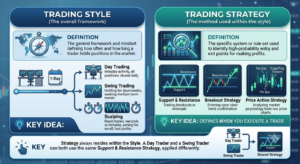
Trading Styles vs Trading Strategy
10 Tips Before Choosing Your Trading Style
- Know how much time you can dedicate daily
- Understand your emotional tolerance
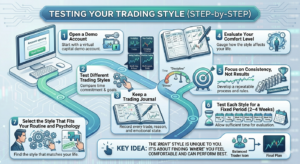
- Start with a demo account first
- Avoid copying other traders blindly
- Focus on learning, not profit at the beginning
- Choose consistency over speed
- Test different styles in demo trading
- Don’t switch styles too quickly
- Keep a trading journal
- Match your style with your lifestyle, not hype
How to Test Your Trading Style (Step-by-Step)
Common Beginner Mistakes When Choosing a Trading Style
Choosing the fastest style too early.
-
-
Many beginners jump into scalping or day trading because it looks exciting.
-
These styles require speed, focus, and strong discipline.
-
Swing trading is usually easier for beginners because it gives more time to analyze trades.
-
Copying another trader’s style.
-
-
A style that works for someone else may not fit your schedule, patience, or personality.
-
Beginners often copy popular traders instead of building their own approach.
-
Ignoring risk tolerance.
-
-
If a style creates stress or emotional decisions, it may not suit you.
-
Your style should match how much risk you can realistically handle.
-
Switching styles too often.
-
-
Beginners sometimes change styles after a few losing trades.
-
This makes it hard to learn anything properly.
-
Consistency is important.
-
Confusing style with strategy.
-
-
Trading style is the time-based approach.
-
Trading strategy is the exact method for entries and exits.
-
Beginners should understand the difference before choosing one.
-
Ignoring risk management.
-
-
Even the best style can fail without stop losses and position sizing.
-
Risk management should always come first.
-
Starting with too many markets.
-
-
Many beginners try forex, stocks, crypto, and commodities at the same time.
-
This usually creates confusion and weak execution.
-
It is better to start with one market first.
-
News and volatility matter a lot.
-
-
News can increase volatility quickly.
-
Volatility can create opportunity, but it also increases risk.
-
Scalping and day trading are more sensitive to sudden news moves.
-
Swing trading and position trading usually give beginners more room.
-
Beginners should understand the news first before trading it.
-
News trading is not ideal for beginners.
-
-
Trading directly around major news events can be difficult.
-
Prices can move sharply and unpredictably.
-
It is often better to wait until the market settles.
-
Volatility can help some styles more than others.
-
-
Moderate volatility can be useful for swing trading.
-
Strong trends and clean setups are often easier to trade than fast spikes.
-
Beginners usually benefit from simpler, less noisy conditions.
-
FAQs About Trading Styles
1. Can I change my trading style later?
Yes, most traders evolve their style as they gain experience.
2. Is scalping profitable for beginners?
It can be, but it is very difficult due to speed and emotional pressure.
3. Do I need technical analysis for all styles?
Yes, but its importance varies depending on the style.
4. Can I combine trading styles?
Yes, but beginners should focus on one style first.
5. Is swing trading safe?
No trading is “safe,” but swing trading is generally more beginner-friendly.
Wrap-up
Choosing a trading style is not about following trends or copying successful traders, it is about understanding yourself first.
The best trading style is not the one that makes money the fastest, but the one that you can stay consistent with over time.
Test your trading style in a risk-free environment with a Caveo FX demo account.