

FIFA World Cup 2026 More Than a Football Tournament
A Global Economic Event Worth Billions
FIFA World Cup 2026 More Than a Football Tournament …. Yeah, we know. We’re supposed to be talking about stocks, forex, and financial markets. So why are we talking about football? Because football is no longer just a sport.
Today, major sporting events have become economic engines capable of moving billions of dollars across industries, creating jobs, boosting tourism, increasing consumer spending, and attracting global investment attention.
And no sporting event is bigger than the FIFA World Cup.
Every four years, millions of fans travel across the globe to watch the tournament, while billions more tune in from home. Behind the excitement, however, lies a massive economic ecosystem involving airlines, hotels, broadcasters, sponsors, retailers, governments, and financial markets.
For investors and traders, the World Cup is far more than a football tournament.
It can influence tourism trends, create opportunities in specific stock market sectors, generate temporary currency flows, and provide valuable insights into consumer spending and economic activity.
Let’s dive in.
What Is the FIFA World Cup?
The FIFA World Cup is the premier international football tournament organized by FIFA every four years.
Since its first edition in 1930, the competition has grown into one of the most watched events in the world, attracting billions of viewers and generating enormous commercial revenues through broadcasting rights, sponsorship agreements, ticket sales, licensing, and hospitality packages.
Today, the World Cup is not only a sporting event but also a global business platform that connects governments, corporations, investors, media companies, and consumers.
What Is FIFA?
FIFA stands for the Fédération Internationale de Football Association, the global governing body of football.
Founded in 1904 and headquartered in Zurich, FIFA is responsible for organizing and regulating international football competitions, including the FIFA World Cup—the most watched sporting event in the world.
Today, FIFA oversees more than 200 national football associations and generates billions of dollars through broadcasting rights, sponsorship agreements, licensing, and ticket sales.
While many fans know FIFA as the organization behind the World Cup, it has evolved into one of the largest sports-business organizations globally, operating a commercial ecosystem that connects media companies, multinational brands, governments, and millions of football fans worldwide.
Why Is the FIFA World Cup 2026 So Important?
The upcoming tournament represents a historic expansion of the competition.
Key Facts
- 48 teams (up from 32)
- 104 matches
- 16 host cities
- Three host countries
- Around 6.5 million expected spectators
This makes the 2026 edition the largest FIFA World Cup ever held.
The scale of the tournament means larger audiences, higher spending, increased travel demand, and greater commercial opportunities than previous editions.
Where Will the Event Be Held?
The tournament will be jointly hosted by:
- United States
- Canada
- Mexico
Matches will take place across major cities including:
- New York City
- Los Angeles
- Dallas
- Toronto
- Vancouver
- Mexico City
- Guadalajara
These cities are expected to receive millions of visitors during the tournament.
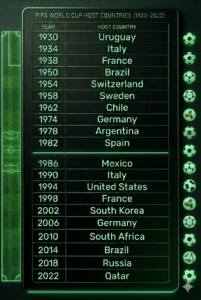
FIFA World Cup Host Countries (1930–2026)
FIFA: A Multi-Billion-Dollar Business
Many people think the biggest winner of the World Cup is the host country. Financially, that is not always true.
In reality, FIFA operates one of the most profitable sporting business models in the world.
For the current four-year cycle ending with the 2026 World Cup, FIFA expects approximately:
- $13 billion in total revenue
- Nearly $9 billion directly linked to the World Cup
Main Revenue Sources for the FIFA World Cup
Broadcasting Rights
- More than $4 billion
Sponsorship Agreements
- Around $1.8 billion
Tickets & Hospitality
- More than $3 billion
Licensing & Commercial Partnerships
- Billions in additional revenue
The modern World Cup has evolved into a global entertainment and media business where broadcasting and sponsorship revenues often exceed traditional sporting revenues.
The Two Economies Behind Every FIFA World Cup
One of the most important concepts investors should understand is that the FIFA World Cup actually creates two separate economic systems.
FIFA’s Economy
FIFA earns revenue from:
- Media rights
- Sponsorships
- Ticket sales
- Licensing
- Hospitality packages
Host Country Economy
Host nations experience:
- Tourism spending
- Infrastructure investments
- Transportation upgrades
- Security expenses
- Operational costs
This means the organization controlling the tournament captures much of the revenue, while host countries often bear a significant share of the costs.
How Much Economic Activity Could Be Generated?
Economic studies estimate that the 2026 tournament could generate:
- More than $80 billion in total economic activity
- Around $40 billion in global economic contribution
These figures include:
- Tourism spending
- Hotel bookings
- Transportation services
- Food and beverage consumption
- Retail purchases
- Media and advertising activity
It is important to understand that economic activity is not the same as profit.
These estimates measure money flowing through the economy rather than net gains.
Tourism: The Biggest Economic Driver
Tourism is expected to be the largest contributor to the World Cup’s economic impact.
Millions of international visitors are expected to spend money on:
- Flights
- Hotels
- Restaurants
- Entertainment
- Local transportation
- Shopping
Historically, major sporting events generate short-term spikes in tourism demand that benefit airlines, hotels, restaurants, and retail businesses.
In many economic impact studies, visitor spending accounts for more than half of the total projected benefit.
Job Creation
Hosting a tournament of this scale requires a large workforce.
The World Cup is expected to support hundreds of thousands of jobs globally.
Key sectors include:
- Construction
- Security
- Hospitality
- Transportation
- Event operations
- Tourism services
However, investors should recognize that many of these positions are temporary and tied directly to tournament-related demand.
Can the FIFA World Cup Affect Currency Markets?
This is where traders become interested.
A World Cup can create short-term currency demand because foreign visitors must exchange money to spend within host countries.
Potential beneficiaries include:
- The U.S. Dollar (USD)
- The Canadian Dollar (CAD)
- The Mexican Peso (MXN)
Possible effects include:
- Higher tourism-related currency inflows
- Increased consumer spending
- Temporary improvements in economic data
However, most economists agree that these effects are usually limited and short-lived.
Long-term currency trends remain far more dependent on:
- Interest rates
- Inflation
- Employment data
- Economic growth
- Central bank policy
A World Cup alone is unlikely to change the long-term direction of a major currency.
Which Stock Market Sectors Could Benefit?
For investors, the biggest opportunities often appear at the sector level rather than the overall market level.
Airlines
Higher international travel demand may benefit airlines through increased passenger volumes.
Hotels & Hospitality
Hotels often experience some of the strongest demand increases during major sporting events.
Food & Beverage
Restaurants, beverage companies, and entertainment venues can benefit from increased visitor spending.
Media & Broadcasting
Broadcasters and media companies generate revenue from advertising and audience growth.
Sportswear Brands
Global brands such as Nike and Adidas often benefit from increased merchandise sales and marketing exposure.
What History Tells Us
Past World Cups have shown mixed economic results.
| Positive Outcomes 📈 | Challenges 📉 |
|---|---|
| Tourism boosts and increased visitor spending | High public spending on infrastructure and event operations |
| Greater global exposure and international recognition | Cost overruns and budget pressures |
| Infrastructure improvements such as transport networks and public facilities | Underutilized stadiums and facilities after the tournament |
| Increased business activity across tourism, hospitality, retail, and services | Economic gains are often temporary rather than long-lasting |
| Short-term job creation and employment opportunities | Benefits may be concentrated in specific sectors and regions |
| Potential increase in future tourism and investment interest | Long-term returns may not justify the initial investment costs |
Many economists argue that while World Cups can generate impressive short-term activity, they do not automatically create long-term economic growth.
The long-term outcome depends largely on how effectively the host country uses the infrastructure and international exposure generated by the event.
What Traders Should Actually Watch
Rather than focusing on football results, traders may find it more useful to monitor:
USD, CAD, and MXN Performance
Look for any unusual currency inflows linked to tourism activity.
Tourism Data
Visitor numbers, hotel occupancy rates, and spending trends can reveal which sectors are benefiting most.
Airline Stocks
Travel demand often becomes one of the clearest indicators of World Cup-related economic activity.
Hospitality Companies
Hotel operators and travel businesses may experience temporary demand surges.
Consumer Spending Data
Retail and restaurant spending can provide insight into how visitors are impacting local economies.
FIFA World Cup Economics
Did Hosting Pay Off?
| World Cup | Host | Key Economic Gain |
|---|---|---|
| 2010 | South Africa | 309,000+ visitors and billions in tourism spending |
| 2014 | Brazil | Major infrastructure upgrades and tourism boost |
| 2018 | Russia | Estimated $14B contribution to GDP from preparation and hosting |
| 2022 | Qatar | 1.4M+ visitors and strong boost to tourism and services |
| 2026* | United States, Canada & Mexico | Projected $80B+ in economic activity and 6.5M visitors |
FAQs: FIFA World Cup and the Economy
Does hosting a FIFA World Cup boost the economy?
Hosting a World Cup can generate significant short-term economic activity through tourism, hospitality, transportation, and consumer spending. However, the long-term economic benefits vary from country to country and depend on how effectively infrastructure and investments are utilized after the tournament.
How does the World Cup impact tourism?
Major tournaments attract millions of domestic and international visitors who spend money on flights, hotels, restaurants, transportation, and entertainment. Tourism is often one of the largest contributors to the tournament’s economic impact.
Can the World Cup affect currency markets?
In the short term, increased tourism can lead to higher demand for the host country’s currency as visitors exchange money for local spending. However, currency movements are typically influenced much more by interest rates, inflation, economic growth, and central bank policies.
Which stock market sectors tend to benefit the most?
Industries that often experience increased demand during a World Cup include:
- Airlines
- Hotels and hospitality
- Food and beverage companies
- Media and broadcasting firms
- Sportswear and merchandise brands
Does hosting a World Cup guarantee economic growth?
No. While the event can create a temporary boost in economic activity, it does not automatically lead to long-term economic growth. The outcome depends on factors such as infrastructure planning, tourism retention, and post-event utilization of facilities.
Why do governments invest billions in hosting the World Cup?
Governments often view the tournament as an opportunity to improve infrastructure, attract tourism, increase international visibility, and strengthen their global reputation. However, these benefits must be weighed against the significant costs involved.
Who earns the most money from the World Cup?
The largest share of direct revenue typically goes to FIFA through broadcasting rights, sponsorship agreements, licensing, ticket sales, and hospitality packages. Host countries mainly benefit through tourism spending and economic activity generated around the event.
What can traders watch during the World Cup?
Traders often monitor:
- Tourism and visitor data
- Airline and hospitality stocks
- Consumer spending trends
- Currency flows in host nations
- Company earnings from sectors linked to travel, media, and sportswear
Are World Cup economic impact estimates always accurate?
Not necessarily. Economic impact studies often measure total economic activity rather than profit. Actual benefits can differ from projections depending on visitor numbers, spending patterns, and post-event economic conditions.
What is the biggest economic lesson from the World Cup?
The World Cup is not just a sporting event—it is a global business and economic ecosystem. Understanding where money flows during the tournament can help investors identify opportunities and assess which sectors may benefit the most.
Wrap up
The FIFA World Cup 2026 is far more than a football tournament. It is a multi-billion-dollar global economic event that influences tourism, employment, consumer spending, media revenues, and selected financial markets.
For investors, the most important lesson is that the biggest opportunities often emerge not from the event itself, but from understanding where money is flowing.
While the World Cup may create temporary opportunities in currencies and specific stock market sectors, history suggests that long-term investment decisions should remain focused on economic fundamentals rather than sporting headlines.
Behind every goal scored, there is also a global economic story unfolding.
The World Cup creates opportunities beyond the pitch. Stay ready for market-moving events.
Open your Caveo FX trading account today.