

Table of Contents
What Is Revenge Trading and How to Avoid It?
What is revenge trading and how to avoid it? …….Ah, such a long story…….It all starts when we lose our first trade 🙁
In movies, they always say that people who seek revenge rarely feel better after getting that revenge. Surprisingly, the same thing happens in trading.
We feel the urge for revenge when we lose money because losing money is hard. We don’t accept it easily. It hurts our ego. We feel like we did this to our own wallet, and somehow we need to make up for it. That’s when many traders make one of the biggest mistakes in trading.
They stop following their strategy and start chasing their losses.

The truth is that revenge trading is one of the worst habits a trader can develop. It can quickly turn a small, manageable loss into a much larger one, damaging both your account and your confidence.
So, in this article, we’ll help you understand what revenge trading is, why it happens, how to recognize it, and most importantly, how to avoid taking the revenge that you were never supposed to take in the first place.
Let’s dive in.
What Is Revenge Trading and How to Avoid It?
Revenge trading is a psychological behavior where traders enter new trades primarily to recover previous losses, driven by emotions like anger, frustration, or ego rather than by a defined trading strategy.
Instead of waiting for valid setups that meet their strategy criteria, revenge traders make rash, ill-considered decisions to “win back” lost money, often increasing position sizes, overtrading, and taking excessive risks that compound losses.
The best way to avoid revenge trading is to accept that losses are part of trading, follow a clear trading plan, use proper risk management, and step away from the market when emotions begin taking over.
Revenge Trading Patterns
Revenge trading represents one of the most destructive patterns in active trading, affecting both novice and experienced traders alike.
At its core, this behavior stems from emotional turmoil following a loss rather than a lack of knowledge or skill. The motivation shifts from executing a strategy properly to restoring emotional balance. The market starts feeling like an opponent rather than a place where opportunities are evaluated objectively.
The phenomenon occurs after traders experience psychological stress or financial loss in the market. Following a losing trade, traders often feel disappointment, anger, frustration, or even embarrassment. Instead of stepping back and reassessing the situation, they jump back into the market hoping to recover the loss immediately.
A trader’s mindset becomes:
“I need to recover this money now.”
That urgency often leads to impulsive decisions such as entering without confirmation, increasing leverage, abandoning risk management rules, or chasing price movements without a valid setup.
Losses are normal in trading.
Revenge trading is what turns normal losses into larger and more damaging ones.
What Is Revenge Trading and How to Avoid It?
What Does it Look Like Exactly?
Increasing Position Size After a Loss
Many traders double their next position after losing money because they want to recover faster. Unfortunately, this usually happens when emotions are strongest and decision-making is weakest.
Entering Trades Without Clear Setups
A trader enters another trade immediately after a loss without waiting for signals that normally meet their strategy.
Trading Excessively
Instead of waiting patiently, the trader begins opening multiple positions, believing that trading more frequently will help recover losses.
Rapid-Fire Trading
Quality is replaced by quantity. The trader focuses on finding any opportunity rather than the right opportunity.
Abandoning Strategy Rules
Stop-losses are ignored, entry criteria become flexible, and discipline disappears under emotional pressure.
Chasing Volatility
Many revenge traders become attracted to highly volatile assets because they believe bigger price swings will help them recover faster. In reality, volatility increases risk just as much as it increases opportunity.
What Causes Revenge Trading and how to avoid it?
Revenge trading usually stems from a psychological response rather than a technical flaw. Losses trigger discomfort. The human brain seeks quick relief, and in trading, that relief appears to be another trade. The urgency to recover losses overrides patience and discipline.
Emotional Response to Losses
Losses trigger frustration, disappointment, and sometimes anger.
Instead of accepting the loss and moving forward, traders try to erase it as quickly as possible. This emotional urgency often overrides patience and rational analysis.
Ego and Self-Validation
Sometimes the loss feels personal.
A trader begins focusing on proving they were right rather than following their trading strategy. The trade becomes about validation instead of execution.
The Need to Recover Immediately
Many traders feel they must recover losses right away.
This creates pressure to act, even when no valid opportunities exist.
What Is Revenge Trading and How to Avoid It? Key Behavioral Triggers
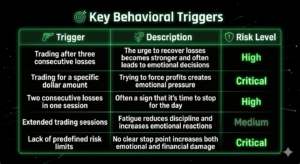
Cognitive Biases Behind Revenge Trading
Revenge trading is often driven by common psychological biases.
These include the fear of losing, the need to be right, the desire for certainty, and the belief that the next trade can immediately fix previous mistakes.
Unfortunately, markets do not reward emotional decision-making.
They reward discipline and consistency.
Signs You’re Revenge Trading and how to avoid it?
The warning signs of revenge trading are usually emotional, behavioral, and even physical.
Emotional Triggers
Feeling angry, frustrated, guilty, or desperate after a loss.
Overtrading
Opening multiple trades without a valid reason or setup.
Tunnel Vision
Focusing only on recovering losses rather than following a long-term plan.
Physical Symptoms
Increased heart rate, tension, impulsive clicking, and an inability to step away from the screen.
Increasing Position Sizes
Risking larger amounts of capital than usual.
Ignoring Risk Management
Removing stop-losses, overleveraging, and abandoning predefined rules.
The Dangerous Effects of Revenge Trading and How to Avoid It
Dangerous Effects of Revenge Trading
- Larger losses due to emotional decisions.
- Overtrading and entering low-quality setups.
- Ignoring stop-loss and risk management rules.
- Increasing position sizes to recover losses faster.
- Loss of trading discipline and consistency.
- Increased stress, frustration, and anxiety.
- Reduced confidence after consecutive losses.
- Poor decision-making caused by emotional pressure.
- Account drawdowns become harder to recover from.
- Small losses can turn into major financial setbacks.
How to Avoid Revenge Trading
- Accept that losses are a normal part of trading.
- Follow a clear trading plan.
- Use strict risk management rules.
- Risk only a small percentage per trade.
- Set daily loss limits and respect them.
- Take a break after consecutive losing trades.
- Avoid trading when angry or frustrated.
- Keep a trading journal to track emotions and mistakes.
- Focus on long-term consistency instead of quick recovery.
- Use stop-loss orders on every trade.
- Reduce position sizes after a losing streak.
- Review losing trades calmly instead of reacting emotionally.
- Practice discipline and patience.
- Test strategies on a demo account before risking real money.
Consequences & Statistics
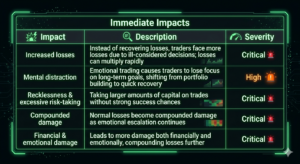
Revenge Trading vs. Disciplined Trading
to answer the question what is revenge trading and how to avoid? we nee to understand first the contrast between revenge trading and disciplined trading and how it is essential for long-term success.
How Professionals Handle Losses vs. Revenge Traders
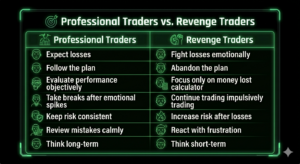
The Role of Risk Management in Preventing Revenge Trading
Risk management is one of the most effective ways to prevent revenge trading.When traders know exactly how much they are willing to risk before entering a trade, losses become easier to accept. Instead of reacting emotionally, they follow a predefined plan.
A good risk management strategy should include:
- Risking only 1–2% of your trading capital on a single trade.
- Using stop-loss orders to limit potential losses.
- Setting daily or weekly loss limits.
- Following consistent position sizing rules.
- Never risking money you cannot afford to lose.
Without proper risk management, even a small loss can feel devastating, increasing the temptation to immediately recover the money. This often leads to emotional decisions, larger positions, and even greater losses.
With a solid risk management plan, losses are viewed as a normal cost of trading rather than a personal failure. This mindset helps traders stay disciplined, protect their capital, and avoid the emotional cycle of revenge trading.
Remember, successful trading is not about avoiding losses. It’s about managing losses properly so that no single trade can significantly damage your account or your confidence.
Revenge Trading and How to Avoid It in 7 Simple Steps
Step 1: Accept the Loss
Don’t try to win your money back immediately. Losses are a normal part of trading.
Step 2: Take a Break
Step away from the charts after a losing trade, especially after multiple losses.
Step 3: Follow Your Trading Plan
Stick to your entry, exit, and risk management rules instead of trading based on emotions.
Step 4: Manage Your Risk
Never risk more than you can afford to lose, and always use a stop-loss.
Step 5: Avoid Increasing Position Sizes
Don’t double your trade size to recover losses faster. This often makes things worse.
Step 6: Keep a Trading Journal
Write down your trades and emotions to identify patterns and improve discipline.
Step 7: Focus on the Long Term
Think about consistency, not quick recovery. Successful trading is a marathon, not a sprint.
FAQ: Revenge Trading and How to Avoid It
What is revenge trading?
Revenge trading is when a trader enters new trades primarily to recover previous losses rather than following a planned trading strategy.
Why is revenge trading dangerous?
It increases risk when emotions are running high, often leading to larger losses and poor decision-making.
Can experienced traders fall into revenge trading?
Yes. Even experienced traders can revenge trade when frustration, anger, or overconfidence replaces discipline.
How can traders stop revenge trading?
By using risk management rules, taking breaks after losses, following a trading plan, and keeping a trading journal.
What is the best way to avoid revenge trading?
The most effective method is having a solid trading plan and sticking to it, regardless of recent wins or losses.
What percentage of traders lose money?
Studies have shown that a large percentage of retail traders lose money over time, often due to poor risk management and emotional decision-making.
What causes revenge trading?
Revenge trading is usually caused by frustration after a loss, a desire to recover money quickly, overconfidence, or emotional attachment to trade outcomes.
What are the signs of revenge trading?
Common signs include increasing position sizes after a loss, overtrading, ignoring stop-losses, entering trades without a setup, and feeling emotional while trading.
How long should I stop trading after a loss?
There is no fixed rule, but many traders take a break after two consecutive losses or whenever emotions begin affecting their judgment.
Is revenge trading a form of emotional trading?
Yes. Revenge trading is one of the most common forms of emotional trading because decisions are driven by feelings rather than analysis.
Can revenge trading blow up a trading account?
Yes. Revenge trading often leads to excessive risk-taking, which can result in significant losses or even wipe out an account.
Does revenge trading affect beginner traders more?
Beginners are generally more vulnerable because they have less experience managing emotions and handling losses.
How does risk management help prevent revenge trading?
Risk management limits the impact of losses, making them easier to accept and reducing the urge to immediately recover them.
Should I increase my position size after a loss?
No. Increasing position sizes after a loss is a common revenge trading mistake that can lead to even larger losses.
Can revenge trading happen after a winning streak?
Yes. Some traders become overconfident after several wins and take unnecessary risks. When they eventually lose, they may start revenge trading to recover quickly.
How do professional traders deal with losses?
Professional traders accept losses as part of the process, review their trades objectively, and focus on following their strategy rather than recovering money immediately.
Is revenge trading common in forex trading?
Yes. Revenge trading can happen in forex, stocks, commodities, cryptocurrencies, CFDs, and virtually any financial market.
Can a trading journal help prevent revenge trading?
Yes. A trading journal helps traders identify emotional patterns, track mistakes, and improve discipline over time.
Why do traders feel the need to recover losses immediately?
Losses can trigger frustration and hurt confidence. Many traders feel pressured to “get their money back,” which often leads to impulsive decisions.
What’s the difference between revenge trading and disciplined trading?
Revenge trading is driven by emotions and the desire to recover losses, while disciplined trading follows a predefined strategy and risk management plan.
Can demo trading help prevent revenge trading?
Yes. Demo accounts allow traders to practice strategies, build discipline, and learn how to handle losses without risking real money.
Is revenge trading related to trading psychology?
Absolutely. Revenge trading is primarily a psychological issue and is often linked to emotions such as fear, frustration, greed, and ego.
What should I do immediately after a losing trade?
Review the trade objectively, determine whether you followed your plan, and avoid placing another trade until your emotions are under control.
Can revenge trading become a habit?
Yes. If traders repeatedly react emotionally to losses, revenge trading can become a destructive habit that damages long-term performance.
How many losing trades in a row should make me stop trading?
Many traders use a rule of stopping after two or three consecutive losses to avoid emotional decision-making and regain focus.
Wrap up
We all know that revenge is bad and nothing good ever comes from taking revenge. In this article, we learned that revenge in trading is also bad, just as it is in real life. So why not first practice all our feelings and frustration in a risk-free environment?
The problem isn’t the loss itself. Losses are a normal part of trading and something even the most successful traders experience regularly. The real danger begins when emotions take control and push you to recover those losses immediately.