Table of Contents
A Complete Guide to Forex Trading Sessions
How Does the Forex Market Work 24 Hours a Day?
The Magic of Trading Sessions Happens only in the forex world, Have you ever thought there’s a market where you can actually stay active 24 hours straight if you really wanted to?
Not in theory. Not “maybe.”
But literally every weekday.

That’s exactly what trading sessions make possible in the Forex market.
While most financial markets open and close within limited hours, Forex keeps moving across the globe through different trading sessions from Sydney to Tokyo, London, and New York.
And the reason is simple: Trading Sessions.
This guide will take you through the “rollercoaster” of how the Forex market actually works behind the scenes, and why it never really sleeps.
Let’s dive in.
The forex market is unique. Unlike stock markets that open and close at fixed local times, forex runs continuously — 24 hours a day, 5 days a week.
What is Trading Sessions?
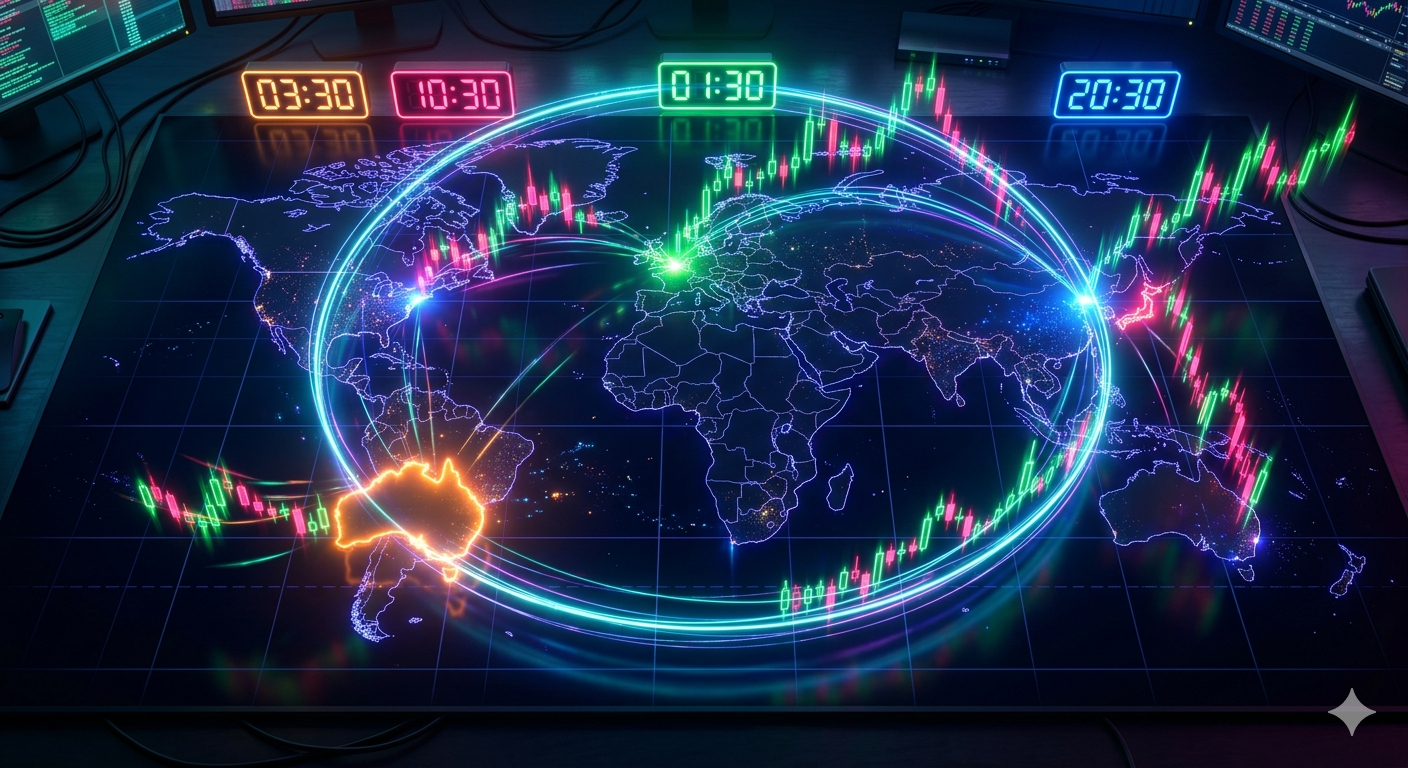
The Forex market is open 24 hours a day, 5 days a week. But that doesn’t mean it’s always the same. Because the market moves from one part of the world to another, trading activity happens in sessions based on major financial centers. These are called trading sessions.
The 4 Forex Trading Sessions
Forex trading sessions is usually divided into four main sessions:
- Sydney session (Australia / Asia-Pacific open)
- Tokyo session (Asia)
- London session (Europe)
- New York session (United States)
Each session represents the time when banks, institutions, and traders in that region are most active.
Why Do Trading Sessions Matter?
Even though Forex is open all day, not all hours are equal.
Different sessions bring different market conditions:
Liquidity
How many people are trading at that time.
Volatility
How fast and how much price moves.
Market Behavior
Some sessions are slow and ranging, others are fast and trending.
The Most Important Part: Overlaps
Sometimes two trading sessions are open at the same time.
This is called a session overlap.
Example:
- London + New York overlap
This is usually the busiest time in Forex, because both Europe and the US are trading at the same time.
Why Forex Trades 24 Hours a Day
The forex market is decentralized, meaning there is no single exchange.
Instead, trading happens through a global network of banks, institutions, brokers, and traders.
As one financial center closes, another opens — creating a continuous cycle of activity.
This gives traders a major advantage:
- ✔ Trade anytime during the week
- ✔ React instantly to global news
- ✔ Choose the most active market hours
But it also creates a challenge:
Not all hours offer the same opportunities
Some periods are highly active and volatile… others are slow and quiet.
Understanding Forex Trading Sessions in details
Each session has its own personality:
✔ Different volatility
✔ Different currency activity
✔ Different trading opportunities
Let’s break them down using UTC (Coordinated Universal Time) for consistency.
1. Sydney Session (Start of the Trading Week)
🕒 22:00 – 07:00 UTC
The Sydney session opens the global trading week.
This is usually the quietest session because liquidity is still building after the weekend.
Key characteristics:
- Lower volatility
- Slower price movements
- Early market positioning
Active pairs:
- AUD/USD
- NZD/USD
- AUD/JPY
2. Tokyo Session (Asian Market Activity)
🕒 00:00 – 09:00 UTC
The Tokyo session represents Asian trading activity and brings more liquidity compared to Sydney.
However, it is still generally calmer than European or US sessions.
Key characteristics:
- Moderate volatility
- Range-bound price movements
- Strong influence from JPY pairs
Active pairs:
- USD/JPY
- EUR/JPY
- GBP/JPY
3. London Session (The Most Important Session)
🕒 08:00 – 17:00 UTC
The London session is the most powerful and active forex session in the world.
It accounts for the highest share of global trading volume.
Key characteristics:
- High liquidity
- Strong volatility
- Major market movements begin here
Active pairs:
- EUR/USD
- GBP/USD
- EUR/GBP
4. New York Session (US Market Power)
🕒 13:00 – 22:00 UTC
The New York session brings in the US market — the world’s largest financial influence.
It overlaps with London for several hours, creating the most active trading period of the day.
Key characteristics:
- High volatility (especially during overlap)
- Strong reaction to US economic data
- Trend continuation or reversals
Active pairs:
- EUR/USD
- GBP/USD
- USD/CAD
Trading Sessions Overlap in details
The real power in forex happens when sessions overlap.
Because two major regions are active at the same time, liquidity increases significantly.
London – New York Overlap
🕒 13:00 – 17:00 UTC
This is the most active trading window of the entire day.
Why?
- Europe is still open
- US market just opened
- Major economic data is released
Result: High volatility + strong trends + fast moves
Asia – Europe Overlap
🕒 08:00 – 09:00 UTC
This is a shorter overlap, but still important.
It often shows whether Asian trends will continue or reverse when Europe enters the market.
Why Trading Session Timing Matters?
Understanding trading sessions is not just theory — it directly affects your trading results.
Different sessions create different conditions:
Quiet sessions:
- Better for range trading
- Lower risk
- Fewer opportunities
Active sessions:
- Better for breakouts
- Strong trends
- Higher profit potential (but more risk)
The Key Idea Most Traders Miss
Forex is not just about what you trade…
It’s also about when you trade it.
A good setup during a slow session may fail.
The same setup during London or New York may explode in your favor.
That’s why professional traders always align their strategy with market sessions.
Trading Sessions and market behavior
| Session | Market Behavior |
|---|---|
| Sydney | slow / random |
| Tokyo | structured / range |
| London | volatile / trending |
| New York | reactive / news-driven |
How Smart Traders Actually Use Trading Sessions
Professional traders don’t trade all day.
They:
- ✔ Pick ONE session
- ✔ Focus on ONE behavior type
- ✔ Wait for high-probability setups
Beginners Common Trading session Mistakes
Trying to trade:
- Every session
- Every move
- Every signal
Trading Sessions & Risk Management
Tips to trade with less risk:
- Adjust your position size based on session volatility. London and New York sessions usually move faster than Asian hours.
- Avoid overleveraging during highly volatile sessions, especially during session overlaps and major news releases.
- Check spreads before entering trades during quiet market hours, as spreads can widen in low-liquidity periods.
- Be cautious during the London–New York overlap, where sharp price swings and fake breakouts are more common.
- Avoid trading when tired or distracted. A 24-hour market does not mean you should trade all day.
- Monitor economic calendars during London and New York sessions, since major data releases can create sudden volatility.
- Match your strategy to the session:
- Scalping often works better in high-volume sessions
- Swing trading may perform better without focusing heavily on session timing
- Focus on quality setups instead of trying to trade every session throughout the day.
- If you are a beginner, calmer sessions like Tokyo may feel easier to manage emotionally.
- Always use stop-loss orders, regardless of the session you trade.
Why Your Trading Session Matters
Every Forex session has a different personality.
Some are:
- calm and slow
- fast and volatile
- trend-heavy
- or completely unpredictable
If your strategy doesn’t match the market conditions, even a good setup can fail.
Matching Your Strategy to the Right Session
If You Like Fast Trading & Scalping
You may prefer:
- London session
- London + New York overlap
Why?
Because volatility and liquidity are high.
This means:
✔ more movement
✔ tighter spreads
✔ faster opportunities
If You Prefer Calm & Structured Markets
The Tokyo session may fit you better.
This session often has:
- smoother price action
- slower movement
- more ranging behavior
Many beginners feel less emotionally overwhelmed during Asian hours.
If You Trade News Events
The New York session is usually the center of:
- major USD news
- inflation data
- interest rate announcements
- NFP releases
This session can create huge opportunities…
But also huge risks if you trade without a plan.
Choosing the trading Session Based on Your Schedule
Full-Time Job?
You may prefer:
- London open before work
- or New York session after work
Night Owl?
You might naturally enjoy:
- New York session
- Asian session
Early Riser?
The London session could fit perfectly.
FAQs About Forex Trading Sessions
What is the best trading session for beginners?
Many beginners prefer the Tokyo session because it is usually calmer and less volatile than London or New York. Slower market conditions can feel easier to manage emotionally while learning.
Which Forex trading session is the most active?
The London session and the London–New York overlap are typically the most active periods in the Forex market due to high liquidity and strong trading volume.
Do I need to trade all Forex sessions?
No. Successful traders usually focus on one or two sessions that match their strategy, schedule, and risk tolerance instead of trying to trade all day.
How do I know which trading session fits me best?
Ask yourself:
- When can I focus properly?
- Do I prefer fast or calm markets?
- Am I a short-term or long-term trader?
- Does this trading time fit my daily routine?
The best session is often the one you can trade consistently and comfortably.
Which session is best for scalping?
Scalpers usually prefer high-volume sessions like London or the London–New York overlap because price movement and liquidity are stronger.
Which session is better for calmer trading conditions?
The Asian session, especially Tokyo hours, is often considered calmer with slower price movement compared to London and New York sessions.
Why does volatility change between sessions?
Different financial centers become active throughout the day. As trading volume and participation increase, volatility and liquidity also change.
Can trading sessions affect risk management?
Yes. Different sessions have different volatility levels, spreads, and liquidity conditions, which can affect stop losses, position sizing, and trade execution.
Is the Forex market active 24 hours equally?
No. The market is open 24 hours a day during weekdays, but activity levels vary depending on the trading session and market participation.
What matters more: strategy or trading session?
Both work together. A good strategy performs best when used in the right market conditions and during the session that matches its style.
Wrap Up
Forex is not random. Every move means something, every second is a chance, and every minute can create a new opportunity all inside a continuous cycle called trading sessions.
The Forex market never truly sleeps, and each session brings a different rhythm, volatility level, and trading opportunity. The key is finding the session that matches your strategy, personality, and schedule best.
Try different trading sessions yourself in a risk-free environment with a demo account from Caveo and discover which market hours work best for you.